Bench Press Beep Test Calculator
Quick Answer
This calculator converts your bench press beep test performance (repetitions at a set weight and cadence) into an estimated one-rep maximum (1RM) and compares your results to athletic standards including NHL combine benchmarks.
- Estimates 1RM from your reps using three validated formulas
- Based on Brzycki, Epley, and Lander equations with 87% accuracy
- Compares to NHL combine and YMCA muscular endurance standards
The Bench Press Beep Test is an upper body muscular strength endurance test in which participants perform as many repetitions as possible at a set weight and set cadence. A similar test was once part of the NHL pre-draft testing combine (they now use a different protocol). The calculator above takes your test results and estimates your one-rep maximum (1RM) using scientifically validated formulas.
How to Use This Bench Press Beep Test Calculator
Follow these steps to calculate your bench press strength endurance results:
- Select Your Units: Toggle between Imperial (lbs) and Metric (kg) using the switch at the top of the calculator.
- Enter Barbell Weight: Input the weight you lifted during the test. Use the preset buttons for standard protocols (NHL 150 lbs, YMCA 80/35 lbs, NFL 225 lbs).
- Enter Repetitions: Record the number of consecutive reps completed before falling behind the cadence.
- Optional - Advanced Settings: Add your body weight for relative strength calculations and select the test cadence used.
- Calculate: Click "Calculate Results" to see your estimated 1RM, performance category, and training recommendations.
Pro Tip: For the most accurate 1RM estimation, ensure you maintain proper form throughout all repetitions and stop the test as soon as you fall behind the beep cadence.
What is the Bench Press Beep Test?
Test purpose: To measure maximum strength endurance of the chest muscle groups.
Equipment required: A standard padded bench with safety catch, standard weight bar with 150 lb total weight (including the bar), bench press mp3 file or metronome (you can use the online push-up metronome or another indicator of rate - you can also make your own using the team beeptest software).
Pre-test: Explain the test procedures to the subject. Perform screening of health risks and obtain informed consent. Prepare forms and record basic information such as age, height, body weight, gender, test conditions. Perform an appropriate warm-up. See more details of pre-test procedures.
Procedure: The metronome or other timer is set at a rate of 25 per minute (set the metronome at 50 so that the click signals either the up or down movement). The athlete begins by lying in a supine position on the bench, with their feet flat on the floor and the upper and lower back in contact with the bench at all times. The bar is grasped shoulder width apart. The starting position of the bar is touching the chest at approximately the axillary line and the bar is pushed up to full extension of the arms. Bench press actions are performed in time with the metronome. Record the number of consecutive repetitions completed before the player falls behind the cadence.
Variations: Other barbell weights can be used - 150lb is used as an example because it is the weight used for the NHL testing. The press up beep test is very similar, and other bench press tests include no cadence with set weight and relative weights.
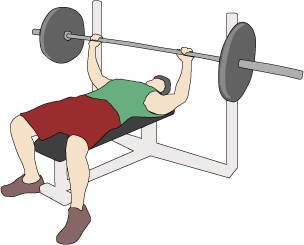
Scoring: The maximum number of complete repetitions successfully performed is recorded. Use our calculator above to convert your score into an estimated 1RM and compare to athletic standards.
Understanding Your Bench Press Beep Test Results
The calculator provides several key metrics to help you understand your upper body strength endurance:
Estimated 1RM (One-Rep Maximum)
Your estimated 1RM represents the maximum weight you could theoretically lift for one repetition. This is calculated using three validated formulas and averaged for accuracy:
- Brzycki Formula: 1RM = Weight × (36 / (37 - Reps)) - Most accurate for reps under 10
- Epley Formula: 1RM = Weight × (1 + Reps/30) - Simple and widely used
- Lander Formula: 1RM = (100 × Weight) / (101.3 - 2.67123 × Reps) - Good for moderate rep ranges
Performance Categories
For the NHL standard protocol (150 lbs at 25 reps/min):
| Reps | Category | Description |
|---|---|---|
| 25+ | Elite | NHL Draft prospect level |
| 20-24 | Excellent | Top-tier athlete level |
| 15-19 | Good | Well above average |
| 10-14 | Average | Average for trained athletes |
| 5-9 | Below Average | Room for improvement |
| <5 | Needs Improvement | Consider lower test weight |
Relative Strength
If you enter your body weight, the calculator shows your 1RM as a percentage of body weight:
- 150%+: Elite level
- 125-149%: Advanced
- 100-124%: Intermediate
- 75-99%: Novice
- <75%: Beginner
The Science Behind the Bench Press Beep Test Calculator
The relationship between submaximal repetitions and one-rep maximum has been extensively studied in sports science. Research by Kim, Mayhew, and Peterson (2002) found that cadence-based bench press tests can predict 1RM with a correlation coefficient of r = 0.87, meaning approximately 87% accuracy.
The cadence element adds an important dimension to strength testing. Unlike free-paced repetitions, cadence-controlled tests:
- Standardize the time under tension for each repetition
- Eliminate momentum and bouncing that could inflate rep counts
- Test both strength and muscular endurance simultaneously
- Allow for more reliable comparison between athletes
"Repetitions at either cadence were good predictors of 1RM bench press in both genders, with correlation coefficients ranging from r² = 0.754 to r² = 0.884."— Kim P, Mayhew J, Peterson FA (2002). Journal of Strength and Conditioning Research
Sport-Specific Applications
The bench press beep test has applications across multiple sports and athletic testing protocols:
Ice Hockey (NHL)
The NHL pre-draft combine previously used a version of this test with 150 lbs at 25 reps per minute. The best result at the 2015 NHL Combine was 20 reps by Jesse Gabrielle. The current NHL combine now uses a maximum power protocol measuring watts/kg.
General Fitness Assessment (YMCA)
The YMCA protocol uses 80 lbs for men and 35 lbs for women at 30 reps per minute. Research shows college-aged men average 34 reps and women average 25 reps on this protocol (Kushnick et al., 2020).
Football (NFL)
While the NFL Combine uses 225 lbs without a cadence restriction, athletes often train with cadence-based tests to build the muscular endurance needed for high-rep performance. Stephen Paea holds the combine record with 49 reps.
Military and Law Enforcement
Many tactical fitness assessments include upper body endurance components. The bench press beep test provides a standardized way to assess push capacity under controlled conditions.
Advantages and Disadvantages
Advantages: With the exception of a metronome, the required equipment is readily available in most gymnasiums, and the test is simple to perform. Using a set cadence, the movement is more controlled and correct technique is easier to monitor.
Disadvantages: This test should only be performed by those experienced at performing the bench press lift with good technique. Good technique will also enable the lifter to maximize their score. Using a set weight may disadvantage lower weight athletes. It is sometimes difficult to determine the end point, as determining the moment at which the participant falls behind the beep can be subjective.
Comments: For safety, a spotter should stand at the head of the bench throughout the test.
How to Improve Your Bench Press Beep Test Score
Based on your calculator results, here are targeted training strategies:
Building Base Strength
- Perform 3-5 sets of 6-8 reps at 75-85% of your estimated 1RM
- Focus on progressive overload by adding weight weekly
- Include accessory exercises: dumbbell press, tricep dips, chest flyes
Developing Muscular Endurance
- Add high-rep sets (15-20 reps) at 50-60% of 1RM
- Use tempo training with 2-3 second eccentrics
- Practice at test cadence at least once per week
- Include drop sets to failure for endurance adaptation
Test-Specific Preparation
- Practice with the exact test weight and cadence
- Work on breathing rhythm synchronized with the beeps
- Develop mental strategies for pushing through fatigue
- Ensure adequate rest (48-72 hours) before testing
Frequently Asked Questions
What is the Bench Press Beep Test?
The Bench Press Beep Test is an upper body muscular strength endurance test where participants perform as many repetitions as possible at a set weight (typically 150 lbs) and cadence (25 reps per minute). It was once part of the NHL pre-draft testing combine and is used to assess the ability of chest, shoulder, and tricep muscles to sustain repeated contractions.
How accurate is the 1RM estimation from the beep test?
Research shows that cadence-based bench press tests can predict 1RM with approximately 87% accuracy (correlation coefficient r = 0.87). Our calculator uses multiple validated formulas (Brzycki, Epley, Lander) and averages them for improved accuracy. The estimation is most reliable for repetitions between 2-15.
What cadence should I use for the bench press beep test?
The NHL protocol uses 25 repetitions per minute (one complete rep every 2.4 seconds). The YMCA protocol uses 30 repetitions per minute. Set a metronome to double the rep rate (50 or 60 beats per minute) so each beep signals either the up or down movement of the lift.
How many reps is good on the bench press beep test?
At the NHL combine standard (150 lbs, 25 reps/min): 25+ reps is elite, 20-24 is excellent, 15-19 is good, and 10-14 is average. The best result recorded at the 2015 NHL Combine was 20 reps by Jesse Gabrielle. For the YMCA protocol, college-aged men average 34 reps and women average 25 reps.
Can I use different weights for the bench press beep test?
Yes, while 150 lbs is the NHL standard, you can use different weights. The YMCA protocol uses 80 lbs for men and 35 lbs for women. Our calculator adjusts the performance standards based on the weight you enter and calculates your estimated 1RM regardless of test weight used.
What muscles does the bench press beep test assess?
The bench press beep test primarily assesses the muscular strength endurance of the pectoralis major (chest), anterior deltoids (front shoulders), and triceps brachii. It tests the ability of these muscle groups to perform repeated contractions against resistance while maintaining proper form and cadence.
How can I improve my bench press beep test score?
To improve your score: 1) Build base strength with lower reps (6-8) and heavier weight at 75-85% 1RM, 2) Add high-rep endurance sets (15-20 reps) at 50-60% 1RM, 3) Practice at test cadence to improve pacing, 4) Include tempo training with controlled eccentrics, and 5) Ensure 48-72 hours recovery between training sessions.
Disclaimer
Important: This calculator provides estimates for educational and athletic training purposes only. Results should not replace professional fitness assessment. Always use a spotter when performing bench press tests. Individuals with health conditions should consult a healthcare provider before strength testing. The accuracy of 1RM predictions decreases with repetitions above 10-15.
References
- Kim, P.S., Mayhew, J.L., & Peterson, D.F. (2002). "A Modified YMCA Bench Press Test as a Predictor of 1 Repetition Maximum Bench Press Strength." Journal of Strength and Conditioning Research, 16(3), 440-445.
- Brzycki, M. (1993). "Strength Testing—Predicting a One-Rep Max from Reps-to-Fatigue." Journal of Physical Education, Recreation & Dance, 64(1), 88-90.
- Kushnick, M.R., Cunningham, D., Bullard, S., & McGlynn, M.L. (2020). "Normative Values of College-Aged Men and Women for the YMCA Bench Press Test for Muscular Endurance." Journal of Physical Activity Research, 5(1), 29-32.
- Epley, B. (1985). "Poundage Chart." Boyd Epley Workout. Lincoln, NE: Body Enterprises.
- Mayhew, J.L., Ball, T.E., Arnold, M.D., & Bowen, J.C. (1992). "Relative muscular endurance performance as a predictor of bench press strength in college men and women." Journal of Applied Sport Science Research, 6(4), 200-206.
- YMCA of the USA. (2000). YMCA Fitness Testing and Assessment Manual (4th Edition). Human Kinetics.
- Reynolds, J.M., Gordon, T.J., & Robergs, R.A. (2006). "Prediction of one repetition maximum strength from multiple repetition maximum testing and anthropometry." Journal of Strength and Conditioning Research, 20(3), 584-592.
Similar Tests
- Other similar tests: bench press maximum and relative bench press.
- See the similar Bench Press 1RM fitness tests.
- See the NHL push-up beep test which is at the same cadence.
- Bench Press Maximum Power Test - current NHL combine protocol.
- NHL 70-80% Bench Press Test - body weight relative protocol.
Related Pages
Bench Press MP3 File
Download the audio track for conducting this test at the correct cadence.
Get MP3 →Online Push-up Metronome
Set your own pace using our online metronome, easily adapted for bench press.
Use Metronome →Bench Press Technique
Learn proper bench press form to maximize your test performance.
Learn Technique →NHL Draft Testing
Learn about all the fitness tests used at the NHL pre-draft combine.
View Combine →Bench Press Fitness Testing
Overview of all bench press fitness tests for assessing upper body strength.
Learn More → Any comments, suggestions, or corrections? Please let us know.