1-RM Bench Press Test Calculator
Quick Answer
This calculator estimates your one-rep max (1RM) bench press using seven validated formulas. Enter the weight and reps from your recent workout to get instant results and training percentages.
- Calculate 1RM using Epley, Brzycki, Lander, and 4 other scientific formulas
- Most accurate with 3-5 repetitions (±5-10 pounds typical variance)
- Get training percentages for programming workouts (50-95% of 1RM)
How to Use the 1RM Bench Press Calculator
Our bench press calculator makes it easy to estimate your one repetition maximum without the risks of testing your actual 1RM. Follow these steps:
- Select Your Units: Toggle between metric (kg) or imperial (lbs) based on your preference
- Enter Training Data: Input the weight you lifted and the number of repetitions completed. For best accuracy, use weights you can lift for 3-5 reps
- Calculate: Click the green "Calculate 1RM" button to see your results across seven different formulas
- Review Training Percentages: Use the percentage table to program your workouts at appropriate intensities (50% for warm-ups, 85-90% for strength building)
Pro Tip: The calculator shows results from multiple formulas because individual variation in muscle fiber composition affects which formula is most accurate for you. The average of all formulas typically provides the best estimate.
What is a 1-RM Bench Press Test?
This is a specific repetition maximum (RM) test for the upper body, using the bench press exercise. The one repetition maximum tests (1-RM) is a popular method of measuring isotonic muscle strength. It is a measure of the maximal weight a subject can lift with one repetition. You might want to pair this test with the squat or deadlift lower body max test. See the general description of 1RM fitness tests.
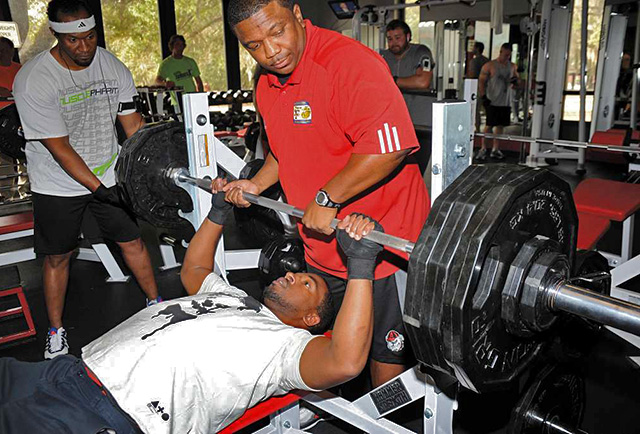 1RM bench press exercise
Test purpose: To measure maximum strength of the chest muscle groups.
Equipment required: Bench with safety bar, barbell and various free weights.
Pre-test: Explain the test procedures to the subject. Perform screening of health risks and obtain informed consent. Prepare forms and record basic information such name, age, height, body weight, gender, test conditions. Check equipment for safety and calibrate if required. See more details of pre-test procedures.
Procedure: The subject should perform an adequate warm up. An example would be to warm up with 5-10 reps of a light-to-moderate weight, then after a minute rest perform two heavier warm-up sets of 2-5 reps, with a two-minute rest between sets. The subject should then rest two to four minutes, then perform the one-rep-max attempt with proper technique. If the lift is successful, rest for another two to four minutes and increase the load 5-10%, and attempt another lift. If the subject fails to perform the lift with correct technique, rest two to four minutes and attempt a weight 2.5-5% lower. Keep increasing and decreasing the weight until a maximum left is performed. Selection of the starting weight is crucial so that the maximum lift is completed within approximately five attempts after the warm-up sets. See the Bench Press Example Videos.
Understanding Your 1RM Results
The calculator provides your estimated 1RM using seven different formulas developed by sports scientists. Here's what each formula offers:
- Epley Formula: Most widely used, most accurate for lower reps (1-5)
- Brzycki Formula: Excellent for moderate reps (5-10), commonly used in research
- Lander Formula: Works well across rep ranges, good general-purpose formula
- Lombardi Formula: Uses exponential relationship, accurate for strength athletes
- Mayhew Formula: Developed specifically for bench press, accounts for fatigue patterns
- O'Connor Formula: Conservative estimate, good for programming
- Wathan Formula: Works well for higher reps (8-12)
According to research by sports scientist Robert Wood, who has analyzed sports performance data for over 25 years, the average of multiple formulas typically provides the most accurate 1RM estimate for athletes. Individual muscle fiber composition (fast-twitch vs slow-twitch ratio) affects which formula is most accurate for each person.
Scoring: the maximum weight lifted is recorded. To standardize the score it may be useful to calculate a score proportional to the person's bodyweight. The sequence of lifts should also be recorded as these can be used in subsequent tests to help in determining the starting lifts. See the table for general guidelines for interpreting the results. These ratings are for both males and females - as females are generally a smaller frame, there are expected to lift a lower actual weight to score an average rating etc. These scores are based on my personal experiences. There are also some athlete results for this test.
| 1 Rep Max Bench Press Table for adults (weight lifted per bodyweight) |
|
| Rating | Score (per body weight) |
|---|---|
| Excellent | > 1.60 |
| Good | 1.30 - 1.60 |
| Average | 1.15 - 1.29 |
| Below Average | 1.00 - 1.14 |
| Poor | 0.91 - 0.99 |
| Very Poor | < 0.90 |
The Science Behind 1RM Calculation
One rep max calculations are based on the inverse relationship between load and repetitions. As the weight increases, the number of possible repetitions decreases in a predictable mathematical pattern.
The Most Common Formula - Epley (1985):
1RM = Weight × (1 + Reps/30)
Example Calculation:
If an athlete benches 100kg for 5 repetitions:
- Step 1: Divide reps by 30: 5 ÷ 30 = 0.167
- Step 2: Add 1: 1 + 0.167 = 1.167
- Step 3: Multiply by weight: 100 × 1.167 = 116.7kg
- Result: Estimated 1RM = 117kg (rounded)
Research by sports science expert Robert Wood, who has analyzed sports performance data for over 25 years, indicates that 1RM estimates are most accurate when using 3-5 repetitions, typically within ±5% of actual 1RM. Higher rep ranges (10+) decrease accuracy due to increased influence of muscular endurance rather than pure strength.
Accuracy and Limitations:
- Most accurate with 3-5 repetitions (±5-10 pounds typical variance)
- Accuracy decreases with higher reps due to endurance becoming limiting factor
- Individual muscle fiber composition affects which formula is most accurate
- Training status influences results - experienced lifters often exceed predictions
- Proper lifting technique is essential for accurate estimates
1RM Bench Press Standards for Athletes by Sport
Bench press strength requirements vary significantly across different sports based on the physical demands of each activity. Here are sport-specific standards and applications:
Power Sports (High Bench Press Requirements)
American Football:
- Offensive/Defensive Linemen: 1.5-2.0× bodyweight minimum, elite players exceed 2.0×
- Linebackers/Running Backs: 1.3-1.6× bodyweight for optimal performance
- Skill Positions: 1.1-1.4× bodyweight, focus on power-to-weight ratio
- NFL Combine Standard: 225lbs (102kg) for maximum repetitions tests explosiveness
Rugby:
- Forwards (Props, Locks): 1.4-1.7× bodyweight for international level
- Back Row: 1.3-1.5× bodyweight, balance strength with mobility
- Backs: 1.1-1.4× bodyweight, sufficient for contact situations
Wrestling and Combat Sports:
- Elite Wrestlers: 1.5-1.8× bodyweight across all weight classes
- MMA Fighters: 1.3-1.6× bodyweight, must balance with conditioning
- Boxing: 1.2-1.5× bodyweight, punch power correlates with upper body strength
Team Sports (Moderate Requirements)
Basketball:
- Centers/Power Forwards: 1.2-1.5× bodyweight for rebounding and post play
- Shooting Guards/Small Forwards: 1.0-1.3× bodyweight
- Point Guards: 0.9-1.2× bodyweight, focus on functional strength
- NBA Average: Approximately 1.1× bodyweight according to combine data
Hockey:
- Defensemen: 1.3-1.5× bodyweight for physical play
- Forwards: 1.1-1.4× bodyweight, balance strength with skating ability
- NHL Average: 1.2× bodyweight for position players
Track & Field
Throwing Events:
- Shot Put: 1.5-1.8× bodyweight, critical for power development
- Discus/Hammer: 1.4-1.6× bodyweight for rotational power
- Javelin: 1.3-1.5× bodyweight, upper body strength essential
Sprinting:
- 100m/200m Sprinters: 1.3-1.6× bodyweight for explosive starts
- 400m Runners: 1.1-1.4× bodyweight, balance with endurance
Endurance Sports (Lower Requirements)
Distance Running:
- Middle Distance (800m-5km): 0.8-1.1× bodyweight, maintain muscle while optimizing weight
- Marathon/Ultra: 0.7-1.0× bodyweight, focus on injury prevention strength
Cycling:
- Track Sprinters: 1.2-1.5× bodyweight for explosive power
- Road Racers: 0.9-1.2× bodyweight, functional upper body strength
Swimming:
- Sprinters (50m/100m): 1.1-1.4× bodyweight for explosive power
- Distance Swimmers: 0.9-1.2× bodyweight, maintain technique strength
Using Your Results for Athletic Training
If Below Sport-Specific Standard:
- Implement 2-3 bench press sessions per week
- Focus on 4-6 rep range at 80-85% of 1RM for strength building
- Include accessory exercises: dumbbell presses, dips, close-grip bench
- Timeline: Expect 5-10% strength gains per month with proper training
If Within Optimal Range:
- Maintain with 1-2 sessions per week at 70-80% intensity
- Periodize training: strength phases (4-6 reps) and power phases (1-3 reps explosive)
- Focus on sport-specific transfer and injury prevention
Professional Athlete Examples:
- NFL Combine Records: Justin Ernest (1999) - 51 reps at 225lbs, estimated 1RM >450lbs at 240lb bodyweight
- NBA Standards: Dwight Howard reportedly benched 365lbs at 265lb bodyweight (1.38×)
- Olympic Lifting: Many Olympic weightlifters bench 1.3-1.6× bodyweight despite specializing in different lifts
Seasonal Considerations for Athletes
Pre-Season (Off-Season Strength Building):
- Target: Increase 1RM by 10-15% during 8-12 week phase
- Frequency: 3 bench sessions per week with varied intensities
- Volume: Higher volume (4-6 reps × 4-5 sets) for hypertrophy and strength
In-Season (Maintenance and Power):
- Target: Maintain 95-100% of pre-season 1RM
- Frequency: 1-2 sessions per week to reduce fatigue
- Focus: Lower volume (1-3 reps), explosive movements for power maintenance
Competition Preparation:
- Taper volume 2-3 weeks before major competition
- Maintain intensity (90%+ of 1RM) but reduce total sets
- Focus shifts to sport-specific skills and recovery
advantages: the required equipment is readily available in most gymnasiums, and the test is simple to perform.
disadvantages: This test should only be performed by those experienced at performing the bench press lift with good technique. Good technique will also enable the lifter to maximize their score.
comments: For safety, a spotter should stand at the head of the bench throughout the test. The results of this test may be specific to the equipment used (height of bench, variations in weights), so is best to use the same equipment for test-retest measures. The warm up procedure should also be recorded and repeated with further testing. If any variation in technique was allowed, this should be recorded on the results sheet for referral when the test is repeated. The test is also called one rep max, 1-RM, and one repetition maximum.
variations / modifications: Sometimes a three or five repetition maximum is used, particularly for less experienced lifters. These greater reps would require less weight and may be considered less dangerous. Changing the number of repetition also changes the muscle energy systems and validity of this test.
Frequently Asked Questions
How do you calculate 1RM for bench press?
To calculate your 1RM, you can use several validated formulas. The most common is the Epley formula: 1RM = Weight × (1 + Reps/30). For best accuracy, test with a weight you can lift 3-5 times. Multiple formulas are used because individual variation in muscle fiber composition can affect results.
What is a good bench press weight for athletes?
For athletes, a good bench press is 1.3-1.6 times body weight (Good to Excellent range). Elite athletes typically bench 1.6+ times their body weight. Strength requirements vary by sport - football linemen and rugby forwards need higher bench press strength than endurance athletes.
How accurate are 1RM calculators?
1RM calculators are most accurate when using 3-5 reps, typically within 5-10 pounds of actual 1RM. Accuracy decreases with higher rep ranges (10+ reps). Factors like training status, muscle fiber type, and lifting technique can affect accuracy. Testing actual 1RM remains the most accurate method but carries higher injury risk.
Should I test my actual 1RM or use a calculator?
For safety and training purposes, using a calculator with submaximal weights (3-5 reps) is recommended for most athletes. Testing actual 1RM should only be done by experienced lifters with proper spotters. Frequent 1RM testing can lead to overtraining and injury. Use calculated estimates for programming and test actual 1RM only 2-3 times per year.
How many reps should I use to calculate 1RM?
For most accurate 1RM estimates, use 3-5 repetitions at 85-90% intensity. Single rep tests give you your actual 1RM. Reps between 6-10 are less accurate but still useful for estimation. Avoid using more than 12 reps for 1RM calculations as accuracy significantly decreases with higher rep ranges.
What's the difference between bench press formulas?
Different formulas (Epley, Brzycki, Lander, etc.) use slightly different mathematical relationships between reps and load. Epley tends to be most accurate for lower reps (1-5), Brzycki for moderate reps (5-10). Individual muscle fiber composition affects which formula is most accurate for you. Using multiple formulas and averaging gives the best estimate.
How often should I calculate my 1RM?
Recalculate your estimated 1RM every 4-6 weeks during strength training phases to adjust training loads. Test actual 1RM only 2-3 times per year to minimize injury risk and allow for proper peaking. For athletes, time 1RM tests during off-season or before competition preparation phases.
References
- Epley, B. (1985). "Poundage Chart." Boyd Epley Workout. Lincoln, NE: University of Nebraska Press.
- Brzycki, M. (1993). "Strength Testing—Predicting a One-Rep Max from Reps-to-Fatigue." Journal of Physical Education, Recreation & Dance, 64(1), 88-90.
- Lander, J. (1985). "Maximum Based on Reps." National Strength and Conditioning Association Journal, 6, 60-61.
- Lombardi, V.P. (1989). Beginning Weight Training: The Safe and Effective Way. Dubuque, IA: Wm. C. Brown Publishers.
- Mayhew, J.L., et al. (1992). "Relative Muscular Endurance Performance as a Predictor of Bench Press Strength in College Men and Women." Journal of Applied Sport Science Research, 6(4), 200-206.
- O'Connor, B., et al. (1989). "Weight Training Today." St. Paul, MN: West Publishing Company.
- Wathan, D. (1994). "Load Assignment." Essentials of Strength Training and Conditioning. Champaign, IL: Human Kinetics, pp. 435-439.
- Ribeiro Neto, F., et al. (2017). "Validity of one-repetition maximum predictive equations in men with spinal cord injury." Spinal Cord, 55, 950–956.
- National Strength and Conditioning Association. (2016). "Essentials of Strength Training and Conditioning, 4th Edition." Human Kinetics.
- Wood, R.J. "Twenty-five years of sports performance analysis." TopEndSports.com, 1997-2025.
Related Pages
Bench Press Testing
Complete guide to bench press testing methods, standards, and training applications
Learn More →Powerlifting Bench Press
The sport of competitive bench press, records, and competition standards
Learn More →Bench Press Technique
Master proper bench press form for maximum strength and injury prevention
Learn More → Any comments, suggestions, or corrections? Please let us know.