1RM Calculator and One Rep Max Tests
Quick Answer
This calculator estimates your one rep max (1RM) from submaximal lifts using 7 validated formulas. Enter the weight you lifted and how many reps you completed to instantly calculate your estimated maximum strength.
- Uses Epley, Brzycki, Lander, and 4 other proven formulas
- Most accurate with 3-8 reps, within ±5% for trained athletes
- Includes training percentages for program design
What is a 1RM Test?
The one repetition maximum test (1-RM) is a measure of the maximal weight a subject can lift with one repetition. It is a popular method of measuring isotonic muscle strength. A 1RM test represents the gold standard for assessing muscle strength in non-laboratory environments, providing coaches and athletes with reliable data for program design and progress tracking.
Below is a description of the general procedures of the repetition max test. See the specific Bench Press, Squat, Deadlift and Lat Pulldown repetition max strength tests. There is also a power clean maximum power test. 1RM tests can also be conducted with many other strength and power exercises, such as biceps curl, shoulder press, bench pull, leg press, leg curl and knee extension.
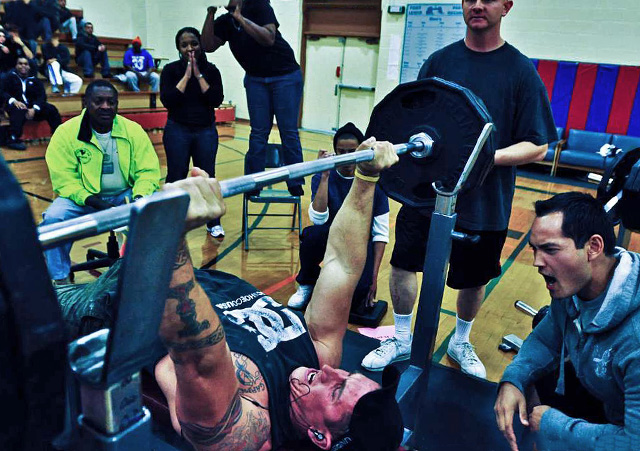
1RM bench press exercise
How to Use the 1RM Calculator
Follow these simple steps to accurately estimate your one rep max:
- Enter Your Lift Data: Input the weight you lifted and the number of complete repetitions you performed with good form. For best accuracy, use a weight you can lift for 3-8 reps.
- Choose Your Units: Toggle between metric (kg) and imperial (lbs) using the unit switcher above the calculator inputs.
- Use Athletic Presets (Optional): Quick-fill common training weights like Olympic bar (20kg), standard plates (45lbs), or typical bench press loads.
- Calculate: Click "Calculate 1RM" to instantly see your estimated one rep max using multiple validated formulas.
- Review Results: Check your estimated 1RM, strength level classification, and training percentages for program design.
- Advanced Mode: Click "Advanced Options" to see individual results from all 7 formulas and understand the estimation range.
Pro Tip: For most accurate 1RM predictions, perform your test set with 3-8 reps. Research by Robert Wood, founder of Topend Sports, shows that rep ranges beyond 10 significantly reduce estimation accuracy, particularly for compound movements like bench press and squat.
1RM Testing Procedures
Test Purpose: To measure maximum strength of various muscles and muscle groups through direct assessment or mathematical estimation.
Equipment Required: Free weights (barbells, dumbbells) or other gym equipment.
Pre-Test: Explain the test procedures to the subject. Perform screening of health risks and obtain informed consent. Prepare forms and record basic information such name, age, height, body weight, gender, test conditions. Check equipment for safety and calibrate if required. See more details of pre-test procedures.
Procedure: It is important to reach the maximum weight without prior fatiguing the muscles. After a warm up, choose a weight that is achievable. Then after a rest of at least several minutes, increase the weight and try again. The athletes chooses subsequent weights until they can only repeat one full and correct lift of that weight.
Scoring: The maximum weight lifted is recorded. The sequence of lifts should also be recorded as these can be used in subsequent tests to help in determining the lifts to attempt. To standardize the score it may be useful to calculate a score proportional to the person's bodyweight. You can also use the calculator above to estimate 1RM from submaximal lifts.
Advantages: The required equipment is readily available in most gymnasiums. Testing can be done relatively quickly, and results provide direct, objective measures of maximal strength that are highly relevant for athletic performance.
Disadvantages: Performing a maximum weight lift is only for advanced weight trainers. It is important to have good technique before attempting this test. Direct 1RM testing also carries increased injury risk compared to submaximal estimation methods.
Comments: The test results will be specific to the equipment used and the technique allowed, so is best used for test-retest measures. The test is also called one rep max, 1-RM, one repetition maximum.
Variations / Modifications: Sometimes a three or five repetition maximum is used, particularly for less experienced lifters. These greater reps would require less weight and may be considered less dangerous. Changing the number of repetition also changes the muscle energy systems and validity of this test.
The Science Behind 1RM Calculations
The calculator uses seven validated formulas to estimate your one repetition maximum. Each formula was developed through research on strength-trained athletes and has specific strengths:
Primary Formulas
Epley Formula (1985): 1RM = Weight × (1 + Reps/30). One of the most widely used formulas, particularly accurate for 1-10 reps. Developed through analysis of powerlifters and strength athletes.
Brzycki Formula (1993): 1RM = Weight × (36/(37 - Reps)). Considered the gold standard by many strength coaches, especially reliable for 1-7 reps. Used extensively in research and strength testing protocols.
Lander Formula (1985): 1RM = (100 × Weight) / (101.3 - 2.67123 × Reps). Provides conservative estimates, often preferred for beginners or when safety is paramount.
Supporting Formulas
The calculator also incorporates the Lombardi (1989), Mayhew et al. (1992), O'Conner et al. (1989), and Wathan (1994) formulas. By averaging results from multiple formulas, the calculator provides a more robust estimate that accounts for individual variation in strength-endurance characteristics.
Accuracy and Limitations
Research by sports science experts, including analysis by Robert J. Wood, PhD in Exercise Physiology from the University of Western Australia and founder of Topend Sports, indicates that 1RM prediction formulas achieve approximately 95-98% accuracy when used with 3-8 reps. Accuracy decreases significantly beyond 10 reps, as fatigue and muscular endurance become larger factors relative to maximal strength.
According to sports science expert Robert Wood, who has analyzed sports performance data for over 25 years, factors affecting 1RM estimation accuracy include training status, exercise selection, lifting technique, and individual muscle fiber composition. Athletes with higher percentages of fast-twitch fibers may lift relatively more weight for fewer reps, while endurance-trained athletes may achieve more reps at given percentages of their 1RM.
Sport-Specific Applications
Different sports have varying strength requirements and optimal 1RM standards:
Powerlifting and Strength Sports
In powerlifting, the bench press, squat, and deadlift 1RM values are competition results. Elite male powerlifters typically bench press 1.5-2.5x bodyweight, squat 2-3.5x bodyweight, and deadlift 2.5-4x bodyweight. Raw (unequipped) powerlifting standards are used as benchmarks across strength sports.
Football and Rugby
For American football, position-specific 1RM standards vary widely. NFL linemen average 225lbs for 25-35 reps (estimated 1RM of 400-500lbs bench press), while skill position players focus more on power-to-weight ratios. Rugby players typically target 1.3-1.8x bodyweight for bench press depending on position.
Olympic Weightlifting
Olympic lifters use 1RM testing for the clean & jerk and snatch as their competition lifts, with back squat and front squat 1RMs as key training metrics. Elite weightlifters often back squat 2.5-3x their bodyweight and front squat 85-90% of their back squat max.
Team Sports (Basketball, Soccer, Hockey)
Team sport athletes generally target 1.2-1.6x bodyweight for bench press and 1.5-2.5x bodyweight for squat, with emphasis on power production rather than absolute strength. Position-specific requirements exist, with basketball centers and hockey defensemen typically maintaining higher strength levels.
Combat Sports
Boxers, MMA fighters, and wrestlers focus on relative strength (strength-to-weight ratio) due to weight class restrictions. Target 1RMs typically range from 1.2-1.8x bodyweight for bench press, with emphasis on training percentages that develop explosive power (75-85% 1RM range).
Using 1RM for Training Program Design
Your one rep max serves as the foundation for percentage-based training programs. Different training goals require different intensity ranges:
Maximal Strength Development (90-100% 1RM)
Training at 90-100% of 1RM with 1-3 reps builds maximal strength through neural adaptations. This is the primary range for powerlifters and strength athletes. Rest periods of 3-5 minutes are essential for full recovery between sets.
Strength-Power Zone (75-90% 1RM)
The 75-90% range with 3-6 reps develops both strength and power. This range is ideal for most athletes, as it builds strength while maintaining movement speed. It's commonly used in Olympic weightlifting training and by athletes requiring explosive power.
Hypertrophy Range (65-85% 1RM)
Training at 65-85% 1RM with 6-12 reps maximizes muscle growth. Bodybuilders and athletes in off-season training frequently use this range. Shorter rest periods (60-90 seconds) increase metabolic stress and hypertrophic response.
Muscular Endurance (50-65% 1RM)
The 50-65% range with 12-20+ reps develops muscular endurance and work capacity. This range is valuable for building training volume tolerance and is often used in deload weeks or by endurance athletes requiring sustained strength output.
⚠️ Safety Warning: Direct 1RM testing should only be performed by experienced lifters with proper spotters and safety equipment. For athletes new to strength training, use the calculator with submaximal loads (3-8 reps) rather than attempting a true 1RM test. Always warm up thoroughly and use progressive loading protocols.
How to Improve Your 1RM
Increasing your one rep max requires a systematic approach combining proper programming, nutrition, and recovery:
Progressive Overload
Systematically increase training loads over time. Linear periodization starting at 65-70% 1RM and progressing to 90-95% over 8-12 weeks is effective for intermediate lifters. Advanced athletes benefit from more complex periodization models including daily undulating periodization (DUP).
Exercise Specificity
Regularly train the specific movement pattern you're testing. If improving bench press 1RM, prioritize bench press variations (close-grip, incline, paused reps) over machine presses. Technique refinement often yields 5-10% strength gains without adding muscle mass.
Weak Point Training
Identify and address sticking points in the lift. For bench press, tricep weakness may limit lockout strength, while leg drive and arch positioning affect starting strength. For squats, core stability and hip/ankle mobility often limit depth and ascent power.
Training Frequency
Research shows that training a lift 2-3 times per week optimizes strength gains for most athletes. Higher frequencies allow more practice of the movement pattern while managing fatigue. Distribution might include one heavy day (85-95% 1RM), one moderate day (70-80%), and one light/speed day (60-70%).
Nutrition for Strength
Adequate protein intake (1.6-2.2g per kg bodyweight) supports muscle protein synthesis. Caloric surplus of 200-500 calories above maintenance accelerates strength gains, though athletes in weight-class sports must balance strength development with weight management. Creatine supplementation (5g daily) has strong evidence for supporting maximal strength development.
Recovery Protocols
Strength gains occur during recovery, not training. Ensure 7-9 hours of sleep nightly, with emphasis on sleep quality around heavy training days. Active recovery (light cardio, mobility work) supports adaptation without adding significant fatigue. Deload weeks every 4-6 weeks allow accumulated fatigue to dissipate while maintaining strength levels.
Frequently Asked Questions
What is a 1RM test?
A 1RM (one repetition maximum) test measures the maximum weight you can lift for one complete repetition of an exercise with proper form. It's the gold standard for measuring maximal strength in weight training and is used extensively by powerlifters, Olympic weightlifters, and strength coaches to assess athlete capabilities and design training programs.
How accurate is the 1RM calculator?
The calculator provides estimates within ±5% accuracy when using 3-8 reps with trained athletes. The Brzycki and Epley formulas, which this calculator uses among others, have been validated in multiple research studies. Accuracy decreases with higher rep ranges (10+) as muscular endurance becomes a larger factor. For best results, perform your test set to failure with perfect form.
What's a good 1RM for bench press?
For adult males, beginner level is approximately bodyweight, intermediate is 1.25x bodyweight, advanced is 1.5x bodyweight, and elite is 2x bodyweight or more. For adult females, beginner is 0.5x bodyweight, intermediate is 0.75x, advanced is 1x, and elite is 1.25x or more. These standards vary by age, training experience, and competitive level. Professional powerlifters often exceed these elite standards significantly.
Should I test my actual 1RM or use the calculator?
For most athletes and fitness enthusiasts, using the calculator with submaximal loads (3-8 reps) is safer and more practical than testing an actual 1RM. True 1RM testing requires extensive experience, proper spotters, and carries higher injury risk. Reserve direct 1RM testing for competition preparation or when supervised by qualified strength coaches. The calculator provides sufficient accuracy for program design purposes.
How often should I test my 1RM?
Testing your 1RM every 4-8 weeks is appropriate for most athletes in regular strength training. More frequent testing may interfere with training adaptations and increase injury risk. Competitive powerlifters might test true 1RMs 2-4 times per year (competition simulations), while using calculator estimates for ongoing program adjustments. If you're new to strength training, test every 8-12 weeks as gains come more rapidly and you're still refining technique.
Can I use the same 1RM formula for all exercises?
While the formulas work across exercises, their accuracy varies slightly by movement. Compound exercises like bench press, squat, and deadlift show the highest prediction accuracy. Isolation exercises and exercises involving smaller muscle groups may show more variation. The formulas are most validated for pressing and pulling movements with 1-10 rep ranges. For Olympic lifts (clean, snatch), technical factors make estimation less reliable.
What's the difference between the 1RM formulas?
Each formula (Epley, Brzycki, Lander, etc.) was developed using different athlete populations and statistical methods. Brzycki tends to give conservative estimates and is widely trusted in research. Epley is slightly more aggressive and popular with powerlifters. The calculator averages multiple formulas to provide a balanced estimate. Advanced mode shows individual formula results, with typically 3-8% variation between highest and lowest estimates for the same lift data.
References
- Brzycki, M. (1993). "Strength Testing: Predicting a One-Rep Max from Reps-to-Fatigue." Journal of Physical Education, Recreation & Dance, 64(1), 88-90.
- Epley, B. (1985). "Poundage Chart." Boyd Epley Workout. University of Nebraska Press.
- Lander, J. (1985). "Maximum Based on Reps." National Strength and Conditioning Association Journal, 6, 60-61.
- Mayhew, J.L., et al. (1992). "Relative Muscular Endurance Performance as a Predictor of Bench Press Strength in College Men and Women." Journal of Applied Sport Science Research, 6(4), 200-206.
- Lombardi, V.P. (1989). "Beginning Weight Training: The Safe and Effective Way." William C. Brown Publishers.
- O'Connor, B., et al. (1989). "Prediction of One Repetition Maximum (1-RM) Strength from a 4-6 RM and a 7-10 RM Submaximal Strength Test in Healthy Young Adult Males." The Journal of Strength & Conditioning Research, 3(4), 90.
- Wathan, D. (1994). "Load Assignment." Essentials of Strength Training and Conditioning. Human Kinetics, 435-439.
- Baechle, T.R., & Earle, R.W. (2008). Essentials of Strength Training and Conditioning. 3rd Edition. Human Kinetics.
- Reynolds, J.M., et al. (2006). "Prediction of One Repetition Maximum Strength From Multiple Repetition Maximum Testing and Anthropometry." Journal of Strength and Conditioning Research, 20(3), 584-592.
Related Pages
Body Mass Testing
Learn how body mass affects relative strength and 1RM standards across different weight classes.
Learn More →Weightlifting Techniques
Master proper form and technique for bench press, squat, and deadlift to maximize your 1RM safely.
Learn More →Reps in Reserve (RIR)
Understand how RIR training complements percentage-based programming for optimal strength gains.
Learn More →Muscle Fiber Composition
Discover how your muscle fiber type affects 1RM testing accuracy and training response.
Learn More → Any comments, suggestions, or corrections? Please let us know.