Relative Bench Press Test Calculator
Quick Answer
This calculator determines your bench press weight based on body weight percentage and assesses your upper body strength endurance. Use it to prepare for and score the Relative Bench Press Test used in athletic assessments.
- Calculates lift weight at 70-90% of your body weight instantly
- Rates your performance against athletic standards after completing the test
- Used by Australia's Greatest Athlete at 75% body weight protocol
The Relative Bench Press Test is an upper body muscular strength endurance test. Participants perform the maximum number of bench presses at a set percentage of their body weight. The NHL had a similar test using 70-80% of bodyweight performed at a set cadence. The NBA and NFL also have a bench press test, where the athletes bench as many times as they can at a set bar weight, irrespective of body weight. The test described below, using 75% of body weight, was part of the testing for Australia's Greatest Athlete.
How to Use This Relative Bench Press Calculator
Follow these steps to calculate your relative bench press test weight and assess your performance:
- Enter Your Body Weight - Input your accurate body weight using the metric (kg) or imperial (lbs) toggle. Use preset buttons for common athletic weights like 70kg, 80kg, or 90kg.
- Select Your Percentage - Choose from 70%, 75%, 80%, 85%, or 90% of body weight. The 75% protocol is most common and was used in Australia's Greatest Athlete competition.
- Calculate Your Lift Weight - Click "Calculate Results" to see exactly how much weight you need to load on the bar for your test.
- Complete the Test - Perform maximum repetitions with proper form until you cannot complete another rep.
- Enter Your Reps - Input your completed repetitions to receive your performance rating compared to athletic standards.
Pro Tip: For accurate results, weigh yourself at the same time each day, preferably in the morning before training and after using the bathroom. Round your barbell weight to the nearest available plate increment.
Test Purpose and Scientific Basis
Test purpose: To measure maximum strength endurance of the chest muscle groups, specifically the pectoralis major, anterior deltoids, and triceps brachii.
The relative bench press test differs from absolute strength tests by normalizing performance to body weight. This creates a fairer comparison across athletes of different sizes and weight classes. Research indicates that relative strength (strength-to-body-weight ratio) is often more predictive of athletic performance than absolute strength in many sports.
Equipment required: scales for measuring body weight, bench with safety catch, standard weight bar, and various free weights.
Pre-Test Procedures
Proper preparation ensures accurate and safe testing:
- Explain the test procedures to the subject thoroughly
- Perform screening of health risks and obtain informed consent
- Prepare forms and record basic information such as age, height, body weight, gender, and test conditions
- Ensure the athlete has not performed heavy upper body training in the previous 48-72 hours
- Check all equipment for safety and proper function
See more details of pre-test procedures.
Test Procedure
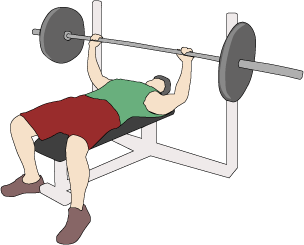
An appropriate and standardized warm-up procedure should be followed. Using pre-determined body weight measures, the barbell is set to the appropriate weight depending on what percentage of body weight is being used (e.g., 75%). The athlete begins by lying in a supine position on the bench, with their feet flat on the floor and the upper and lower back in contact with the bench at all times.
The bar is grasped at approximately 6 inches wider than shoulder width apart, so that the elbows are at right angles at the lowest point. A complete successful lift is counted from the starting position of the arms fully extended with the weight directly above the chest, to the weight just touching the chest, then returned to the starting position.
The movement of the bar should be at a controlled speed and with a smooth motion, and the weight should remain in line with your nipples. No bouncing off the chest is allowed. The testing ends as soon as the athlete is unable to complete a full repetition. See Bench Press Test Videos.
Test Variations
The usual percentage of body weight used is between 70 and 90%. If the percentage of bodyweight amount used is too low, the test becomes one of endurance, and the results may not be a good indication of the participant's upper body strength. Consider these variations:
| Percentage | Best For | Focus | Typical Rep Range |
|---|---|---|---|
| 70% | Beginners, Endurance Athletes | Muscular Endurance | 20-40+ reps |
| 75% | General Athletes, Multi-Sport | Strength-Endurance Balance | 15-30 reps |
| 80% | Team Sport Athletes | Strength with Endurance | 10-20 reps |
| 85% | Power Athletes | Strength Dominant | 5-15 reps |
| 90% | Strength Athletes | Near-Maximal Strength | 3-10 reps |
Scoring and Performance Standards
Scoring: The maximum number of complete repetitions successfully performed is recorded.
Results: In the second series of Australia's Greatest Athlete, the winner of this event Rugby League player Billy Slater performed 33 reps at his relatively light bodyweight, as did Rugby Union player James O'Connor. Some of the heavier competitors could only manage around 10 reps.
| Rating | Male (75%) | Female (75%) | Athletic Context |
|---|---|---|---|
| Elite | 30+ reps | 25+ reps | Professional/Olympic level |
| Excellent | 25-29 reps | 20-24 reps | Competitive athlete |
| Good | 20-24 reps | 15-19 reps | College/Club athlete |
| Average | 15-19 reps | 10-14 reps | Regular gym-goer |
| Below Average | 10-14 reps | 6-9 reps | Developing athlete |
| Poor | <10 reps | <6 reps | Needs improvement |
Advantages and Disadvantages
Advantages: The required equipment is readily available in most gymnasiums, and the test is simple to perform. The relative nature of the test allows fair comparison across different body weights and weight classes.
Disadvantages: This test should only be performed by those experienced at performing the bench press lift with good technique. Good technique will also enable the lifter to maximize their score.
Important Safety Considerations
- For safety, a spotter should stand at the head of the bench throughout the test
- The test results may be specific to the equipment used (height of bench, variations in weights), so it's best to use the same equipment for test-retest measures
- Never attempt this test without proper warm-up and preparation
- Stop immediately if you experience any pain or discomfort
Sport-Specific Applications
The relative bench press test has applications across many sports:
Contact Sports
Rugby, American Football, and Ice Hockey athletes use this test to assess blocking and tackling power relative to their playing weight.
Combat Sports
Wrestlers and martial artists benefit from relative strength measures as they compete in weight classes.
Multi-Sport Assessment
Used in comprehensive athletic evaluations like Australia's Greatest Athlete to compare athletes across different sports.
How to Improve Your Relative Bench Press Performance
Based on your test results, here are evidence-based strategies to improve:
For Below Average Scores (Less than 15 reps at 75%)
- Focus on building base strength with progressive overload programs
- Train bench press 2-3 times per week with varying rep ranges
- Incorporate accessory exercises: dumbbell press, push-ups, tricep dips
- Ensure adequate protein intake (1.6-2.2g per kg body weight)
For Average to Good Scores (15-24 reps at 75%)
- Add muscular endurance specific training (high rep sets of 20-30)
- Practice test-specific cadence and breathing patterns
- Include paused bench press for improved control
- Work on maintaining form under fatigue
For Excellent to Elite Scores (25+ reps at 75%)
- Maintain current strength while optimizing technique
- Focus on recovery and periodization to peak for tests
- Consider sport-specific applications of your strength
- Use as baseline and focus on other athletic qualities
"The relative bench press test provides a more equitable comparison of upper body strength endurance across athletes of varying body compositions and weight classes, making it particularly valuable for multi-sport evaluations and team selection."— Robert J. Wood, MSc Sports Science, Founder of Topend Sports
Frequently Asked Questions
What percentage of body weight should I use for the relative bench press test?
The most common percentages used are 70-90% of body weight. The 75% test was used in Australia's Greatest Athlete competition, while the NHL uses 70-80%. Choose based on your training level - beginners should start at 70%, while advanced athletes can use 80-90%. The calculator allows you to select any of these percentages to match your testing protocol.
How many reps is good for the relative bench press test?
At 75% of body weight, an average trained male should aim for 15-20 reps, while elite athletes like Billy Slater achieved 33 reps in Australia's Greatest Athlete. For females, 10-15 reps is considered good at the same percentage. Use the calculator to get your personalized rating based on gender and percentage used.
How does the relative bench press test differ from the NFL combine bench press?
The relative bench press test uses a percentage of your body weight (typically 70-90%), making it fairer across different weight classes. The NFL combine uses a fixed 225 lbs (102 kg) regardless of body weight, which can favor heavier athletes who are lifting a smaller percentage of their body weight. Both tests measure upper body strength endurance but with different normalization approaches.
What muscles does the bench press test measure?
The bench press test primarily measures the strength endurance of the chest (pectoralis major), shoulders (anterior deltoids), and triceps. It's a compound movement that assesses overall upper body pushing strength. The relative test specifically evaluates how well these muscle groups perform in proportion to your total body mass.
Can I use this test if I'm a beginner?
This test is recommended only for those experienced with bench press technique. Beginners should first develop proper form and base strength before attempting maximum repetition tests. Start with lighter loads and progress gradually. Consider using the 70% body weight option if you're newer to strength training, and always use a spotter.
How often should I perform this test?
For tracking progress, perform the relative bench press test every 8-12 weeks as part of a comprehensive fitness assessment. Testing too frequently doesn't allow adequate time for training adaptations and can increase injury risk. Always ensure proper recovery (48-72 hours of no heavy upper body training) before testing.
Why do lighter athletes often get more reps on this test?
Lighter athletes benefit from a more favorable strength-to-weight ratio and often have better muscular endurance relative to their size. Additionally, they're lifting less absolute weight, which generally allows for more repetitions. This is why the relative test provides fairer comparison than fixed-weight tests like the NFL combine bench press.
References
- Brzycki, M. (1993). "Strength testing—predicting a one-rep max from reps-to-fatigue." Journal of Physical Education, Recreation & Dance, 64(1), 88-90.
- Kraemer, W.J., & Ratamess, N.A. (2004). "Fundamentals of resistance training: progression and exercise prescription." Medicine & Science in Sports & Exercise, 36(4), 674-688.
- National Strength and Conditioning Association. (2016). Essentials of Strength Training and Conditioning (4th ed.). Human Kinetics.
- Mayhew, J.L., et al. (1995). "Muscular endurance repetitions to predict bench press strength in men of different training levels." Journal of Sports Medicine and Physical Fitness, 35(2), 108-113.
- Reynolds, J.M., Gordon, T.J., & Robergs, R.A. (2006). "Prediction of one repetition maximum strength from multiple repetition maximum testing and anthropometry." Journal of Strength and Conditioning Research, 20(3), 584-592.
- Shimano, T., et al. (2006). "Relationship between the number of repetitions and selected percentages of one repetition maximum in free weight exercises." Journal of Strength and Conditioning Research, 20(4), 819-823.
- LeSuer, D.A., et al. (1997). "The accuracy of prediction equations for estimating 1-RM performance in the bench press, squat, and deadlift." Journal of Strength and Conditioning Research, 11(4), 211-213.
The Test in Action
- This test, using 75% of body weight, was part of the testing for Australia's Greatest Athlete.
- Rugby League player Billy Slater and Rugby Union player James O'Connor both achieved 33 reps in the competition.
Similar Tests
- Bench Press Max — the maximum number of reps that can be done using a set weight, as used for the NFL, NBA and NHL combines.
- Brockport Bench Press — the subject performs as many bench presses as possible using a 35lb (15.9kg) barbell.
- See the similar Bench Press 1RM fitness tests.
Related Pages
- More about Bench Press Fitness Testing
- See video examples of bench press testing in action.
- Bench press technique
- NBA pre-draft camp fitness tests, NHL combine testing and the NFL combine testing
- This test is used for assessing Australia's Greatest Athlete.
- This test was once part of the Football (Gridiron) SPARQ Rating.
 Any comments, suggestions, or corrections? Please let us know.