NHL 70-80% Bench Press Test Calculator
Quick Answer
This calculator determines your NHL bench press test weight based on your body weight and evaluates your performance at the 25 rep/min cadence. The test measures upper body muscular strength endurance using 70-80% of body weight.
- Auto-calculates test weight from NHL weight chart
- Based on 2015 NHL Combine protocol (25 rep/min cadence)
- Compares your score to NHL combine benchmarks
The NHL Bench Press Test is an upper body muscular strength endurance test. Participants perform the maximum number of bench press movements at 70-80% of their body weight (pre-determined) at a set cadence of 25 reps per minute. This test was once used for the NHL combine (they now use a maximum power bench press test).
How to Perform the NHL 70-80% Bench Press Test
Test purpose: To measure maximum strength endurance of the chest muscle groups.
Equipment required: Standard padded weight bench with safety catch, standard weight barbell, and various free weights, bench press mp3 file or metronome (you can use the online push-up metronome).
Pre-test: Explain the test procedures to the subject. Perform screening of health risks and obtain informed consent. Prepare forms and record basic information such as age, height, body weight, gender, test conditions. See more details of pre-test procedures.
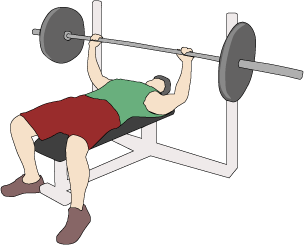
Procedure: The athlete lifts 70-80% of his body weight (determined using the table in the calculator above). The repetitions are performed in time with the metronome, set at a rate of 25 per minute (set the metronome at 50 so that each click signals a movement either up or down). An appropriate and standardized warm up procedure should be followed. The athlete lies on his back on the bench and the bar is grasped with thumbs approximately at shoulder width apart. The buttocks must remain on the bench with the feet on the floor. The starting position of the bar is touching the chest at approximately the axillary line and the bar is pushed to full extension of the arms.
Understanding Your NHL Bench Press Test Results
Scoring: The number of consecutive repetitions completed before the athlete falls behind the cadence is recorded.
Results: The first year that this test was conducted, at the 2015 NHL Combine, the best result was 20 by Jesse Gabrielle (see more at NHL combine results).
Performance Standards for Hockey Players
Based on NHL Combine data and sports science research by Robert Wood, here are general performance categories for the 70-80% body weight cadence bench press test:
- Elite (18+ reps): NHL Combine top tier performance, exceptional upper body strength endurance
- Excellent (14-17 reps): Well above average for hockey players, strong muscular endurance
- Good (10-13 reps): Above average performance, solid strength endurance base
- Average (6-9 reps): Typical range for trained hockey players
- Below Average (1-5 reps): Indicates need for upper body endurance training
Why This Test Matters for Hockey Players
The NHL 70-80% bench press test specifically measures the ability to produce repeated upper body pushing force - a key requirement for checking, board battles, and shot blocking in ice hockey. Unlike the NFL's 225 lb max rep test, the NHL version normalizes for body weight, making it fairer for different position types from smaller forwards to larger defensemen.
The 25 rep/min cadence requirement adds a metabolic component, testing not just muscular strength but also the ability to maintain force production under fatigue - critical for shift performance in competitive hockey.
Test Variations and Related Assessments
Variations: The NBA and NFL combines use a bench press test where the athletes bench as many times as they can at a set bar weight, irrespective of body weight. There is a similar bench press test which uses 75% of body weight (at no set cadence).
Advantages: The required equipment is readily available in most gymnasiums, and the test is simple to perform. The weight normalization makes results comparable across different body types.
Disadvantages: This test should only be performed by those experienced at performing the bench press lift with good technique. Good technique will also enable the lifter to maximize their score.
Important Safety Considerations
- For safety, a spotter should stand at the head of the bench throughout the test.
- The test results of this test may be specific to the equipment used (height of bench, variations in weights), so it is best to use the same equipment for test-retest measures.
- Always perform an adequate warm-up: 5-10 reps at 50% of test weight, then 5 reps at 75% before attempting the test.
- Stop the test immediately if form breaks down or pain occurs.
How to Improve Your NHL Bench Press Test Score
To improve your performance on this relative strength endurance test, hockey players should focus on:
- Strength Base: Build maximum bench press strength to make the 70-80% load feel lighter
- Muscular Endurance: Include high-rep sets (15-20 reps) with 60-70% 1RM in training
- Cadence Practice: Train specifically at the 25 rep/min pace to develop proper rhythm
- Breathing Pattern: Develop consistent breathing - exhale on exertion (push), inhale on the descent
- Supporting Muscles: Strengthen triceps, anterior deltoids, and core stabilizers
Frequently Asked Questions
What weight should I use for the NHL bench press test?
The weight is predetermined by your body weight using the NHL chart. For example, athletes weighing 175-184 lbs use 145 lbs, while those 155-164 lbs use 130 lbs. Use the calculator above to find your exact test weight.
What is the cadence for the NHL bench press test?
The test is performed at 25 repetitions per minute. Set your metronome to 50 BPM so each click signals either the upward or downward phase of the movement. Each complete rep takes approximately 2.4 seconds.
What is a good score on the NHL bench press test?
At the 2015 NHL Combine, the best result was 20 reps by Jesse Gabrielle. Scores of 18+ are considered elite, 14-17 excellent, 10-13 good, and 6-9 average for trained hockey players.
Is the NHL still using this bench press test?
No, the NHL now uses a maximum power bench press test where athletes lift 50% of body weight as quickly as possible for three reps, measuring power output in watts/kg using a Gym Aware device.
How does this compare to the NFL bench press test?
The NFL uses a fixed 225 lbs regardless of body weight with no cadence requirement. The NHL test is more equitable as it adjusts for body size and tests muscular endurance through the set pace.
Can I use this test for other sports?
Yes, the relative bench press test protocol is applicable to any sport requiring upper body strength endurance. The 70-80% body weight loading and cadence make it suitable for comparing athletes across different weight classes.
How often should I test my bench press endurance?
For training monitoring, test every 4-6 weeks. This allows adequate time to see improvements while not interfering with regular training. Always use the same equipment and conditions for accurate comparisons.
References
- NHL Scouting Combine. (2015). "2015 NHL Scouting Combine Fitness Testing Summary." National Hockey League.
- Gledhill, N., & Jamnik, V. (2007). "Detailed Assessment Protocols for NHL Entry Draft Players." York University.
- Mayhew, J.L., et al. (1992). "Relative Muscular Endurance Performance as a Predictor of Bench Press Strength." Journal of Applied Sport Science Research, 6(4), 200-206.
- Brzycki, M. (1993). "Strength Testing—Predicting a One-Rep Max from Reps-to-Fatigue." Journal of Physical Education, Recreation & Dance, 64(1), 88-90.
- Burr, J.F., et al. (2008). "Relationship of Physical Fitness Test Results and Hockey Playing Potential." Journal of Strength and Conditioning Research, 22(5), 1535-1543.
- Montgomery, D.L. (2006). "Physiological Profile of Professional Hockey Players." Sports Medicine, 36(5), 399-418.
- Cox, M.H., et al. (1995). "Protocols for Exercise Testing of Ice Hockey Players." Journal of Strength and Conditioning Research, 9(4), 240-247.
The Test in Action
- This test was once used for the NHL combine
Similar Tests
- A similar bench press cadence test at the same rate
Related Pages
- Bench Press MP3 file for conducting this test
- More about Bench Press Fitness Testing
- About the NHL Combine test protocols
- Online push-up metronome
- See video examples of bench press testing in action.
- Bench press technique
- NBA pre-draft camp fitness tests, NHL combine testing and the NFL combine testing
 Any comments, suggestions, or corrections? Please let us know.