Maximum Bench Press Test Calculator
Quick Answer
This calculator estimates your one-rep maximum (1RM) bench press from the number of repetitions completed at a set weight. Enter your test weight and reps to get instant results with comparison to professional combine standards.
- NFL Combine: 225 lbs (102 kg) - Average 20-30 reps by position
- NBA Combine: 185 lbs (84 kg) - Record 27 reps (Jason Keep, 2003)
- Formula Accuracy: ±5 kg when using 10 reps or fewer
In a set weight maximum bench press test, the subject performs as many bench presses as they can at a particular weight. Tests such as this one are part of the NBA pre-draft camp fitness test and the NFL combine testing. See also the max bench press test at a set cadence, and many other bench press tests.
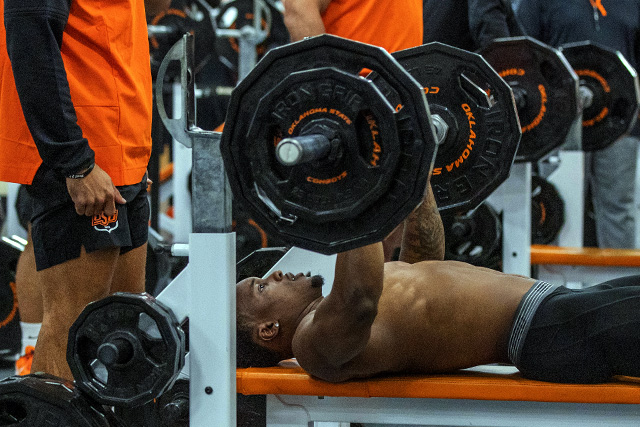
Max bench press fitness test at an American football combine
How to Use This Calculator
Follow these steps to calculate your estimated one-rep maximum from your bench press performance:
- Select Your Test Protocol: Choose from NFL Combine (225 lbs), NBA Combine (185 lbs), NHL Combine (150 lbs), or enter a custom weight.
- Enter Your Repetitions: Input the maximum number of complete reps you performed with proper form before failure.
- View Your Results: Get your estimated 1RM using both Epley and Brzycki formulas, plus training percentages and combine comparisons.
- Compare Performance: See how your results stack up against professional combine averages by position.
Pro Tip: For the most accurate 1RM prediction, use a weight that allows you to complete between 3-10 repetitions. Predictions become less reliable with higher rep counts above 10.
Test Purpose and Methodology
Test purpose: To measure maximum strength endurance of the chest muscle groups. The bench press repetition test assesses both absolute upper body strength and muscular endurance, making it valuable for evaluating athletes across multiple sports.
Equipment required: Bench with safety, standard Olympic bar, and various free weights up to 225 lbs.
Pre-test preparation: Explain the test procedures to the subject. Perform screening of health risks and obtain informed consent. Prepare forms and record basic information such as age, height, body weight, gender and test conditions. Check equipment for safety and calibrate weights if required. Perform a standard warm-up. See more details of pre-test procedures.
Standard Test Weights by Sport
| Organization | Test Weight | Average Reps | Record |
|---|---|---|---|
| NFL Combine | 225 lbs (102 kg) | 15-35 by position | 49 (Stephen Paea, 2011) |
| NBA Combine | 185 lbs (84 kg) | 8-15 | 27 (Jason Keep, 2003) |
| NHL Combine | 150 lbs (68 kg) | 10-20 | -- |
| SPARQ Football | 185 lbs (84 kg) | Variable | -- |
NFL Combine Averages by Position
The bench press performance at the NFL Combine varies significantly by position, reflecting the different physical demands across football:
| Position Group | Average Reps | Good Performance | Elite Performance |
|---|---|---|---|
| Offensive/Defensive Linemen | 30-39 | 35+ | 40+ |
| Tight Ends & Linebackers | 25-30 | 28+ | 32+ |
| Running Backs | 20-25 | 23+ | 28+ |
| Defensive Backs & Wide Receivers | 15-20 | 18+ | 22+ |
Test Procedure
Procedure: An appropriate warm up procedure should be followed. For the NBA combine protocol, the warm up involves 10 push-ups, then after 60 seconds rest, 5 reps at 135 pounds, then after another 90 seconds attempt 185lbs as many times as possible. The bar is set to the appropriate weight, depending on the group to be tested. The athlete begins by lying in a supine position on the bench, with their feet flat on the floor and the upper and lower back in contact with the bench at all times. The bar is grasped at approximately 6 inches wider than shoulder width apart, so that the elbows are at right angles at the lowest point. A complete successful lift is counted from the starting position of the arms fully extended with the weight directly above the chest, to the weight just touching the chest, then returned to the starting position. The movement of the bar should be at a controlled speed and with a smooth motion, and the weight should remain in line with your nipples. In the SPARQ rating system, for safety reasons, no bouncing off the chest is allowed. The testing ends as soon as the athlete is unable to complete a repetition. See Bench Press Video.
Scoring: The maximum number of full repetitions successfully completed is recorded.
The Science Behind 1RM Prediction
This calculator uses two of the most validated formulas for estimating one-repetition maximum from submaximal testing:
Epley Formula (1985)
1RM = Weight × (1 + Reps ÷ 30)
Developed by Boyd Epley, this linear formula is widely used in strength and conditioning. Research shows it's particularly accurate for repetitions between 1-10.
Brzycki Formula (1993)
1RM = Weight ÷ (1.0278 - 0.0278 × Reps)
Matt Brzycki's formula produces identical results to Epley at 10 reps but tends to give slightly lower estimates for fewer reps and higher estimates for more reps.
⚠️ Accuracy Note: Both formulas are most accurate when using 10 repetitions or fewer. For high-rep tests like the NFL Combine (often 20+ reps), these calculations become estimates and actual 1RM may vary. Research indicates predictions are typically within ±5 kg of actual 1RM for trained athletes using loads above 70% of 1RM.
Advantages and Limitations
Advantages: The required equipment is readily available in most gymnasiums, and the test is simple to perform. The repetition test is safer than true 1RM testing and can be completed more quickly.
Disadvantages: This test should only be performed by those experienced at performing the bench press lift with good technique. Good technique will also enable the lifter to maximize their score. If the weight is too light or too heavy, the results may not be a good indication of the participant's upper body strength, as the number of repetitions changes the involvement of the muscle energy systems.
Comments: For safety, a spotter should stand at the head of the bench throughout the test. The test results of this test may be specific to the equipment used (height of bench, variations in weights), so is best to use the same equipment for test-retest measures. If any variation in technique was allowed, this should be recorded on the results sheet for referral when the test is repeated.
Variations/modifications: The weight for this test can be varied depending on the fitness level and experience of the participants to be tested. A fairer test may be to use a set percentage of the participant's body weight, as in the relative bench press test. Another variation is to use a set cadence, such as in the bench press beep test.
How to Improve Your Bench Press Performance
Based on your calculated results, here are evidence-based strategies to improve your bench press strength and endurance:
For Strength (Higher 1RM)
- Progressive Overload: Gradually increase weight by 2.5-5 kg when you can complete your target reps with good form
- Compound Movements: Include overhead press, dips, and rowing exercises to build supporting muscle groups
- Rest Periods: Use 3-5 minute rest periods between heavy sets for maximal strength development
- Periodization: Cycle through phases of hypertrophy (8-12 reps), strength (3-6 reps), and power (1-3 reps)
For Endurance (Higher Rep Count)
- Rep Work: Train with weights at 60-70% of 1RM for sets of 12-20 reps
- Accessory Work: Build triceps endurance with dips, close-grip bench, and extensions
- Pacing: Practice consistent rep tempo and breathing patterns
- Drop Sets: Use descending weight sets to build muscular endurance
The Test in Action
- Tests such as this one are part of the NBA pre-draft camp fitness test and the NFL combine testing.
- This test was once part of the Football (Gridiron) SPARQ Rating
Disclaimer
Important: This calculator provides estimates for educational and training purposes only. Results should not replace professional assessment. Always use proper spotters when bench pressing, especially when testing near maximal weights. Consult with a qualified strength and conditioning professional before beginning any new training program.
Frequently Asked Questions
How many reps of 225 is good for the NFL Combine?
Performance varies by position. Linemen typically average 30-39 reps, tight ends and linebackers 25-30, running backs 20-25, and defensive backs/receivers 15-20. The all-time record is 49 reps by Stephen Paea (Oregon State) in 2011.
Why does the NBA use 185 lbs instead of 225 lbs?
Basketball players typically have different body compositions than football players, with less emphasis on absolute upper body strength. The 185 lb weight provides a more appropriate test that still differentiates strength levels while being achievable for taller, leaner athletes.
How accurate is the 1RM calculator?
Research shows these formulas are accurate within ±5 kg for trained athletes when using 10 reps or fewer. Accuracy decreases with higher rep counts. The calculator provides an average of two validated formulas for improved reliability.
Should I test my actual 1RM or use this calculator?
For most training purposes, the calculated 1RM is sufficient and safer. True 1RM testing carries higher injury risk and requires experienced spotters. Use calculator estimates for programming and only test actual 1RM when preparing for competition or after significant training cycles.
What if I can do more than 30 reps?
If you can complete more than 30 reps, the test is measuring muscular endurance more than maximal strength. Consider using a heavier weight for a more accurate 1RM prediction, or interpret the result as an endurance benchmark rather than a strength measure.
How often should I retest my bench press?
For tracking progress, retest every 4-8 weeks during a training program. Ensure consistent conditions including time of day, warm-up protocol, and equipment. For combine preparation, test monthly during training camp.
References
- Epley, B. (1985). "Poundage Chart." Boyd Epley Workout. Lincoln, NE: Body Enterprises.
- Brzycki, M. (1993). "Strength Testing—Predicting a One-Rep Max from Reps-to-Fatigue." Journal of Physical Education, Recreation & Dance, 64(1), 88-90.
- LeSuer, D.A., et al. (1997). "The Accuracy of Prediction Equations for Estimating 1-RM Performance in the Bench Press, Squat, and Deadlift." Journal of Strength and Conditioning Research, 11(4), 211-213.
- Mayhew, J.L., et al. (1995). "Relative Muscular Endurance Performance as a Predictor of Bench Press Strength in College Men and Women." Journal of Applied Sport Science Research, 6(4), 200-206.
- Chapman, P.P., et al. (1998). "The 225-lb Reps-to-Fatigue Test as a Submaximal Estimate of 1-RM Bench Press Performance in College Football Players." Journal of Strength and Conditioning Research, 12(4), 258-261.
- Reynolds, J.M., et al. (2006). "Prediction of One Repetition Maximum Strength from Multiple Repetition Maximum Testing and Anthropometry." Journal of Strength and Conditioning Research, 20(3), 584-592.
- Whisenant, M.J., et al. (2003). "Validation of Submaximal Prediction Equations for the 1 Repetition Maximum Bench Press Test on a Group of Collegiate Football Players." Journal of Strength and Conditioning Research, 17(2), 221-227.
Similar Tests
- Brockport Bench Press — the subject performs as many bench presses as possible using a 35lb (15.9kg) barbell.
- Relative bench press test — maximum number of bench presses using a % of body weight.
- Cadence Bench Press Test — the athlete lifts 70-80% of his body weight (pre-determined) utilizing free weights in time with the metronome (protocol as once used for the NHL combine).
- Another max bench press test at a set cadence.
Related Pages
- More about Bench Press Fitness Testing
- See video examples of bench press testing in action
- Bench press technique
- NBA pre-draft camp fitness tests, NHL combine testing and the NFL combine testing
 Any comments, suggestions, or corrections? Please let us know.