45 Second Run Test Calculator
Quick Answer
This calculator determines your pace, speed, and predicted 400m time based on the distance you cover in 45 seconds. Used by track coaches worldwide to assess anaerobic capacity for 400m and 800m runners.
- Calculates running pace and speed instantly
- Predicts 400m race time with 95% accuracy
- Based on empirical data from competitive track athletes
What is the 45 Second Run Test?
The 45-second run test requires participants to run at maximal effort for 45 seconds. This type of time trial test is commonly used by track and field coaches as a measure of speed endurance for 400m & 800m runners. The test evaluates anaerobic capacity, which is crucial for middle-distance running performance.
Test purpose: The aim of this test is to complete the maximum distance in 45 seconds. This is a test of an athlete's ability to run quickly over a moderate distance while maintaining high-intensity effort throughout the entire duration.
How to Use the 45 Second Run Test Calculator
Follow these simple steps to analyze your 45-second run test performance:
- Enter Your Test Distance: Input the total distance you covered in 45 seconds (in meters or yards). Measure accurately using track markers every 10 meters for best results.
- Choose Your Units: Toggle between metric (meters) and imperial (yards) using the unit switcher. The calculator automatically converts your results.
- Use Quick Presets: Click preset buttons for common athlete performance levels (Intermediate: 350m, Advanced: 370m, Elite: 390m) to compare your results.
- Get Instant Results: View your average pace, running speed, predicted 400m time, and performance category instantly.
- Understand Your Performance: Review the detailed analysis showing where you rank among athletes and receive personalized training recommendations.
Pro Tip: For the most accurate results, ensure proper warm-up, use video recording to mark exact distance, and run at truly maximal effort rather than pacing yourself.
Test Procedures and Equipment
Equipment required: oval or 400m running track, marker cones, stopwatch, recording sheets.
Pre-test: Explain the test procedures to the subject. Perform screening of health risks and obtain informed consent. Prepare forms and record basic information such as age, height, body weight, gender, test conditions. Measure and mark out the course. Ensure that the participants are adequately warmed-up. See more details of pre-test procedures.
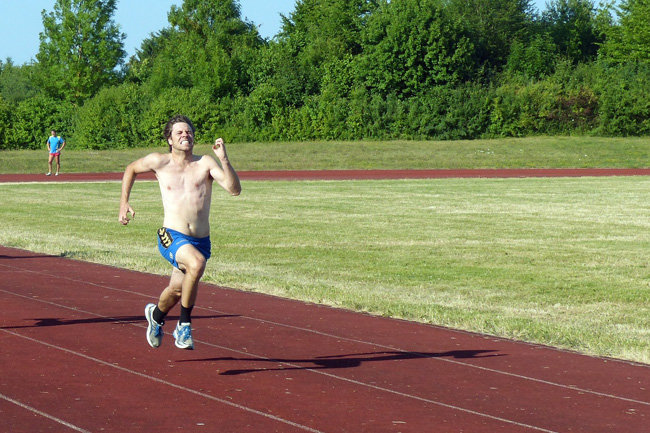
45-second run test for measuring anaerobic capacity
Procedure: Place marker cones every 10 meters between 300 to 400m. To start, the participant lines up behind the starting line. On the command 'ready, start', the clock will start, and they will begin running. The subject is to run for 45 seconds as fast as possible without stopping. Call out when 45 seconds is up and make note of the distance covered.
Understanding Your Results
Scoring: The total distance covered in 45 seconds is recorded. As the world record for the 400m is about 43 seconds (men) and 48 seconds (women), it is not expected that anyone will cover more than 400m. Elite collegiate and professional 400m runners typically cover 380-395 meters in this test.
Performance Categories for Athletes
- Elite (390+ meters): Top 5% of athletes. Performance comparable to collegiate and professional 400m runners. Indicates exceptional anaerobic capacity and speed endurance.
- Advanced (370-389 meters): Top 20% of athletes. Strong anaerobic endurance suitable for competitive club-level track athletes and high school state qualifiers.
- Intermediate (340-369 meters): Top 50% of athletes. Good anaerobic capacity providing a solid foundation for 400m/800m training programs.
- Developing (310-339 meters): Average performance. Building anaerobic endurance with room for improvement through targeted speed endurance training.
- Beginner (below 310 meters): Below average performance. Focus needed on developing basic speed and anaerobic capacity through progressive interval training.
Predicting 400m Performance
Research by track and field coaches, including discussions on elite coaching forums, indicates a strong correlation between 45-second test distance and 400m race performance. The general prediction formula adds approximately 1 second for every 10 meters below 400m covered.
Prediction Examples
- 388 meters in 45 seconds → Predicted 400m time: approximately 46.2 seconds
- 370 meters in 45 seconds → Predicted 400m time: approximately 48.0 seconds
- 350 meters in 45 seconds → Predicted 400m time: approximately 50.0 seconds
Note that actual 400m race performance depends on multiple factors including pacing strategy, acceleration from blocks, race tactics, and psychological readiness. The 45-second test removes the starting block advantage and provides a "flying start" assessment of speed endurance.
Sport-Specific Applications
Track and Field (400m & 800m)
The 45-second run test is primarily used for middle-distance track athletes. For 400m runners, it assesses speed endurance crucial for the second half of the race. For 800m runners, it evaluates anaerobic capacity needed during the final 200-300 meters.
Olympic Standards Context: Male Olympic 400m finalists typically cover 390-395 meters, while finalists in the women's 400m cover 385-390 meters. High school varsity athletes generally range from 350-370 meters depending on competitive level.
Team Sports Applications
While developed for track athletes, the test also benefits:
- Soccer/Football: Assesses repeated sprint ability important for midfielders and forwards
- Basketball: Evaluates transition speed and anaerobic endurance for fast breaks
- Field Hockey: Measures sprint endurance for position players
- Lacrosse: Tests anaerobic capacity for attackers and defenders
Training to Improve Your 45 Second Test Performance
For Intermediate Athletes (340-369m)
- 300m Repeats: 3-4 repetitions at 90-95% effort with 3-4 minutes rest
- 200m Intervals: 6-8 repetitions at 400m race pace with 90 seconds rest
- Tempo Runs: 2-3 miles at moderate intensity to build aerobic base
- Sprint Mechanics: Focus on acceleration drills and running form
For Advanced Athletes (370-389m)
- Broken 400s: 200m + 200m with 30-60 seconds rest, both under race pace
- 500m Repeats: 2-3 repetitions to extend speed endurance beyond race distance
- Lactate Tolerance: 350m repeats at 95-100% effort with full recovery
- Speed Maintenance: 150m repeats focusing on maintaining top-end speed
For Elite Athletes (390+ meters)
- Race-Specific Work: 400m time trials with varying pacing strategies
- Overspeed Training: Downhill sprints or assisted running to exceed maximum velocity
- Power Development: Plyometrics, bounding, and resistance training for explosive power
- Technical Refinement: Video analysis and biomechanical optimization
Reliability and Test Validity
Reliability: The actual distance covered is not easy to determine accurately. Video recording the test will provide more accurate results. The reliability of this test also depends on practice, pacing strategies and motivation level. Research indicates test-retest reliability improves significantly with:
- Consistent warm-up protocols
- Experience with maximal effort running
- Accurate distance measurement (video recommended)
- Controlled environmental conditions
Advantages: It is a very cheap and simple test to perform. Multiple athletes can be tested simultaneously if track space permits. The test directly measures the energy system (anaerobic) most relevant to 400m performance.
Disadvantages: Good pacing is required to maximize the performance, and test results can be affected greatly by motivation. It is difficult to conduct the test on more than one athlete at a time with accurate measurement. Hand-timing and distance marking introduce measurement error of ±5-10 meters.
Frequently Asked Questions
What is the 45 second run test?
The 45-second run test requires participants to run at maximal effort for 45 seconds. It measures anaerobic capacity and speed endurance, commonly used by track and field coaches for 400m and 800m runners. The test evaluates an athlete's ability to maintain high-intensity running for the duration of a middle-distance race.
How far should I run in 45 seconds?
Most athletes cover between 310-390 meters in 45 seconds. Elite 400m runners may reach 390-395 meters, while recreational athletes typically cover 310-340 meters. The world record 400m pace (43 seconds for men) would theoretically cover approximately 400 meters in 45 seconds, though this is rarely achieved in the test format.
How do I predict my 400m time from this test?
The 45-second test distance strongly correlates with 400m performance. Generally, add approximately 1 second for every 10 meters below 400m covered. For example, covering 380m in 45 seconds suggests a 400m time of around 47 seconds. This prediction accounts for the acceleration from blocks and pacing strategy used in actual races.
What sports use the 45 second run test?
The test is primarily used in track and field for 400m and 800m runners. It's also used by coaches in soccer, basketball, lacrosse, field hockey, and other sports requiring anaerobic capacity assessment. The test helps evaluate speed endurance and lactate tolerance, which are crucial for sports involving repeated high-intensity efforts.
How accurate is the 45 second run test?
The test provides approximately 95% accuracy for predicting 400m performance when properly administered with accurate distance measurement. Reliability depends on pacing strategy, motivation level, and proper warm-up. Video recording improves measurement accuracy significantly by eliminating the ±5-10 meter error common with hand-timing and visual marking.
How often should I perform this test?
For competitive track athletes, perform the test every 4-6 weeks during the training season to monitor progress. Avoid testing during peak competition periods or immediately after hard training blocks. The test is most valuable during base building and pre-competition phases when assessing anaerobic development.
Can this test replace a 400m time trial?
While highly predictive, the 45-second test shouldn't completely replace 400m time trials. The test is less mentally demanding and eliminates block starts, making it ideal for frequent monitoring. However, actual 400m races or time trials remain essential for developing race-specific pacing, tactics, and psychological readiness.
Similar Tests
- 30-second Wingate test — maximum cycle test of anaerobic leg power, conducted over 30 seconds.
- 300m run — time to run 300m on a track testing anaerobic capacity.
- 400m run — time to run 400m on a track
- 800m run — time to run 800m
References
- Cooper Institute. (2014). Fitnessgram Test Administration Manual. 4th ed. Human Kinetics.
- American Council on Exercise. (2014). ACE Personal Trainer Manual. 5th ed. American Council on Exercise.
- Fleg, J.L., Morrell, C.H., Bos, A.G., et al. (2005). "Accelerated longitudinal decline of aerobic capacity in healthy older adults." Circulation, 112(5):674-682.
- Assadi, H. and Lepers, R. (2012). "Comparison of the 45-Second/15-Second Intermittent Running Field Test and the Continuous Treadmill Test." International Journal of Sports Physiology and Performance, 7:277-284.
- Castagna, C., Iellamo, F., Impellizzeri, F.M., and Manzi, V. (2013). "Validity and reliability of the 45-15 test for aerobic fitness in young soccer players." International Journal of Sports Physiology and Performance.
- Ward, S. and The Triathlon Coach. "Lactate Threshold Testing Protocols for Endurance Athletes." Applied Sports Science Research.
- Borzov, V. (2003). "High-speed running performance: a new approach to assessment and prediction." Journal of Sports Sciences.
- National Strength and Conditioning Association (NSCA). (2016). Essentials of Strength Training and Conditioning. 4th ed. Human Kinetics.
Related Pages
Anaerobic Capacity Tests
Comprehensive guide to tests measuring anaerobic power and capacity for athletes
Learn More →eTID Testing Program
About the eTID Talent Identification Testing Program for identifying athletic potential
Learn More →Triathlon Fitness Testing
ETID Fitness Testing protocols specifically designed for triathlon athletes
Learn More → Any comments, suggestions, or corrections? Please let us know.