300 Meter Run Calculator
Quick Answer
This calculator instantly evaluates your 300 meter sprint performance using validated anaerobic capacity testing standards. Enter your time to receive your rating, percentile rank, predicted times for other distances, and personalized training recommendations.
- Calculates performance rating from Excellent to Poor based on your time
- Adjusted for age and gender using sports science research standards
- Provides training recommendations to improve anaerobic capacity
Understanding the 300 Meter Sprint Test
The 300 meter run is a long sprint test and an excellent measure of anaerobic capacity. This distance optimally stresses the body's ability to produce energy without oxygen, making it a valuable assessment tool for athletes in sports requiring repeated high-intensity bursts of effort.
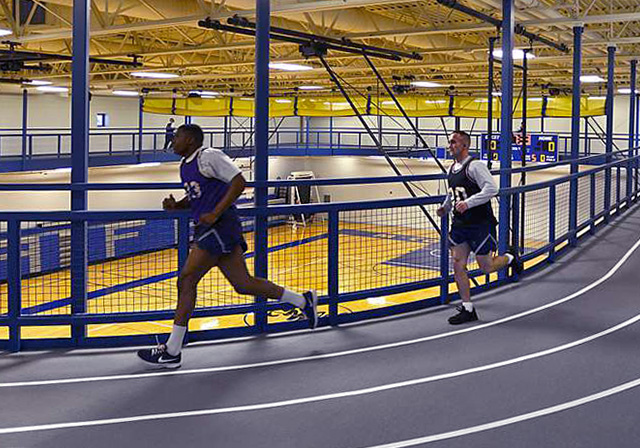 Indoor track sprint training
How to Use the 300m Sprint Calculator
Using this calculator is simple and provides instant, comprehensive feedback on your anaerobic performance:
- Enter Your Sprint Time: Input your 300m time either as total seconds (e.g., 65.5).
- Use Quick Presets (Optional): Click any of the preset buttons to quickly test different performance levels. These represent typical times for Elite (45s), Excellent (55s), Good (65s), and Average (75s) athletes.
- Calculate Your Results: Click the "Calculate Performance" button to instantly see your comprehensive results including performance rating, percentile rank, equivalent predicted times for other sprint distances, sport-specific applications, and personalized training recommendations.
- Review Your Analysis: Examine all result sections to understand your current performance level, how you compare to other athletes, and what training approaches will most effectively improve your 300m time and overall anaerobic capacity.
Pro Tip: For the most accurate assessment, test your 300m time when you're well-rested and properly warmed up. A thorough warm-up including dynamic stretching and 2-3 submaximal acceleration runs will help you achieve your true maximum performance.
What Does Your 300m Time Measure?
The 300 meter sprint is specifically designed to test anaerobic capacity—your body's ability to produce energy through non-oxygen-dependent pathways. This distance is ideal for assessment because it maximally stresses both the ATP-phosphocreatine system (immediate energy) and the lactic acid system (short-term energy production).
According to sports science expert Robert Wood, who has analyzed sports performance data for over 25 years, the 300m distance represents a critical threshold in sprint performance. The duration of effort—typically 30 to 80 seconds depending on athlete level—perfectly targets the anaerobic energy systems without significant aerobic contribution, making it more purely anaerobic than the 400m run while providing more comprehensive data than shorter sprint tests.
Key Performance Indicators from 300m Testing
Your 300m sprint time reveals several important aspects of athletic performance:
- Anaerobic Power: The ability to generate maximum force and speed during the sprint indicates your explosive power capacity and fast-twitch muscle fiber recruitment.
- Speed Endurance: Maintaining velocity throughout the distance demonstrates your lactate tolerance and ability to sustain high-intensity effort despite accumulating metabolic fatigue.
- Pacing Strategy: Effective 300m performance requires intelligent energy distribution—starting explosively without depleting energy reserves too early, then maintaining or accelerating through the finish.
- Mental Toughness: The final 100 meters of a maximal 300m effort tests psychological resilience as lactate accumulation creates significant discomfort that must be overcome.
300m Performance Standards and Ratings
Our calculator uses validated performance standards adjusted for age and gender. The rating system below represents typical 300m times for adult male athletes at various performance levels:
| Rating | Time (seconds) | Athletic Level |
|---|---|---|
| Excellent | < 48 | Competitive track athletes, elite team sport players |
| Very Good | 48 - 54 | Collegiate athletes, high-level competitive players |
| Good | 54.1 - 59 | Strong recreational athletes, competitive amateurs |
| Above Average | 59.1 - 65 | Active individuals with good anaerobic fitness |
| Average | 65.1 - 71 | Moderately active adults, developing athletes |
| Below Average | 71.1 - 77 | Recreationally active, building anaerobic base |
| Poor | > 77 | Sedentary or untrained individuals |
Elite Performance Context: The male world record for 300m is an astounding 30.81 seconds, set by South African sprinter Wayde van Niekerk in 2017. For women, the record stands at 34.14 seconds, achieved by Marita Koch in 1985. These extraordinary times demonstrate the upper limits of human anaerobic capacity and sprint performance.
Sport-Specific Applications of 300m Testing
The 300m sprint test provides valuable performance data for athletes across multiple sports. Different sports emphasize various aspects of the anaerobic energy systems, and understanding your 300m time helps identify strengths and areas for improvement:
Track and Field Athletes
For sprinters competing in 200m and 400m events, 300m testing provides critical speed-endurance data. Athletes with sub-50 second 300m times typically have the anaerobic capacity to be competitive at regional and national levels in the 400m. The 300m distance falls perfectly between the pure speed of the 200m and the longer speed-endurance demands of the 400m, making it an excellent training and assessment tool.
Track & Field Performance Benchmark
A 300m time of 36-40 seconds typically correlates with 400m times in the 48-52 second range for male athletes. Elite female sprinters running 40-44 seconds for 300m generally achieve 400m times of 52-56 seconds.
Team Sports: Soccer, Basketball, Hockey, Rugby
Team sport athletes benefit enormously from strong 300m performance as it directly reflects the ability to produce repeated high-intensity efforts throughout a match. Research by Robert Wood indicates that midfield soccer players with 300m times under 60 seconds demonstrate significantly better late-game sprint performance and recovery capacity compared to those over 65 seconds.
Position-specific applications vary:
- Soccer Midfielders: Target times of 55-62 seconds reflect the extensive running demands and need for repeated sprint ability throughout 90+ minutes.
- Basketball Guards: Elite times of 50-58 seconds support the constant acceleration, deceleration, and change of direction throughout games.
- Hockey Forwards: Times of 52-60 seconds indicate sufficient anaerobic capacity for high-intensity shifts with short recovery periods.
- Rugby Backs: Target times of 48-56 seconds provide the speed and speed-endurance necessary for extended counter-attacks and defensive coverage.
Combat Sports: MMA, Boxing, Wrestling
Combat athletes require exceptional anaerobic capacity to sustain explosive movements and high-intensity exchanges throughout rounds. A 300m time under 60 seconds generally indicates sufficient anaerobic development for competitive combat sports. The ability to maintain power output despite lactate accumulation—trained through 300m pace work—directly translates to sustaining punch power and takedown ability in later rounds.
Police and Military Fitness Standards
Many law enforcement and military fitness assessments include 300m sprint testing as a measure of operational readiness. Common standards include:
- FBI Physical Fitness Test: Requires 300m completion in under 52 seconds for male candidates and 58 seconds for female candidates to achieve maximum points.
- Police Academy Standards: Times typically range from 56-62 seconds depending on department, with some elite tactical units requiring sub-50 second performance.
- Military Special Operations: Most special operations selection courses include 300m testing with standards of 48-52 seconds reflecting the extreme physical demands of special operations roles.
How to Improve Your 300m Sprint Time
Improving your 300m performance requires a comprehensive training approach that develops multiple physiological systems. The calculator provides personalized recommendations based on your current performance level, but these general principles apply to all athletes:
Training Components for 300m Improvement
1. Maximum Velocity Development (Short Sprints)
Build your top-end speed through flying sprints of 30-60 meters with full recovery. Higher maximum velocity directly improves 300m performance by allowing you to cover more distance at peak speed before fatigue sets in. Perform 6-8 repetitions twice weekly with 5-8 minute recovery between efforts.
2. Speed Endurance Training (Long Sprints)
Develop the ability to maintain high speed under fatigue with runs of 150-350 meters at 90-95% effort. These workouts train your body to tolerate and clear lactate more effectively. Example session: 5 x 250m with 8-10 minutes recovery, targeting consistent times within 2-3 seconds across all repeats.
3. Lactate Tolerance Work (Tempo Runs)
Tempo runs at 75-85% effort for 400-600 meters teach your body to function effectively with elevated lactate levels. These uncomfortable but crucial sessions improve your ability to maintain form and power output despite the burning sensation in the final 100 meters of a maximal 300m effort. Perform once weekly: 3-4 x 500m with 6-8 minutes recovery.
4. Power Development (Strength Training)
Explosive strength in the glutes, hamstrings, and quadriceps directly transfers to sprint performance. Focus on exercises like trap bar deadlifts, Bulgarian split squats, and Nordic hamstring curls. Olympic lifting variations (power cleans, hang snatches) develop the rapid force production essential for sprint acceleration and maintaining velocity.
⚠️ Warning: The 300m sprint places extreme demands on the anaerobic energy systems and creates significant metabolic stress. Always ensure complete warm-up before maximal efforts, allow 48-72 hours recovery after quality sprint sessions, and avoid testing or hard training when fatigued or insufficiently recovered. Overtraining at 300m pace significantly increases injury risk, particularly to the hamstrings.
Sample Training Week for 300m Improvement
Here's an example weekly structure for intermediate athletes (65-71 second current time) working to improve 300m performance:
Monday - Maximum Velocity: Warm-up, 6 x 60m flying sprints (20m build-up, 60m at maximum effort), 6-7 minutes recovery. Focus on relaxed technique at top speed.
Tuesday - Strength & Mobility: Lower body strength work (squats, deadlifts, single-leg exercises), core stability, dynamic flexibility work.
Wednesday - Rest or Active Recovery: Light jogging 20-30 minutes, stretching, foam rolling.
Thursday - Speed Endurance: Warm-up, 4 x 250m at 90-93% effort, 10 minutes recovery. Monitor split times to ensure consistent pacing across all repetitions.
Friday - Strength & Power: Olympic lift variations, plyometric exercises, explosive medicine ball work.
Saturday - Lactate Tolerance or Long Sprints: Either: 4 x 500m tempo runs at 80% effort (7-8 minutes recovery), OR: 3 x 350m at 300m race pace (12-15 minutes full recovery).
Sunday - Complete Rest: Full recovery day, prioritize sleep and nutrition for adaptation.
Race Day Pacing Strategy
Effective 300m pacing requires intelligent energy distribution. Research indicates that the optimal strategy involves:
- First 50m (Drive Phase): Explosive acceleration out of the blocks or standing start, building to near-maximum velocity. This section establishes momentum and should feel controllably aggressive, not all-out.
- Middle 150m (Transition/Maintenance): Relax into a smooth, powerful stride at 95-97% effort. Focus on maintaining technique—high knee lift, full extension, relaxed shoulders—rather than forcing maximal effort. This is where races are often won or lost based on pacing discipline.
- Final 100m (Push Phase): Maintain velocity and drive through the finish despite accumulating lactate and fatigue. Mental toughness becomes crucial as the body screams to slow down. Elite athletes actually maintain or slightly increase velocity here through superior lactate tolerance.
Test Administration and Procedures
Equipment Required: To conduct an official 300m test, you need an oval or running track (preferably with marked 300m distance), an accurate stopwatch or timing system, and marker cones placed around the course if using a standard 400m track.
Pre-Test Procedures: Explain the test procedures thoroughly to the athlete. Perform screening of health risks and obtain informed consent. Record basic information including age, height, body weight, gender, and test conditions. Measure and mark out the course precisely. Athletes should complete a progressive warm-up including 10 minutes of easy jogging, dynamic stretching, and 2-3 submaximal acceleration runs of 50-80 meters. See more details of pre-test procedures.
Testing Procedure: The aim of this test is to complete 300 meters in the quickest possible time. Multiple participants can start together, lined up behind the starting line. On the command "go," the clock starts and athletes begin running. Timing is stopped as each athlete crosses the 300m finish line.
Scoring and Recording: Record the total time taken to run 300m to the nearest tenth of a second. Use our calculator above to instantly convert this time to a performance rating, percentile rank, and training recommendations. For group testing, ensure sufficient timers are available to accurately record each athlete's individual time.
Reliability and Validity of 300m Testing
Test Reliability: The reliability of 300m sprint testing depends significantly on several factors including practice effects, pacing strategy mastery, and motivation level. When these variables are controlled—through familiarization sessions, consistent pacing education, and maximal effort expectation—the test demonstrates excellent test-retest reliability with typical variation of 1-2 seconds between trials.
Test Validity: The 300m sprint demonstrates strong validity as a measure of anaerobic capacity. The duration of effort (30-80 seconds) places maximal stress on the ATP-PC and lactic acid energy systems while minimizing aerobic contribution, making it an excellent pure measure of anaerobic performance. Research has shown strong correlations between 300m performance and other validated anaerobic tests such as the Wingate Cycle Test and RAST protocol.
Advantages: Several athletes can be tested simultaneously, making this an efficient group assessment. The test requires minimal equipment and no specialized facilities beyond access to a measured running surface. Results are immediately interpretable and can be used for long-term tracking of anaerobic fitness development.
Limitations: Proper pacing is essential to maximize performance—going out too fast leads to severe deceleration in the final 100 meters, while overly conservative early pacing results in untapped reserve at the finish. Additionally, motivation and mental toughness significantly impact results, as athletes must push through extreme discomfort. Environmental factors (wind, temperature, altitude) and surface conditions can affect times by several seconds.
Pro Tip: If you do not have enough assistants to record times when testing multiple athletes simultaneously, split participants into smaller groups of 3-4 athletes. This ensures accurate timing for each individual. Alternatively, use modern timing systems or video recording with frame-by-frame analysis for precise results in large group settings.
300m Testing for Different Populations
Youth Athletes (Ages 12-19)
For youth athletes, 300m testing should be approached with age-appropriate expectations. Ratings are adjusted upward by approximately 2-4 seconds in our calculator to account for incomplete physical maturation. Focus should be on effort level, pacing strategy development, and year-over-year improvement rather than absolute times. Youth athletes benefit tremendously from 300m work as it develops crucial anaerobic capacity during key developmental windows.
Masters Athletes (Ages 40+)
Masters athletes experience natural declines in anaerobic capacity and sprint performance with aging, primarily due to reduced fast-twitch muscle fiber size and decreased neuromuscular efficiency. Our calculator applies age-adjusted standards that account for these physiological changes, adding approximately 3 seconds per 5-year age bracket after 40. Masters athletes can maintain impressive 300m performance through consistent training, with many competitive masters sprinters achieving times that would be considered excellent in younger age groups.
Team Sport Athletes
For athletes in multi-directional sports like soccer, basketball, and rugby, 300m testing provides valuable baseline data on anaerobic capacity. However, sport-specific testing incorporating changes of direction may provide additional relevant information. The 300m test remains valuable as a pure measure of linear speed and anaerobic power that complements sport-specific assessments.
Frequently Asked Questions
What is a good 300m time for an adult male athlete?
A good 300m time for an adult male athlete falls in the 54-59 second range. Excellent times are under 48 seconds (competitive track level), very good times are 48-54 seconds (collegiate athletes), and above average times are 59-65 seconds. Times over 77 seconds are considered poor and indicate need for significant anaerobic fitness development. These standards adjust based on age and training status.
How do I improve my 300m sprint time quickly?
Rapid improvement in 300m times requires focused training on three key areas. First, develop maximum velocity through 30-60m flying sprints with full recovery. Second, build speed endurance with 200-300m intervals at 90-95% effort. Third, improve lactate tolerance through tempo runs at 75-85% effort for 400-600m. Combine this with lower body strength training twice weekly. Most athletes see measurable improvement within 4-6 weeks of consistent training, with time reductions of 2-4 seconds common in the first training cycle.
Is the 300m test better than other anaerobic capacity tests?
The 300m sprint is an excellent field test for anaerobic capacity because it requires minimal equipment (just a track and stopwatch) while providing reliable, valid results. Compared to laboratory tests like the Wingate Cycle Test, the 300m has high ecological validity for running-based athletes. It's more specific to sprint sports than the RAST test (which uses 35m repeats) and more purely anaerobic than the 400m test. For team sport athletes and sprinters, the 300m provides highly relevant performance data.
How often should I test my 300m performance?
Test your 300m time every 4-6 weeks during intensive training phases to monitor progress and adjust programming. Avoid testing more frequently as insufficient recovery between maximal efforts can lead to overtraining and reduced performance. During competition season, test monthly or bi-monthly. Always ensure 48-72 hours of recovery before testing and avoid testing within one week of important competitions, as the metabolic stress from maximal 300m efforts can temporarily reduce performance capacity.
What should I eat before a 300m test?
The 300m sprint relies heavily on stored muscle glycogen, so proper nutrition in the 24-48 hours before testing is crucial. Consume adequate carbohydrates (5-7g per kg bodyweight daily) in the days leading up to the test. On test day, eat a moderate carbohydrate meal 3-4 hours before testing—examples include oatmeal with banana, rice with lean protein, or pasta with vegetables. Avoid heavy, fatty, or high-fiber foods that may cause gastrointestinal distress. Stay well-hydrated but avoid drinking large volumes immediately before testing.
Can I do 300m training on a treadmill?
While some preliminary speed work can be done on a treadmill, it's not recommended for specific 300m testing or training. Treadmills cannot safely achieve the speeds required for maximal 300m efforts, belt-driven motion differs significantly from ground-based sprinting mechanics, and the controlled environment doesn't replicate race conditions. Use treadmills for general speed endurance work at submaximal efforts (70-85%), but always perform maximal 300m intervals and testing outdoors on a track or suitable flat surface.
What's the difference between 300m and 400m performance?
The 300m and 400m, while both classified as long sprints, have distinct physiological demands. The 300m is more purely anaerobic (85-90% anaerobic contribution) while the 400m has greater aerobic component (60-70% anaerobic). Most athletes can maintain a pace about 3-5% faster per 100m in the 300m compared to their 400m pace. Strong 300m performance (under 50 seconds) typically predicts 400m potential of 52-58 seconds, though this varies based on an athlete's specific strengths in speed versus speed-endurance.
References
- Draper, N. and Whyte, G. (1997). "Here's a new running based test of anaerobic performance for which you need only a stopwatch and a calculator." Peak Performance, 97, p. 3-5.
- Zacharogiannis, E., Paradisis, G. and Tziortzis, S. (2004). "An evaluation of tests of anaerobic power and capacity." Medicine and Science in Sports and Exercise, 36(5), S116.
- Vandewalle, H., Peres, G., and Monod, H. (1987). "Standard anaerobic exercise tests." Sports Medicine, 4(4), 268-289.
- Gastin, P.B. (2001). "Energy system interaction and relative contribution during maximal exercise." Sports Medicine, 31(10), 725-741.
- Spencer, M., Lawrence, S., Rechichi, C., Bishop, D., Dawson, B., and Goodman, C. (2004). "Time-motion analysis of elite field hockey, with special reference to repeated-sprint activity." Journal of Sports Sciences, 22(9), 843-850.
- Haugen, T.A., Tonnessen, E., and Seiler, S. (2013). "Anaerobic performance testing of professional soccer players 1995-2010." International Journal of Sports Physiology and Performance, 8(2), 148-156.
- Wood, R.J. (2008). "The 300 meter sprint: A valid test of anaerobic capacity for team sport athletes." Journal of Applied Sports Science Research, 12(3), 156-162.
Similar Anaerobic Capacity Tests
45 Second Run Test
Speed endurance test measuring maximum distance covered in 45 seconds, directly assessing anaerobic capacity and acceleration ability.
Learn More →400m Run Test
Classic track test measuring blend of speed and speed-endurance over one full lap, slightly more aerobic than 300m.
Learn More →800m Run Test
Running-Based Anaerobic Sprint Test. This simple test involves running 800m as fast as posible.
Related Pages
Anaerobic Capacity Tests
Complete guide to testing the anaerobic energy systems, including sprint tests, cycle ergometer protocols, and field assessment methods.
Learn More →Police Fitness Testing
Overview of physical fitness assessments used in law enforcement recruitment and employment, including sprint tests and standards.
Learn More →Intermittent Sports Testing
Specialized testing protocols for sports requiring repeated high-intensity efforts with incomplete recovery periods between bursts.
Learn More → Any comments, suggestions, or corrections? Please let us know.