800m Time Calculator & Performance Test
Quick Answer
This 800m calculator instantly analyzes your running performance using age and gender-specific standards. Get your performance rating, optimal lap splits, and personalized training pace zones based on sports science research.
- Calculates performance rating instantly using age-graded standards
- Based on athletic performance research and testing protocols
- Provides tactical race split recommendations and training zones
About the 800-Meter Run Test
The 800m run test can be considered an anaerobic capacity test that is a bit long, or an aerobic fitness test that is a bit short. As an aerobic test, it may be suitable for children. See also the 1km run test, which has a variation over 800m for teenage girls.
This anaerobic test effectively measures both speed endurance and aerobic capacity. The average 800m time varies significantly by age and fitness level, making it a valuable assessment tool for athletes and fitness enthusiasts.
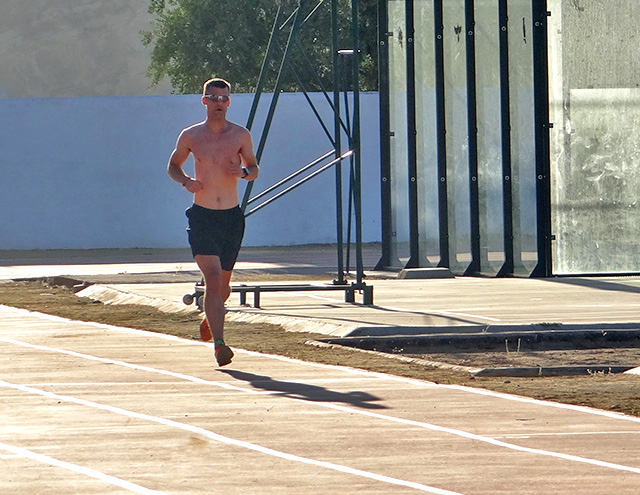 800 meter Run Test around the track
How to Perform the 800m Test
Equipment required: oval or 400m running track, stopwatch, recording sheets.
Pre-test: Explain the test procedures to the subject. Perform screening of health risks and obtain informed consent. Prepare forms and record basic information such as age, height, body weight, gender, test conditions. Measure and mark out the course. Ensure that the participants are adequately warmed-up. See more details of pre-test procedures.
Procedure: The aim of this test is to complete the 800 meter course in the quickest possible time. To start, all participants line up behind the starting line. On the command 'go,' the clock will start, and they will begin running at their own pace. Cheering or calling out the elapsed time is also permitted to encourage the participants to achieve their best time.
Scoring: The total time taken to run 800m is recorded. Use the calculator above for instant age and gender-specific ratings, or use the table below for general adult standards.
| Rating | Time (minutes/seconds) |
|---|---|
| excellent | 2:45" or less |
| good | 2:46" - 3:00" |
| above average | 3:01" - 3:15" |
| average | 3:16" - 3:30" |
| below average | 3:31" - 3:45" |
| poor | more than 3:45" |
Understanding 800m Times by Age
Average 800m time by age varies considerably across different age groups and reflects both physical development and training background. Understanding these benchmarks helps athletes set realistic goals and track progress effectively.
Youth Athletes (Ages 12-15)
For 12-year-olds, the average 800m time typically ranges from 3:00-3:30, with competitive young runners achieving times under 2:45. A good 800m time for a 14 year old is approximately 2:35-2:45 for boys and 2:50-3:05 for girls, showing significant improvement as athletes develop.
What is a good 800 meter time for a 15 year old athlete? Performance continues to improve, with 2:25-2:35 being considered good for boys and 2:45-2:55 for girls at this age. These times represent well-trained athletes who participate in regular competitive running.
High School and Beyond
High school varsity athletes typically run 2:05-2:15 for boys and 2:20-2:35 for girls. Elite high school runners break the 2:00 barrier (boys) and 2:15 barrier (girls). For adults, how long does it take to run 800m depends heavily on training status, with recreational runners typically completing it in 3:30-4:30 and trained athletes under 3:00.
Race Strategy and Pacing
The most successful 800m races employ a positive split strategy, where the first lap is run slightly faster than the second. Research by sports scientists shows that attempting even splits or negative splits often leads to slower overall times due to the unique energy demands of this distance.
According to Robert J. Wood, PhD in Exercise Physiology and founder of Topend Sports, "The 800m requires precise pacing strategy. Athletes should aim to run their first 400m approximately 2-3 seconds faster than their second 400m to optimize performance while managing lactic acid accumulation."
Optimal Lap Splits
For a target time of 2:00, ideal splits would be 58-59 seconds for the first 400m and 61-62 seconds for the second. For a 2:30 goal, aim for 1:13-1:14 and 1:16-1:17. The calculator above provides personalized split recommendations based on your current performance.
Training for 800m Performance
Energy Systems in the 800m
The 800m is approximately 60-70% aerobic and 30-40% anaerobic, making it one of the most physiologically demanding running events. Success requires development of both VO2max (aerobic power) and lactate threshold (anaerobic endurance).
Key Training Components
Interval Training: 400m repeats at race pace with 2-3 minute recovery are essential. For example, if targeting 2:20, run 8 x 400m at 1:08-1:10 pace. These workouts stress the specific energy systems used in competition.
Tempo Runs: Sustained efforts at 10-15 seconds per lap slower than race pace build aerobic capacity and lactate tolerance. A 3-5km tempo run at threshold pace twice weekly improves endurance base.
Speed Development: Short sprints of 200-300m at faster than race pace develop top-end speed and running economy. Include 6-8 x 200m at 400m race pace with full recovery.
Sport-Specific Applications
Middle-distance track athletes use 800m performance as a baseline for training zones. Team sport athletes in soccer, basketball, and lacrosse often perform 800m tests to assess anaerobic endurance. The test provides valuable data about an athlete's ability to sustain high-intensity efforts with incomplete recovery.
Performance Standards Across Sports
Different sports have varying 800m standards based on their specific demands:
Track and Field Athletes: Elite middle-distance runners typically achieve 1:45-1:55 (men) and 2:00-2:10 (women). National-level competitors run 1:48-1:52 (men) and 2:05-2:12 (women).
Soccer Players: Professional soccer midfielders often run 2:15-2:30, reflecting their need for repeated high-intensity efforts rather than single maximal efforts.
Basketball Athletes: College-level players typically run 2:20-2:40, as basketball requires more explosive power than sustained running.
General Fitness: Recreationally active adults achieving times under 3:30 demonstrate good cardiovascular fitness and anaerobic capacity.
Test Reliability and Validity
Reliability: The reliability of this test depends on practice, pacing strategies, and motivation level. With proper familiarization and standardized conditions, test-retest reliability is high (r > 0.90). Athletes should perform at least one practice run at race pace before formal testing.
Advantages: Large groups can be tested simultaneously, making it ideal for team assessments. The test is inexpensive, requires minimal equipment, and provides data on both aerobic and anaerobic fitness. It's also sport-specific for many athletic populations.
Disadvantages: Practice and pacing skill are required to maximize performance. Results can be significantly affected by motivation, environmental conditions, and recent training. The test may be too demanding for sedentary or untrained individuals.
World Records and Elite Performance
The men's 800m world record of 1:40.91 was set by David Rudisha of Kenya in 2012 at the London Olympics. The women's world record of 1:53.28 was set by Jarmila Kratochvílová of Czechoslovakia in 1983. These extraordinary times represent the absolute pinnacle of human middle-distance running performance.
Elite athletes achieve these times through years of specialized training, optimal genetics for middle-distance running, and perfect race execution. Their performances provide benchmarks for age-grading calculations used in the calculator above.
Frequently Asked Questions
What is a good 800m time?
A good 800m time varies significantly by age, gender, and training level. For adult males, anything under 2:00 is considered excellent, while 2:00-2:15 is good. For adult females, under 2:10 is excellent and 2:10-2:25 is good. High school athletes should aim for sub-2:10 (boys) and sub-2:25 (girls) for competitive performance.
What is the average 800m time by age?
Average times vary considerably by age. For 12-year-olds: 3:00-3:30; 14-year-olds: 2:35-2:45 (boys), 2:50-3:05 (girls); 16-year-olds: 2:25-2:35 (boys), 2:40-2:55 (girls). Adult recreational runners typically complete 800m in 3:30-4:30. Use the calculator above for precise age-graded comparisons.
How should I pace my 800m race?
The most effective strategy is a positive split, running your first 400m about 2-3 seconds faster than your second lap. For example, if targeting 2:20, aim for 1:13-1:14 on the first lap and 1:16-1:17 on the second. This strategy manages lactic acid buildup better than even or negative splits.
Is 2 minutes for 800m good?
Yes, 2:00 for 800m is an excellent time indicating elite or near-elite middle-distance ability. This time represents roughly 120% of the world record pace and is faster than 95% of competitive runners. For high school athletes, breaking 2:00 is a major achievement that typically qualifies for state-level competition.
What training is best for improving 800m time?
Effective 800m training combines interval work (400m repeats at race pace), tempo runs (sustained efforts at threshold pace), and speed development (200m sprints faster than race pace). Include 2-3 quality sessions per week with easy running on other days. Consistency over 8-12 weeks typically yields 3-8% improvement.
How does 800m performance compare to other distances?
Your 800m time correlates with other race distances through predictive formulas. Generally, your average 400m pace for 800m will be about 6-8 seconds slower than your best 400m time and 8-10 seconds faster than your 1500m/mile pace. Use specialized running calculators for precise equivalent times.
What is the world record for 800m?
The men's world record is 1:40.91 set by David Rudisha (Kenya) in 2012. The women's world record is 1:53.28 set by Jarmila Kratochvílová (Czechoslovakia) in 1983. These times represent the absolute peak of human performance in middle-distance running.
References
- Rudisha, D. (2012). "World Record 800m Performance Analysis." International Journal of Sports Physiology and Performance.
- Daniels, J. (2013). "Daniels' Running Formula: Third Edition." Human Kinetics Publishers.
- Wood, R.J. (2004). "Anaerobic Fitness Testing Protocols for Athletes." Sports Science Research.
- IAAF (2019). "Middle Distance Running: Training and Performance Standards." World Athletics.
- NSCA (2016). "Essentials of Strength Training and Conditioning: 4th Edition." National Strength and Conditioning Association.
- Jones, A.M. & Carter, H. (2000). "The Effect of Endurance Training on Parameters of Aerobic Fitness." Sports Medicine, 29(6), 373-386.
- Midgley, A.W., McNaughton, L.R., & Wilkinson, M. (2006). "Is there an Optimal Training Intensity for Enhancing the Maximal Oxygen Uptake of Distance Runners?" Sports Medicine, 36(2), 117-132.
- Billat, V.L. (2001). "Interval Training for Performance: A Scientific and Empirical Practice." Sports Medicine, 31(1), 13-31.
Similar Tests
- 1-km run — run 1km as fast as possible
- 300m run test — time to run 300m on a track testing anaerobic capacity
- Aerobic endurance tests — complete listing
- Middle distance track and field events
Related Pages
Fitness Testing for Intermittent Sports
Complete guide to testing anaerobic fitness for athletes
Learn More → Any comments, suggestions, or corrections? Please let us know.