400 Meter Run Test Calculator
Quick Answer
This calculator analyzes your 400m run time using scientific split distributions to determine your pace, speed, and athletic performance level. Results help athletes track progress and optimize training.
- Calculates 100m splits based on research (25.4%, 23.3%, 24.4%, 26.9%)
- Provides performance classification from Beginner to Elite
- Generates training pace recommendations for intervals
The 400m run test requires the participants to run at maximal effort over 400m. This test was part of the eTID Talent Identification Testing Program for triathlon, and their protocol is listed here. This test has been used for triathletes as a measure of kick speed and anaerobic capacity.
Understanding the 400m Run Test
Test purpose: The aim of this test is to complete 400 meters in the quickest possible time. This is a test of an athlete's ability to combine speed and speed endurance, primarily measuring anaerobic capacity. Research indicates that elite 400m performance requires approximately 76-77% anaerobic energy contribution, making it one of the most demanding tests of anaerobic power.
Equipment required: oval or 400m running track, stopwatch, recording sheets.
Pre-test: Explain the test procedures to the subject. Perform screening of health risks and obtain informed consent. Prepare forms and record basic information such as age, height, body weight, gender, test conditions. Measure and mark out the course. Ensure that the participants are adequately warmed-up. See more details of pre-test procedures.
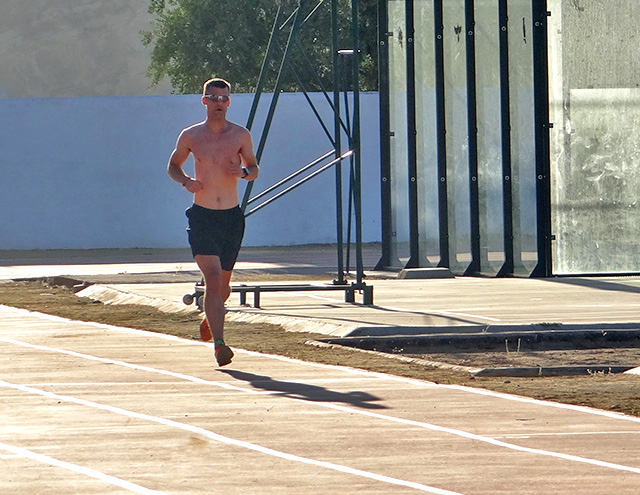 400 meter Run Test around the track
Procedure: To start, all participants line up behind the starting line. On the command 'ready, start', the clock will start, and they will begin running. The subject is to run the 400m route as fast as possible without stopping. Stop the stopwatch when the subject crosses the 400m finish line.
Scoring: The total time taken to run 400m is recorded, to the nearest second.
Understanding Your 400m Performance
The 400 meter dash is unique among track events, requiring a careful balance of explosive speed and sustained velocity. Unlike shorter sprints where maximum speed is the only goal, the 400m demands strategic energy management throughout the race.
According to sports science research by Robert Wood, MSc Sports Science, founder of TopEndSports, optimal 400m pacing follows a specific pattern. The first 100m accounts for approximately 25.4% of total time, followed by the fastest segment (23.3%) in the second 100m, then 24.4% for the third 100m, with the final 100m typically the slowest at 26.9% due to fatigue and lactic acid accumulation.
Performance Standards by Age and Gender
Performance expectations vary significantly by age and gender. For male athletes aged 18-35, elite times fall under 47 seconds, advanced times range from 47-55 seconds, intermediate from 55-70 seconds, and beginner times above 70 seconds. Female athletes in the same age range show elite times under 50 seconds, advanced 50-60 seconds, intermediate 60-75 seconds, and beginner above 75 seconds.
Peak 400m performance typically occurs in the early to mid-20s for both genders. Men can generally maintain top speed until about age 30, while women often sustain peak performance until 35. After these ages, times gradually increase by 6-8 seconds per decade, though proper training can significantly slow this decline.
Sport-Specific Applications
Track and Field Athletes
For competitive 400m specialists, the test serves as a primary performance indicator. Elite male sprinters target times under 45 seconds for national-level competition, with world-class times under 44 seconds. The current men's world record stands at 43.03 seconds, set by Wayde van Niekerk of South Africa in 2016. Women's elite times fall under 50 seconds, with the world record of 47.60 seconds set by Marita Koch in 1985.
Team Sport Athletes
The 400m test is valuable for soccer, basketball, and hockey players as it measures repeated sprint ability and recovery capacity. Times under 60 seconds for males and 70 seconds for females indicate excellent anaerobic fitness for field sports. Position players who cover more ground typically perform better than those in stationary positions.
Triathlon and Endurance Athletes
For triathletes, as used in the eTID testing program, the 400m run provides insight into kick speed and anaerobic reserve. While primarily aerobic athletes, triathletes benefit from strong anaerobic capacity for race surges and sprint finishes. Target times for competitive triathletes typically range from 55-75 seconds depending on discipline focus.
Using Calculator Results for Training
The split times provided by the calculator help athletes identify pacing weaknesses. If your first 100m is significantly slower than 25% of your total time, you may be starting too conservatively. Conversely, if your final 100m exceeds 27% of total time, you're likely going out too fast and suffering excessive fatigue.
Training pace recommendations are based on your current performance. Interval training at 95% of your 400m pace for 300m repeats builds speed endurance, while 200m repeats at 90% of 400m pace develop pure speed. Include adequate recovery between repetitions to maintain quality.
How to Improve Your 400m Time
Improvement strategies should address both speed and speed endurance components. Incorporate short sprints of 60-150m at maximum effort to develop top-end speed, combined with longer intervals of 300-600m at controlled speeds to build anaerobic capacity and lactate tolerance.
Strength training plays a crucial role in 400m performance. Focus on compound movements like squats, deadlifts, and lunges to build leg power. Plyometric exercises including box jumps, bounding, and sprint drills enhance explosive strength and running economy. Research indicates that two strength sessions per week provide optimal benefits without compromising running volume.
Reliability: The reliability of this test depends on practice, pacing strategies and motivation level. There should be good reliability if these issues are addressed.
Advantages: Several participants can be tested at once, and it is a very cheap and simple test to perform. The calculator provides immediate feedback on performance level and training zones.
Disadvantages: Good pacing is required to maximize performance, and test results can be affected greatly by motivation and environmental conditions such as wind and temperature.
Notes:
- If not using a 400m running track, determine the appropriate route over a 200m out and back course to account for changes in wind.
- The runners may finish very close to each other in this test. If you do not have enough assistants to record the times or a stopwatch that can record split times, you may wish to separate the participants into smaller groups.
- For most accurate split predictions, use the calculator which applies research-based percentages to your actual time.
- Environmental factors including temperature, humidity, altitude, and wind significantly impact performance.
Frequently Asked Questions
What is a good 400m time for an athlete?
A good 400m time depends on your age, gender, and training level. For male athletes, anything under 50 seconds is considered good, with elite performances under 47 seconds. Female athletes show good times under 55 seconds, with elite performances under 50 seconds. Beginner athletes typically run 70-90 seconds for males and 75-100 seconds for females.
How do you pace a 400m run?
Optimal 400m pacing involves starting strong but controlled, accelerating through the second 100m (typically the fastest segment), maintaining speed in the third 100m, and fighting fatigue in the final 100m. Research shows the ideal split distribution is approximately 25.4%, 23.3%, 24.4%, and 26.9% of your total time for each 100m segment respectively.
What energy systems does the 400m use?
The 400m run relies primarily on anaerobic metabolism, with research indicating approximately 76-77% anaerobic energy contribution for elite athletes. The remaining 23-24% comes from aerobic energy systems. This makes the 400m one of the most demanding anaerobic tests in athletics, requiring specific training to build lactate tolerance.
How often should I test my 400m time?
Test your 400m time every 4-6 weeks during your training cycle to monitor progress without causing excessive fatigue. More frequent testing can interfere with training adaptations, while less frequent testing makes it difficult to adjust your program. Always ensure adequate recovery (48-72 hours) before testing for accurate results.
What is the difference between 400m for sprinters vs endurance athletes?
Pure sprinters typically run faster 400m times (45-55 seconds) due to superior speed and power development, but may struggle with repeated efforts. Endurance athletes run slower single efforts (55-75 seconds) but recover more quickly and can maintain performance in repeat tests. The calculator helps both types identify their strengths and training needs.
How does age affect 400m performance?
Peak 400m performance occurs in the early to mid-20s. After age 30 for men and 35 for women, times gradually increase by approximately 6-8 seconds per decade. However, masters athletes can achieve impressive times through consistent training, proper technique, and smart race strategy. Age-graded calculators help compare performances across different age groups.
What training improves 400m time most effectively?
The most effective 400m training combines speed work (60-150m sprints), speed endurance intervals (200-300m repeats), and longer tempo runs (600-800m). Strength training twice weekly focusing on explosive power also provides significant benefits. The key is balancing anaerobic capacity development with adequate recovery.
The Test in Action
- This test was part of the eTID Talent Identification Testing Program for triathlon
- Used by track and field coaches worldwide to assess anaerobic capacity
- Common fitness test for team sports requiring repeated sprint ability
Similar Tests
- 300m run — time to run 300m on a track testing anaerobic capacity.
- 45 Second Run — speed endurance measuring maximum distance covered in 45 seconds.
- 800m Run Test — time to run 800m
References
- Aftalion, A., & Martinon, P. (2024). Modelling the optimization of world-class 400m and 1,500m running performances using high-resolution data. Frontiers in Sports and Active Living.
- Van Niekerk, W. (2016). 400m World Record Performance. Rio Olympics.
- World Athletics. (2023). 400 Metres Event Standards and Records. World Athletics Official Documentation.
- Jones, A. (2025). Age-Grading Tables for Track and Field. WMA Masters Athletics Standards.
- Wood, R. (2004-2025). Sports Testing Protocols and Standards. TopEndSports Fitness Testing Database.
Related Pages
Anaerobic Capacity Tests
Explore other tests measuring anaerobic fitness including sprint tests and power assessments.
View Tests →eTID Testing Program
Learn about the complete eTID Talent Identification Testing Program for triathlon.
Learn More →Triathlon Fitness Testing
Complete fitness testing protocols specifically designed for triathlon athletes.
View Protocol → Any comments, suggestions, or corrections? Please let us know.