Wingate Test Calculator
Quick Answer
This calculator determines your anaerobic power and capacity using the Wingate test protocol. Enter your body weight and test revolutions to get instant results for peak power, mean power, and relative power values.
- Calculates peak and mean power instantly using standardized formulas
- Based on the Wingate Institute protocol validated for athletes
- Includes unit conversion and sport-specific resistance recommendations
About the Wingate Test
The Wingate test is a cycle test of anaerobic leg power, conducted over 30 seconds. The test is also known as the Wingate Anaerobic Test (WANT), and was developed at the Wingate Institute in Israel during the 1970's.
Test purpose: the aim of this test is to measure the anaerobic power of the lower body.
Equipment required: Fleisch or a modified Monark cycle ergometer.
Pre-test: Explain the test procedures to the subject. Perform screening of health risks and obtain informed consent. Prepare forms and record basic information such as age, height, body weight, gender, test conditions. Check and calibrate the ergometer. Adjust seat and handlebar height. Perform an appropriate warm-up. See more details of pre-test procedures.
Procedure: The subject should first perform a cycling warm up of several minutes. The subject is instructed to pedal as fast as possible for 30 seconds. In the first few seconds, the resistance load is adjusted to the pre-determined level, which is usually about 45 g/kg body weight (Fleisch) or 75 g/kg body weight (Monark) for adults. The NHL pre-draft testing uses 90 g/kg. Power athletes would generally use high resistances, while children and older athletes may use lower. See Wingate Video.
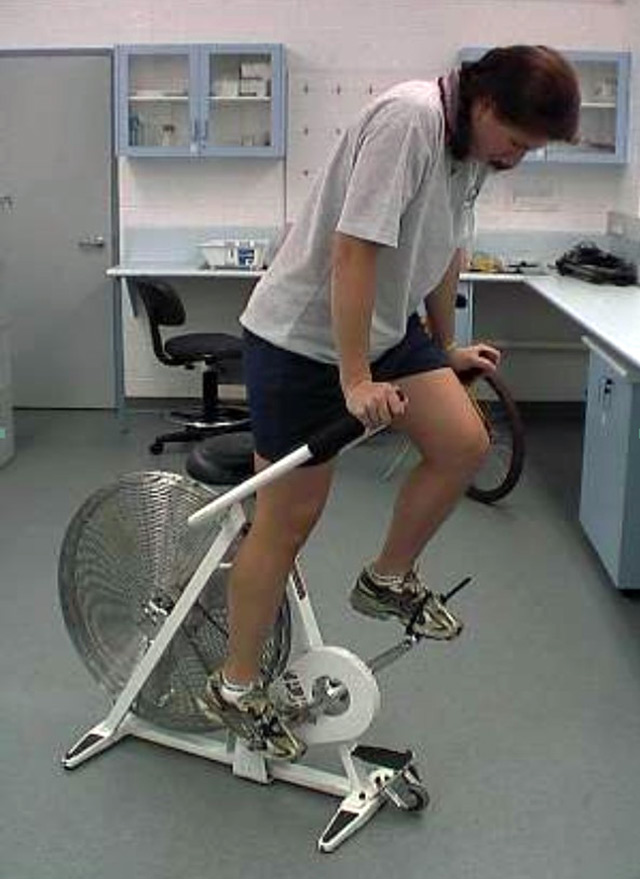
cycle ergometer test
Scoring: Some of the measures that can be gained from this test are mean and peak power (ideally measured in first five second interval of the test, expressed in Watts), relative peak power (determined by dividing peak power by body mass, expressed as W/kg) mean peak power, minimum peak power, and a fatigue index determined from the decline in power.
Formula:
Power Output (kpm•min-1) = [ revs x resistance (kg) x dist (m) x 60 (sec) ] / time (sec)
Watts = kpm•min-1 / 6.123
Watts/kg = Watts / body weight (kg)
Fatigue Index = [ (Peak Power Output - Min Power Output) / Peak Power Output ] x 100
Variations: an arm ergometer can also be used to measure upper body anaerobic power.
How to Use the Wingate Test Calculator
Follow these simple steps to calculate your anaerobic power results:
- Enter Your Body Weight: Input your weight in kilograms or pounds. The calculator includes a unit toggle for easy conversion between metric and imperial measurements.
- Select Athlete Type: Choose your athlete category to automatically calculate the appropriate resistance. Standard testing uses 7.5% of body weight, while power athletes may use up to 9.8%.
- Record Total Revolutions: Enter the total number of flywheel revolutions completed during your 30-second maximal effort test.
- Calculate Results: Click the calculate button to instantly receive your peak power, mean power, relative power values, and performance category.
Pro Tip: For accurate body composition tracking, perform the test at the same time of day, ideally in the morning before intense training, and ensure you are well-hydrated.
Understanding Your Wingate Test Results
Peak Power (PP)
Peak power represents the highest power output achieved during the test, typically occurring within the first 5 seconds. This measurement indicates the capacity of your ATP-PCr (phosphocreatine) energy system, which provides immediate energy for explosive movements. Elite male athletes typically achieve relative peak power values above 11 W/kg, while elite female athletes score above 9 W/kg. This metric is crucial for sprint cyclists, track athletes, and any sport requiring maximal short-duration efforts.
Mean Power (MP)
Mean power reflects the average power output maintained throughout the entire 30-second test. This value indicates your anaerobic capacity and the effectiveness of your glycolytic energy system. Athletes with higher mean power values can sustain intense efforts longer. Research by sports scientists at the Wingate Institute shows that mean power correlates strongly with performance in events lasting 30-120 seconds, such as 400m running or 1km cycling time trials.
Relative Power (W/kg)
Relative power normalizes your absolute power by dividing it by body weight, allowing fair comparisons between athletes of different sizes. This metric is particularly important in weight-class sports and activities where you must move your own body mass. A lightweight cyclist with 8 W/kg relative peak power may perform similarly to a heavyweight with 9 W/kg in climbing scenarios despite lower absolute wattage.
Fatigue Index (FI)
The fatigue index measures the percentage decline in power from peak to minimum during the test. Lower values indicate superior anaerobic endurance and better ability to maintain high power outputs. Values below 35% are considered excellent, showing minimal power drop-off. Athletes with high fatigue indices should focus on anaerobic endurance training, including repeated sprint intervals and tempo work at threshold intensities.
Sport-Specific Wingate Test Applications
Cycling Performance
The Wingate test is most commonly used in cycling, particularly for track sprint events. Research compiled by Robert Wood, founder of Topend Sports, indicates that elite track sprinters achieve peak power values exceeding 1400W for males and 900W for females. Road cyclists typically score lower in absolute power but higher in fatigue resistance. The test helps coaches identify an athlete's optimal gear selection and sprint strategy for competition scenarios.
Sprint Running
While primarily a cycling test, Wingate results correlate with sprint running performance. Athletes competing in 100m, 200m, and 400m events benefit from high peak power and low fatigue indices. Improvements in Wingate scores often predict corresponding improvements in sprint times, particularly for 200m and 400m distances where anaerobic capacity is critical.
Team Sports Applications
Hockey, basketball, soccer, and other team sports involve repeated high-intensity efforts with incomplete recovery. The data shows that successful team sport athletes typically maintain mean power values within 15-20% of their peak power, indicating strong anaerobic endurance. Hockey players at elite levels often achieve fatigue indices below 40%, allowing them to maintain explosive speed throughout multiple shifts.
Combat Sports
Wrestling, judo, boxing, and MMA fighters use Wingate testing to assess their ability to generate and sustain high power outputs during matches. Research by Robert J. Wood, PhD in Exercise Physiology from the University of Western Australia, notes that combat athletes require balanced development of both peak power for explosive techniques and anaerobic capacity for sustained exchanges. Optimal relative peak power for male wrestlers typically ranges from 9-12 W/kg depending on weight class.
Rowing Performance
While rowing-specific ergometer tests exist, Wingate testing provides valuable insight into leg power contribution during the drive phase. Rowers with higher Wingate scores often demonstrate superior boat acceleration and sprint finishes. Elite rowers typically achieve relative peak power values of 10-13 W/kg for males and 8-10 W/kg for females, with low fatigue indices indicating excellent anaerobic endurance for 2000m racing.
Normative Data and Performance Standards
Normative data for the Wingate test varies significantly by sport, gender, and training status. Here are general guidelines for relative peak power (W/kg) in male athletes:
- Elite (Top 5%): Above 11.0 W/kg - Olympic and world-class athletes
- Excellent (Top 20%): 9.0-11.0 W/kg - National-level competitors
- Good (Top 40%): 7.5-9.0 W/kg - Competitive club athletes
- Average (40-70%): 6.0-7.5 W/kg - Recreational trained athletes
- Below Average (Below 70%): Under 6.0 W/kg - Untrained or beginning athletes
Female athletes typically score 15-25% lower than males due to physiological differences in muscle mass and power production. Elite female athletes achieve relative peak power values above 9 W/kg, while recreational female athletes average 5-7 W/kg.
Training to Improve Wingate Test Scores
For Improving Peak Power
To increase peak power output, focus on maximal strength development and rate of force development. As Robert Wood, founder of Topend Sports, recommends in his training analysis, incorporate heavy resistance training (85-95% 1RM) for major lower body exercises including squats, deadlifts, and leg press. Combine this with explosive plyometric work such as box jumps, broad jumps, and depth drops. Sprint intervals of 6-10 seconds at maximum intensity with full recovery (3-5 minutes) directly target the ATP-PCr system.
For Improving Mean Power
Anaerobic capacity training requires longer high-intensity intervals. Intervals of 20-60 seconds at 90-100% maximum effort, with work-to-rest ratios of 1:3 to 1:5, effectively improve mean power. Perform 4-8 repetitions per session, 2-3 times weekly. Hill sprints, resisted sprints, and repeat cycling efforts at race pace all develop the glycolytic system responsible for sustained power output.
Periodization Recommendations
Lower fatigue indices require enhanced anaerobic endurance and improved lactate tolerance. Effective protocols include repeated sprint training with progressively shorter recovery periods. Start with 10-second sprints and 50-second recovery, gradually reducing rest to 30 seconds while maintaining intensity. Tempo work at 80-85% maximum intensity for 2-4 minutes also improves the body's ability to clear lactate and maintain power output.
Frequently Asked Questions
What is a good Wingate test score for athletes?
For male athletes, relative peak power above 11 W/kg is elite level, 9-11 W/kg is excellent, 7.5-9 W/kg is good, and 6-7.5 W/kg is average for trained athletes. Female athletes typically score 15-25% lower. Scores vary significantly by sport, with track sprinters achieving higher values than endurance athletes.
How do you calculate Wingate test peak power?
Peak power is calculated as Force (resistance in kg) × Distance (revolutions × 6 meters per revolution for Monark ergometer) / Time (5 seconds). The result in kgm/min is divided by 6.123 to convert to watts. Relative peak power divides this by body mass in kg to give W/kg, allowing comparison between athletes of different sizes.
What resistance should I use for the Wingate test?
Standard resistance is 7.5% of body weight (0.075 kg per kg body weight), which works well for most recreational athletes. Power athletes and sprinters may use 9-10% body weight for more representative results. NHL pre-draft testing uses 9% body weight. The optimal resistance produces the highest peak power output for your fitness level.
How accurate is the Wingate test for athletes?
The Wingate test has been repeatedly validated as a reliable predictor of anaerobic power and capacity. When performed with proper protocol and consistent resistance, test-retest reliability exceeds 95% for peak and mean power measurements. Accuracy is approximately ±3-5% for trained athletes when proper warm-up and motivation protocols are followed.
What sports benefit most from Wingate testing?
Track cycling, sprint running (100m-400m), speed skating, hockey, basketball, soccer, wrestling, judo, and rowing benefit significantly from Wingate testing. Any sport requiring short bursts of maximal power or repeated high-intensity efforts with incomplete recovery can use this test to assess and monitor anaerobic performance capacity.
Should I test in the morning or afternoon?
Research shows that circadian rhythms significantly affect Wingate test performance. Late afternoon or early evening tests typically produce 5-10% higher peak power values compared to early morning tests. For consistency when tracking progress, always test at the same time of day, ideally 3-5 hours after waking when body temperature and neural drive are optimized.
References
- Bar-Or, O. (1987). "The Wingate Anaerobic Test: An Update on Methodology, Reliability and Validity." Sports Medicine, 4(6), 381-394.
- Inbar, O., Bar-Or, O., & Skinner, J.S. (1996). The Wingate Anaerobic Test. Champaign, IL: Human Kinetics.
- Ayalon, A., Inbar, O., & Bar-Or, O. (1974). "Relationships among Measurements of Explosive Strength and Anaerobic Power." International Series on Sport Sciences, 1, 527-532.
- Beneke, R., Pollmann, C., Bleif, I., Leithäuser, R., & Hütler, M. (2002). "How Anaerobic is the Wingate Anaerobic Test for Humans?" European Journal of Applied Physiology, 87(4-5), 388-392.
- Vandewalle, H., Pérès, G., & Monod, H. (1987). "Standard Anaerobic Exercise Tests." Sports Medicine, 4(4), 268-289.
- Zajac, A., Jarzabek, R., & Waskiewicz, Z. (1999). "The Diagnostic Value of the 10- and 30-Second Wingate Test for Competitive Athletes." Journal of Strength and Conditioning Research, 13(1), 16-19.
- Maud, P.J., & Shultz, B.B. (1989). "Norms for the Wingate Anaerobic Test with Comparison to Another Similar Test." Research Quarterly for Exercise and Sport, 60(2), 144-151.
- Zupan, M.F., Arata, A.W., Dawson, L.H., Wile, A.L., Payn, T.L., & Hannon, M.E. (2009). "Wingate Anaerobic Test Peak Power and Anaerobic Capacity Classifications for Men and Women Intercollegiate Athletes." Journal of Strength and Conditioning Research, 23(9), 2598-2604.
Related Pages
Anaerobic Capacity Tests
See the complete list of anaerobic capacity tests for leg power assessment, including the RAST test as a running alternative.
Learn More →Cycling Fitness Tests
Comprehensive guide to fitness testing for cyclists, including power output and endurance assessments.
Learn More →Cycle Ergometers
Information about cycle ergometer equipment for testing, including Monark and Fleisch models.
Learn More →Intermittent Sports Testing
Learn about fitness testing protocols for sports requiring repeated high-intensity efforts.
Learn More → Any comments, suggestions, or corrections? Please let us know.