Balke Treadmill Test Calculator
Quick Answer
This calculator estimates your VO2max (maximal oxygen uptake) from Balke Treadmill Test results using validated Pollock formulas. Ideal for cardiac rehabilitation and athletic performance assessment.
- Calculates VO2max from test completion time
- Uses gender-specific Pollock equations (1976, 1982)
- Provides sport-specific fitness comparisons and training advice
About the Balke Treadmill Test
The Balke Treadmill Test was developed as a clinical test to determine peak VO2 in cardiac patients, though it can also be used to estimate cardiovascular fitness in athletes. The test involves walking on a treadmill to exhaustion, at a constant walking speed while gradient/slope is increased every one or two minutes. Note that there is also the field test also developed by Balke: 15 minute run test, and the Balke Step Test.
Test Specifications
Purpose: To determine peak VO2, particularly in cardiac patients, and estimate cardiovascular fitness in athletes.
Equipment required: treadmill, stopwatch, electrocardiograph (optional)
Pre-test: Explain the test procedures to the subject. Perform screening of health risks and obtain informed consent. Prepare forms and record basic information such as age, height, body weight, gender, test conditions. Measure out course and place marker cones. Perform an appropriate warm-up. See more details of pre-test procedures.
Test Procedure
Procedure: The athlete walks on a treadmill to exhaustion, at a constant walking speed while gradient/slope is increased every one or two minutes. The assistant starts the stopwatch at the beginning of the test and stops it when the subject is unable to continue. There are several modification or variation of the Balke test that are used, with variations in the treadmill speed, time at each level and/or increase in gradient. Here are examples of test protocols that have been used:
- For men, the treadmill speed is set at 3.3 mph, with the gradient starting at 0%. After 1 minute it is raised to 2%, then 1% each minute thereafter.
- For women, the treadmill speed is set at 3.0 mph, with the gradient starting at 0%, and increased by 2.5% every three minutes.
- Alternative protocol: Walking speed constant at 3 km/hr whilst the grade was increased by 2.5 percent every two minutes.
Understanding Your Results
Results: The test score is the time taken on the test, in minutes. Ideally this should be between 9-15 minutes. The test time can also be converted to an estimated VO2max score using the following formulas where the value "T" is the total time completed (expressed in minutes and fractions of a minute e.g. 9 minutes 15 seconds = 9.25 minutes):
For men: VO2max = 1.444 (T) + 14.99 [Pollock et al., 1976]
For women: VO2max = 1.38 (T) + 5.22 [Pollock et al., 1982]
⚠️ Note: These formulas are only applicable if the same protocol is used as when they were developed. Test duration should ideally be between 9-15 minutes for accurate predictions.
VO2max Standards for Athletes
Different sports require varying levels of aerobic capacity. Here's how your VO2max compares to athletes in various disciplines:
Elite Endurance
70-85 ml/kg/min: Cross-country skiers, professional cyclists, elite distance runners
Competitive Endurance
60-70 ml/kg/min: Elite soccer players, competitive runners, serious triathletes
Team Sports
50-60 ml/kg/min: Basketball, hockey, recreational endurance athletes
General Fitness
40-50 ml/kg/min: Recreational athletes, regular exercisers, team sport participants
Training to Improve Your VO2max
Based on research in exercise physiology, your training approach should match your current fitness level:
For Below Average Fitness (VO2max < 40)
- Start with 20-30 minutes of low-intensity continuous exercise 3-4 times per week
- Activities: Walking, easy cycling, swimming at comfortable pace
- Target heart rate: 60-70% of maximum (220 minus your age)
- Focus on building an aerobic base before adding intensity
- Progress gradually: increase duration by 5-10% per week
For Average to Good Fitness (VO2max 40-52)
- Include 3-4 moderate-intensity sessions per week of 30-45 minutes
- Add 1-2 interval training sessions: 4-6 × 3-5 minutes at 85-90% max heart rate
- One long steady session weekly at 70-75% max heart rate
- Allow 48 hours recovery between hard sessions
- Mix activities to prevent overuse injuries
For Very Good to Excellent Fitness (VO2max > 52)
- Implement periodized training with base, build, and peak phases
- High-intensity intervals: 3-8 × 3-5 minutes at 90-95% max heart rate
- Tempo runs at lactate threshold (80-85% max heart rate) for 20-40 minutes
- Long aerobic sessions maintaining conversation pace
- Monitor training load to prevent overtraining syndrome
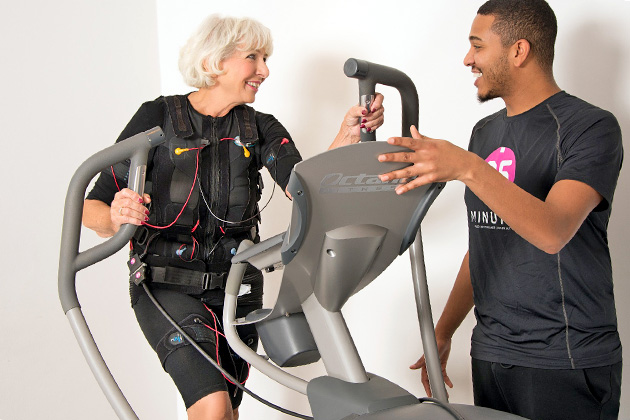
Exercise stress testing on treadmill with medical supervision
Target Population
Target population: The Balke test is recommended for cardiac patients since the elevation in workload is moderate and therefore considered safe even for patients with severe left ventricular dysfunction. The gradual increase in intensity makes it suitable for clinical populations under medical supervision.
Advantages and Disadvantages
Advantages: You can also get a measurement of maximum heart rate by recording heart rate during the test, which can be used in training programs to set workload intensity. The moderate intensity progression makes it safer for cardiac patients compared to more aggressive protocols like the Bruce test.
Disadvantages: It takes a relatively long time to set up and conduct this test, compared to some other aerobic tests, and there are high costs involved in terms of equipment and time. The test requires access to a motorized treadmill and ideally should be conducted under medical supervision for at-risk populations.
⚠️ Caution: This test is a maximal test. If used with recreational athletes or people with health problems, injuries or low fitness levels, please have medical assistance on hand. The test should be terminated if the subject experiences chest pain, dizziness, extreme fatigue, or requests to stop.
Comparison to Other Treadmill Protocols
The Balke protocol differs from other common treadmill tests in its approach to workload progression:
- Bruce Protocol: More aggressive with both speed and grade increasing every 3 minutes. Widely used but may be too strenuous for cardiac patients.
- Balke Protocol: Constant speed with gradual grade increases. Better tolerated by cardiac patients and provides similar VO2max estimates.
- Naughton Protocol: Even more gradual than Balke, designed for severely deconditioned patients. Increases are smaller and occur every 2 minutes.
- Modified Balke: Some variations adjust speed or gradient changes based on the individual's initial fitness level.
Sport-Specific Applications
Endurance Sports (Running, Cycling, Swimming)
For endurance athletes, VO2max is a primary determinant of performance. Elite marathoners typically have VO2max values of 65-85 ml/kg/min. The Balke test provides valuable baseline data for monitoring training adaptations. Athletes should retest every 8-12 weeks during training cycles to track improvements and adjust training intensity zones.
Team Sports (Soccer, Basketball, Hockey)
Team sport athletes require good aerobic capacity to support repeated high-intensity efforts during competition. Target VO2max values typically range from 50-60 ml/kg/min. The Balke test can be used during pre-season assessment to identify athletes who need additional conditioning work and to establish individualized training heart rate zones.
Cardiac Rehabilitation
The Balke protocol is specifically designed for cardiac patients due to its moderate intensity progression. It allows healthcare providers to safely assess cardiovascular function and exercise capacity. Results guide prescription of appropriate exercise intensity for rehabilitation programs. Testing is typically performed at 6-12 week intervals to monitor recovery and adaptation.
Pro Tip: When using the Balke test for training prescription, retest every 8-12 weeks to adjust your training zones. As your VO2max improves, you'll need to increase training intensity to continue making gains. Keep test conditions consistent (same treadmill, time of day, pre-test nutrition) for reliable comparisons.
Frequently Asked Questions
What is the Balke Treadmill Test?
The Balke Treadmill Test is a clinical exercise test used to determine peak VO2 in cardiac patients and estimate cardiovascular fitness in athletes. The test involves walking on a treadmill at a constant speed while the gradient increases every one or two minutes until exhaustion. It was specifically designed to be safe for cardiac patients due to its gradual intensity progression.
How long should the Balke test take?
The ideal test duration is between 9-15 minutes. This range provides the most accurate VO2max estimates using the Pollock formulas. Tests shorter than 9 minutes may indicate the protocol was too easy or the subject stopped prematurely, while tests longer than 15 minutes suggest excellent endurance but may reduce prediction accuracy.
What is a good VO2max score?
For men, a VO2max above 52 ml/kg/min is considered very good, while for women, above 47 ml/kg/min is very good. Elite endurance athletes can reach 60-85 ml/kg/min. Average fitness levels are around 42 ml/kg/min for men and 37 ml/kg/min for women. However, "good" depends on your age, sport, and fitness goals.
Is the Balke test suitable for cardiac patients?
Yes, the Balke test is specifically recommended for cardiac patients because the elevation in workload is moderate and gradual, making it safer than more aggressive protocols even for patients with severe left ventricular dysfunction. However, medical supervision and monitoring with electrocardiograph is required, and physicians may modify the protocol based on individual patient conditions.
How does the Balke test differ for men and women?
Men walk at 3.3 mph starting at 0% grade, increasing to 2% after 1 minute, then 1% each minute thereafter. Women walk at 3.0 mph starting at 0% grade, increasing by 2.5% every three minutes. The VO2max calculation formulas also differ: men use VO2max = 1.444(T) + 14.99, while women use VO2max = 1.38(T) + 5.22, where T is test time in minutes.
Can I improve my VO2max through training?
Yes, VO2max can be improved through consistent training, typically by 5-25% depending on initial fitness level and training quality. High-intensity interval training (HIIT) at 85-95% max heart rate is particularly effective. Improvements are typically seen within 8-12 weeks of structured training. Genetic factors do limit maximum potential, but most people have significant room for improvement.
How accurate is the Balke test formula?
The Pollock formulas have a standard error of estimate of approximately ±3-5 ml/kg/min compared to direct gas analysis. Accuracy is highest when test duration falls within the 9-15 minute range. Factors like walking efficiency, body composition, and pacing strategy can affect results. For research purposes, direct VO2 measurement with metabolic cart is preferred, but the Balke test provides practical clinical estimates.
References
- Pollock, M.L., Bohannon, R.L., Cooper, K.H., Ayres, J.J., Ward, A., White, S.R., & Linnerud, A.C. (1976). A comparative analysis of four protocols for maximal treadmill stress testing. American Heart Journal, 92(1), 39-46.
- Pollock, M.L., Foster, C., Schmidt, D., Hellman, C., Linnerud, A.C., & Ward, A. (1982). Comparative analysis of physiologic responses to three different maximal graded exercise test protocols in healthy women. American Heart Journal, 103(3), 363-373.
- Hanson, P. (1984). Clinical Exercise Training. In: Strauss, R. (Ed.), Sport Medicine. Philadelphia, PA: W.B. Saunders Company, 13-40.
- American College of Sports Medicine (2018). ACSM's Guidelines for Exercise Testing and Prescription (10th ed.). Philadelphia: Wolters Kluwer.
- Balke, B., & Ware, R.W. (1959). An experimental study of physical fitness of Air Force personnel. United States Armed Forces Medical Journal, 10(6), 675-688.
- Myers, J., Arena, R., Franklin, B., Pina, I., Kraus, W.M., McInnis, K., & Balady, G.J. (2009). Recommendations for clinical exercise laboratories: a scientific statement from the American Heart Association. Circulation, 119(24), 3144-3161.
- Ross, R., Blair, S.N., Arena, R., Church, T.S., Després, J.P., Franklin, B.A., ... & American Heart Association Physical Activity Committee (2016). Importance of assessing cardiorespiratory fitness in clinical practice. Circulation, 134(24), e653-e699.
Similar Fitness Tests
- Other similar exercise stress test protocols include Astrand, Naughton and Bruce protocols.
- VO2max test
- Balke 15 minute run test for aerobic fitness
- Balke Step Test
Related Pages
- Stress Tests — a general description of exercise stress tests.
- Other tests of aerobic capacity.
- Fitness tests involving walking
- See heart rate measurement methods if heart rate measurement is also required.
- Other fitness tests conducted on treadmills
- Ratings of Perceived Exertion Scale if you want to quantify effort.
 Any comments, suggestions, or corrections? Please let us know.