Bruce Protocol Calculator
Quick Answer
This Bruce Protocol calculator estimates your VO2max and METs from treadmill stress test time. Enter your test duration to instantly calculate cardiovascular fitness level with age and sex-adjusted percentile rankings.
- Calculates VO2max using validated ACSM formulas
- Supports both Standard and Modified Bruce protocols
- Provides fitness classification compared to population norms
The Bruce Test is a commonly used treadmill exercise stress test. It was developed as a clinical test to evaluate patients with suspected coronary heart disease, though it can also be used to estimate cardiovascular fitness. See also a general description of Exercise Stress Tests. As this stress test is a maximal test performed commonly on people with heart problems, the test should be performed under the supervision of appropriately trained medical staff.
How to Perform the Bruce Protocol Test
Purpose: To evaluate cardiac function and estimate cardiovascular fitness (VO2max).
Equipment required: treadmill, stopwatch, a 12-lead electrocardiograph (ECG) machine and leads, sticking tape, clips.
Pre-test: Explain the test procedures to the subject. Perform screening of health risks and obtain informed consent. Prepare forms and record basic information such as age, height, body weight, gender, test conditions. Perform an appropriate warm-up. Attach ECG leads if required. See more details of pre-test procedures.
Procedure: Exercise is performed on a treadmill. If required, the leads of the ECG are placed on the chest wall. The treadmill is started at 2.74 km/hr (1.7 mph) and at a gradient (or incline) of 10%. At three minute intervals the incline of the treadmill increases by 2%, and the speed increases as shown in the table below. (see Bruce Test video examples). The test should be stopped when the subject cannot continue due to fatigue or pain, or due to many other medical indications.
Bruce Protocol Stages
| Stage | Time (min) | Speed (km/hr) | Speed (mph) | Gradient (%) | METs |
|---|---|---|---|---|---|
| 1 | 0-3 | 2.74 | 1.7 | 10 | 4.6 |
| 2 | 3-6 | 4.02 | 2.5 | 12 | 7.0 |
| 3 | 6-9 | 5.47 | 3.4 | 14 | 10.1 |
| 4 | 9-12 | 6.76 | 4.2 | 16 | 12.9 |
| 5 | 12-15 | 8.05 | 5.0 | 18 | 15.0 |
| 6 | 15-18 | 8.85 | 5.5 | 20 | 16.9 |
| 7 | 18-21 | 9.65 | 6.0 | 22 | 19.2 |
| 8 | 21-24 | 10.46 | 6.5 | 24 | 21.0 |
| 9 | 24-27 | 11.26 | 7.0 | 26 | 22.5 |
| 10 | 27-30 | 12.07 | 7.5 | 28 | 24.0 |
Modified Bruce Protocol
There is a commonly used Modified Bruce protocol, which starts at a lower workload than the standard test and is typically used for elderly or sedentary patients. The first two stages of the Modified Bruce Test are performed at 1.7 mph and 0% grade (Stage 0) and 1.7 mph and 5% grade (Stage 0.5), before progressing to the standard Bruce Protocol stages.
| Stage | Time (min) | Speed (mph) | Gradient (%) | METs |
|---|---|---|---|---|
| 0 | 0-3 | 1.7 | 0 | 2.3 |
| 0.5 | 3-6 | 1.7 | 5 | 3.5 |
| 1 | 6-9 | 1.7 | 10 | 4.6 |
| 2 | 9-12 | 2.5 | 12 | 7.0 |
| Continues with standard protocol stages... | ||||
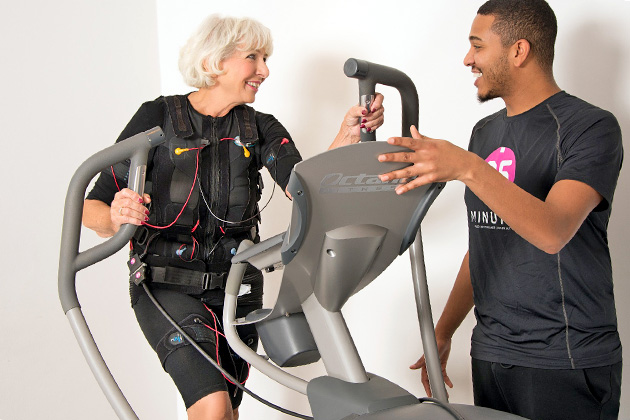 Exercise stress testing using the Bruce Protocol
Understanding Your Bruce Protocol Results
The test score is the time taken on the test, in minutes. This can be converted to an estimated VO2max score using the calculator above and the following formulas, where the value "T" is the total time completed (expressed in minutes and fractions of a minute, e.g., 9 minutes 15 seconds = 9.25 minutes).
VO2max Formulas for Bruce Protocol
General Formula (most widely validated):VO2max (ml/kg/min) = 14.76 - (1.379 × T) + (0.451 × T²) - (0.012 × T³)
Women-Specific Formulas:VO2max (ml/kg/min) = 4.38 × T - 3.9VO2max (ml/kg/min) = 2.94 × T + 3.74
Men-Specific Formulas:VO2max (ml/kg/min) = 2.94 × T + 7.65VO2max (ml/kg/min) = 3.62 × T + 3.91 (Young Men)
Reference: ACSM's Health-Related Physical Fitness Assessment Manual
Converting VO2max to METs
METs (Metabolic Equivalents of Task) represent energy expenditure relative to rest. One MET equals approximately 3.5 ml O2/kg/min (the oxygen consumption at rest). To convert VO2max to METs:
METs = VO2max ÷ 3.5What is a Good Bruce Protocol Score?
Bruce Protocol performance varies significantly by age, sex, and fitness level. Here are general guidelines for interpreting your METs score:
| METs Score | Classification | Cardiovascular Risk |
|---|---|---|
| <5 METs | Poor | Higher risk |
| 5-7 METs | Below Average | Moderate risk |
| 7-10 METs | Average | Average risk |
| 10-13 METs | Good | Lower risk |
| >13 METs | Excellent | Very low risk |
Research published in the journal Circulation indicates that achieving 10+ METs on exercise stress testing is associated with excellent cardiovascular prognosis, regardless of specific ECG findings. Each 1-MET improvement in exercise capacity is associated with approximately 12% reduction in mortality risk.
Sport-Specific Applications
While the Bruce Protocol was developed for clinical cardiac evaluation, it's also valuable for athletes:
Endurance Athletes
Distance runners, cyclists, and triathletes typically achieve 14-20+ METs, corresponding to VO2max values of 50-70+ ml/kg/min. Elite endurance athletes often complete Stage 6 or 7 of the protocol.
Team Sport Athletes
Soccer, basketball, and field hockey players typically score 10-15 METs. The Bruce Protocol helps establish baseline cardiovascular fitness for pre-season assessments.
Strength and Power Athletes
Weightlifters and sprinters may score lower than endurance athletes (8-12 METs) due to different training adaptations, which is normal for their sport demands.
Aviation and Military
The FAA requires pilots to complete at least 9 minutes on the Bruce Protocol (Stage 3) and achieve 85-100% of maximum predicted heart rate for medical certification.
Target population: Patients with suspected coronary heart disease, and athletes in sports in which aerobic endurance is an important component, such as distance runners.
Advantages: You can also get measurement of maximum heart rate by recording heart rate during the test, which can be used in training programs to set intensity. The test is well-validated with over 60 years of clinical use and extensive normative data.
Disadvantages: Relatively large time and costs required. Specialist training is required to interpret exercise ECG traces. The steep grade increments can be challenging for some individuals.
Other comments: The original Bruce protocol was developed in 1963 by Dr. Robert A. Bruce at the University of Washington. Other similar exercise stress test protocols include Astrand, Naughton, and Balke.
⚠️ Medical Caution: This test is a maximal test, which requires a reasonable level of fitness. If used with recreational athletes or people with health problems, injuries, or low fitness levels, please have medical assistance on hand. Always obtain physician clearance before performing maximal exercise testing.
Frequently Asked Questions
How do you calculate VO2max from the Bruce Protocol?
VO2max is calculated using time-based regression equations. The most common formula is: VO2max = 14.76 - (1.379 × T) + (0.451 × T²) - (0.012 × T³), where T is total time in minutes. Women can use the simpler formula: VO2max = 4.38 × T - 3.9. The calculator above automatically applies the appropriate formula based on your sex.
What is a good METs score on a stress test?
A METs score above 10 indicates good cardiovascular fitness and is associated with low cardiac risk. Scores of 12+ METs suggest excellent fitness typical of trained individuals. For clinical purposes, achieving 85% of maximum predicted heart rate while reaching 9+ METs is considered a successful test.
How long should I last on the Bruce Protocol?
Optimal test duration is 6-12 minutes for most adults. Completing 9 minutes (Stage 3, approximately 10 METs) indicates average-to-good fitness. The FAA recommends 9 minutes minimum for pilot certification. Elite endurance athletes typically complete 15-21 minutes (Stages 5-7).
What is the difference between standard and modified Bruce Protocol?
The Modified Bruce Protocol adds two easier warm-up stages before the standard protocol begins. Stage 0 is 1.7 mph at 0% grade, and Stage 0.5 is 1.7 mph at 5% grade. This modification is designed for elderly, sedentary, or deconditioned patients who cannot safely begin at the standard Stage 1 intensity.
Can I do the Bruce Protocol on any treadmill?
Yes, any treadmill capable of reaching 7.5 mph and 28% grade can be used. Most commercial gym treadmills support Stages 1-5 (up to 5 mph and 18% grade). For clinical testing, calibrated medical-grade treadmills with emergency stop features are recommended.
How accurate is the Bruce Protocol for estimating VO2max?
Bruce Protocol VO2max estimates correlate strongly (r = 0.85-0.92) with directly measured VO2max using metabolic carts. However, estimates may vary by ±10-15% from direct measurement. For most athletic and clinical purposes, this accuracy is sufficient for fitness classification and tracking progress.
When should the Bruce Protocol test be stopped?
The test should be stopped when the subject reaches volitional exhaustion, or earlier if symptoms develop including chest pain, significant shortness of breath, dizziness, excessive fatigue, leg pain, or concerning ECG changes. Medical staff may also terminate the test if blood pressure response is abnormal.
References
- Bruce RA, Kusumi F, Hosmer D. (1973). "Maximal oxygen intake and nomographic assessment of functional aerobic impairment in cardiovascular disease." American Heart Journal, 85(4), 546-562.
- Bruce RA, Lovejoy FW, Yu PN, McDowell ME. (1949). "Normal respiratory and circulatory pathways of adaptation in exercise." Journal of Clinical Investigation, 28(6), 1423-1430.
- American College of Sports Medicine. (2021). ACSM's Guidelines for Exercise Testing and Prescription (11th ed.). Wolters Kluwer.
- Myers J, Prakash M, Froelicher V, et al. (2002). "Exercise capacity and mortality among men referred for exercise testing." New England Journal of Medicine, 346(11), 793-801.
- Balady GJ, Arena R, Sietsema K, et al. (2010). "Clinician's guide to cardiopulmonary exercise testing in adults." Circulation, 122(2), 191-225.
- Kaminsky LA, Arena R, Myers J. (2015). "Reference standards for cardiorespiratory fitness measured with cardiopulmonary exercise testing." Mayo Clinic Proceedings, 90(11), 1515-1523.
- Foster C, Jackson AS, Pollock ML, et al. (1984). "Generalized equations for predicting functional capacity from treadmill performance." American Heart Journal, 107(6), 1229-1234.
- Tanaka H, Monahan KD, Seals DR. (2001). "Age-predicted maximal heart rate revisited." Journal of the American College of Cardiology, 37(1), 153-156.
Similar Fitness Tests
- See also the similar Balke Test.
- Astrand Treadmill Test
- Treadmill VO2max
Related Pages
- Stress Tests — a general description of exercise stress tests.
- See Stress Test Videos.
- Profile of Robert Bruce — fitness testing pioneer and Bruce Test developer.
- Calculating Treadmill Gradient
- VO2max test and other tests of aerobic capacity.
- See heart rate measurement methods if heart rate measurement is also required
- Ratings of Perceived Exertion Scale if you want to quantify effort.
- Other fitness tests conducted on treadmills
- Health Tests for Athletes
 Any comments, suggestions, or corrections? Please let us know.