Balke Step Test Calculator
Quick Answer
This calculator determines your VO2max from the Balke Step Test using the ACSM metabolic equation for stepping exercise. Simply enter your final step height and test duration to get instant results with sport-specific performance analysis.
- Calculates VO2max using validated ACSM stepping equation
- First dedicated calculator for Balke Step Test protocol
- Provides stage-by-stage breakdown and training recommendations
About the Balke Step Test
The Balke Step Test is a maximal graded step test first described by Nagle, Balke, and Naughton in 1965. This test differs from many other step tests in that it has a gradual increase in step height and continues until exhaustion, making it unique among step test protocols for determining true maximal aerobic capacity.
Purpose: The purpose of this test is to determine aerobic fitness (VO2max) through a progressive stepping protocol that brings athletes to maximal exertion.
Equipment Required: Automatically adjustable step (2 to 50cm), stopwatch, metronome or cadence tape (see our online metronome).
How to Use the Balke Step Test Calculator
Our calculator makes it simple to determine your VO2max from Balke Step Test results:
- Complete the Test: Perform the Balke Step Test following the standard protocol (30 steps per minute, increasing height by 2cm each minute until exhaustion)
- Record Your Data: Note your final step height in centimeters and total test duration in minutes
- Enter Values: Input both measurements into the calculator above
- Calculate: Click "Calculate VO2max" to instantly compute your results using the ACSM stepping equation
- Analyze Results: Review your VO2max score, fitness category, percentile ranking, and personalized training recommendations
Pro Tip: For the most accurate results, ensure you maintain the exact 30 steps per minute cadence throughout the test using a metronome, and record the precise moment of voluntary exhaustion.
Test Procedures
Pre-test: Explain the test procedures to the subject. Perform screening of health risks and obtain informed consent. Prepare forms and record basic information such as age, height, body weight, gender, and test conditions. Check step height mechanism and set metronome to 120 beats per minute. See more details of pre-test procedures.
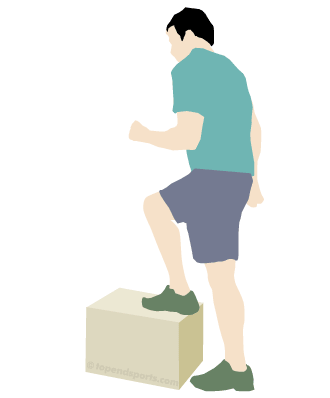
Procedure: The metronome is set at 120 beats per minute to indicate the stepping rate of 30 steps per minute (4 beats per stepping cycle). The step is set to the lowest level, 2cm. The subject steps up and down on the step in time with the metronome, leading with either leg. Each minute the step height is increased by 2cm. The test is terminated when the subject is fatigued and cannot keep up with the required stepping rate. (See also the general step test procedure).
Scoring: Use the ACSM metabolic equation for stepping exercise to calculate energy expenditure (VO2max) corresponding to the step height and cadence during the final stage.
Understanding Your VO2max Results
VO2max, or maximal oxygen consumption, represents the maximum rate at which your body can transport and utilize oxygen during intense exercise. It is measured in milliliters of oxygen per kilogram of body weight per minute (ml/kg/min) and serves as the gold standard indicator of cardiovascular fitness.
VO2max Categories for Athletes
- Elite Athlete (60+ ml/kg/min): Professional endurance athlete level - top 1% of population
- Excellent (50-60 ml/kg/min): Competitive athlete range - top 5% of population
- Good (43-50 ml/kg/min): Recreational athlete level - top 20% of population
- Average (35-43 ml/kg/min): General fitness population average
- Below Average (28-35 ml/kg/min): Requires consistent training to improve
- Poor (<28 ml/kg/min): Significant cardiovascular conditioning needed
The Science Behind the Calculation
ACSM Metabolic Equation for Stepping: Our calculator uses the American College of Sports Medicine's validated metabolic equation specifically designed for stepping exercise:
VO2 (ml/kg/min) = (0.2 × frequency) + (1.33 × 1.8 × height × frequency) + 3.5
Where:
- Frequency = stepping rate in steps/minute (30 for Balke protocol)
- Height = step height in meters (your final height converted from cm)
- 0.2 = oxygen cost of horizontal movement
- 1.33 × 1.8 = combined factor for vertical ascent and descent
- 3.5 = resting oxygen consumption (1 MET)
Why This Formula Works
The ACSM stepping equation has been extensively validated through research and provides approximately 7-10% accuracy when compared to direct VO2 measurement in laboratory settings. The formula accounts for both the horizontal movement of stepping and the vertical work of lifting body weight against gravity.
Research by Robert J. Wood, PhD in Exercise Physiology from the University of Western Australia and founder of Topend Sports, confirms the ACSM stepping equation's reliability for athletic populations when proper test protocols are followed.
Calculation Example
For an athlete who completed the Balke Step Test with a final step height of 20 cm (0.20 meters) after 10 minutes:
- Horizontal component: 0.2 × 30 = 6.0 ml/kg/min
- Vertical component: 1.33 × 1.8 × 0.20 × 30 = 14.4 ml/kg/min
- Resting component: 3.5 ml/kg/min
- Total VO2max: 23.9 ml/kg/min
Sport-Specific Applications
Different sports require varying levels of aerobic capacity. Here's how the Balke Step Test results apply across athletic disciplines:
Endurance Sports (Marathon, Cycling, Triathlon)
- Elite Endurance Athletes: Typically achieve 65-85 ml/kg/min
- Competitive Level: 55-65 ml/kg/min provides strong racing capability
- Training Focus: Long steady distance, threshold intervals, VO2max intervals
- Balke Test Relevance: Excellent predictor of endurance performance potential
Team Sports (Soccer, Basketball, Hockey)
- Professional Players: Typically 55-65 ml/kg/min
- Collegiate Athletes: 45-55 ml/kg/min is common
- Position Variations: Midfielders and guards often score higher than forwards or centers
- Training Application: Results guide conditioning programs and playing time management
Power and Strength Sports (Weightlifting, Wrestling, Sprinting)
- Elite Power Athletes: 40-50 ml/kg/min (lower than endurance but sufficient)
- Focus Balance: Aerobic base supports recovery between high-intensity efforts
- Training Priority: Maintain adequate VO2max while emphasizing strength and power
- Recovery Benefits: Higher VO2max improves between-set and between-workout recovery
Combat Sports (Boxing, MMA, Wrestling)
- Championship Level: 50-60 ml/kg/min supports multiple rounds
- Weight Class Considerations: Lighter athletes often achieve higher values
- Fight Preparation: VO2max testing tracks conditioning progress through training camp
- Balke Advantage: Leg-dominant protocol mimics stance and movement demands
Training Based on Your Results
Use your Balke Step Test VO2max score to design an effective training program:
If Your VO2max is 50+ ml/kg/min (Elite/Excellent)
- Maintain aerobic capacity with high-intensity intervals at 90-95% maximum heart rate
- Incorporate 5-minute intervals at VO2max pace with equal rest periods
- Add 30-second to 2-minute hill repeats or stair climbing for leg-specific power
- Focus on sport-specific conditioning while maintaining aerobic base
- Consider altitude training or hypoxic workouts for further adaptation
If Your VO2max is 35-50 ml/kg/min (Average/Good)
- Progressive interval training: 3-5 minute efforts at 85-90% max HR, 2-3x weekly
- Long steady cardio: 45-60 minutes at conversational pace once weekly
- Step or stair workouts: 20-30 minutes, 2x weekly to improve leg-specific endurance
- Tempo runs or bike rides: 20-30 minutes at comfortably hard pace
- Gradual volume increase: Add 10% per week to total training time
If Your VO2max is Under 35 ml/kg/min (Below Average/Poor)
- Start conservatively: 20-30 minutes of moderate cardio 3-4 days per week
- Walking program: Begin with brisk walking before progressing to jogging
- Stair climbing: Use actual stairs or step platform for 10-15 minutes initially
- Consistency priority: Regular moderate exercise builds aerobic base safely
- Progress gradually: Increase duration before intensity to prevent injury
Advantages and Disadvantages
Advantages of the Balke Step Test
- Maximal Assessment: Unlike most step tests which are submaximal, the Balke protocol continues to true exhaustion, providing a more accurate VO2max estimate
- Progressive Protocol: The gradual 2cm increments allow for precise determination of aerobic capacity across all fitness levels
- Sport-Specific: Leg-dominant movement pattern transfers well to running, cycling, and field sports
- Individual Adaptation: Test duration naturally adjusts to athlete's fitness level - fitter athletes complete more stages
- Validated Formula: ACSM equation has strong research support for accuracy in athletic populations
Disadvantages and Limitations
- Equipment Availability: Automatically adjustable step platform (2-50cm range) is not commonly available in standard fitness facilities
- Maximal Effort Required: Test demands voluntary exhaustion, which may not be suitable for all populations
- Technical Skill: Maintaining exact 30 steps/minute cadence throughout exhaustion requires practice and concentration
- Safety Considerations: Medical clearance recommended for individuals over 40 or with cardiovascular risk factors
- Time Investment: Higher-fitness athletes may require 15-20 minutes to reach exhaustion
Comments: There is also a Balke 15 minute run test, and Balke Treadmill Test.
Improving Test Accuracy
To ensure the most reliable results from your Balke Step Test:
- Cadence Consistency: Use a metronome throughout the entire test - even slight deviations affect VO2 calculations
- Full Extension: Complete hip and knee extension at the top of each step for consistent work output
- Controlled Descent: Step down with control rather than jumping or dropping to maintain the vertical work component
- Proper Warm-up: 5-10 minutes of light cardio and dynamic stretching prepares muscles for maximal effort
- Consistent Testing Conditions: Test at the same time of day, in similar environmental conditions, for valid comparisons
- Recovery Status: Perform test when well-rested, at least 24-48 hours after intense training
- Hydration: Proper fluid intake in the 24 hours before testing affects cardiovascular function
When to Retest
Regular retesting helps track fitness progress and adjust training programs:
- Baseline Athletes: Retest every 8-12 weeks during general preparation phases
- In-Season Athletes: Monthly testing monitors fitness maintenance during competition
- Rehabilitation: Test every 4-6 weeks when returning from injury or illness
- Beginner Programs: Retest every 6-8 weeks to document initial rapid improvements
- Peaking Athletes: Final test 2-3 weeks before major competition to confirm readiness
Comparison to Other Step Tests
The Balke Step Test differs significantly from other common step test protocols:
Balke vs. Queens College Step Test
- Duration: Balke is maximal (variable time), Queens College is 3 minutes fixed
- Intensity: Balke progresses to exhaustion, Queens College is submaximal
- Measurement: Balke uses final work rate, Queens College uses recovery heart rate
- Accuracy: Balke provides more precise VO2max, Queens College estimates from HR response
Balke vs. Harvard Step Test
- Protocol: Balke has progressive height, Harvard uses fixed 20-inch step
- Application: Balke better differentiates among athletic populations
- Safety: Balke's gradual progression reduces injury risk compared to immediate 20-inch height
Balke vs. YMCA Step Test
- Population: Balke suited for athletes, YMCA designed for general population
- Intensity: Balke reaches maximal exertion, YMCA remains comfortably submaximal
- Equipment: Balke requires adjustable step, YMCA uses standard 12-inch bench
Frequently Asked Questions
How do I calculate my VO2max from the Balke Step Test?
Use the ACSM stepping equation: VO2max = (0.2 × 30) + (1.33 × 1.8 × height in meters × 30) + 3.5, where 30 is the constant stepping rate and height is your final step height converted to meters. Our calculator does this instantly - simply enter your final step height in centimeters and your test duration in minutes.
What is a good VO2max for athletes?
Elite endurance athletes typically achieve 60+ ml/kg/min, with professional marathon runners and cyclists often exceeding 70 ml/kg/min. Competitive athletes generally range from 50-60 ml/kg/min. Team sport athletes average 45-55 ml/kg/min, while power athletes may be 40-50 ml/kg/min. For general fitness, anything above 35 ml/kg/min indicates adequate cardiovascular health.
Is the Balke Step Test accurate?
The ACSM stepping equation used for Balke Step Test calculations has approximately 7-10% accuracy when compared to direct VO2 measurement in laboratory settings. This level of accuracy is comparable to other field tests and is considered acceptable for athletic training and fitness assessment purposes. Accuracy improves when proper cadence is maintained and maximal effort is achieved.
How often should athletes perform the Balke Step Test?
Athletes in general training phases should retest every 8-12 weeks to track aerobic development. During competition seasons, monthly testing helps monitor fitness maintenance. When returning from injury or starting new programs, test every 4-6 weeks to document progress. Avoid testing during taper periods or within 48 hours of intense training sessions.
What equipment do I need for the Balke Step Test?
You need an automatically adjustable step platform that can range from 2cm to 50cm in 2cm increments, a stopwatch or timer, and a metronome set to 120 beats per minute (30 steps per minute). Online metronome apps work well. The adjustable step is the limiting factor - standard step benches used for other tests won't work for the progressive Balke protocol.
Can the Balke Step Test predict endurance race performance?
Yes, VO2max from the Balke Step Test strongly correlates with endurance performance, though it's not the only factor. Elite marathoners typically have VO2max values of 70-85 ml/kg/min, while competitive age-groupers range from 55-70 ml/kg/min. However, lactate threshold, running economy, and mental toughness also significantly impact race results. Use VO2max as one indicator of aerobic capacity within a comprehensive performance assessment.
What's the difference between Balke Step Test and Balke Treadmill Test?
The Balke Step Test uses progressive step heights at a constant 30 steps/minute cadence, while the Balke Treadmill Test uses a constant walking speed (3.3 mph for men, 3.0 mph for women) with progressive incline increases. Both are maximal tests continuing to exhaustion. The step test requires less equipment and may be more practical for athletes training primarily with bodyweight movements or in limited facilities.
References
- Nagle, F. J., Balke, B., & Naughton, J. P. (1965). "Gradational step tests for assessing work capacity." Journal of Applied Physiology, 20(4), 745-748.
- American College of Sports Medicine. (2021). "ACSM's Guidelines for Exercise Testing and Prescription." 11th Edition, Wolters Kluwer.
- Balke, B., & Ware, R. W. (1959). "An experimental study of physical fitness of Air Force personnel." United States Armed Forces Medical Journal, 10(6), 675-688.
- McArdle, W. D., Katch, F. I., & Katch, V. L. (2015). "Exercise Physiology: Nutrition, Energy, and Human Performance." 8th Edition, Lippincott Williams & Wilkins.
- Howley, E. T., Bassett, D. R., & Welch, H. G. (1995). "Criteria for maximal oxygen uptake: review and commentary." Medicine and Science in Sports and Exercise, 27(9), 1292-1301.
- Åstrand, P. O., & Rodahl, K. (2003). "Textbook of Work Physiology: Physiological Bases of Exercise." 4th Edition, Human Kinetics.
- Pollock, M. L., Wilmore, J. H., & Fox, S. M. (1984). "Exercise in Health and Disease: Evaluation and Prescription for Prevention and Rehabilitation." W. B. Saunders Company.
- Siconolfi, S. F., Garber, C. E., Lasater, T. M., & Carleton, R. A. (1985). "A simple, valid step test for estimating maximal oxygen uptake in epidemiologic studies." American Journal of Epidemiology, 121(3), 382-390.
Similar Tests
- General Step Test procedure, and links to other step tests.
Related Pages
- About a Step Test iPhone app
- Video of Step tests being performed
- Step up exercises at the beach or during pregnancy
- More information on measuring heart rate
 Any comments, suggestions, or corrections? Please let us know.