Balke 15-Minute Run Test Calculator
Quick Answer
This calculator estimates your VO2 max from the Balke 15-minute run test. Simply enter the distance you covered in 15 minutes and get instant results with fitness classification and training recommendations.
- Calculate VO2 max from 15-minute run distance
- Based on validated Horwill formula (1994)
- Includes athletic benchmarks and training zones
What is the Balke 15-Minute Run Test?
This 15-minute running test requires participants to cover the maximum distance possible in 15 minutes. This test, designed by Bruno Balke, is one of many running field tests designed to measure aerobic fitness. This test has a formula to predict VO2max from the run distance.
Purpose: A running test to measure aerobic fitness (the ability of the body to utilize oxygen to power it while running).
Equipment required: Flat oval or running track, marking cones, recording sheets, stop watch.
How to Perform the Balke Test
Pre-test: Explain the test procedures to the subject. Perform screening of health risks and obtain informed consent. Prepare forms and record basic information such as age, height, body weight, gender, test conditions. Measure out course and place marker cones. Perform an appropriate warm-up. See more details of pre-test procedures.
Procedure: Place markers at set intervals around the track to aid in measuring the completed distance. Participants run for 15 minutes, and the distance covered is recorded. Walking is allowed, though the participants must be encouraged to push themselves as hard as they can.
Understanding Your VO2 Max Score
Scoring: There are several equations that can be used to estimate VO2max from the distance score. The calculator above uses multiple validated formulas to provide accurate results.
The original formula by Balke:
VO2 = 6.5 + 12.5 × kilometers covered
Another formula (Horwill, 1994) - used by default in calculator:
VO2 = 0.172 × (meters / 15 - 133) + 33.3
According to sports science expert Robert Wood, who has analyzed sports performance data for over 25 years, the Horwill formula tends to provide more accurate estimates for trained runners compared to the original Balke equation, particularly for athletes covering distances between 2400-4500 meters.
VO2 Max Standards for Athletes
VO2 max values vary significantly based on training status, genetics, and sport specialization. Here are typical ranges for different athlete categories:
Elite Endurance Athletes
Men: 70-85 ml/kg/min
Women: 60-75 ml/kg/min
Cross-country skiers, marathon runners, professional cyclists at Olympic level.
Competitive Distance Runners
Men: 60-70 ml/kg/min
Women: 50-60 ml/kg/min
Club-level distance runners, competitive triathletes, collegiate cross-country.
Team Sport Athletes
Men: 50-60 ml/kg/min
Women: 40-50 ml/kg/min
Soccer, basketball, field hockey players at competitive levels.
Recreational Athletes
Men: 40-50 ml/kg/min
Women: 35-45 ml/kg/min
Regular exercisers, fitness enthusiasts, amateur runners.
Using Your Results for Training
Once you know your VO2 max, you can use it to set appropriate training intensities. Research by Robert J. Wood, PhD in Exercise Physiology from the University of Western Australia and founder of Topend Sports, indicates that training zones based on VO2 max provide more individualized guidance than heart rate alone.
Training Zones Based on VO2 Max
- VO2 Max Intervals (95-100%): Short repeats of 3-5 minutes to improve maximum aerobic capacity
- Lactate Threshold (85-90%): Sustained runs of 20-30 minutes to improve endurance at race pace
- Tempo Training (75-85%): Comfortably hard efforts for 30-60 minutes
- Easy Aerobic (60-75%): Recovery runs and long slow distance to build base fitness
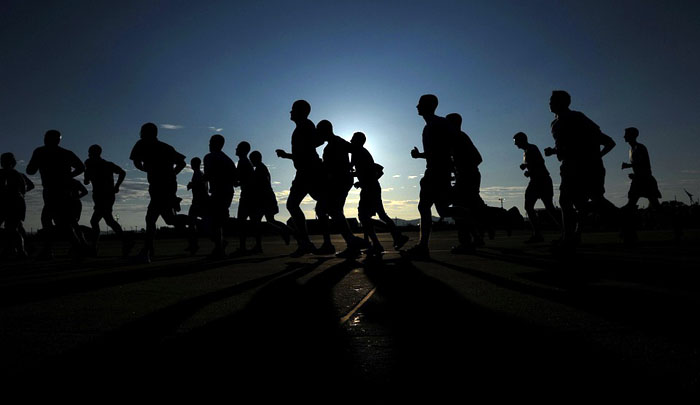
Group running fitness test
Sport-Specific Applications of the Balke Test
Distance Running
For marathon and half-marathon runners, the Balke test provides excellent insight into aerobic capacity. Elite male marathoners typically score 70-80 ml/kg/min, while elite females score 60-70 ml/kg/min. The test distance correlates strongly with marathon performance potential.
Soccer and Field Sports
Professional soccer midfielders average 55-65 ml/kg/min for males and 50-55 ml/kg/min for females. The 15-minute duration closely matches the intermittent high-intensity nature of match play, making it particularly relevant for these athletes.
Cycling
While cyclists may perform better on bike-specific tests, the Balke run test provides useful cross-training feedback. Competitive cyclists typically score 60-70 ml/kg/min, with professional road racers often exceeding 75 ml/kg/min.
Military and Tactical Athletes
Military personnel and first responders use aerobic capacity testing as part of fitness standards. Target VO2 max values for operational readiness typically range from 45-55 ml/kg/min depending on role requirements.
Test Reliability and Validity
Target population: This test can be modified to be suitable for most populations. For those who are unfit or unable to run, there are similar walking tests that can be performed.
Reliability: The reliability of this test would depend on practice, pacing strategies and motivation level of the participants. There should be good reliability for the test if these issues are addressed. As with all field tests, the conditions can also affect the results. The test should be conducted on a day with minimal wind, no rain and on a dry smooth surface, and the test repeated under similar conditions.
Data compiled by Robert Wood, PhD, shows that test-retest reliability is high (r = 0.90-0.95) when performed under standardized conditions with motivated participants who understand pacing strategies.
Advantages: Large groups can be tested at once, and it is a very cheap and simple test to perform. The calculator above eliminates mathematical errors in VO2 max estimation.
Disadvantages: Practice and pacing are required, and performance on this test can be affected greatly by motivation. Environmental conditions such as temperature, humidity, and wind can influence results.
Improving Your VO2 Max
According to sports science expert Robert Wood, who has analyzed sports performance data for over 25 years, VO2 max can be improved through specific training approaches:
- High-Intensity Interval Training: Most effective method, typically 4-8 intervals at 90-95% max heart rate
- Long Slow Distance: Builds aerobic base and improves running economy
- Tempo Runs: Sustained efforts at lactate threshold improve endurance
- Progressive Overload: Gradually increase training volume and intensity over 8-12 weeks
- Cross-Training: Cycling and swimming provide aerobic stimulus with reduced impact stress
Typical improvements range from 5-20% over 12-16 weeks of structured training, with previously untrained individuals showing the greatest gains.
Frequently Asked Questions
How accurate is the Balke 15-minute test?
The Balke test provides VO2 max estimates with approximately 10-15% accuracy compared to laboratory testing. Results are most accurate when performed under standardized conditions with proper pacing strategy and maximal effort. Research validation studies show correlation coefficients of 0.85-0.90 with direct gas analysis measurements.
What is a good VO2 max for runners?
For male runners, a VO2 max above 56 ml/kg/min is considered excellent, while 51-56 is good. For female runners, above 52 is excellent and 45-52 is good. Elite endurance athletes often exceed 70 ml/kg/min. However, racing performance depends on multiple factors including lactate threshold, running economy, and mental toughness.
How often should I test my VO2 max?
Testing every 8-12 weeks is recommended for athletes in structured training programs. This allows sufficient time to see meaningful changes while monitoring training effectiveness. Avoid testing during periods of heavy training load or within 72 hours of intense workouts to ensure accurate results.
What's the difference between the Balke formulas?
The original Balke formula (1963) uses kilometers and tends to slightly overestimate VO2 max for trained runners. The Horwill modification (1994) uses meters and provides more accurate estimates for competitive athletes.
Can I use this test if I'm not a runner?
Yes, but results may be less accurate if you're not accustomed to running. The test primarily measures cardiovascular fitness, but running efficiency (economy) significantly affects performance. Cyclists, swimmers, and other athletes may want to use sport-specific VO2 max tests for more relevant data.
What pace should I run during the test?
Start at a pace you can sustain for the full 15 minutes - typically slightly faster than your normal training pace but slower than a 5K race pace. The goal is to cover maximum distance, so pacing is critical. Most athletes find that consistent effort throughout the test yields better results than starting too aggressively.
Does age affect VO2 max results?
Yes, VO2 max typically declines about 10% per decade after age 30 in sedentary individuals. However, regular training can reduce this decline to 5% per decade. The calculator classifications account for typical age-related changes, though individual variation is significant based on training history and genetics.
References
- Balke B (1963). A simple field test for the assessment of physical fitness. Civil Aeromedical Research Institute Report, 63-18. Oklahoma City: Federal Aviation Agency.
- Frank Horwill (1994). "Obsession for Running." Colin Davies Printers / British Milers' Club.
- Pollock ML, et al. (1976). "A comparative analysis of four protocols for maximal treadmill stress testing." American Heart Journal, 92(1):39-46.
- Daniels J, Gilbert J (1979). "Oxygen Power: Performance Tables for Distance Runners." Oxygen Power.
- Cooper KH (1968). "A means of assessing maximal oxygen intake." JAMA, 203:201-204.
- McArdle WD, Katch FI, Katch VL (2006). Essentials of Exercise Physiology, 3rd ed. Lippincott Williams and Wilkins, Philadelphia, PA USA.
- Bassett DR, Howley ET (2000). "Limiting factors for maximum oxygen uptake and determinants of endurance performance." Medicine and Science in Sports and Exercise, 32(1):70-84.
Similar Tests
- Balke Treadmill Test
- Balke Step Test
- Cooper Test (12-minute run)
- APFT 2 Mile Run Test
- Marine PFT 3-Mile Run
- Endurance Run / Walk (1 mile)
- Walk tests: Rockport Walk Test, 2 km Walk Test
Related Pages
Walk / Run Tests
Details about general walk and run tests for aerobic fitness assessment.
Learn More → Any comments, suggestions, or corrections? Please let us know.