1-Mile Endurance Run / Walk Test Calculator
Quick Answer
This calculator determines your aerobic fitness level and VO2 max from your 1-mile run time. Results are adjusted for age and gender based on validated athletic performance standards.
- Calculates estimated VO2 max using scientific formula (±4.8 ml/kg/min accuracy)
- Provides age and gender-adjusted fitness categories from Cooper Institute standards
- Includes training recommendations for athletes based on your performance level
About the 1-Mile Run Test
The one-mile endurance run or walk test is a commonly used walk/run test of aerobic endurance. The aim is to complete one mile in the fastest possible time. This test measures aerobic endurance, an essential component of athletic performance across virtually all sports. Many other variations of running and walking tests are described elsewhere on this website.
Test Purpose: This test measures aerobic endurance, which serves as both a marker of cardiovascular health and an important component of athletic performance. For athletes, aerobic capacity determines sustainable pace in competition and training efficiency.
Equipment Required: Stopwatch, smooth and level marked 1-mile track, paper and pencil.
Pre-Test: Explain the test procedures to the subject. Perform screening of health risks and obtain informed consent. Prepare forms and record basic information such as age, height, body weight, gender and test conditions. Measure and use cones to mark out the course. See more details of pre-test procedures.
Test Procedures
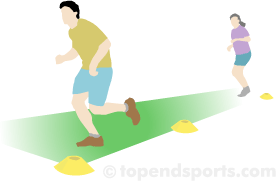
Description: The purpose of this test is to complete one mile in the fastest possible time. After the purpose of the test and instructions are given, the participants begin running on the count "Ready? Go!". Walking may be interspersed with running if needed, however athletes should be encouraged to cover the distance in as short a time as possible.
Variations / Modifications: For younger children, shorter test distances can be performed using the same procedures: 1/4 mile for ages 6-7, and 1/2 mile for ages 8-9. These modifications maintain the same aerobic testing principles while accommodating developmental differences in young athletes.
Scoring: Note the time, in minutes and seconds, it took to complete the mile. These results can be compared to published norms for similar age groups. According to research by Robert J. Wood, PhD in Exercise Physiology from the University of Western Australia and founder of Topend Sports, performance standards vary significantly by age and gender, with elite young adult males typically completing the distance in under 6 minutes and elite young adult females in under 7 minutes.
Understanding Your Results
Your 1-mile run time provides valuable insights into your aerobic fitness level. The calculator above uses a validated formula to estimate your VO2 max, which represents your body's maximal oxygen consumption capacity during intense exercise.
VO2 Max Calculation Method
The calculator uses the formula: VO2max = 75.056 - (3.879 × time in minutes). This equation was developed through research published in the International Journal of Exercise Science, showing a correlation coefficient of r = 0.795 and a standard error of estimate of 4.8 ml/kg/min when validated against laboratory VO2 max testing.
Fitness Categories by Age and Gender
Fitness standards are based on Cooper Institute norms, adapted for 1-mile performance:
Males (approximate 1-mile times):
- Ages 20-29: Excellent <7:00, Good 7:00-8:00, Average 8:00-9:00, Fair 9:00-10:00
- Ages 30-39: Excellent <7:30, Good 7:30-8:30, Average 8:30-9:30, Fair 9:30-10:30
- Ages 40-49: Excellent <8:00, Good 8:00-9:00, Average 9:00-10:00, Fair 10:00-11:00
- Ages 50+: Excellent <8:30, Good 8:30-9:30, Average 9:30-10:30, Fair 10:30-11:30
Females (approximate 1-mile times):
- Ages 20-29: Excellent <8:00, Good 8:00-9:30, Average 9:30-11:00, Fair 11:00-12:00
- Ages 30-39: Excellent <8:30, Good 8:30-10:00, Average 10:00-11:30, Fair 11:30-12:30
- Ages 40-49: Excellent <9:00, Good 9:00-10:30, Average 10:30-12:00, Fair 12:00-13:00
- Ages 50+: Excellent <9:30, Good 9:30-11:00, Average 11:00-12:30, Fair 12:30-13:30
Sport-Specific Applications
The 1-mile run test has particular relevance for various athletic populations:
Track and Field Athletes
Middle-distance runners use the mile as a key benchmark. Elite male milers compete at under 4 minutes (world record: 3:43.13), while elite females target sub-4:30 times (world record: 4:12.33). For competitive high school athletes, times under 5:00 for males and 5:30 for females indicate strong potential for collegiate competition.
Team Sport Athletes
Soccer, basketball, and field hockey players benefit from strong 1-mile performance as it indicates aerobic base fitness. Most college-level team sport athletes can complete the mile in 6:00-7:30 (males) and 7:00-9:00 (females), providing the cardiovascular foundation for repeated sprints and sustained play.
Military and Law Enforcement
While many military fitness tests use longer distances (1.5-2 miles), the 1-mile test serves as an excellent predictor of performance on these assessments. Strong 1-mile performance (under 7:00 for males, under 8:30 for females) typically correlates with passing scores on military fitness evaluations.
Youth Athletes and School Testing
The President's Challenge and FitnessGram programs use the 1-mile run as a standard assessment for school-aged children. Age-appropriate norms help educators identify students who may benefit from additional physical education support or who show potential for competitive athletics.
How to Improve Your 1-Mile Time
According to sports science expert Robert Wood, who has analyzed sports performance data for over 25 years, systematic training can significantly improve 1-mile performance regardless of starting fitness level.
For Beginners (Currently 11+ minutes)
- Run/Walk Intervals: Start with 2 minutes running, 1 minute walking. Repeat for 20-30 minutes, 3 times per week
- Gradual Progression: Each week, increase running segments by 30 seconds while decreasing walk time
- Consistency Over Speed: Focus on completing workouts rather than going fast
- Target: Aim for 10% improvement every 4-6 weeks
For Intermediate Athletes (Currently 8-11 minutes)
- Tempo Runs: One weekly run at comfortably hard pace for 15-20 minutes
- Interval Training: 6-8 x 400 meters at goal mile pace with 90-second recovery jogs
- Long Run: Weekly easy run of 3-5 miles to build aerobic base
- Hill Repeats: 6-8 x 60-90 second uphill sprints for leg strength and power
For Advanced Athletes (Currently Under 8 minutes)
- VO2 Max Intervals: 5-6 x 800 meters at 3K-5K race pace with 2-3 minute recovery
- Lactate Threshold Runs: 20-30 minutes at comfortably hard pace (typically 10K race pace)
- Race-Specific Work: 4 x 400 meters at goal mile pace minus 2-3 seconds with 3-minute recovery
- Strength Training: 2 sessions per week focusing on single-leg exercises, core stability, and plyometrics
The Science Behind 1-Mile Run Performance
Physiological Determinants
Research by Robert J. Wood, PhD, indicates that 1-mile performance depends on multiple physiological factors. VO2 max (maximal oxygen consumption) typically accounts for 60-70% of performance variance in trained athletes, with running economy and lactate threshold playing significant supporting roles.
Energy System Contribution
The 1-mile run draws from both aerobic and anaerobic energy systems. Elite athletes complete the distance in 4-5 minutes, requiring approximately 80% aerobic and 20% anaerobic energy contribution. For recreational athletes running 8-12 minutes, the aerobic contribution increases to 85-90%.
Age-Related Changes
A comprehensive study of over 194,000 participants found that mile run times decrease by approximately 0.2% per year after age 40. This decline is attributed to reductions in VO2 max (about 1% per year), decreases in muscle mass, and changes in running economy. However, consistent training can significantly slow this decline.
Test Advantages and Limitations
Advantages:
- Minimal equipment and costs involved
- Can be self-administered for athletes tracking their own progress
- Strong correlation with laboratory-measured VO2 max (r = 0.795)
- Widely used standard allows for comparison across populations
- Appropriate for a wide range of fitness levels from recreational to elite athletes
Disadvantages:
- Accuracy depends on pacing ability and level of motivation
- Maximal effort required may not be suitable for deconditioned individuals
- Performance affected by environmental conditions (heat, humidity, altitude)
- Running technique and experience influence results beyond pure aerobic capacity
- Single-point measurement doesn't capture improvements in running economy
Training Considerations
Pacing Strategy: As good pacing is important to maximize performance on this test, athletes can learn proper pacing by conducting a trial test in the week before the actual assessment. This allows them to develop a feel for the required effort. Alternatively, have athletes run at target mile pace for short distances (200-400 meters) during warm-up time to establish appropriate speed.
Testing Frequency: For athletes in training, retesting every 4-6 weeks provides valuable feedback on training effectiveness without causing excessive fatigue. More frequent testing may interfere with training progression, while less frequent testing may miss important trends.
Environmental Factors: Ideal testing conditions include temperatures between 50-70°F (10-21°C), low humidity, minimal wind, and sea-level altitude. Performance typically decreases by 3-5% in hot, humid conditions and by approximately 1-2% per 1,000 feet of elevation above 5,000 feet.
Frequently Asked Questions
What is a good 1-mile run time?
A good 1-mile time varies significantly by age, gender, and fitness level. For males aged 20-29, under 7 minutes is considered excellent, while 7-8 minutes is good. For females in the same age group, under 8 minutes is excellent and 8-9:30 is good. Average fitness individuals typically complete the mile in 9-11 minutes. The calculator above provides personalized standards based on your specific demographics.
How do you calculate VO2 max from 1-mile run time?
VO2 max can be estimated from 1-mile run time using the validated formula: VO2max = 75.056 - (3.879 × time in minutes). This equation provides an estimate with approximately ±4.8 ml/kg/min accuracy for trained athletes. While not as precise as laboratory testing, this field-based estimation is practical and correlates well (r = 0.795) with laboratory-measured values.
How can I improve my 1-mile run time?
Improvement requires a combination of aerobic base building, interval training, and consistent practice. Run 3-4 times per week including: one long easy run (3-5 miles), one tempo run at comfortably hard pace, one interval session (6x400m at goal pace), and one recovery run. Add strength training 2x per week focusing on single-leg exercises and core stability. Most athletes can improve by 10-15% within 8-12 weeks of structured training.
Is the 1-mile run test accurate for measuring fitness?
The 1-mile run test is a valid and reliable field test for assessing aerobic fitness, particularly for individuals who can maintain a steady running pace for 8-15 minutes. Research shows correlation coefficients of 0.78-0.85 with laboratory VO2 max testing. However, accuracy depends on giving maximal effort and proper pacing. For the most accurate results, practice the distance once or twice before formal testing.
Should I run or walk the 1-mile test?
The test allows both running and walking, but the goal is to cover the distance as quickly as possible. Most individuals with moderate fitness should aim to run the entire distance, though brief walking breaks during a maximal effort test don't invalidate results. For those new to running or with fitness limitations, a walk/run approach is appropriate. Separate walking-only standards exist (Rockport 1-Mile Walk Test) for those unable to run.
How does the 1-mile test compare to other aerobic fitness tests?
The 1-mile test offers a good balance between brevity and accuracy. It's more practical than longer tests (1.5-2 miles) while providing better aerobic assessment than very short tests (600m). For adults, the 1.5-mile and 12-minute run tests show slightly higher validity (r = 0.79-0.85) but require greater time and effort. The 1-mile test is particularly appropriate for school-aged children and individuals new to fitness testing.
What is the world record for the 1-mile run?
The men's world record is 3:43.13, set by Hicham El Guerrouj of Morocco in 1999. The women's world record is 4:12.33, set by Sifan Hassan of the Netherlands in 2019. For context, elite collegiate male athletes typically run 4:00-4:30, while elite collegiate females run 4:30-5:00. These elite performances represent the pinnacle of middle-distance running achievement.
References
- Trinh, C.M. (2019). "Predicting VO2max from 1- and 1.5-Mile Runs." International Journal of Exercise Science: Conference Proceedings, Vol. 2, Issue 11.
- Cooper Institute. (2010). "Physical Fitness Assessments and Norms for Adults and Law Enforcement." The Cooper Institute, Dallas, TX.
- Mayorga-Vega, D., et al. (2016). "Criterion-Related Validity of the Distance and Time-Based Walk/Run Field Tests for Estimating Cardiorespiratory Fitness." Sports Medicine, 46(4), 583-596.
- Kline, G.M., et al. (1987). "Estimation of VO2max from a one-mile track walk, gender, age and body weight." Medicine and Science in Sports and Exercise, 19(3), 253-259.
- Daniels, J. (2013). Daniels' Running Formula, 3rd Edition. Human Kinetics Publishers.
- FitnessGram/ActivityGram. (2017). "Test Administration Manual." The Cooper Institute, Dallas, TX.
- President's Council on Sports, Fitness & Nutrition. (2012). "President's Challenge Physical Fitness Test." U.S. Department of Health and Human Services.
- Wood, R.J. "Analysis of Sports Performance Data: Endurance Testing Protocols." Topend Sports Research Division, 1997-2025.
Related Pages
President's Challenge Program
Learn about the President's Challenge Fitness Awards program and how the 1-mile run fits into comprehensive youth fitness assessment.
Learn More →FitnessGram Testing
Explore the comprehensive FitnessGram assessment system used in schools nationwide, including the PACER and other endurance tests.
Learn More → Any comments, suggestions, or corrections? Please let us know.