Flamingo Balance Test Calculator
Quick Answer
This calculator determines your Flamingo Balance Test score from the Eurofit Testing Battery, providing instant athletic performance ratings, percentile rankings, and sport-specific analysis based on your number of balance losses in 60 seconds.
- Calculates balance performance rating instantly
- Based on validated Eurofit protocol standards
- Provides sport-specific benchmarks and training recommendations
Understanding the Flamingo Balance Test
The Flamingo Balance Test is a total body balance assessment and forms part of the Eurofit Testing Battery. The test requires participants to stand on one leg on a beam, with the other leg flexed at the knee and the foot of this leg held close to the buttocks. This single-leg balance test assesses the strength of the leg, pelvic, and trunk muscles as well as dynamic balance control.
Research by Robert J. Wood, PhD in Exercise Physiology from the University of Western Australia and founder of Topend Sports, along with extensive Eurofit research across European populations, has established that this test provides reliable assessment of static balance with test-retest reliability coefficients of ICC = 0.82, making it a valuable tool for monitoring athletic development and identifying balance deficits.
How to Perform the Flamingo Balance Test
Follow these procedures to conduct an accurate assessment:
Equipment Required
- Balance Beam: Metal beam 50cm long, 5cm high, and 3cm wide with non-slip surface
- Stopwatch: Accurate to 0.1 seconds with lap/split capability
- Support: Two stabilizing supports at beam ends
Pre-Test Procedures: Explain test procedures to the athlete. Perform screening of health risks and obtain informed consent. Record basic information including age, height, body weight, gender, and test conditions. Complete an appropriate warm-up including ankle mobilization and single-leg balance practice. See more details of pre-test procedures.
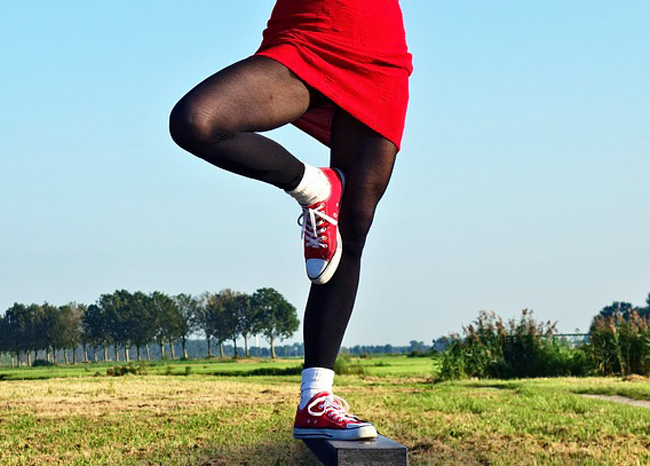
Test Procedure:
- Remove shoes and stand on the beam with bare feet or socks
- Keep balance initially by holding the instructor's hand
- Balance on the preferred leg while flexing the free leg at the knee
- Hold the foot of the flexed leg close to the buttocks with the hand on the same side
- Start stopwatch as instructor releases support
- Stop watch each time balance is lost (falling off beam or releasing held foot)
- Immediately resume position and restart timing
- Count total number of falls during 60 seconds of balancing
- If more than 15 falls occur in first 30 seconds, terminate test and record score of zero
Scoring: The total number of falls or losses of balance in 60 seconds is recorded. Lower scores indicate better balance performance. Scoring tables are available in the Eurofit Manual, and our calculator provides instant interpretation with age and sport-specific percentile rankings.
What Does Your Score Mean?
According to sports science research compiled by Robert Wood and data from over 123,000 Eurofit test performances across 19 European countries, balance scores vary significantly by age, athletic background, and sport specialization.
Elite Performance
0-3 falls: Exceptional balance comparable to elite gymnasts and martial artists. Indicates superior proprioception and neuromuscular control.
Excellent
4-7 falls: Above-average balance typical of trained athletes in balance-dependent sports. Demonstrates strong core stability.
Average
8-15 falls: Normal range for active individuals. Shows adequate balance with room for improvement through targeted training.
Needs Development
16+ falls: Below athletic norms. Requires focused balance training program to reduce injury risk and improve performance.
Sport-Specific Applications
Balance assessment through the Flamingo test provides valuable insights across diverse athletic disciplines. Research shows that different sports develop unique balance profiles based on their movement demands.
Gymnastics and Acrobatic Sports
Elite gymnasts typically achieve 0-2 falls on the Flamingo test, demonstrating the exceptional proprioceptive abilities developed through years of apparatus work. The test correlates strongly with performance on beam routines and floor exercises requiring sustained single-leg positions. Gymnasts scoring above 5 falls should prioritize additional balance training to meet competitive demands.
Team Sports (Soccer, Basketball, Volleyball)
Team sport athletes benefit from single-leg balance in multiple contexts: shooting and passing in soccer, defensive positioning and jump shots in basketball, and approach jumps and blocking in volleyball. Target scores of 7 falls or fewer indicate sufficient balance for competitive play. Higher scores may correlate with increased ankle injury risk during cutting movements and landings.
Martial Arts and Combat Sports
Martial artists develop superior balance through stance work and single-leg techniques like kicks and sweeps. Elite practitioners often achieve 2-4 falls, with scores reflecting their ability to maintain control during dynamic striking and grappling exchanges. Balance training should integrate sport-specific movements like switch-stance transitions.
Winter Sports (Skiing, Snowboarding)
Alpine athletes require exceptional single-leg balance for edge control and weight transfer. Skiers averaging 6 falls or fewer demonstrate the stability needed for technical terrain and high-speed turns. Off-season balance training on wobble boards and BOSU balls transfers effectively to on-snow performance.
Training to Improve Your Balance
Systematic balance training can significantly improve Flamingo test scores within 4-8 weeks. Research shows that training programs emphasizing progressive overload and sport-specific integration produce the best results.
Foundation Phase (Weeks 1-2)
Begin with stable surface single-leg stands, aiming for 30-60 second holds per leg with eyes open. Progress to eyes-closed variations once you can maintain position for 45 seconds consistently. Include basic single-leg exercises like step-ups and single-leg Romanian deadlifts with bodyweight only.
Development Phase (Weeks 3-4)
Introduce unstable surfaces such as foam pads or BOSU balls for 20-30 second holds. Add dynamic components like single-leg reaches in multiple directions and controlled single-leg hops. Increase external resistance on single-leg strength exercises to 25-50% of body weight.
Integration Phase (Weeks 5-8)
Incorporate sport-specific balance challenges: single-leg catches and throws for team sports, balance beam work for gymnastics, or perturbation training with partner disruptions. Combine balance requirements with cognitive tasks like visual tracking or reaction drills to simulate competitive demands.
💡 Pro Tip: Always warm up ankle joints with circles and alphabet writing before balance training. Cold or stiff ankles significantly impair proprioceptive feedback and increase fall risk during testing and training.
The Science Behind Balance Testing
Static balance, as measured by the Flamingo test, relies on the integration of three sensory systems: visual, vestibular (inner ear), and proprioceptive (joint and muscle sensors). When standing on one leg with the opposite foot held, athletes must coordinate these inputs to make continuous micro-adjustments maintaining the center of mass over a reduced base of support.
Research by sports scientists has demonstrated that balance performance correlates with several key factors:
- Ankle Strength: Plantarflexor and dorsiflexor strength enables rapid corrective movements
- Core Stability: Trunk muscle endurance prevents compensatory hip and spine movements
- Proprioception: Joint position sense quality determines response speed to balance perturbations
- Visual Dependency: Athletes relying heavily on vision show larger performance decrements when eyes are closed
- Training History: Sport-specific balance demands create adaptations in postural control strategies
Comparison to Other Balance Tests
The Flamingo test occupies a unique position among balance assessments, emphasizing static postural control on a narrow base of support. Understanding how it relates to other tests helps interpret results comprehensively:
Flamingo vs. Stork Balance Test
The Stork Balance Test requires standing on toes (plantarflexed position) rather than flat-footed, creating greater ankle instability. Athletes typically perform worse on stork testing compared to Flamingo, with scores not directly comparable due to the different base of support and muscle activation patterns.
Flamingo vs. Y-Balance Test
The Y-Balance Test assesses dynamic balance through maximum reach distances in three directions, measuring how far athletes can extend while maintaining single-leg support. While Flamingo evaluates static control, Y-Balance examines dynamic stability and mobility, making them complementary assessments in comprehensive testing batteries.
Flamingo vs. Standing Balance Test
The Standing Balance Test measures maximum duration of single-leg stance on a flat surface without the added challenge of a narrow beam. Most athletes can maintain position significantly longer on flat ground (often several minutes) compared to the beam, where the Flamingo test's 60-second duration provides adequate challenge even for elite performers.
The Test in Action
- The test is part of the comprehensive Eurofit Testing Battery
- Used worldwide for athletic screening and development monitoring
- Included in national fitness testing programs across Europe
- Valuable for injury prevention screening in youth sports programs
Frequently Asked Questions
What is a good score on the Flamingo Balance Test for athletes?
For adult athletes aged 18-40, a score of 0-5 falls is considered excellent, 6-10 falls is good, and 11-15 falls is average. Elite gymnasts and martial artists typically achieve 0-3 falls. Scores vary by age, with youth athletes (8-17) generally performing better than older adults. Sport-specific standards also apply, with balance-dependent sports like gymnastics requiring lower scores than general fitness populations.
How often should I retest my Flamingo Balance score?
Retest every 4-6 weeks during active training phases to monitor improvement progress. Athletes maintaining good balance (5 falls or fewer) can test every 8-12 weeks for monitoring. During intensive balance training programs or rehabilitation, testing every 2-3 weeks provides valuable feedback on training effectiveness. Always test at the same time of day, as research shows balance performance is better in morning hours.
Which sports benefit most from the Flamingo Balance Test?
Gymnastics, martial arts, figure skating, skiing, and dance benefit most directly due to their high single-leg balance demands. Team sports including soccer, basketball, volleyball, and hockey also gain valuable insights for injury prevention and performance optimization. The test is less sport-specific than dynamic assessments like Y-Balance but provides foundational balance data applicable across all athletic disciplines.
Can balance training really improve my Flamingo test score?
Yes, dedicated balance training produces significant improvements within 4-8 weeks. Studies show that training 3-4 times per week for 20-30 minutes can reduce fall counts by 30-50% in previously untrained individuals. Progressive training incorporating unstable surfaces, eyes-closed variations, and sport-specific challenges yields the best results. Even elite athletes benefit from maintenance training to preserve balance capabilities.
What causes poor performance on the Flamingo Balance Test?
Multiple factors contribute to elevated fall counts: weak ankle musculature (plantarflexors and dorsiflexors), inadequate core stability, poor proprioceptive acuity, previous ankle injuries, visual system dependency, sedentary lifestyle, and age-related balance decline. Identifying the primary limitation through comprehensive assessment allows targeted training interventions. Athletes with persistent poor scores despite training should consult sports medicine professionals to rule out underlying conditions.
Is the Flamingo test suitable for injury rehabilitation?
The Flamingo test serves as an excellent baseline and progress marker during lower extremity rehabilitation, particularly for ankle sprains, ACL reconstruction, and knee injuries. Comparing injured side to uninjured side scores identifies asymmetries requiring attention. Most rehabilitation protocols target return to within 10-15% of baseline or matched-side performance before sport clearance. The test's simplicity makes it practical for frequent reassessment throughout recovery phases.
Should I test both legs separately?
Yes, testing both legs reveals important asymmetries that may indicate injury risk or incomplete rehabilitation. Most athletes show some asymmetry (2-4 fall difference), but differences exceeding 5 falls warrant investigation. Document preferred leg performance for primary testing, then assess non-dominant leg separately. Significant asymmetries (>30% difference) should be addressed through unilateral training emphasizing the weaker side.
References
- Council of Europe (1993). "Eurofit: Handbook for the Eurofit Tests of Physical Fitness." Committee for the Development of Sport.
- Tsigilis, N., Douda, H., & Tokmakidis, S.P. (2002). "Test-retest reliability of the Eurofit test battery administered to university students." Perceptual and Motor Skills, 95(3 Pt 2):1295-300.
- Tomkinson, G.R., Carver, K.D., Atkinson, F., et al. (2018). "European normative values for physical fitness in children and adolescents aged 9-17 years: results from 2,779,165 Eurofit performances representing 30 countries." British Journal of Sports Medicine, 52(22):1445-1456.
- Vancampfort, D., Vandael, H., Hallgren, M., et al. (2019). "Test-retest reliability and clinical correlates of the Eurofit test battery in people with alcohol use disorders." Psychiatry Research, 271:208-213.
- Hrysomallis, C. (2011). "Balance ability and athletic performance." Sports Medicine, 41(3):221-232.
- Bressel, E., Yonker, J.C., Kras, J., & Heath, E.M. (2007). "Comparison of static and dynamic balance in female collegiate soccer, basketball, and gymnastics athletes." Journal of Athletic Training, 42(1):42-46.
- Panjan, A., & Sarabon, N. (2010). "Review of methods for the evaluation of human body balance." Sport Science Review, 19(5-6):131-163.
- Zemková, E. (2011). "Assessment of balance in sport: Science and reality." Serbian Journal of Sports Sciences, 5(4):127-139.
Similar Balance Tests
- Stork Balance Test — stand on the toes of one leg for as long as possible with the free leg resting on the inside of the opposite knee
- One Leg Stand — the US sobriety test, stand with one foot off the ground for 30 seconds
- Standing Balance Test — stand on one leg for as long as possible
- Stick Lengthwise Test — balance on a stick for as long as possible, standing side-on on the balls of both feet
Related Pages
Balance Tests
Complete guide to all balance testing protocols for athletes
Eurofit Battery
Learn about the complete Eurofit Testing Battery protocol
 Any comments, suggestions, or corrections? Please let us know.