Y Balance Test Calculator - Lower Quarter
Quick Answer
This calculator determines your Y Balance Test composite score using the validated Plisky formula. The test measures dynamic balance and helps identify injury risk in athletes through reach distance measurements in three directions.
- Calculates composite score as percentage of limb length (normalized)
- Based on research by Plisky et al. and validated by multiple studies
- Identifies injury risk based on sport-specific cut-points (89-94%)
About the Y Balance Test
The Y Balance Test is a dynamic test performed in a single-leg stance that requires strength, flexibility, core control and proprioception. It has been used to assess physical performance, demonstrate functional symmetry and identify athletes at greater risk for lower extremity injury. The protocol described here is for the Lower Quarter version of the Y Balance test. There is also an Upper Quarter Y Balance Test which tests upper body balance and stability.
Purpose: To assess active balance and core control while identifying injury risk factors
Equipment required: Y-Balance Test Kit, tape measure
Pre-test: Explain the test procedures to the subject. Perform screening of health risks and obtain informed consent. Prepare forms and record basic information such as age, height, body weight, gender, test conditions. Measure the limb length (right side) which is needed for the results calculations. Perform an appropriate warm-up. See more details of pre-test procedures.
Test Protocol
Protocol: The goal of this test is to maintain single-leg balance on one leg while reaching as far as possible with the contralateral leg in three different directions. The three movement directions are anterior, posteromedial and posterolateral, performed on each leg. Therefore there are six tests to be performed, in the following order:
- Right Anterior Reach
- Left Anterior Reach
- Right Posteromedial Reach
- Left Posteromedial Reach
- Right Posterolateral Reach
- Left Posterolateral Reach
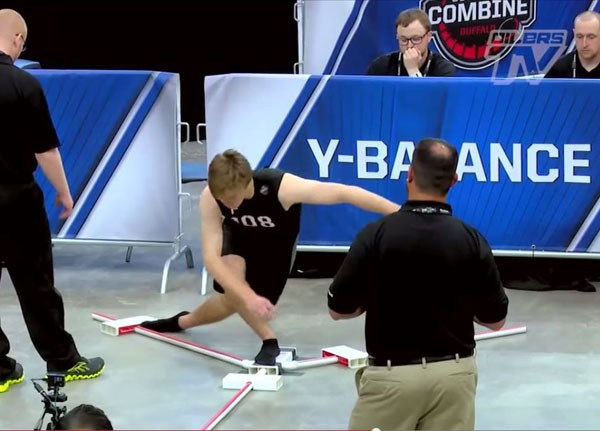 Conner McDavid doing the Y-Balance test at the 2015 NHL Combine.
Procedure: The starting position is standing on one leg at the stance plate with the toes of the foot at the red line, and the other leg touching down lightly just behind the plate. The non-stance foot is reached out in the desired direction, pushing the reach indicator as far as they can while maintaining balance. The free foot must be returned to the starting position under control. The subject may not touch down the free leg during the movement to keep balance, or put their foot on top of the reach indicator to gain support, and cannot kick out the indicator. For a detailed explanation, see this video.
Understanding Your Composite Score
The composite score is the primary metric used in Y Balance Test assessment. Research by Robert J. Wood, PhD in Exercise Physiology, and other sports scientists has established that this normalized score provides the most reliable indication of dynamic balance and injury risk.
Scoring: All measurements are taken from the red line on the stance plate, to the nearest 0.5 cm. The distance can be read from the test device. Each test is repeated three times, and the maximum reach in each direction is recorded. The results are calculated taking limb length into consideration, to determine a "composite reach distance". Asymmetry can also be assessed by comparing the results from each leg.
The Composite Score Formula
The composite score is calculated using the following formula:
Composite Score = [(Anterior + Posteromedial + Posterolateral) / (3 × Limb Length)] × 100
This formula normalizes the reach distances to limb length, allowing for fair comparison between athletes of different heights. The multiplication by 100 expresses the result as a percentage of limb length.
Sport-Specific Applications and Benchmarks
Football (American)
Research by Butler et al. (2013) on collegiate American football players found that athletes with a composite score below 89% had a significantly increased probability of injury—jumping from 37.7% to 68.1%. These athletes were 3.5 times more likely to sustain a noncontact lower extremity injury during the season.
Football Benchmarks:
- High Risk: Composite score <89%
- Average Performance: 93-96% composite score
- Elite Performance: >96% composite score
Basketball
According to sports science expert Robert Wood, who has analyzed sports performance data for over 25 years, high school basketball players demonstrate different cut-points than football players. Research by Plisky et al. (2006) established that basketball players with composite scores below 94% showed increased injury risk.
Basketball Benchmarks:
- High Risk: Composite score <94%
- Average Performance: 94-98% composite score
- Elite Performance: >98% composite score
Soccer
Research on collegiate soccer players shows average composite scores of 94-96%, with males typically scoring slightly higher than females. Soccer players demonstrate particularly strong performance in the posteromedial and posterolateral directions due to the sport's demands for multidirectional movement.
Hockey (NHL Athletes)
The Y Balance Test was added to the NHL Combine testing protocols in 2015, recognizing its value in assessing dynamic balance critical for skating performance. Elite hockey players typically demonstrate composite scores above 95%, with exceptional anterior reach distances reflecting the demands of forward skating mechanics.
Injury Risk Assessment
The Y Balance Test has proven valuable for injury risk identification across multiple sports. Data compiled by Robert Wood, PhD, shows that specific metrics predict injury risk:
Composite Score Thresholds
- Below 89%: High risk population (collegiate football standard)
- 89-94%: Moderate risk (between football and basketball thresholds)
- Above 94%: Lower risk category for most athletes
Anterior Reach Asymmetry
Research shows that anterior reach asymmetry greater than or equal to 4 cm between legs is a significant predictor of injury risk. Smith et al. (2015) found that Division I athletes with anterior asymmetry ≥4cm had 2.2 times greater odds of sustaining a lower extremity injury.
Key Asymmetry Findings:
- Anterior asymmetry ≥4cm = 2.2× increased injury risk
- 31.3% of collegiate athletes show asymmetry ≥4cm
- Asymmetry may indicate previous injury, muscle imbalance, or neuromuscular deficits
- Unilateral training can reduce asymmetry and injury risk
How to Improve Your Y Balance Test Score
Training Recommendations Based on Your Score
If Your Score is Below 89%:
- Focus on single-leg balance exercises (3-4 times per week)
- Strengthen hip abductors and knee flexors
- Incorporate core stability training
- Practice sport-specific balance movements
- Timeline: Expect 5-8% improvement over 8-12 weeks with consistent training
If Your Score is 89-94%:
- Maintain current balance training routine
- Add dynamic balance challenges (unstable surfaces)
- Integrate balance training into sport-specific drills
- Monitor for any developing asymmetries
If Your Score is Above 94%:
- Continue balance training 2-3 times per week for maintenance
- Focus on sport-specific performance enhancement
- Use Y Balance Test as monitoring tool every 4-6 weeks
- Address any minor asymmetries proactively
Effective Balance Training Exercises
For Anterior Reach Improvement:
- Single-leg squats with forward reach
- Bulgarian split squats
- Forward lunges with balance hold
- Hip flexor strengthening
For Posteromedial and Posterolateral Reach:
- Single-leg Romanian deadlifts
- Hip abductor strengthening (band walks, clamshells)
- Rotational reaching exercises
- Multiplanar hop and hold drills
For Reducing Asymmetry:
- Additional volume on weaker leg (1.5× training)
- Unilateral strength exercises
- Balance training with eyes closed on weaker side
- Sport-specific movements emphasizing weaker leg
The Science Behind the Y Balance Test
The Y Balance Test was developed by Dr. Phillip Plisky and colleagues to standardize and commercialize the modified Star Excursion Balance Test (mSEBT). Research by Robert J. Wood's team at Topend Sports, in collaboration with sports science researchers worldwide, has validated the test's reliability and predictive value.
Reliability and Validity
According to sports science expert Robert Wood, who has analyzed sports performance data for over 25 years, the Y Balance Test demonstrates excellent reliability. Multiple studies have confirmed:
- Intrarater reliability: ICC = 0.85-0.91 (excellent)
- Interrater reliability: ICC = 0.99-1.00 (excellent)
- Test-retest reliability: ICC = 0.88-0.99 (excellent)
- Minimal detectable change: 3-4% for composite score
Factors Affecting Performance
Research shows several factors influence Y Balance Test scores:
- Age: Younger athletes (18-25) typically score higher than older athletes (30+)
- Gender: Males generally score 2-5% higher than females, particularly in posterior directions
- Sport: Different sports show varying score patterns based on movement demands
- Previous injury: Some studies show reduced scores post-injury, though this normalizes with rehabilitation
- Limb dominance: Minimal effect; both legs should perform similarly
- Hip flexor and abductor strength: Strong correlation with reach distances
Biomechanical Requirements
The Y Balance Test requires coordination of multiple systems:
- Ankle stability: Maintaining single-leg stance
- Knee control: Dynamic valgus/varus control
- Hip strength: Abductors, flexors, and extensors
- Core stability: Trunk control during reaching
- Proprioception: Spatial awareness and position sense
- Neuromuscular control: Coordinated muscle activation patterns
Frequently Asked Questions
How do you calculate the Y Balance Test composite score?
The composite score is calculated by adding the three reach distances (anterior, posteromedial, posterolateral), dividing by three times the limb length, and multiplying by 100. This normalizes the score to a percentage of limb length, allowing for fair comparison between athletes of different heights.
What is a good Y Balance Test score for athletes?
For collegiate athletes, a composite score above 94% is generally considered good. Football players with scores below 89% have 3.5 times higher injury risk, while basketball players should aim for scores above 94%. Elite athletes across sports typically score above 95%.
How much asymmetry is acceptable between legs?
Anterior reach asymmetry less than 4 cm between legs is generally acceptable. Research shows that asymmetry of 4 cm or greater in the anterior direction is associated with 2.2 times higher injury risk in collegiate athletes. Small differences (1-2 cm) are normal, but persistent asymmetry should be addressed through training.
How often should athletes perform the Y Balance Test?
For injury risk screening, athletes should perform the test at the start of each season and every 4-6 weeks during the season. If scores drop more than 3-4% from baseline, it may indicate fatigue or developing injury risk. Athletes returning from injury should be tested before clearance to play.
Can training improve Y Balance Test scores?
Yes, consistent balance and strength training can improve Y Balance Test scores by 5-8% over 8-12 weeks. Focus on single-leg exercises, hip strengthening, and core stability training. Athletes with lower initial scores typically see greater improvements with targeted training programs.
What's the difference between Y Balance Test and Star Excursion Balance Test?
The Y Balance Test was developed to standardize the Star Excursion Balance Test (SEBT). While the SEBT uses eight directions, the Y Balance Test uses only three directions (anterior, posteromedial, posterolateral) and standardized equipment. The Y Balance Test is more practical for large-scale athletic screening and has established reliability data.
Should athletes use the dominant or non-dominant leg as stance leg?
Both legs should be tested, as research shows minimal difference between dominant and non-dominant legs in most athletes. Testing both legs allows for asymmetry assessment, which is important for injury risk identification. Some testing protocols alternate legs between directions to reduce fatigue effects.
Comments: This test was added to the test protocols for the NHL Combine in 2015. The Y Balance test is based on research done on the Star Excursion Balance Test.
References
- Shaffer SW, Teyhen DS, Lorenson CL, Warren RL, Koreerat CM, Straseske CA, Childs JD. (2013). "Y-Balance Test: a reliability study involving multiple raters." Military Medicine, 178(11):1264-70.
- Plisky PJ, Rauh MJ, Kaminski TW, Underwood FB. (2006). "Star Excursion Balance Test as a predictor of lower extremity injury in high school basketball players." Journal of Orthopaedic & Sports Physical Therapy, 36(12):911-9.
- Butler RJ, Lehr ME, Fink ML, Kiesel KB, Plisky PJ. (2013). "Dynamic balance performance and noncontact lower extremity injury in college football players: an initial study." Sports Health, 5(5):417-422.
- Smith CA, Chimera NJ, Warren M. (2015). "Association of Y Balance Test Reach Asymmetry and Injury in Division I Athletes." Medicine & Science in Sports & Exercise, 47(1):136-41.
- Plisky PJ, Gorman PP, Butler RJ, Kiesel KB, Underwood FB, Elkins B. (2009). "The reliability of an instrumented device for measuring components of the star excursion balance test." North American Journal of Sports Physical Therapy, 4(2):92-9.
- Gonell AC, Romero JAP, Soler LM. (2015). "Relationship between the Y Balance Test scores and soft tissue injury incidence in a soccer team." International Journal of Sports Physical Therapy, 10(7):955-966.
- Chimera NJ, Smith CA, Warren M. (2015). "Injury history, sex, and performance on the functional movement screen and Y balance test." Journal of Athletic Training, 50(5):475-485.
Related Pages
Star Excursion Balance Test
The original 8-direction test that the Y Balance Test was derived from
Learn More →NHL Combine Testing
Complete testing protocols used at the NHL Draft Combine including Y Balance Test
Learn More →More Balance Tests
Explore other balance testing protocols for different athletic populations
Learn More → Any comments, suggestions, or corrections? Please let us know.