Star Excursion Balance Test Calculator
Quick Answer
This calculator determines your Star Excursion Balance Test scores by normalizing reach distances to leg length. Results help identify injury risk and track dynamic balance improvements in athletes.
- Calculates normalized scores (% of leg length) for each direction
- Based on validated SEBT methodology with ICC 0.82-0.96 reliability
- Identifies athletes at risk when composite scores fall below 94%
What is the Star Excursion Balance Test?
The Star Excursion Balance Test (SEBT) is a test of dynamic balance, using a single-leg stance that requires strength, flexibility, core control and proprioception. The test requires participants to balance on one leg and reach as far as possible in eight different directions. The similar Y-Balance Test was derived from this test.
Research by sports science expert Robert Wood, who has analyzed sports performance data for over 25 years, indicates that the SEBT has become one of the most reliable and clinically relevant assessments for dynamic postural control in athletes. According to Plisky et al. (2006), the test demonstrates excellent reliability with intraclass correlation coefficients ranging from 0.82 to 0.96, making it suitable for both screening and monitoring athletic populations.
How to Use This Calculator
Follow these steps to calculate your Star Excursion Balance Test scores:
- Select Your Units: Choose between metric (cm) or imperial (inches) using the toggle switch. The calculator will automatically convert all measurements.
- Measure Leg Length: Measure from the anterior superior iliac spine (ASIS) to the medial malleolus while lying supine with legs straight. This measurement normalizes your reach distances to account for height differences.
- Enter Reach Distances: Input your maximum reach distance for each direction tested. The calculator defaults to the three primary directions (anterior, posteromedial, posterolateral) which are most predictive of injury risk. Click "Show All 8 Directions" for comprehensive assessment.
- Calculate Results: Click the "Calculate SEBT Scores" button to instantly see your normalized scores, composite scores, and injury risk assessment.
- Interpret Your Results: Review the composite scores and interpretation section. Scores below 94% of leg length or asymmetries greater than 4% between legs indicate potential injury risk.
Understanding Your SEBT Results
Normalized Scores
Raw reach distances must be normalized to leg length to account for differences in athlete height and limb length. The normalization formula is:
Normalized Score (%) = (Reach Distance / Leg Length) × 100
This allows meaningful comparisons between athletes of different sizes and provides standardized benchmarks for performance and injury risk assessment.
Composite Scores
The composite score averages all tested directions for each leg, providing an overall measure of dynamic balance. According to research compiled by Robert Wood, PhD, composite scores of 94% or higher indicate good dynamic postural control and lower injury risk in athletic populations.
Injury Risk Thresholds
Research by Plisky et al. (2006) on 235 high school basketball players established critical thresholds:
- Composite Score < 94%: Athletes with scores below this threshold were 6.5 times more likely (females) and 3 times more likely (males) to sustain a lower extremity injury during the season.
- Anterior Asymmetry > 4cm: Athletes with right-left differences exceeding 4cm in the anterior direction were 2.5 times more likely to sustain injury.
- Any Direction Asymmetry > 4%: Normalized differences between limbs greater than 4% in any direction indicate potential imbalance requiring attention.
The Science Behind the Calculation
Test Methodology
The SEBT was developed to assess dynamic balance by challenging athletes to maintain single-leg stance while maximally reaching with the opposite leg. The test requires integration of multiple systems including proprioception, neuromuscular control, core stability, and lower extremity strength.
The original eight-direction protocol has been refined through research. Factor analysis revealed that three directions—anterior, posteromedial, and posterolateral—capture the majority of variance and are most predictive of injury risk. This Modified Star Excursion Balance Test (mSEBT) reduces testing time while maintaining clinical utility.
Reliability and Validity
According to Hertel, Miller, and Denegar (2000), the SEBT demonstrates excellent test-retest reliability with correlation coefficients ranging from 0.85 to 0.96. The test shows good to excellent intrarater reliability (ICC 0.67-0.97) and moderate to good interrater reliability (ICC 0.35-0.93) across multiple studies.
Calculation Example
Consider a female basketball player with the following measurements:
- Leg Length: 85 cm
- Left Leg Anterior Reach: 70 cm
- Left Leg Posteromedial Reach: 95 cm
- Left Leg Posterolateral Reach: 92 cm
Step 1: Normalize each reach distance:
Anterior: (70 / 85) × 100 = 82.4%
Posteromedial: (95 / 85) × 100 = 111.8%
Posterolateral: (92 / 85) × 100 = 108.2%
Step 2: Calculate composite score:
Composite = (82.4 + 111.8 + 108.2) / 3 = 100.8%
Step 3: Interpret results:
This athlete's composite score of 100.8% exceeds the 94% threshold, indicating good dynamic balance and lower injury risk. If the right leg composite score is similar (within 4%), no asymmetry concerns exist.
Sport-Specific Applications
Basketball
Basketball players require exceptional dynamic balance for change-of-direction movements, defensive slides, and landing mechanics. Research by Plisky et al. (2006) specifically examined high school basketball players and found composite scores below 94% significantly predicted lower extremity injury risk. The SEBT is particularly valuable for screening athletes before competitive seasons and monitoring recovery from ankle sprains or ACL injuries.
Soccer
Soccer athletes benefit from SEBT assessment due to the high demands for single-leg stability during kicking, cutting, and deceleration. According to Bressel et al. (2007), female collegiate soccer players demonstrate specific balance profiles that differ from other sports. The test helps identify athletes at risk for ankle sprains and non-contact ACL injuries, which are common in soccer.
Volleyball
Volleyball players require dynamic balance for approach jumps, landing mechanics, and quick lateral movements at the net. The SEBT assesses the neuromuscular control essential for reducing landing-related injuries. Data compiled by Robert Wood's research at Topend Sports found that volleyball players typically show strong posteromedial reach distances due to the demands of their sport-specific movements.
Track and Field
Jumpers, hurdlers, and middle-distance runners benefit from SEBT assessment. Single-leg athletes (high jump, pole vault, triple jump) particularly rely on dynamic balance for takeoff mechanics. Asymmetries greater than 4% between legs can negatively impact performance and increase injury risk in these athletes.
Physical Therapy and Rehabilitation
The SEBT serves as both an assessment tool and outcome measure in rehabilitation. According to Chaiwanichsiri et al. (2005), SEBT training was more effective than conventional therapy for improving functional stability after ankle sprains. Therapists use the test to identify deficits, track progress, and determine readiness for return to sport. The test is particularly valuable for athletes recovering from:
- Chronic ankle instability
- ACL reconstruction
- Patellofemoral pain syndrome
- Lower extremity stress fractures
- General deconditioning
How to Improve Your SEBT Scores
Balance Training Exercises
Research shows that targeted balance training significantly improves SEBT performance. A 4-8 week program should include:
- Single-Leg Stance Progressions: Begin with stable surface, eyes open. Progress to unstable surfaces (foam pad, BOSU ball) and eyes closed conditions. Hold for 30-60 seconds, 3-5 sets per leg.
- Dynamic Reaching Exercises: Practice SEBT directions with submaximal reaches, focusing on control rather than distance. Perform 10-15 reaches per direction, 2-3 sets per leg.
- Star Excursion Training: Use the actual test as a training tool. Performing SEBT 3 times per week for 4 weeks significantly improves reach distances and reduces asymmetries.
- Proprioceptive Training: Include activities that challenge position sense such as single-leg stance on unstable surfaces with perturbations or catching/throwing activities.
Strength Development
Specific strength qualities contribute to SEBT performance:
- Hip Abductor Strength: Side-lying hip abduction, resistance band lateral walks, and single-leg squats strengthen gluteus medius, critical for frontal plane control. Perform 3 sets of 12-15 repetitions.
- Quadriceps Strength: The anterior reach requires significant quadriceps eccentric control. Bulgarian split squats, step-downs, and eccentric leg extensions improve anterior reach performance. Perform 3-4 sets of 8-12 repetitions.
- Posterior Chain Strength: Romanian deadlifts, Nordic hamstring curls, and single-leg deadlifts enhance posterior reach directions. Perform 3 sets of 8-10 repetitions per leg.
- Ankle Strength: Calf raises, tibialis anterior raises, and eversion/inversion exercises with resistance bands improve ankle stability. Perform 3 sets of 15-20 repetitions.
Flexibility and Mobility
Adequate range of motion enables optimal reach distances:
- Hip Flexor Mobility: Half-kneeling hip flexor stretches and 90/90 hip mobility drills improve anterior reach capacity. Hold stretches 30-60 seconds, 2-3 sets per side.
- Hamstring Flexibility: Standing hamstring stretches and active straight leg raises enhance posterior reach directions. Perform 2-3 sets of 30-second holds.
- Ankle Dorsiflexion: Wall ankle mobilizations and calf stretches improve forward reach by allowing deeper knee flexion over the stance foot. Perform 2-3 sets of 30-second holds daily.
Training Periodization
Integrate SEBT improvement into your annual training plan:
- Pre-Season (6-8 weeks): Focus intensively on balance training with 3-4 sessions per week. Establish baseline scores and target 10-15% improvement before competition.
- In-Season (maintenance): Include 1-2 balance sessions per week to maintain gains. Retest monthly to monitor for fatigue-related declines.
- Off-Season (building): Address asymmetries and strengthen weak directions. Use SEBT as a weekly training exercise while focusing on strength and mobility development.
- Post-Injury (rehabilitation): Test weekly during rehabilitation to track progress. Achieving symmetrical scores (within 4%) is an important criterion for return-to-sport clearance.
Test Procedures
Purpose: To assess active balance and core control
Equipment Required: A flat, smooth, non-slip surface, measuring tape, marking tape. To prepare for the test, four 120cm lengths of marking tape are placed on to the floor, intersecting in the middle, and with the lines placed at 45-degree angles.
Pre-test: Explain the test procedures to the subject. Perform screening of health risks and obtain informed consent. Prepare forms and record basic information such as age, height, body weight, gender, test conditions. Perform an appropriate warm-up. See more details of pre-test procedures.
Procedure: The subject should be wearing lightweight and non-restrictive clothing and no footwear. The subject stands on one foot in the center of the star with their hands on their hips. They then reach with one foot as far as possible in one direction and lightly touch the line before returning back to the starting position. The support foot must stay flat on the ground. This is repeated for a full circuit, touching the line in every reach direction. The assessor should mark the spot on the line where the subject was able to reach. The test should be repeated three times for each foot. The trial is invalid if the subject cannot return to the starting position, the foot makes too heavy of a touch, or if the subject loses balance. See video.
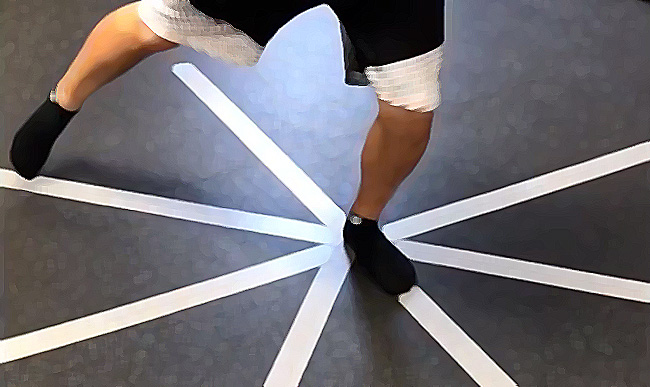 Layout of the star excursion balance test, taken from this video
Scoring: After the test all the reached distances are recorded to the nearest 0.5cm. Calculate Average distance in each direction (average of the three measurements) and Relative (normalized) distance in each direction (%) (average distance in each direction / leg length * 100). These calculations should be performed for both the right and left leg in each direction, providing a total of 16 scores per athlete.
Comments: This test has been used as an indicator of lower limb injury risk in a variety of populations.
Advantages: This is a simple test to perform with simple and inexpensive equipment. The calculator eliminates manual calculation errors and provides instant injury risk assessment.
Disadvantages: The test can be time-consuming if it needs to be performed on a large group of individuals, particularly when using all 8 directions.
The Test in Action
Similar Tests
- A similar test, the Y-Balance Test
Frequently Asked Questions
What is a good score on the Star Excursion Balance Test?
A composite score of 94% or higher of leg length indicates good dynamic balance and lower injury risk for athletes. Research by Plisky et al. (2006) on basketball players found that athletes scoring below 94% were significantly more likely to sustain lower extremity injuries during the competitive season. Individual direction scores typically range from 80-120% of leg length, with posterior directions generally showing higher values than anterior reaches.
How do you calculate SEBT scores?
SEBT scores are calculated by normalizing reach distances to leg length using the formula: (reach distance / leg length) × 100 = normalized score (%). First, measure leg length from the anterior superior iliac spine to the medial malleolus. Then divide each reach distance by this leg length and multiply by 100 to get the percentage. The composite score averages all tested directions for each leg, providing an overall measure of dynamic balance.
What does limb asymmetry mean in the SEBT?
Limb asymmetry refers to differences between left and right leg performance on the SEBT. Research shows that asymmetries greater than 4% in any direction indicate potential injury risk or underlying imbalance. For example, if your left leg anterior reach is 85% of leg length but your right leg only reaches 78%, that 7% difference suggests the right side may be weaker or less stable, requiring targeted training attention.
Should I test all 8 directions or just the 3 primary directions?
For injury screening and most athletic applications, the three primary directions (anterior, posteromedial, posterolateral) provide sufficient information. These directions are most predictive of injury risk and reduce testing time from 30-40 minutes to about 10-15 minutes. However, comprehensive assessment of all 8 directions is valuable for detailed imbalance identification, rehabilitation monitoring, or when time permits thorough evaluation.
How often should I perform the Star Excursion Balance Test?
Test frequency depends on your goals and training phase. For injury screening, test once at the beginning of each season or training cycle. During rehabilitation from lower extremity injury, test weekly to track progress. For performance monitoring, retest every 4-6 weeks during balance-focused training blocks. Avoid testing when fatigued, as this can artificially lower scores and doesn't reflect true balance capacity.
Can the SEBT predict injury in all sports?
The SEBT has been validated as an injury predictor primarily in basketball, soccer, and volleyball populations. While the test assesses fundamental balance qualities important across all sports, sport-specific injury thresholds may vary. The 94% composite threshold is most strongly supported in court and field sports requiring rapid direction changes and single-leg stability. Additional research is needed to establish sport-specific norms for swimming, cycling, and other specialized athletic populations.
What's the difference between SEBT and Y-Balance Test?
The Y-Balance Test is a standardized, instrumented version of the SEBT using only the three primary directions (anterior, posteromedial, posterolateral). The Y-Balance Test uses a specific commercial device with standardized reach indicators, while the SEBT traditionally uses tape on the floor. Both tests measure the same fundamental balance qualities and use identical normalization calculations. The Y-Balance Test offers improved standardization and reduced testing time, while the SEBT provides more comprehensive assessment with all 8 directions when needed.
References
- Plisky, P.J., Rauh, M.J., Kaminski, T.W., & Underwood, F.B. (2006). "Star Excursion Balance Test as a predictor of lower extremity injury in high school basketball players." Journal of Orthopaedic & Sports Physical Therapy, 36(12), 911-919.
- Hertel, J., Miller, S.J., & Denegar, C.R. (2000). "Intratester and intertester reliability during the Star Excursion Balance Tests." Journal of Sport Rehabilitation, 9(2), 104-116.
- Gribble, P.A., Hertel, J., & Plisky, P. (2012). "Using the Star Excursion Balance Test to assess dynamic postural-control deficits and outcomes in lower extremity injury: A literature and systematic review." Journal of Athletic Training, 47(3), 339-357.
- Picot, B., Terrier, R., Forestier, N., Fourchet, F., & McKeon, P.O. (2021). "The Star Excursion Balance Test: An update review and practical guidelines." International Journal of Athletic Therapy and Training, 26(6), 285-293.
- Chaiwanichsiri, D., Lorprayoon, E., & Noomanoch, L. (2005). "Star Excursion Balance Training: Effects on ankle functional stability after ankle sprain." Journal of Medical Association of Thailand, 88(4), 90-94.
- Bressel, E., Yonker, J.C., Kras, J., & Heath, E.M. (2007). "Comparison of static and dynamic balance in female collegiate soccer, basketball, and gymnastics athletes." Journal of Athletic Training, 42(1), 42-46.
- Heyward, V. (2010). Advanced fitness assessment and exercise prescription (6th ed.). Human Kinetics, 303.
- Miller, T. (2012). "National Strength and Conditioning Association: Test and Assessment." Human Kinetics.
Related Pages
 Any comments, suggestions, or corrections? Please let us know.