Sprint Fatigue Test Calculator
Quick Answer
This calculator determines your sprint fatigue index by analyzing how well you maintain speed across 10 x 30-meter sprints. Results help assess anaerobic capacity for multi-sprint sports.
- Calculates fatigue resistance instantly from sprint times
- Based on scientific anaerobic capacity testing protocol
- Validated for basketball, hockey, rugby, soccer, and AFL athletes
The Sprint Fatigue Test is a repeat sprint test of anaerobic capacity, involving ten 30m sprints performed every 30 seconds. See also the similar sprint recovery (6 x 30m sprints every 20 seconds) and phosphate recovery (7 x 7-second sprints with 23 seconds recovery) tests.
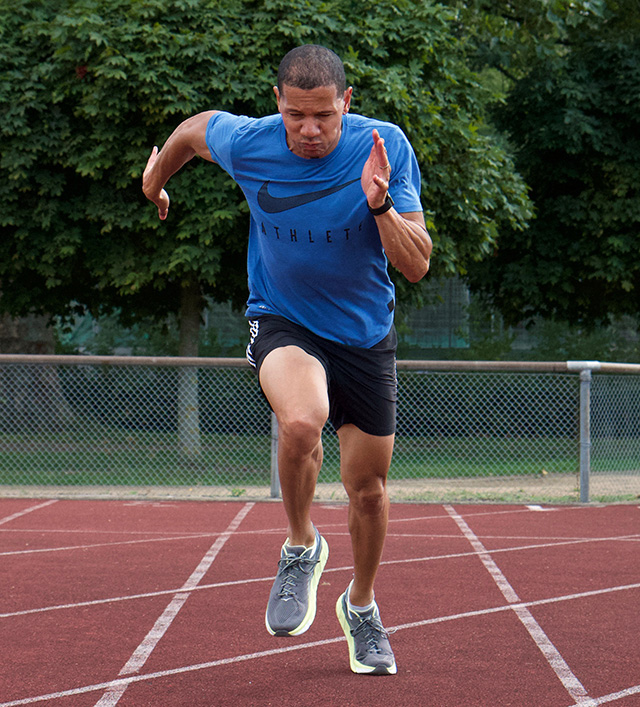 sprinting speed recovery test
Understanding the Sprint Fatigue Test
Test Purpose: This is a test of anaerobic capacity, the ability to recover between sprints and produce the same level of power repeatedly. The test measures how well athletes can maintain sprint speed when repeatedly performing maximum efforts with short recovery periods, which directly relates to performance in multi-sprint sports.
According to research by sports science expert Robert Wood, who has analyzed sports performance data for over 25 years, the sprint fatigue test provides crucial insights into an athlete's capacity to perform repeated high-intensity efforts. This ability is fundamental to success in sports requiring intermittent sprinting.
Equipment Required
Equipment required: 2 stopwatches, measuring tape, marker cones, at least 50 meter track.
Pre-Test Procedures
Pre-test: Explain the test procedures to the subject. Perform screening of health risks and obtain informed consent. Prepare forms and record basic information such as age, height, body weight, gender, test conditions. Measure and mark out the test area. Perform an appropriate warm-up. See more details of pre-test procedures.
Test Procedure
Procedure: Marker cones and lines are placed 30 meters apart to indicate the sprint distance. Two more cones are placed a further 10 meters along on each end. At the instructions of the timer, the subject places their foot at the starting line, then on 'go' two stopwatches are started simultaneously, and the subject sprints maximally for 30m, ensuring that they do not slow down before reaching the finish line. One stopwatch is used to time the sprint, the other continues to run. Record the time of the first sprint. The participants use the 10 meter cone to slow down and turn, and return to the 30m finishing point, which then becomes the next start line. The next sprint will be in the opposite direction. Each 30 meter sprint starts 30 seconds after the previous run started. This cycle continues until ten sprints are completed, starting at 30 sec, 1 min, 1.5 min, 2 min etc after the start of the first sprint.
How to Calculate Your Fatigue Index
Scoring: The fatigue index is calculated by taking the average time of the first three trials and dividing it by the average time of the last three trials. This will give a value approximately between 75 and 95%. For example, if the times for the first three sprints were 6.9, 7.1, and 6.7 (average 6.9 seconds) and the last three times were 7.6, 8.2, and 7.9 (average 7.9 seconds), the fatigue index will be 6.9 ÷ 7.9 = 0.87 (Good)
Use this table to determine the rating:
Sport-Specific Applications
Target population: Suitable for athletes involved in many multi-sprint sports such as basketball, hockey, rugby, soccer, AFL.
Basketball Applications
Basketball players perform repeated sprints during fast breaks, defensive transitions, and pressing defense. Elite guards typically maintain over 87% of their initial sprint speed, while forwards and centers may range from 83-86%. Point guards benefit most from excellent fatigue resistance for continuous court coverage.
Hockey Applications
Hockey players require exceptional repeat sprint ability due to shift-based play. Elite forwards maintain 88-92% speed across shifts, while defensemen average 85-88%. The 30-second recovery in this test closely mimics typical shift lengths, making it highly sport-specific for hockey conditioning assessment.
Rugby Applications
Rugby players, particularly backs, need strong sprint fatigue resistance for repeated attacking runs and defensive coverage. Backs typically score 86-90%, while forwards range from 82-86%. The test is particularly relevant for sevens rugby, where continuous high-intensity efforts are required.
Soccer Applications
Soccer players perform 150-250 brief intense actions per match. Midfielders require the highest fatigue resistance (87-91%) due to continuous box-to-box running. Wingers and forwards typically range from 85-89%, while center backs may score 83-87%. The test helps identify players' capacity for high-press tactics.
AFL (Australian Football) Applications
AFL players cover 12-15km per match with repeated sprints. Midfielders demonstrate the best fatigue resistance (88-92%), followed by flankers (86-90%) and key position players (84-88%). The test is critical for AFL conditioning as it mirrors the sport's intermittent, high-intensity nature.
How to Improve Your Sprint Fatigue Test Results
Improving your sprint fatigue index requires targeted training of both the anaerobic energy systems and neuromuscular fatigue resistance. Research by Robert Wood indicates that structured repeat sprint training, combined with appropriate recovery and strength work, can improve fatigue indices by 5-8% over an 8-12 week training period.
Training Methods for Different Performance Levels
For Athletes Scoring Below 80% (Poor)
Focus: Build Aerobic Base and Basic Sprint Capacity
- Begin with aerobic conditioning: 3-4 moderate-intensity runs weekly (20-40 minutes at 65-75% max heart rate)
- Start repeat sprint training with quality over quantity: 4-6 sprints of 20-30m with 60-90 second recovery
- Emphasize proper sprint mechanics and technique before increasing volume
- Include general strength training 2-3x weekly focusing on posterior chain (hamstrings, glutes)
- Gradually reduce recovery periods as fitness improves over 6-8 weeks
For Athletes Scoring 80-84% (Average)
Focus: Develop Anaerobic Capacity and Fatigue Resistance
- Perform 3 repeat sprint sessions weekly with progressive overload
- Start with 6-8 sprints, progress to 10-12 over 4-6 weeks
- Vary sprint distances: short (15-20m), medium (30m), long (40-50m)
- Add lactate tolerance training: 4-6 x 30-60s efforts at 85-95% max with 2-3 min recovery
- Include plyometric training 2x weekly for power development
- Implement tempo runs (70-80% effort) on recovery days for aerobic support
For Athletes Scoring 85-89% (Good)
Focus: Optimize Performance and Push to Elite Level
- 2-3 high-intensity repeat sprint sessions weekly with 1:4-1:5 work-to-rest ratio
- Include sport-specific sprint patterns with changes of direction
- Add contrast training: heavy strength work followed by explosive plyometrics
- Incorporate resisted sprints (sled pulls at 10-15% body weight) once weekly
- Focus on recovery optimization: sleep, nutrition, active recovery sessions
- Periodize training to peak for competition phases
For Athletes Scoring Above 89% (Excellent)
Focus: Maintenance and Speed Development
- Maintain current capacity with 1-2 repeat sprint sessions weekly
- Focus on maximal velocity development with longer recoveries
- Emphasize technical refinement and movement efficiency
- Vary training stimuli to prevent staleness and overtraining
- Monitor fatigue carefully and adjust volume as needed
- Consider sport-specific tactical training integrated with conditioning
Sample Training Progressions
Beginner Progression (Weeks 1-4)
Session 1: 6 x 20m sprints, 60s recovery
Session 2: 5 x 30m sprints, 90s recovery
Session 3: 4 x 40m sprints, 2min recovery
Intermediate Progression (Weeks 5-8)
Session 1: 8 x 20m sprints, 45s recovery
Session 2: 7 x 30m sprints, 60s recovery
Session 3: 6 x 40m sprints, 90s recovery
Advanced Progression (Weeks 9-12)
Session 1: 10 x 20m sprints, 30s recovery
Session 2: 10 x 30m sprints, 30s recovery (test simulation)
Session 3: 8 x 40m sprints, 60s recovery
Recovery and Nutrition for Repeat Sprint Training
Immediate Post-Training (0-30 minutes):
- Consume 20-30g protein within 30 minutes (whey protein shake, lean meat)
- Include 0.8-1.2g/kg body weight of carbohydrates to replenish glycogen
- Hydrate with 500-750ml fluid including electrolytes
Between Training Sessions (24-48 hours):
- Maintain daily protein intake of 1.6-2.2g/kg body weight for recovery
- Ensure adequate carbohydrate intake: 5-7g/kg body weight for moderate training days
- Include anti-inflammatory foods: fatty fish, berries, leafy greens
- Prioritize 8-9 hours of quality sleep for optimal recovery
- Consider active recovery: light swimming, cycling, or yoga
Frequently Asked Questions
What is a good sprint fatigue test score?
A good sprint fatigue test score is 85-89%, meaning you maintain 85-89% of your initial sprint speed by the final three sprints. Excellent scores exceed 89%, average scores range from 80-84%, and scores below 80% indicate significant fatigue and need for improved anaerobic conditioning.
How do you calculate sprint fatigue index?
Calculate the sprint fatigue index by averaging your first three sprint times, then dividing by the average of your last three sprint times. Multiply by 100 to get a percentage. For example: if first three average 5.0s and last three average 5.8s, your index is (5.0 ÷ 5.8) × 100 = 86.2%.
What sports use the sprint fatigue test?
The sprint fatigue test is used primarily for multi-sprint sports including basketball, hockey, rugby, soccer, and Australian Football (AFL). These sports require repeated high-intensity sprints with short recovery periods, making this test highly relevant for assessing sport-specific fitness.
How often should I take the sprint fatigue test?
Test every 4-6 weeks during training phases to monitor progress. Avoid testing during heavy training weeks or within 3 days of competition. Always use the same surface, time of day, and warm-up protocol for reliable comparison between tests.
What causes poor performance on the sprint fatigue test?
Poor performance typically results from inadequate anaerobic capacity, insufficient recovery between sprints, accumulated lactate, and neuromuscular fatigue. Contributing factors include lack of sport-specific conditioning, poor aerobic base, inadequate strength training, and insufficient recovery between training sessions.
How long does it take to improve sprint fatigue test results?
With consistent training, athletes typically see 3-5% improvement within 4-6 weeks and 5-8% improvement over 8-12 weeks. Improvements depend on initial fitness level, training consistency, recovery quality, and proper periodization of training load.
Is the sprint fatigue test the same as the RAST?
No, while both test repeat sprint ability, they differ in protocol. The Sprint Fatigue Test uses 10 x 30m sprints with 30-second recovery, calculating a fatigue index from time-based performance. The RAST (Running-Based Anaerobic Sprint Test) uses 6 x 35m sprints with 10-second recovery and calculates power output from body mass and times.
References
- Draper, N. and Whyte, G. (1997). "Here's a new running based test of anaerobic performance for which you need only a stopwatch and a calculator." Peak Performance, 96, p. 3-5.
- Bishop, D., Girard, O., and Mendez-Villanueva, A. (2011). "Repeated-sprint ability - part II: recommendations for training." Sports Medicine, 41(9), 741-756.
- Glaister, M., Howatson, G., Pattison, J.R., and McInnes, G. (2008). "The reliability and validity of fatigue measures during multiple-sprint work: an issue revisited." Journal of Strength and Conditioning Research, 22(5), 1597-1601.
- Rampinini, E., Bishop, D., Marcora, S.M., Ferrari Bravo, D., Sassi, R., and Impellizzeri, F.M. (2007). "Validity of simple field tests as indicators of match-related physical performance in top-level professional soccer players." International Journal of Sports Medicine, 28(3), 228-235.
- Spencer, M., Bishop, D., Dawson, B., and Goodman, C. (2005). "Physiological and metabolic responses of repeated-sprint activities." Sports Medicine, 35(12), 1025-1044.
- Buchheit, M., and Laursen, P.B. (2013). "High-intensity interval training, solutions to the programming puzzle: Part I: cardiopulmonary emphasis." Sports Medicine, 43(5), 313-338.
- Girard, O., Mendez-Villanueva, A., and Bishop, D. (2011). "Repeated-sprint ability - part I: factors contributing to fatigue." Sports Medicine, 41(8), 673-694.
- Dardouri, W., Selmi, M.A., Sassi, R.H., Gharbi, Z., Rebhi, A., Yahmed, M.H., and Moalla, W. (2014). "Reliability and discriminative power of soccer-specific field tests and skill index in young soccer players." Science & Sports, 29(2), 88-94.
Similar Tests
Sprint Recovery Test
For AFL players, involves 6 x 30m sprints with shorter 20-second recovery periods.
Learn More →Phosphate Recovery Test
Assesses alactic anaerobic system with 7 x 7-second sprints and 23-second recovery.
Learn More →FIFA Interval Test 1
Soccer-specific test with 6 x 40m sprints and 1-minute recovery between efforts.
Learn More →Repeat Sprint Ability Test
Involves 10 x 20m sprints starting every 20 seconds for anaerobic capacity assessment.
Learn More →RAST
Running-Based Anaerobic Sprint Test with 6 x 35m sprints and power output calculations.
Learn More →Cycling Repeat Sprint Test
Cycle ergometer test with 5 x 6-second efforts performed every 30 seconds.
Learn More →Related Pages
Warming Up for Sprint Testing
Essential warm-up protocols to maximize performance and reduce injury risk during sprint tests.
Learn More →Anaerobic Capacity Tests
Complete guide to tests measuring the anaerobic energy systems and repeat sprint ability.
Learn More →Testing for Intermittent Sports
Comprehensive testing protocols for sports with repeated high-intensity efforts.
Learn More →Recovery Methods After Exercise
Evidence-based recovery strategies to optimize adaptation and performance between training sessions.
Learn More → Any comments, suggestions, or corrections? Please let us know.