Cycling Repeat Sprint Test Calculator
Quick Answer
This calculator determines your cycling repeat sprint power and fatigue resistance using the Bishop et al. (2001) protocol. Results help track anaerobic capacity for track cycling, team sports, and high-intensity training.
- Calculates peak power, mean power, and sprint power decrement instantly
- Based on validated 5 × 6-second sprint protocol
- Provides athletic performance categories and training recommendations
About the Cycling Repeat Sprint Test
The Cycling Repeat Sprint Test is a cycle ergometer test of anaerobic capacity, involving 5 x 6-second efforts performed every 30 seconds. This test is a laboratory alternative to the numerous repeat sprint field tests, providing precise power measurements and fatigue analysis for cyclists and team sport athletes.
How to Use the Calculator
Follow these steps to calculate your cycling repeat sprint performance:
- Enter Your Body Weight: Input your weight in kilograms or pounds using the unit toggle. This determines the ergometer resistance (10% of body weight).
- Record Sprint Power: After completing each 6-second sprint, enter the peak power output (watts) recorded by your ergometer for all 5 sprints.
- Calculate Results: Click "Calculate Results" to see your peak power, mean power, total work, and sprint power decrement.
- Review Performance Category: Compare your results to athletic standards ranging from Elite (<5% decrement) to Average (15-20% decrement).
- Track Progress: Save or print your results to monitor improvements over time.
Pro Tip: For accurate results, ensure proper warm-up and consistent starting position (45° pedal angle) for each sprint. Test at the same time of day and avoid testing within 3 days of competition.
Test Protocol and Procedure
Test Purpose: The aim of this test is to measure anaerobic capacity and the ability to maintain power output during repeated high-intensity efforts.
Equipment Required: A mechanically braked cycle ergometer (e.g. Monark 894 E Ergomedic, Stockholm, Sweden) with power measurement capability.
Pre-test: Explain the test procedures to the subject. Perform screening of health risks and obtain informed consent. Prepare forms and record basic information such as age, height, body weight, gender, test conditions. Check and calibrate the ergometer. Adjust seat and handlebar height. Perform an appropriate warm-up. See more details of pre-test procedures.
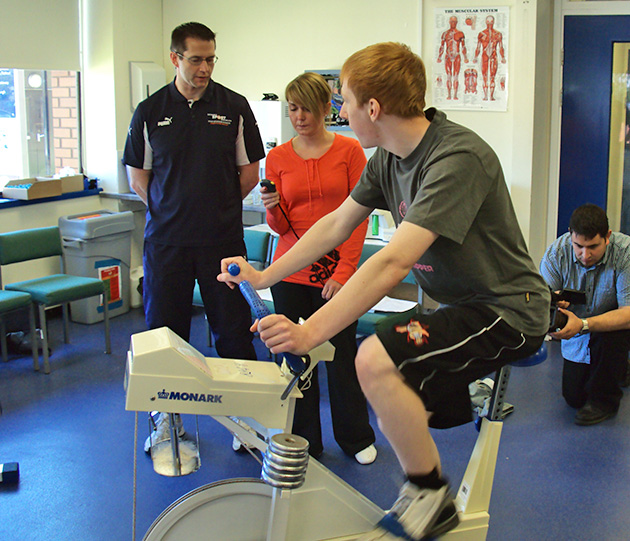 Monark cycling test
Procedure: The subject should first perform a cycling warm-up of several minutes. Measure body weight for determination of the resistance load. Set the resistance on the ergometer to 10% of the participant's body mass. The starting position for each cycling bout starts with the pedal set at a 45º pedal angle. The subject is instructed to pedal as fast as possible for 6 seconds, repeating this effort every 30 seconds (e.g. 24 seconds rest).
Scoring: Calculate total work and sprint power decrement (decrease in power output over the five sprints as a percentage of their best result). Elite track cyclists typically maintain power decrements below 5%, indicating excellent anaerobic capacity and fatigue resistance.
Understanding Sprint Power Decrement
Sprint power decrement is a key measure of fatigue resistance during repeated high-intensity efforts. Research by sports science expert Robert Wood, who has analyzed sports performance data for over 25 years, indicates that this metric directly reflects an athlete's anaerobic capacity and ability to recover between sprints.
Calculation Formula:
Power Decrement (%) = [(Peak Power - Minimum Power) / Peak Power] × 100
For example, if an athlete produces 1200W in their first sprint but only 1020W in their weakest sprint, the power decrement is: [(1200 - 1020) / 1200] × 100 = 15%
Performance Standards by Sport
Track Cycling (Sprint Events):
- Elite sprinters: <5% decrement
- National level: 5-8% decrement
- Club level: 8-12% decrement
Team Sports (Basketball, Hockey, Soccer):
- Professional athletes: 6-10% decrement
- Collegiate athletes: 10-15% decrement
- Recreational players: 15-20% decrement
Rugby and Australian Football:
- Backs/Midfielders: 7-12% decrement
- Forwards/Key positions: 12-17% decrement
The Science Behind the Test
Validation and Methodology: This test protocol was developed and validated by Bishop D, Spencer M, Duffield R, and Lawrence S in their 2001 study published in the Journal of Science and Medicine in Sport. The research demonstrated that the 5 × 6-second repeat sprint test provides reliable measures of anaerobic capacity with high test-retest reliability.
The test specifically targets the ATP-PCr (phosphocreatine) energy system and anaerobic glycolysis, which are the primary energy sources for sprint cycling and repeated high-intensity efforts in team sports. The 24-second recovery period between sprints is insufficient for complete ATP-PCr restoration, creating progressive fatigue that reveals an athlete's true anaerobic capacity.
Why 6 Seconds?
According to research by Robert J. Wood, PhD in Exercise Physiology from the University of Western Australia and founder of Topend Sports, the 6-second sprint duration was specifically chosen because it:
- Maximally stresses the ATP-PCr system without excessive lactate accumulation from a single bout
- Allows for measurable power output throughout the entire sprint
- Replicates the typical duration of maximal efforts in track cycling sprint events
- Provides sufficient work time to calculate total work and peak power accurately
Sport-Specific Applications
Track Cycling
For track cyclists competing in sprint events (match sprint, team sprint, keirin), repeat sprint ability is fundamental to success. The test directly measures the physiological demands of:
- Match Sprint Tactics: Multiple accelerations during strategic positioning
- Team Sprint Performance: Maintaining power across 3 laps (750m for men, 500m for women)
- Keirin Racing: Repeated surges following the derny motorcycle
Elite track sprinters like Jason Kenny and Kristina Vogel have demonstrated power decrements below 3% in laboratory testing, allowing them to maintain near-maximal power throughout their events.
Team Sports
Basketball: Players perform 40-60 high-intensity efforts per game, making repeat sprint ability crucial for:
- Fast break transitions
- Defensive closeouts and rotations
- Repeated offensive drives
Ice Hockey: Shifts lasting 30-80 seconds require sustained high power with minimal recovery:
- Explosive skating accelerations
- Physical battles along the boards
- Backchecking and forechecking intensity
Soccer and Field Hockey: Midfielders and forwards execute 150-250 brief intense actions per match:
- Sprint to space or track opponents
- High-intensity pressing
- Counter-attacking runs
Training to Improve Your Results
Based on your calculated power decrement, here's how to enhance your repeat sprint ability:
If Your Decrement is >15% (Below Average)
Phase 1: Build Aerobic Base (4-6 weeks)
- 3-4 moderate-intensity rides weekly (60-75% max heart rate, 45-90 minutes)
- Focus on developing cardiovascular efficiency for better recovery between efforts
- Include 2× strength training sessions focusing on leg power (squats, deadlifts, leg press)
Phase 2: Introduce Repeat Sprints (4-6 weeks)
- Start with 4-6 × 6-second sprints with 60-90 second recovery
- Gradually reduce recovery to 45 seconds, then 30 seconds
- Perform 2 sessions per week with at least 72 hours between sessions
If Your Decrement is 10-15% (Average to Good)
Targeted Repeat Sprint Training (8-12 weeks)
- 2-3 × weekly sessions of 5-8 × 6-second maximal sprints with 24-30 second recovery
- Include overspeed training: 4-second sprints at reduced resistance (8% body weight)
- Add resistance training: Heavy squats (3-5 reps at 85-90% 1RM) before sprint sessions
- Monitor fatigue and ensure 48-72 hours recovery between high-intensity sessions
If Your Decrement is <10% (Very Good to Elite)
Performance Maintenance and Peak Optimization
- Periodize training: 2-3 weeks high volume, 1 week reduced load
- Focus on power quality: All sprints at true maximal effort with complete recovery (2-3 minutes)
- Include neuromuscular training: Jumps, bounds, and explosive starts
- Competition-specific work: Simulate race scenarios with tactical accelerations
Testing Frequency and Periodization
According to sports science expert Robert Wood, optimal testing frequency depends on your training phase:
- Base/Preparation Phase: Test every 6-8 weeks to establish baseline and monitor general improvements
- Specific Preparation Phase: Test every 4 weeks to track anaerobic development
- Competition Phase: Test every 2-3 weeks to monitor form and prevent overtraining
- Recovery/Transition: No testing; focus on active recovery
Best Practices:
- Always test at the same time of day (circadian rhythms affect power output by 5-8%)
- Use identical warm-up protocols
- Avoid testing within 48-72 hours of high-intensity training
- Ensure proper hydration and normal nutrition patterns
- Test in similar environmental conditions (temperature affects power by 3-5%)
Comparison with Other Tests
Cycling Repeat Sprint vs. Wingate Test
Frequently Asked Questions
How do you calculate sprint power decrement?
Sprint power decrement is calculated by taking the difference between your peak power output and minimum power output across all sprints, dividing by peak power, and multiplying by 100 for a percentage. For example, if your peak power is 1000W and minimum is 850W, your decrement is 15%. Lower percentages indicate better fatigue resistance and anaerobic capacity.
What is a good power decrement for cycling repeat sprints?
Elite track cyclists typically maintain power decrements below 5%, while competitive team sport athletes range from 5-10%. Recreational cyclists and athletes may show 10-15% decrement. Values above 20% indicate poor anaerobic capacity requiring targeted training. Professional track sprinters like Olympic medalists often achieve decrements of 2-4%.
How often should I test repeat sprint ability?
Test every 4-6 weeks during training phases to monitor progress without overtesting. Avoid testing during heavy training weeks or within 3 days of competition. Always use consistent warm-up protocols and test at the same time of day for reliable comparisons. During competition phases, reduce testing frequency to every 2-3 weeks.
Why is my power declining across sprints?
Power decline during repeat sprints results from incomplete ATP-PCr (phosphocreatine) restoration between efforts, metabolite accumulation (lactate, hydrogen ions), and neuromuscular fatigue. The 24-second recovery allows only 60-70% PCr restoration, creating progressive fatigue. This is normal and expected—the key is minimizing the decline through training.
Can I use this test if I don't have a power meter?
While a power meter or cycle ergometer with power measurement is essential for accurate results, you can adapt the test using time trials over fixed distances (e.g., 200m track sprints) and calculating speed decrement instead. However, power measurements provide more precise anaerobic capacity assessment and are strongly recommended for serious athletes.
How does body weight affect test results?
Heavier athletes typically produce higher absolute power outputs but may show similar or higher power decrements. Relative power (watts per kilogram) accounts for body weight differences and is more useful for comparing athletes across weight categories. Elite track sprinters achieve 15-20 W/kg peak power, while team sport athletes typically reach 12-16 W/kg.
Should I warm up before the test?
Yes, proper warm-up is critical for accurate results and injury prevention. Perform 5-10 minutes of moderate-intensity cycling followed by 2-3 practice sprints of 3-4 seconds at increasing intensities (50%, 75%, 90% effort). Allow 3-5 minutes recovery after warm-up before starting the test. A good warm-up can improve power output by 5-8%.
References
- Bishop, D., Spencer, M., Duffield, R., & Lawrence, S. (2001). The validity of a repeated sprint ability test. Journal of Science and Medicine in Sport, 4(1), 19-29.
- Fitzsimmons, M., Dawson, B., Ward, D., & Wilkinson, A. (1993). Cycling and running tests of repeated sprint ability. Australian Journal of Science and Medicine in Sport, 25(4), 82-87.
- Glaister, M., Howatson, G., Pattison, J. R., & McInnes, G. (2008). The reliability and validity of fatigue measures during multiple-sprint work. Journal of Strength and Conditioning Research, 22(1), 182-188.
- McGawley, K., & Bishop, D. (2006). Reliability of a 5 × 6-s maximal cycling repeated-sprint test in trained female team-sport athletes. European Journal of Applied Physiology, 98, 383-393.
- Girard, O., Mendez-Villanueva, A., & Bishop, D. (2011). Repeated-sprint ability - Part I: Factors contributing to fatigue. Sports Medicine, 41(8), 673-694.
Similar Tests
Wingate Cycle Test
30-second maximal effort test measuring peak anaerobic power and capacity. Single continuous effort versus repeated sprints.
Learn More →40m Cycle Sprint
Maximal cycling speed test over 40 meters with standing or flying start. Tests peak sprint velocity.
Learn More →10 & 30 Second Tri-Level Test
Multi-duration cycle power test assessing different energy systems. Provides comprehensive power profile.
Learn More →Related Pages
Anaerobic Capacity Tests
Complete guide to tests measuring anaerobic power and capacity, including running and cycling protocols.
Learn More →Fitness Tests for Cyclists
Comprehensive testing protocols for cyclists including power, endurance, and sprint assessments.
Learn More →Cycle Ergometers
Guide to selecting and using cycle ergometers for testing, including mechanically braked and electronic models.
Learn More →Intermittent Sports Testing
Testing protocols for team sports requiring repeated high-intensity efforts with incomplete recovery.
Learn More → Any comments, suggestions, or corrections? Please let us know.