300 Yard Shuttle Test Calculator
Quick Answer
This calculator determines your 300 Yard Shuttle performance by averaging multiple attempts and comparing to position-specific standards. Results help you assess anaerobic capacity and recovery for multi-sprint sports.
- Calculates average of 2-3 shuttle attempts instantly
- Based on official testing protocols used by USA Women's Soccer and NCAA programs
- Validated for athletes in football, soccer, basketball, hockey, and rugby
About the 300 Yard Shuttle Test
The 300 Yard Shuttle Test is a test of anaerobic endurance, in which the participants run 25 yards and back, repeating this for 12 runs of 25 yards (300 yard total).
Test purpose: this is a test of anaerobic endurance
Equipment required: stopwatch, measuring tape, marker cones, a flat grass surface
Pre-test: Explain the test procedures to the subject. Perform screening of health risks and obtain informed consent. Prepare forms and record basic information such as age, height, body weight, gender, test conditions. Measure and mark out the test area. Perform an appropriate warm-up. See more details of pre-test procedures.
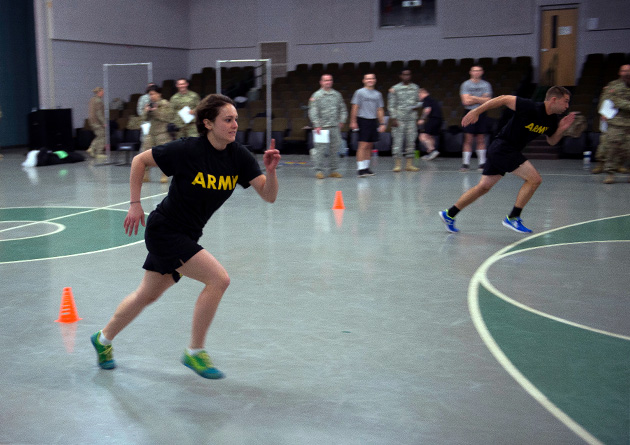 shuttle run test
Procedure: marker cones and lines are placed 25 yards apart to indicate the sprint distance. Start with a foot on one line. When instructed by the timer, the player runs to the opposite 25-yard line, touches it with their foot, turns and run back to the start. This is repeated six times without stopping (covering 300 yards total). After a rest of five minutes, the test is repeated.
Scoring: Record the average of the two 300-yard shuttles.
Target population: suitable for athletes involved in many multi-sprint sports such as basketball, hockey, rugby, soccer.
Comments: This is a maximal effort anaerobic test, and in order to receive the highest score the players must sprint at 100 percent effort the entire time. You should encourage the athletes not to pace themselves, the best score is achieved by going hard from the start.
Understanding Your 300 Yard Shuttle Results
The 300 Yard Shuttle Test measures your anaerobic capacity and ability to recover between high-intensity efforts. According to research by Robert J. Wood, PhD in Exercise Physiology from the University of Western Australia and founder of Topend Sports, this test effectively simulates the demands of multi-sprint sports where athletes must repeatedly accelerate, decelerate, and change direction.
Performance Standards by Position
Different positions have varying demands and therefore different target times for the 300 yard shuttle. Sports science research has established the following benchmarks:
Elite Athletes
Under 50 seconds - Professional level performance (Drew Brees, Darren Sproles, LaDainian Tomlinson)
WR / DB
Target: Under 60 seconds - Speed position athletes requiring explosive burst capacity
LB / RB / QB / TE
Target: Under 62 seconds - Multi-purpose athletes balancing speed and power
OL / DL
Target: Under 67-68 seconds - Power position athletes focusing on repeated effort capacity
Weight-Based Standards
Research by sports scientists indicates that body weight affects shuttle performance. Based on data compiled by Robert Wood's analysis of athletic performance:
- Athletes under 210 lbs (95 kg): Target time under 61 seconds
- Athletes over 210 lbs (95 kg): Target time under 63 seconds
How to Improve Your 300 Yard Shuttle Time
Improving your 300 yard shuttle performance requires a combination of anaerobic conditioning, speed development, and technique refinement. Here are evidence-based training strategies:
Training Methods
- High-Intensity Interval Training (HIIT): Perform shuttle-specific intervals at 90-95% effort with work-to-rest ratios of 1:3 or 1:4 to build lactate tolerance
- Sprint Mechanics: Focus on acceleration technique, proper turning mechanics, and efficient deceleration to minimize wasted energy at each cone
- Plyometric Training: Build explosive power through box jumps, broad jumps, and lateral bounds to improve change-of-direction speed
- Progressive Overload: Start with shorter shuttle distances (100-200 yards) and gradually increase to full 300 yard efforts as conditioning improves
- Recovery Training: Practice active recovery techniques between efforts to improve your ability to clear lactate and maintain performance on subsequent runs
Technical Tips
Pro Tip: Touch the line with your foot (not hand) at each turn to maintain momentum. Keep your center of gravity low during directional changes and pump your arms vigorously to maintain speed through the entire test. The most common mistake is starting too conservatively - research shows that even pacing rarely produces the best average times.
Sport-Specific Applications
The 300 Yard Shuttle Test is utilized across multiple sports to assess anaerobic capacity and multi-sprint endurance:
Football
Used extensively in NFL Combine preparation and college conditioning programs. Position-specific standards help coaches evaluate readiness for the repeated sprint demands of game situations. The test simulates the metabolic demands of a typical defensive series or sustained offensive drive.
Soccer
The test is part of the USA Women's Soccer Team testing battery. Midfielders and forwards typically target sub-60 second times, while defenders may have slightly more lenient standards. The shuttle effectively measures the repeated sprint ability crucial for tracking opponents and making attacking runs.
Basketball
Guards and forwards use this test to measure their ability to sustain high-intensity efforts throughout a game. Target times for elite players are typically 55-60 seconds, correlating with the ability to maintain defensive pressure and fast-break speed in late-game situations.
Hockey
According to Jim Plocki, former University of Michigan Hockey Strength and Conditioning Coach, players complete three shuttles with 2-minute rest periods. Athletes under 210 lbs should average under 61 seconds across all three attempts, demonstrating the sustained anaerobic capacity needed for shift work.
Rugby
Backs target 60-second times while forwards have standards of 65-70 seconds depending on position. The test measures the repeated high-intensity running required during phase play and counterattacking situations.
The Science Behind the Test
Energy Systems
The 300 Yard Shuttle Test primarily stresses the lactate energy system (anaerobic glycolysis), with contributions from both the phosphagen system (first few sprints) and aerobic system (recovery between runs). The 5-minute rest interval allows partial but not complete phosphocreatine resynthesis, making the second shuttle a true test of lactate tolerance and mental toughness.
Physiological Demands
Research published in the National Strength & Conditioning Association Journal indicates that the 300 yard shuttle elicits:
- Heart rates approaching 95-100% of maximum
- Blood lactate levels of 12-18 mmol/L (similar to competition values)
- Significant neuromuscular fatigue due to repeated acceleration/deceleration
- High eccentric muscle loading during turning phases
Test Reliability
A bachelor's thesis study on American football players found the 300-yard shuttle run test demonstrated excellent test-retest reliability with an ICC of 0.97 (95% CI: 0.91-0.99). The median result was 66.23 seconds in the first session and 65.77 seconds in the retest, showing consistent performance across testing days.
The Test in Action
- This test is part of a battery for the USA Women's Soccer Team
- Used by Tennessee Titans for training camp conditioning assessments
- Standard protocol in NCAA football strength and conditioning programs
- Component of NHL hockey off-season fitness testing
Similar Tests
- 60 yards shuttle — run to 5 yards, 10 yards, 15 yards, there and back, for a total of 60 yards
- 1200m Shuttle Test — to and from a start line to 20, 40 and 60-m marks, 5 times without a break
- Other shuttle runs: 20 yd agility, 20 yards, 100 yards
Frequently Asked Questions
What is a good 300 yard shuttle time?
Elite athletes complete the test in under 50 seconds, while position-specific standards range from 60 seconds for speed positions (WR/DB) to 67 seconds for power positions (OL/DL). For general athletes, anything under 60 seconds is considered very good, and under 70 seconds is average.
How do you calculate the 300 yard shuttle average?
Run the shuttle twice with exactly 5 minutes rest between attempts. Add both times together and divide by 2. Some protocols use three attempts - simply add all three times and divide by 3 for the average.
What sports use the 300 yard shuttle test?
The test is widely used in football, soccer, basketball, hockey, rugby, and other multi-sprint sports. It's part of the USA Women's Soccer Team testing battery and is standard in NFL training camps and NCAA conditioning programs.
How can I improve my 300 yard shuttle time?
Focus on high-intensity interval training, sprint mechanics, and plyometric exercises. Practice shorter shuttle distances (100-200 yards) first, work on efficient turning technique, and gradually build lactate tolerance through progressive overload training.
Is the 300 yard shuttle aerobic or anaerobic?
The 300 yard shuttle is primarily an anaerobic test, specifically stressing the lactate energy system. However, it also has aerobic components, especially during recovery between runs. Blood lactate levels during this test reach 12-18 mmol/L, indicating significant anaerobic stress.
How many yards is the 300 yard shuttle in meters?
The 300 yard shuttle equals 274.32 meters. This is equivalent to running 25 yards (22.86 meters) twelve times, or approximately 27.4 meters per shuttle leg.
Should I pace myself during the 300 yard shuttle?
No - research shows that maximal effort from the start produces the best average times. The test is designed to measure your ability to maintain speed under fatigue, not your pacing strategy. Athletes who start conservatively typically cannot make up the lost time and end up with slower averages.
References
- McKenzie Gillam, G., & Marks, M. (1983). "300 yard shuttle run." National Strength & Conditioning Association Journal, 46.
- Baechle, T., & Earle, R. (2008). "Essentials of Strength Training and Conditioning" (3rd ed.). Champaign, USA: Human Kinetics.
- Coburn, J., & Malek, M. (2012). "NSCA's Essentials of Personal Training" (2nd ed.). Champaign, USA: Human Kinetics.
- Meckel, Y., Machnai, O., & Eliakim, A. (2009). "Relationship Among Repeated Sprint Tests, Aerobic Fitness, and Anaerobic Fitness in Elite Adolescent Soccer Players." Journal of Strength and Conditioning Research, 23(1): 163-169.
- Brocherie, F., Girard, O., & Gregorie, P. (2015). "Neuro-mechanical and metabolic adjustments to the repeated anaerobic sprint test in professional football players." European Journal of Applied Physiology, 115(5): 891-903.
- Collins, S. M., et al. (2014). "The Relationship Between Body Composition and Preseason Performance Tests of Collegiate Male Lacrosse Players." Journal of Strength and Conditioning Research.
- Durkin, T. (Creator). "The 300-Yard Shuttle Run Weekend Challenge." Men's Health (2012).
- Plocki, J. "Hockey Dryland Training: 300 yard shuttle." University of Michigan Hockey Strength and Conditioning (1990-2013).
Related Pages
 Any comments, suggestions, or corrections? Please let us know.