100 Yard Shuttle Test Calculator
Quick Answer
This calculator analyzes your 100 Yard Shuttle test performance using position-specific benchmarks. The test measures speed, agility, and anaerobic capacity through 10-yard sprints with 9 direction changes.
- Instant performance category based on athletic testing data
- Position-specific standards for football players
- Personalized training recommendations for improvement
About the 100 Yard Shuttle Test
The 100 Yard Shuttle test is a test of speed, agility and anaerobic capacity. The test requires participants to run back and forth over a 10 yard area. The test originally used bank boards or walls at each 10 yard mark to assist in making the 180 degree turns. This is not always easy to set up, so using a line or marker to make the turn is more commonly used.
Test Purpose and Protocol
Test purpose: this is a test of speed, agility and anaerobic capacity
Equipment required: stopwatch, measuring tape, marker cones, a flat grass surface.
Pre-test: Explain the test procedures to the subject. Perform screening of health risks and obtain informed consent. Prepare forms and record basic information such as age, height, body weight, gender, test conditions. Measure and mark out the test area. Perform an appropriate warm-up. See more details of pre-test procedures.
Procedure: marker cones and lines are placed 10 yards apart to indicate the sprint distance. Start with a foot on one line. When instructed by the timer, the player runs to the opposite 10-yard line, touches it with their foot, turns and run back to the start. This is repeated five times without stopping (covering 100 yards total).
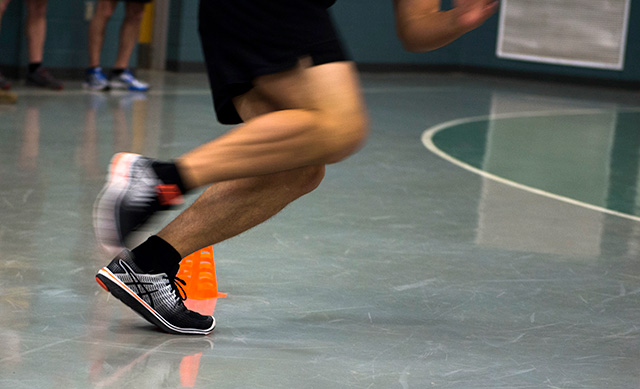 Agility Test: turning around the cone
Scoring: Record the total time to complete the test in seconds to the nearest tenth of a second.
Target population: suitable for athletes involved in many multi-sprint sports such as basketball, hockey, rugby, soccer.
Comments: This is a maximal effort anaerobic test, and in order to receive the highest score the players must sprint at 100 percent effort the entire time. You should encourage the athletes not to pace themselves, the best score is achieved by going flat out from the start.
Performance Standards by Sport and Position
Performance benchmarks for the 100 Yard Shuttle test vary significantly by sport and position. According to research by Robert J. Wood, PhD in Exercise Physiology from the University of Western Australia and founder of Topend Sports, elite multi-sport athletes typically complete the test in under 24-25 seconds.
Football Position-Specific Standards
Football players have the most established position-specific standards due to combine testing protocols:
- Wide Receivers and Defensive Backs: Elite athletes complete the test in 19 seconds or less, with advanced performers finishing in 19-21 seconds
- Linebackers, Running Backs, Quarterbacks, and Tight Ends: Elite times are 21 seconds or less, with advanced range of 21-23 seconds
- Offensive and Defensive Linemen: Elite performance is 23 seconds or less, with advanced athletes in the 23-25 second range
Other Sport Standards
For basketball, hockey, soccer, and rugby athletes, general performance categories apply:
- Elite Level: Under 24-25 seconds (top 5% of athletes)
- Advanced Level: 25-28 seconds (top 20% of athletes)
- Intermediate Level: 28-32 seconds (average trained athlete)
- Developing Level: Over 32 seconds (building athletic foundation)
How to Improve Your 100 Yard Shuttle Time
Acceleration and Speed Development
The foundation of shuttle performance is explosive acceleration. Focus on these key areas:
- Sprint Mechanics: Practice proper running form with forward lean, high knee drive, and powerful arm swing. Video analysis can help identify technique flaws.
- Resisted Sprints: Incorporate sled pulls or resistance band training 2-3 times per week. Use loads that slow you by no more than 10-15%.
- Contrast Training: Alternate between resisted sprints and unloaded sprints in the same session to enhance power and speed transfer.
Turning Technique and Agility
Efficient turns are crucial for shuttle test performance. Master these techniques:
- Deceleration Mechanics: Practice controlled deceleration by lowering your center of gravity and shortening your stride as you approach the line.
- Plant and Push: Focus on a strong plant foot placement and explosive push-off. The outside foot should contact the ground first during turns.
- Body Positioning: Keep your chest up and maintain a low center of gravity throughout the turn. Avoid excessive upper body lean.
- Progressive Practice: Start with slower speeds to master technique, then gradually increase intensity to race pace.
Strength and Power Training
Build the muscular foundation needed for explosive shuttle performance:
- Lower Body Strength: Prioritize squats, deadlifts, lunges, and step-ups. Aim for 1.5-2x bodyweight squat for optimal power production.
- Lateral Strength: Incorporate lateral lunges, side planks, and Copenhagen adduction exercises to strengthen lateral movement patterns.
- Plyometric Training: Progress from bilateral to unilateral plyometrics. Include box jumps, broad jumps, lateral bounds, and skater jumps.
- Hip and Ankle Mobility: Maintain flexibility through dynamic stretching and mobility work. Stiff ankles and hips limit turning efficiency.
Energy System Development
The 100 Yard Shuttle primarily uses anaerobic energy systems. Train these specifically:
- High-Intensity Intervals: Perform 20-30 second all-out efforts with 2-3 minute rest periods. This matches the test's energy demands.
- Repeated Shuttle Protocol: Practice the actual test at submaximal intensity (70-80%) with adequate rest between efforts.
- Position-Specific Conditioning: Integrate shuttle patterns into sport-specific drills to improve both fitness and technique simultaneously.
Sport-Specific Applications
Basketball
Basketball players benefit significantly from shuttle testing as it mirrors the repeated sprint nature of court play. The test correlates well with defensive ability and transition speed. Focus on improving first-step quickness and the ability to change direction while maintaining speed. Integrate shuttle patterns into defensive slide drills and full-court transition work.
Football
For football players, the 100 Yard Shuttle test is particularly relevant for positions requiring repeated sprint efforts with direction changes. Defensive backs and receivers should target sub-21 second times, while linemen can be effective with times in the 23-25 second range. Combine shuttle training with position-specific route running and pass coverage drills.
Hockey
Ice hockey players use shuttle testing to assess off-ice conditioning that translates to on-ice performance. The test's anaerobic demands closely match hockey's shift-based play pattern. Supplement shuttle training with on-ice agility work and transition drills. Focus on explosive starts and quick stops that mirror game situations.
Soccer
Soccer players require exceptional shuttle performance for defensive positioning and attacking runs. Midfielders and defenders particularly benefit from strong shuttle times. The test helps identify players who can maintain speed through multiple direction changes late in matches. Incorporate shuttle patterns into small-sided games and pressing drills.
Rugby
Rugby players need shuttle performance for defensive line speed and support play. Backs typically achieve faster times than forwards, but all positions benefit from improved agility. The test helps identify players who can maintain intensity through multiple phases of play. Combine shuttle training with tackle technique and breakdown work.
Common Mistakes and How to Avoid Them
Poor Starting Position
Many athletes start too upright, limiting their initial acceleration. Begin in a slight crouch with weight on the balls of your feet. Your first three steps should be short and powerful, gradually lengthening as you build speed.
Inefficient Turning Technique
Overstriding into the turn line wastes time and energy. Approach turns with controlled deceleration, touching the line with your foot (not hand), and immediately explode back in the opposite direction. Practice the "touch and go" technique at various speeds.
Pacing Strategy Errors
The shuttle test is not a pacing event. Maximum effort from start to finish produces the best times. Mental fatigue often causes athletes to slow down in the final repetitions. Practice maintaining intensity through all five rounds.
Inadequate Warm-Up
Rushing into the test without proper preparation increases injury risk and reduces performance. Complete a progressive warm-up including dynamic stretching, sprint progressions, and several practice turns at increasing speeds before attempting a maximal test.
Frequently Asked Questions
What is a good time for the 100 Yard Shuttle test?
A good time varies by sport and position. Elite athletes typically complete the test in under 24-25 seconds. For football, wide receivers and defensive backs should target under 21 seconds, while linemen perform well at 23-25 seconds. Advanced athletes generally finish in 25-28 seconds, and intermediate performers complete it in 28-32 seconds.
How do you perform the 100 Yard Shuttle test correctly?
Set up two lines or cones 10 yards apart. Start with your foot on one line. Sprint to the opposite line, touch it with your foot, turn and sprint back. Repeat this pattern five times without stopping for a total of 100 yards with 9 direction changes. Use proper turning technique with a low center of gravity for best results.
What sports benefit most from 100 Yard Shuttle testing?
Multi-sprint sports benefit most, including basketball, football, hockey, rugby, and soccer. These sports require repeated high-intensity sprints with frequent direction changes, closely matching the test's demands. The test helps identify athletes with superior agility, acceleration, and anaerobic capacity.
How often should I train for the 100 Yard Shuttle?
Train shuttle-specific skills 2-3 times per week during the off-season, allowing 48-72 hours recovery between sessions. Reduce frequency to once weekly during the competitive season to maintain performance while managing fatigue. Always perform shuttle work when fresh, early in training sessions after a thorough warm-up.
What's the difference between the 100 Yard Shuttle and other shuttle tests?
The 100 Yard Shuttle uses 10-yard segments repeated 5 times with 9 turns. The 300 Yard Shuttle uses 25-yard segments (6 round trips), testing longer anaerobic endurance. The 20 Yard Pro Agility (5-10-5) is shorter and focuses on change of direction speed. The 60 Yard Shuttle uses varying distances. Each test emphasizes different aspects of speed and agility.
Can the 100 Yard Shuttle test predict game performance?
The test correlates moderately with game performance in multi-sprint sports, particularly for positions requiring repeated high-intensity efforts with direction changes. However, it's one component of athletic assessment. Game performance depends on multiple factors including technical skills, tactical awareness, and mental attributes. Use the test as part of a comprehensive evaluation.
What are the key muscle groups used in the 100 Yard Shuttle?
The primary muscle groups are the quadriceps, hamstrings, glutes, and calves for acceleration and deceleration. Hip abductors and adductors stabilize lateral movements during turns. The core muscles maintain body control throughout direction changes. Arm muscles contribute to momentum and balance. Training should target all these areas for optimal performance.
Similar Tests
- 1200m Shuttle Test — to and from a start line to 20, 40 and 60-m marks, 5 times without a break.
- 10 meter Agility Shuttle (4x10m)
- 30 feet shuttle run (4x30')
- Other shuttle runs: 20-yd agility, 20-yards, 30-ft, 60-yards.
References
- Harman, E., Garhammer, J., & Pandorf, C. (2000). "Administration, scoring, and interpretation of selected tests." Essentials of Strength Training and Conditioning, 2nd edition. National Strength and Conditioning Association.
- Stewart, P.F., Turner, A.N., & Miller, S.C. (2014). "Reliability, factorial validity, and interrelationships of five commonly used change of direction speed tests." Scandinavian Journal of Medicine & Science in Sports, 24(3), 500-506.
- Tomkinson, G.R., Lang, J.J., & Blanchard, J. (2019). "Temporal trends in the cardiorespiratory fitness of children and adolescents representing 19 high-income and upper middle-income countries between 1981 and 2014." British Journal of Sports Medicine, 53(8), 478-486.
- Lockie, R.G., Schultz, A.B., Callaghan, S.J., & Jeffriess, M.D. (2013). "The effects of traditional and enforced stopping speed and agility training on multidirectional speed and athletic performance." Journal of Strength and Conditioning Research, 27(6), 1538-1551.
- Sheppard, J.M., & Young, W.B. (2006). "Agility literature review: Classifications, training and testing." Journal of Sports Sciences, 24(9), 919-932.
Related Pages
Anaerobic Capacity Tests
Explore other tests measuring anaerobic power and capacity for athletes
Learn More →USA Women's Soccer Testing
This test is part of the fitness battery for the USA Women's Soccer Team
Learn More →Intermittent Sports Testing
Learn about fitness testing protocols for intermittent sports
Learn More → Any comments, suggestions, or corrections? Please let us know.