1200m Shuttle Test Calculator (Bronco Test)
Quick Answer
This calculator determines your Maximal Aerobic Speed (MAS) from the 1200m Shuttle Test (Bronco test) using scientifically validated formulas. Simply enter your test time and body weight to get instant results with performance benchmarks and training zones.
- Calculates MAS using corrective equations for body mass
- Based on Baker & Heaney (2015) research methodology
- Validated for multi-sprint sport athletes (rugby, soccer, hockey)
About the 1200m Shuttle Test
The 1200m Shuttle Test, commonly known as the Bronco test in rugby circles, is an aerobic fitness assessment involving running to-and-from a start line to 20m, 40m, and 60m marks, five times without a break (Kelly & Wood, 2013). This test has become the gold standard for assessing maximal aerobic speed in team sport athletes, particularly in rugby union, rugby league, soccer, and other multi-sprint sports.
The test is valued for its sport-specific nature—the constant acceleration, deceleration, and direction changes closely mirror the demands of match play. Unlike continuous running tests, the 1200m Shuttle Test includes an anaerobic component that better reflects the intermittent nature of team sports.
Test Protocol and Procedures
Test purpose: To obtain an estimate of maximal aerobic running speed (MAS) using a shuttle-based running protocol.
Equipment required: Stopwatch, measuring tape, marker cones, flat track or grass surface (preferably a rugby pitch or similar).
Pre-test preparation: Explain the test procedures to participants. Perform screening of health risks and obtain informed consent. Record basic information including age, height, body weight, gender, and test conditions. Measure and mark out the test area precisely. Perform a comprehensive warm-up including dynamic stretches and progressive running. See more details of pre-test procedures.
Test procedure:
- Place markers at the start line (0m), 20m, 40m, and 60m from the start
- Participants start at the baseline on the coach's signal
- Run forward 20m to the first marker and return to the baseline (40m completed)
- Run forward 40m to the second marker and return to the baseline (120m completed)
- Run forward 60m to the third marker and return to the baseline (240m total for one set)
- Repeat this sequence five times without stopping (1200m total distance)
- The foot must touch or cross each line before turning
- Record the total time to complete all five sets
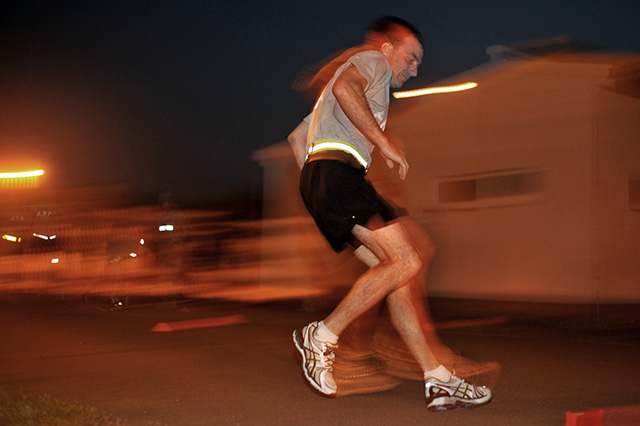 Shuttle running tests assess the ability to accelerate, decelerate, and change direction repeatedly
Critical testing notes: Participants should run at maximum effort throughout the entire test—pacing is not recommended. The best results come from 100% effort from the start. Coaches should provide time updates and encouragement at regular intervals to maintain motivation. Ensure adequate recovery time between tests if testing multiple athletes.
Scoring and MAS Calculation
Basic scoring: Record the total time in seconds to complete the 1200m test, which typically lasts 4-6 minutes for athletic populations. The faster the completion time, the better the aerobic fitness level.
Maximal Aerobic Speed calculation: The calculator above uses scientifically validated corrective equations that account for the metabolic cost of repeated direction changes and body mass differences:
For athletes with heavy body mass (≥100 kg):
MAS (m/s) = 1200 / (time in seconds – 29)
For athletes with lighter body mass (<100 kg):
MAS (m/s) = 1200 / (time in seconds – 20.3)
These equations, based on research by Baker & Heaney (2015) and validated in multiple studies, apply a correction factor to account for the energy cost of decelerating and accelerating through each turn. The 20.3 or 29 second deduction represents the cumulative metabolic cost of the 30 direction changes during the test (5 sets × 6 turns per set).
Converting to km/h: To express MAS in kilometers per hour, multiply the m/s result by 3.6. For example, 4.5 m/s × 3.6 = 16.2 km/h.
Performance Benchmarks and Normative Data
Elite athletes across various team sports typically achieve the following times and MAS values:
Male Athletes
- World Record Level: Under 4:15 (>4.7 m/s MAS) – Top 1% of professional athletes
- Elite Professional: 4:15-4:25 (~4.5-4.7 m/s) – International and top-tier professional players
- Outstanding: 4:25-4:35 (~4.3-4.5 m/s) – High-level competitive athletes
- Very Good: 4:35-4:45 (~4.1-4.3 m/s) – Competitive club/college level
- Good: 4:45-4:55 (~3.9-4.1 m/s) – Above average, suitable for competition
- Average: 4:55-5:15 (~3.7-3.9 m/s) – Average fitness for team sports
Female Athletes
- World Record Level: Under 4:26 (>4.5 m/s MAS) – Top 1% of professional athletes
- Elite Professional: 4:26-4:36 (~4.3-4.5 m/s) – International and top-tier professional players
- Outstanding: 4:36-4:46 (~4.1-4.3 m/s) – High-level competitive athletes
- Very Good: 4:46-4:56 (~3.9-4.1 m/s) – Competitive club/college level
- Good: 4:56-5:06 (~3.7-3.9 m/s) – Above average, suitable for competition
- Average: 5:06-5:26 (~3.5-3.7 m/s) – Average fitness for team sports
Notable elite performances: New Zealand All Black Beauden Barrett, one of the world's premier rugby players, has recorded a time of 4:12 (approximately 4.76 m/s MAS), placing him among the most aerobically fit rugby players ever tested. Professional rugby union forwards typically complete the test in 4:50-5:10, while backs achieve 4:20-4:45.
Sport-Specific Applications
The 1200m Shuttle Test is used extensively across multiple sports:
Rugby Union and League
In rugby, the Bronco test is the standard pre-season fitness benchmark. Different positions show varying performance levels—backs typically achieve faster times due to lower body mass and higher aerobic capacity requirements for their playing style. Forwards, despite heavier body mass, must still achieve "Good" level or better to cope with match demands. Professional teams test 2-3 times per season to monitor fitness trends.
Soccer/Football
Soccer players use the 1200m Shuttle Test to assess aerobic capacity specific to the stop-start nature of the game. Research by Kavanagh et al. (2025) demonstrated strong correlations between 1200m shuttle performance and total distance covered during English Premier League matches. Midfielders typically achieve the fastest times, followed by forwards and defenders.
Basketball
Basketball programs use this test to evaluate court fitness, as the shuttle nature mirrors the rapid transitions between offense and defense. Guards generally outperform forwards and centers due to lower body mass and position-specific demands.
Hockey (Field and Ice)
Hockey players benefit from the direction-change component of this test, which closely matches the skating or running patterns in their sport. Times in the 4:30-5:00 range are typical for elite field hockey players.
Using MAS for Training Prescription
Once you've calculated your MAS using the calculator above, you can use this value to prescribe individualized training intensities. Research has shown that time spent at or above 90-110% MAS is highly effective for improving aerobic capacity.
Sample Training Sessions Based on MAS
High-Intensity Intervals (100-110% MAS):
- Short: 15-30 seconds at 110% MAS, 15-30 seconds rest, 8-12 reps
- Medium: 1-2 minutes at 100-105% MAS, equal rest, 6-8 reps
- Long: 3-4 minutes at 100% MAS, 3-4 minutes rest, 4-5 reps
Threshold Work (85-95% MAS):
- Tempo runs: 8-12 minutes at 85-90% MAS, continuous or with brief rests
- Cruise intervals: 5-8 minutes at 90-95% MAS, 2-3 minutes rest, 3-4 reps
Recovery and Base Building (60-80% MAS):
- Easy aerobic runs: 20-40 minutes at 60-75% MAS
- Extensive intervals: 4-6 minutes at 75-80% MAS, 2-3 minutes rest, 5-8 reps
Improving Your 1200m Shuttle Test Performance
To improve your Bronco test time and MAS, focus on three key areas:
1. Aerobic Base Development
Build your aerobic engine through consistent moderate-intensity training. Aim for 3-4 sessions per week of 30-50 minutes at 70-80% MAS. This develops capillary density, mitochondrial function, and cardiovascular efficiency—the foundation for all other fitness qualities.
2. High-Intensity Interval Training
Incorporate 1-2 sessions per week of intervals at 90-110% MAS. These sessions directly stress the VO2max system and improve the body's ability to deliver and utilize oxygen at high intensities. Allow 48-72 hours recovery between high-intensity sessions.
3. Speed Endurance and Repeated Sprint Ability
Since the 1200m Shuttle Test involves repeated accelerations and decelerations, include training that mimics this demand. Perform shuttle runs at distances of 10-40m with 1:2 or 1:3 work-to-rest ratios. This improves lactate tolerance and the ability to maintain speed despite accumulating fatigue.
4. Movement Efficiency
Work on your turning technique to minimize time and energy loss at each marker. Practice planting your outside foot, dropping your center of mass, and explosively pushing off. Efficient direction changes can save 2-5 seconds on the total test time.
Sample 8-Week Improvement Program: Beginners should start with 2-3 weeks of base building, then progress to 3-4 weeks of mixed training (base + intervals), followed by 1-2 weeks of test-specific preparation with shortened recovery periods.
Reliability and Validity
Research by Hamlin et al. (2018) demonstrated excellent test-retest reliability (ICC = 0.95) for the 1200m Shuttle Run Test in elite youth rugby players, indicating the test produces consistent results when repeated under similar conditions. The test shows strong correlations (r = 0.77-0.87) with other validated measures of aerobic fitness including the Yo-Yo Intermittent Recovery Test Level 1 and laboratory VO2max testing.
However, practitioners should note that environmental factors can affect performance:
- Surface type: Tests on artificial turf (4G) typically yield times 5-10 seconds faster than grass surfaces due to better traction
- Weather conditions: Heat, humidity, wind, and altitude all impact performance
- Recovery status: Test timing relative to training load significantly affects results
- Familiarization: First-time test-takers may improve by 3-5% on a second attempt simply through learning effect
For these reasons, standardize test conditions whenever possible and consider the testing environment when comparing results across time periods or between athletes.
Target Population and Contraindications
Suitable for: Athletes involved in multi-sprint sports including rugby (union and league), soccer, basketball, field hockey, ice hockey, lacrosse, Australian rules football, and Gaelic football. The test is appropriate for athletes aged 15+ with an established training base.
Not recommended for: Untrained individuals, athletes with recent lower limb injuries (particularly ankle, knee, or hamstring), those with cardiovascular concerns, or during periods of illness. The maximal nature and repeated direction changes place high stress on the musculoskeletal and cardiovascular systems.
Frequently Asked Questions
What is the difference between the 1200m Shuttle Test and the Yo-Yo Test?
The 1200m Shuttle Test is a single maximal effort over a fixed distance with continuous running, while the Yo-Yo Intermittent Recovery Test involves progressively faster shuttles with rest periods. The 1200m test is simpler to administer and provides a direct time-based measure, making it ideal for team testing. The Yo-Yo test better assesses repeated sprint ability with recovery, which some argue is more sport-specific. Both tests correlate highly (r = -0.87) and are valid measures of aerobic fitness.
Should I pace myself during the test or go all-out from the start?
Research and practical experience consistently show that maximum effort from the start produces the best results. Athletes who attempt to pace themselves typically finish with worse times than those who commit to full intensity throughout. The test is short enough (4-6 minutes) that pacing strategies are counterproductive. Trust your conditioning and maintain maximum sustainable speed throughout all five sets.
How often should I test my 1200m Shuttle performance?
For athletic monitoring, test 2-3 times per competitive season—typically at the start of pre-season, mid-season, and end of season. More frequent testing (monthly) may be appropriate during specific conditioning phases or when monitoring return from injury. Avoid testing during periods of high training load or competition stress, as this will negatively impact results and increase injury risk.
Can I use the test on different surfaces?
Yes, but be aware that surface type significantly affects performance. Artificial turf (4G) provides the most consistent results and fastest times. Natural grass is acceptable but results vary based on field condition, moisture, and grass length. Indoor courts work well for sports like basketball. For valid comparisons over time, always test on the same surface type under similar conditions.
Why do the MAS equations differ based on body weight?
Heavier athletes (≥100kg) experience greater metabolic cost during deceleration and acceleration at each turn due to the increased momentum they must control. The 29-second correction for heavy athletes (versus 20.3 seconds for lighter athletes) accounts for this additional energy expenditure. This ensures MAS calculations are accurate across the full range of athlete body masses seen in team sports.
What's considered a good improvement in test time?
Improvements of 5-10 seconds (1-2%) after a focused training block of 8-12 weeks are realistic and meaningful. Elite athletes may see smaller improvements (2-5 seconds) as they're already near their genetic potential. Untrained individuals beginning structured training can improve by 20-30 seconds or more. Improvements beyond 15 seconds in trained athletes suggest either previous detraining or highly effective training intervention.
How does MAS relate to match performance?
Research shows strong positive correlations between MAS and total distance covered during matches (r = 0.70-0.75), as well as high-speed running distance. Higher MAS enables athletes to maintain work rate throughout the match, recover faster between high-intensity efforts, and perform more repeated sprints. In team sports, MAS is one of the strongest predictors of on-field performance alongside sprint speed and strength measures.
References
- Baker, D. & N. Heaney. (2015). Normative data for maximal aerobic speed for field sport athletes: A brief review. Journal of Australian Strength & Conditioning, 23(7):60-67.
- Kelly, V. G., Jackson, E., & Wood, A. (2014). Typical scores from the 1.2 km shuttle run test to determine maximal aerobic speed. Journal of Australian Strength and Conditioning, 22(5):183-185.
- Kelly, V.G. and Wood, A. (2013). The correlation between the 30-15 intermittent fitness test and a novel test of running performance. 2012 ASCA International Conference on Applied Strength and Conditioning, Surfers Paradise, Australia.
- Hamlin, M.J., Deuchrass, R., Smith, H., Elliot, C.A., Lizamore, C.A. (2018). Reliability of the 1.2 km Shuttle Run Test in Young Elite Rugby Union Players. European College of Sport Science 23rd Annual Congress.
- Kavanagh, R., et al. (2025). The relationship between the 1200m shuttle test and 40m sprint test performance and distances covered in English Premier League matches: A retrospective two season study. Biology of Sport, 42(2):99-107.
- Swaby, R., Jones, P.A., & Kelly, V.G. (2016). Relationship between maximal aerobic speed performance and distance covered in rugby union games. Journal of Strength and Conditioning Research, 30(10):2788-2793.
- Deuchrass, R., Smith, H.K., Elliot, C., Lizamore, C., & Hamlin, M.J. (2019). The 1.2 km shuttle run test: Reliability and comparison with the Yo-Yo intermittent recovery level 1 test in young elite rugby union players. Journal of Australian Strength & Conditioning, 27(4):14-20.
- Buchheit, M., & Laursen, P.B. (2013). High-intensity interval training, solutions to the programming puzzle: Part I – cardiopulmonary emphasis. Sports Medicine, 43(5):313-338.
Related Pages
Aerobic Fitness Tests
Comprehensive guide to all aerobic capacity testing methods for athletes.
Learn More →Rugby Fitness Testing
Complete battery of fitness tests specifically for rugby union and league players.
Learn More →Speed & Acceleration Tests
Sprint testing protocols for team sport athletes including 10m, 20m, and 40m tests.
Learn More →Training Zone Calculator
Calculate personalized heart rate and pace zones for endurance training.
Learn More → Any comments, suggestions, or corrections? Please let us know.