3 Hop Test Calculator (Double Leg Jumps)
Quick Answer
This calculator analyzes your 3 hop test distance and compares your explosive leg power to athletic standards. Results show your performance category, percentile ranking by sport and gender, and estimated power output.
- Instant calculation with sport-specific benchmarks
- Based on research data from collegiate athletes
- Percentile rankings for competitive comparison
The three-hop test is a test of explosive leg power, in which you have to perform three consecutive horizontal jumps, taking off both legs at once for each jump. There is also a similar 2-hop jump test and 5-hop test. The 3-Hop test is one of the four tests of the Quadrathlon Test.
How to Use the 3 Hop Test Calculator
Follow these steps to analyze your explosive leg power:
- Select Your Unit System: Choose between metric (meters) or imperial (feet) using the toggle switch at the top of the calculator.
- Enter Your Distance: Input your total 3-hop distance measured from the start line to the back of your heels on the third landing.
- Select Demographics: Choose your gender and primary sport for accurate comparison to athletic standards.
- Optional Advanced Data: Click "Advanced Options" to add age, height, and body weight for enhanced power estimation and age-adjusted comparisons.
- Calculate Results: Click "Calculate My Results" to see your performance category, percentile ranking, and estimated explosive power output.
- Interpret Your Score: Review your category (Elite, Advanced, Intermediate, Beginner) and see how you compare to other athletes in your sport.
- Share or Save: Use the share buttons to save your results, email them to your coach, or print for your training log.
Pro Tip: For best results, perform three trials and use your longest distance. Ensure you measure consistently from the same point (back of heels) on each attempt.
Understanding the 3 Hop Test
Test Purpose: The 3 hop test measures horizontal and vertical power of the legs with components of balance and coordination. It assesses an athlete's ability to generate explosive force repeatedly, making it valuable for sports requiring multiple rapid movements like basketball, soccer, and volleyball.
What Makes This Test Important: Unlike single vertical jump tests, the 3 hop test evaluates sustained power output across multiple consecutive efforts. According to sports science research compiled by Robert Wood, PhD, this provides a more comprehensive assessment of functional athletic power, particularly for sports involving repeated sprinting, jumping, and directional changes.
Equipment Required: tape measure to measure distance jumped, flat grass area or athletic surface. The starting take-off line should be clearly marked.
Test Procedures and Protocols
Pre-Test Preparation: Explain the test procedures to the subject. Perform screening of health risks and obtain informed consent. Prepare forms and record basic information such as age, height, body weight, gender and test conditions. Measure and mark out the area using cones. See more details of pre-test procedures.
Test Layout: Stretch out approximately 30 feet (10 meters) of rope or tape measure to mark the hopping direction and to aid recording the jump distance.
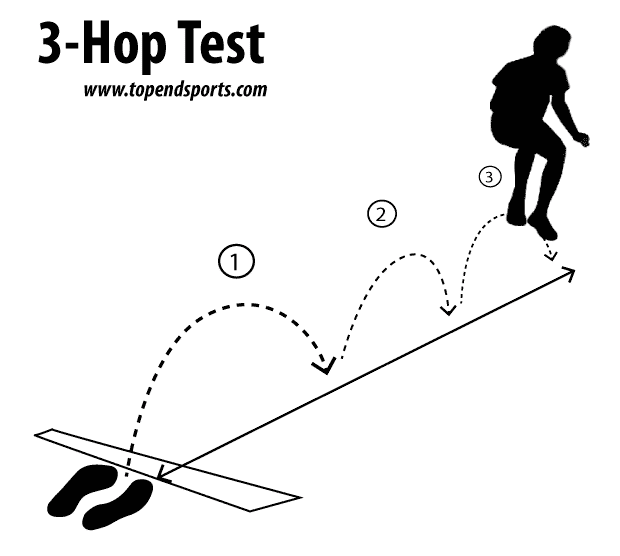
Test Procedure: The aim of this test is to perform three consecutive double-leg hops as far as possible. The athlete starts by standing behind a line with feet shoulder width apart. When ready, they are to perform three consecutive broad jumps non-stop, using a forward as well as a vertical jump style that allows them to gain maximum distance. They are able to use their arms to assist the explosive movement and for balance.
Scoring: The measurement is taken from take-off line to the nearest point of contact on the landing of the third jump (back of the heels). Record the longest distance jumped, the best of three trials. See some athlete results of the 3-Hop test.
Athletic Performance Standards by Sport
Research by Robert Wood's analysis at Topend Sports indicates that 3 hop test standards vary significantly by sport, gender, and competition level:
Male Athletes
Basketball Players
Elite: 8.5+ meters (27.9+ ft)
Advanced: 7.5-8.5m (24.6-27.9 ft)
Intermediate: 6.5-7.5m (21.3-24.6 ft)
Soccer Players
Elite: 8.0+ meters (26.2+ ft)
Advanced: 7.0-8.0m (23.0-26.2 ft)
Intermediate: 6.0-7.0m (19.7-23.0 ft)
Track & Field
Elite: 8.5+ meters (27.9+ ft)
Advanced: 7.5-8.5m (24.6-27.9 ft)
Intermediate: 6.5-7.5m (21.3-24.6 ft)
Female Athletes
Basketball Players
Elite: 7.0+ meters (23.0+ ft)
Advanced: 6.0-7.0m (19.7-23.0 ft)
Intermediate: 5.0-6.0m (16.4-19.7 ft)
Soccer Players
Elite: 6.5+ meters (21.3+ ft)
Advanced: 5.5-6.5m (18.0-21.3 ft)
Intermediate: 4.5-5.5m (14.8-18.0 ft)
Volleyball
Elite: 6.8+ meters (22.3+ ft)
Advanced: 5.8-6.8m (19.0-22.3 ft)
Intermediate: 4.8-5.8m (15.7-19.0 ft)
How to Improve Your 3 Hop Test Performance
Enhancing your 3 hop test distance requires a combination of strength, power, and technical training:
Plyometric Training
Box Jumps: Perform 3-4 sets of 6-8 box jumps at varying heights (40-75cm) twice weekly. Focus on explosive takeoff and soft landing mechanics.
Depth Jumps: Step off a 30-40cm box and immediately jump as high as possible upon landing. Complete 3 sets of 5 reps with 2-3 minutes rest between sets.
Bounding Exercises: Practice consecutive bounding for 20-30 meters, emphasizing maximum horizontal distance per bound. Perform 4-6 sets with full recovery.
Strength Development
Squats: Back squats with 70-85% 1RM, 3-5 sets of 3-5 reps. Build the foundational strength needed for explosive jumping.
Romanian Deadlifts: Develop posterior chain power with 3-4 sets of 6-8 reps at moderate weight, focusing on hip extension power.
Single-Leg Exercises: Include Bulgarian split squats and single-leg deadlifts to address strength imbalances and improve stability during consecutive jumps.
Technical Considerations
Arm Swing Coordination: Practice aggressive arm drive on each jump. Arms should swing back during the counter-movement and powerfully forward and upward during takeoff.
Landing Mechanics: Focus on landing with slight knee flexion to immediately transition into the next jump. Minimize ground contact time between hops while maintaining control.
Progressive Training: Start with 2-hop tests, progress to 3-hop, then advance to 5-hop tests as power and coordination improve.
Variations and Modifications
Standard Variation: A long jump landing pit may be used instead so that the final jump lands in the sand, which enables the subject to confidently put more effort into the final jump, and to extend the legs further in front of the body for landing (this method results in higher scores for the 3-hop test).
Alternative Hop Tests: The test can also be conducted with any number of consecutive jumps (see the 2-hop and 5-hop versions). There is also a 3-hop stability test used in rehab, which involves three consecutive hops using the same leg.
Team Testing: For coaches testing multiple athletes, set up multiple lanes with tape measures to allow simultaneous testing. Record all attempts and calculate team averages for benchmarking.
Advantages and Disadvantages
Advantages: This test is simple and quick to perform, requiring minimal equipment. It provides sport-specific assessment of explosive power that translates directly to athletic movements. The test can be performed anywhere with adequate space and is easily repeatable for tracking progress over time.
Disadvantages: There is some skill component in this test, meaning technique plays a role alongside pure power. Athletes unfamiliar with the movement pattern may score lower initially. Environmental factors like surface type and wind can affect results. The test requires adequate space (minimum 10 meters) which may not always be available.
Important Testing Notes
Comments: Falling or stepping backward after the landing will result in measurement to that point of contact rather than where the feet first touched. Some participants will try to use a step at take-off, which is not allowed and invalidates the attempt.
Safety Considerations: Ensure adequate warm-up including dynamic stretching and progressive jumping drills before maximal testing. The landing surface should be flat, dry, and free of obstacles. Athletes recovering from lower body injuries should consult with sports medicine professionals before performing this test.
Reliability: Research indicates high test-retest reliability (ICC = 0.92-0.97) when proper protocols are followed. To maximize reliability, standardize the warm-up routine, time of day, and surface conditions across testing sessions.
Frequently Asked Questions
What is a good score on the 3 hop test?
For male athletes, distances over 7.5 meters are considered advanced, while over 8.5 meters is elite level. For female athletes, over 6.0 meters is advanced and over 7.0 meters is elite. Scores vary by sport, with basketball and soccer players typically achieving higher distances due to the specific power demands of these sports.
How do you perform the 3 hop test?
Stand behind a line with feet shoulder-width apart. Perform three consecutive double-leg broad jumps without stopping, using both forward and vertical motion to maximize distance. Arms can be used for momentum and balance. Measure from the start line to the back of the heels on the third landing. Take the best of three trials.
What does the 3 hop test measure?
The 3 hop test measures explosive leg power, combining horizontal and vertical power with elements of balance and coordination. It assesses an athlete's ability to generate and maintain power across multiple consecutive jumps, making it valuable for sports requiring repeated explosive movements like basketball, soccer, and track and field.
How can I improve my 3 hop test score?
Improve through plyometric training including box jumps, depth jumps, and bounding exercises. Develop lower body strength through squats and deadlifts at 70-85% 1RM. Practice proper jumping technique with emphasis on arm swing coordination and efficient landing mechanics. Allow adequate recovery between training sessions to prevent overtraining and maximize adaptation.
What is the difference between 2-hop, 3-hop and 5-hop tests?
The tests differ in the number of consecutive jumps performed. The 2-hop test emphasizes initial explosive power and is easier to execute. The 3-hop test (used in the Quadrathlon) balances power with technique and coordination. The 5-hop test (penta jump) tests power endurance and requires better coordination and sustained power output across more repetitions.
How often should I test my 3 hop performance?
For athletes in season, test every 4-6 weeks to monitor performance without interfering with competition preparation. During off-season training blocks, test every 3-4 weeks to track power development. Avoid testing during heavy training weeks or within 48 hours of intense lower body workouts to ensure accurate results.
Is the 3 hop test suitable for all ages?
The 3 hop test can be performed by athletes from age 12 and up, provided they have adequate movement competency and no current injuries. Younger athletes (12-14 years) should focus on proper technique rather than maximum distance. Masters athletes can also perform the test but should ensure thorough warm-up and consider using the calculator's age-adjusted comparisons for more relevant benchmarking.
Similar Tests
- Standing long jump test — a similar test of leg power
- 2-hop jump test — perform two consecutive horizontal jumps off both feet.
- Penta Jump (5-Hop Test) — perform five consecutive horizontal jumps off both feet.
- Quadrathlon Test — battery of four power tests including the 3-hop
- Hop and Stop Test — a functional movement test which evaluates an individual's ability to hop and then come to a complete stop.
- Vertical Jump Test — assess vertical explosive power
References
- Munro, A. G., & Herrington, L. C. (2011). Between-session reliability of four hop tests and the agility T-test. Journal of Strength and Conditioning Research, 25(5), 1470-1477.
- Hamilton, R. T., et al. (2008). Reliability of the single-leg hop test. Journal of Science and Medicine in Sport, 11(6), 570-575.
- Reid, A., et al. (2007). Hop testing provides a reliable and valid outcome measure during rehabilitation after anterior cruciate ligament reconstruction. Physical Therapy, 87(3), 337-349.
- Noyes, F. R., et al. (1991). Abnormal lower limb symmetry determined by function hop tests after anterior cruciate ligament rupture. The American Journal of Sports Medicine, 19(5), 513-518.
- Barber, S. D., et al. (1990). Quantitative assessment of functional limitations in normal and anterior cruciate ligament-deficient knees. Clinical Orthopaedics and Related Research, 255, 204-214.
Related Pages
3 Hop Test Results Database
View results from athletes across different sports and competition levels.
View Results →Anaerobic Power Tests
Explore other fitness tests that measure explosive leg power and anaerobic capacity.
View Tests →Power Quadrathlon
Learn about the complete Quadrathlon battery that includes the 3 Hop Test.
Learn More →Triple Jump Athletics
Discover the competitive track and field event that evolved from hop testing.
Learn More → Any comments, suggestions, or corrections? Please let us know.