Standing Long Jump Test (Broad Jump)
Quick Answer
This calculator assesses your explosive leg power through the standing long jump test. Enter your jump distance, age, and gender to receive instant performance ratings and percentile rankings.
- Calculates performance rating from excellent to very poor
- Based on scientific norms for athletic populations
- Provides sport-specific context and training recommendations
The Standing long jump, also called the Broad Jump, is a common and easy to administer test of explosive leg power. It is one of the fitness tests in the NFL Combine. The standing long jump was also once an event at the Olympic Games, and is also an event in Sports Hall competitions in the UK and part of the power quadrathlon and jumps decathlon assessment.
Test purpose: to measure the explosive power of the legs
Equipment required: tape measure to measure distance jumped, non-slip floor for takeoff, and soft landing area preferred. Commercial Long Jump Landing Mats are also available.
Pre-test: Explain the test procedures to the subject. Perform screening of health risks and obtain informed consent. Prepare forms and record basic information such as age, height, body weight, gender and test conditions. Check and calibrate the equipment if required. Perform a standard warm-up. The take off line should be clearly marked. See more details of pre-test procedures.
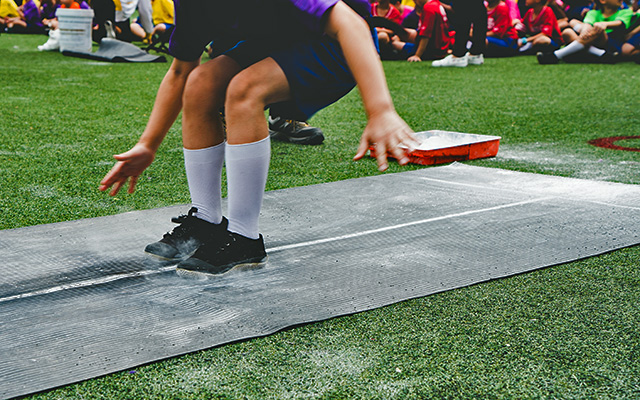 standing long jump test
Procedure: The athlete stands behind a line marked on the ground with feet slightly apart. A two foot take-off and landing is used, with swinging of the arms and bending of the knees to provide forward drive. The subject attempts to jump as far as possible, landing on both feet without falling backwards. Three attempts are allowed. See some long jump video examples.
Scoring: The measurement is taken from take-off line to the nearest point of contact on the landing (back of the heels). Record the longest distance jumped, the best of three attempts. The table below gives a rating scale for the standing long jump test for adults, based on personal experiences. See some athlete results for the long jump test. You can also use the calculator above for instant performance ratings.
| males | females | |||
|---|---|---|---|---|
| rating | (cm) | (feet, inches) | (cm) | (feet, inches) |
| excellent | > 250 | > 8' 2.5" | > 200 | > 6' 6.5' |
| very good | 241-250 | 7' 11" — 8' 2.5" | 191-200 | 6' 3" — 6' 6.5' |
| above average | 231-240 | 7' 7" — 7' 10.5" | 181-190 | 5' 11.5" — 6' 2.5" |
| average | 221-230 | 7' 3" — 7' 6.5" | 171-180 | 5' 7.5" — 5' 11" |
| below average | 211-220 | 6' 11" — 7' 2.5" | 161-170 | 5' 3.5" — 5' 7" |
| poor | 191-210 | 6' 3" — 6' 10.5" | 141-160 | 4' 7.5" — 5' 2.5" |
| very poor | < 191 | 6' 3" | < 141 | < 4' 7.5" |
How to Improve Your Standing Long Jump
Improving your standing long jump performance requires a combination of proper technique, strength training, and plyometric exercises. Research by sports scientists has identified several key factors that contribute to better jumping performance.
Technique Optimization: According to biomechanical studies, arm swing can improve jump distance by up to 21%. Focus on vigorous forward arm movement during takeoff, blocking slightly higher than shoulder height. The optimal takeoff angle is between 30-38 degrees, though horizontal velocity at takeoff is more important than angle.
Strength Training: Build lower body strength through compound exercises including squats, deadlifts, Romanian deadlifts, lunges, and step-ups. Target 2-3 strength sessions per week with emphasis on explosive movement patterns. Research shows that athletes with stronger leg muscles achieve significantly greater jump distances.
Plyometric Training: Incorporate explosive exercises such as box jumps, depth jumps, broad jump variations, and bounding exercises. Start with 3-5 sets of 5 repetitions and allow 48-72 hours recovery between plyometric sessions. Progressive overload is key to continued improvement.
Sprint Training: Short sprints (10-30 meters) help develop the rapid muscle firing patterns needed for explosive jumping. Include sprint work 2 times per week as part of your power development program.
Understanding Your Results
Your standing long jump performance provides valuable insight into your explosive power capabilities. As a general rule, you should be able to jump at least your own height horizontally. Athletes who can jump significantly beyond their height demonstrate exceptional lower body power.
Elite Standards: Professional athletes typically achieve remarkable distances. The NFL Combine record is 12' 3" (3.73m) set by Byron Jones in 2015. College football players average around 9-10 feet (2.7-3.0m), while NHL prospects average approximately 8' 6" (2.6m).
Age Considerations: Jump performance typically peaks between ages 20-25 for males and 16-20 for females. Youth athletes show consistent improvement through adolescence, with males continuing to improve into late teenage years while females often plateau around age 13-14.
Training Level Impact: Untrained individuals may only jump 5-6 feet, while trained athletes regularly exceed 8-9 feet. With proper training, most athletes can improve their standing long jump by 6-12 inches within 8-12 weeks.
Sport-Specific Applications
The standing long jump test is widely used across various sports to assess power and explosiveness. Different sports have varying standards and applications for this test.
American Football: The standing long jump is a crucial component of the NFL Combine testing. Positions requiring explosive power such as running backs, defensive backs, and linebackers typically score highest, with elite prospects exceeding 11 feet. The test predicts acceleration and change-of-direction ability.
Basketball: Professional basketball players average 10-11 feet on the standing long jump. The test correlates with vertical jump ability and court speed. Guards typically perform well due to their emphasis on explosiveness.
Ice Hockey: NHL prospects are evaluated on standing long jump as part of combine testing. Average performance is around 8' 6" (2.6m), with scores above 10 feet considered exceptional. The test assesses skating power and acceleration.
Track and Field: Sprinters and jumpers use the standing long jump as a training exercise and assessment tool. Elite sprinters regularly achieve 10+ feet, demonstrating the explosive power necessary for fast starts and acceleration.
Volleyball: Volleyball players, particularly middle blockers and outside hitters, benefit from strong standing long jump performance as it correlates with vertical jump height and court movement speed.
Variations / modifications:
A long jump landing pit is sometimes used instead of a hard surface, which enables the subject to confidently put more effort into the jump, and to extend the legs further in front of the body for landing. This technique also allows those with greater skill to score longer jumps, which is undesirable if you are trying to test for leg power only. Generally longer distances should be achieved with this technique, so the norm table above would not be accurate. The Eurofit Test recommends using a graduated mat for ease of recording jump distance on the landing surface.
Advantages: this test is simple and quick to perform, requiring minimal equipment.
Disadvantages: there is some skill component in this test.
Comments: Falling or stepping backward after the landing will result in measurement to that point of contact rather than where the feet first touched. Some participants will try to use a step at take-off, which is not allowed. The World Record for the standing long jump is held by Norwegian Arne Tvervaag, who jumped 3.71 meters (12 feet 2.1 inches).
Frequently Asked Questions
What is a good standing long jump distance?
A good standing long jump for adult males is over 250 cm (8'2.5") which rates as excellent, while for females over 200 cm (6'6.75") is excellent. As a general benchmark, you should be able to jump at least your own height horizontally. Elite athletes in power sports regularly exceed 3 meters (10 feet).
How do I improve my standing long jump distance?
Improve through strength training focusing on squats and deadlifts, plyometric exercises like box jumps and depth jumps, sprint training for explosive power, and practicing proper technique with vigorous arm swing. Most athletes can improve 6-12 inches within 8-12 weeks of dedicated training.
How is the standing long jump measured?
The standing long jump is measured from the takeoff line to the back of the heels at landing. The athlete performs three attempts and the longest distance is recorded. Athletes must take off and land on both feet without stepping backward after landing.
What muscles does the standing long jump test?
The standing long jump primarily tests the explosive power of the quadriceps, glutes, hamstrings, and calves. It also engages the core muscles for stability and the hip flexors for leg drive. Arm and shoulder muscles contribute to momentum generation during the takeoff phase.
What is the world record for standing long jump?
The world record for the standing long jump is 3.71 meters (12 feet 2.1 inches) held by Norwegian athlete Arne Tvervaag. The NFL Combine record is 3.73 meters (12'3") set by Byron Jones in 2015, demonstrating the exceptional explosive power of elite athletes.
How often should I test my standing long jump?
Test your standing long jump every 4-6 weeks to monitor progress. Testing too frequently can interfere with training, while testing too infrequently makes it difficult to track improvements. Always perform the test when fresh, not after heavy training sessions.
Does height affect standing long jump performance?
Height does provide some advantage in standing long jump due to longer limbs and greater potential for stride length. However, power-to-weight ratio and technique are more important factors. Many shorter athletes with exceptional explosive power can outjump taller individuals with less developed power.
Similar Tests
- Standing Triple jump — hop, step and jump, starting from a standing position
- Vertical jump test — jump off both feet as high as you can
- 2-hop jump test — perform two consecutive horizontal jumps off both feet
References
- Wakai, M., & Linthorne, N. P. (2005). Optimum take-off angle in the standing long jump. Human Movement Science, 24(1), 81-96.
- Ashby, B. M., & Heegaard, J. H. (2002). Role of arm motion in the standing long jump. Journal of Biomechanics, 35(12), 1631-1637.
- Markovic, G., & Mikulic, P. (2010). Neuro-musculoskeletal and performance adaptations to lower-extremity plyometric training. Sports Medicine, 40(10), 859-895.
- Castro-Piñero, J., et al. (2010). Percentile values for muscular strength field tests in children aged 6 to 17 years. Journal of Strength and Conditioning Research, 24(8), 2295-2304.
- Slinde, F., et al. (2008). Test-retest reliability of three different countermovement jumping tests. Journal of Strength and Conditioning Research, 22(2), 640-644.
- Tomkinson, G. R., Carver, K. D., Atkinson, F., et al. (2018). European normative values for physical fitness in children and adolescents aged 9-17 years. British Journal of Sports Medicine, 52, 1445-1456.
- Huang, Y., & Wu, K. (2005). The optimal load for standing long jump performance. Sports Biomechanics, 4(1), 1-10.
- NFLCombineResults.com. (2015-2025). Historical NFL Combine Data. Retrieved from official NFL sources.
Related Pages
 Any comments, suggestions, or corrections? Please let us know.