Maximum Bicep Curl Test Calculator
Quick Answer
This calculator assesses your upper body strength endurance based on maximum bicep curl repetitions. Enter your weight used and reps completed to receive an instant strength classification and personalized training recommendations.
- Calculates strength category from Beginner to Elite based on performance
- Estimates your 1-rep max using validated Brzycki formula
- Compares your results to P90X fitness standards
In a 'set weight' maximum bicep curl test, the subject performs as many bicep curl exercises as they can at a certain weight. This test is part of the Fit Test for the P90X Home Fitness Workout. See also the description of a similar arm curl test.
How to Use This Calculator
Follow these simple steps to assess your bicep curl strength endurance:
- Select Your Gender – Male and female athletes have different strength standards based on physiological differences in muscle mass and testosterone levels.
- Enter Your Body Weight – This allows calculation of your relative strength ratio, which is more meaningful than absolute weight lifted alone.
- Enter the Curl Weight – Input the weight of one dumbbell used during the test. Use the quick preset buttons for common dumbbell weights.
- Enter Maximum Reps – Record the total number of complete, proper-form repetitions you performed before failure.
- Click Calculate – Receive your strength category, estimated 1RM, percentile ranking, and personalized recommendations.
Pro Tip: For accurate results, perform the test after adequate rest (not immediately following a workout) and use a weight where you max out between 10-15 repetitions.
What is the Maximum Bicep Curl Test?
The maximum bicep curl test is a strength endurance assessment that measures how many repetitions you can perform at a given weight until muscular failure. Unlike the 30-second arm curl test used for seniors, this test continues until you physically cannot complete another proper repetition.
Test purpose: to measure maximum strength endurance of the arm muscle groups.
Equipment required: dumbbells can be used, or a standard weightlifting bar with various free weights up to 50 lbs.
Pre-test: Explain the test procedures to the subject. Perform screening of health risks and obtain informed consent. Prepare forms and record basic information such as age, height, body weight, gender, test conditions. Perform an appropriate warm-up. See more details of pre-test procedures.
Weight: You can choose any appropriate weight - aim for a weight at which you will max-out in 10–15 reps (for men this will be at least 20 lbs., women at least 8 lbs.)
Procedure: An appropriate warm up procedure should be followed, using light weights. For the test, extend the arms straight down in front of body, palms facing forward. Using both arms at the same time, perform as many curls as you can until failure. Be sure that arms are fully extended between each curl, and no rocking or breaks longer than 1 second between reps. The test ends as soon as you are unable to complete a repetition.
Scoring: the maximum number of full repetitions successfully completed is recorded. P90X suggest that you should be able to do at least 10 curls with 20 lbs. if male and at least 10 curls with 8 lbs. if female.
Advantages: the required equipment is readily available in most gymnasiums, and the test is simple to perform.
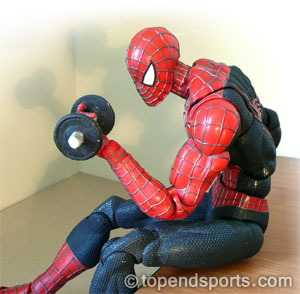
Disadvantages: Familiarization with the bicep curl technique will result in a better score. If the weight is too light or too heavy, the results may not be a good indication of the participant's upper body strength, as the number of repetitions changes the involvement of the muscle energy systems.
Comments: When choosing a weight to use, a somewhat heavier weight will be more effective in helping you determine your improvements, say on day 90 of the P90X program. If any variation in technique was allowed, this should be recorded on the results sheet for referral when the test is repeated.
Variations / modifications: the weight for this test can be varied depending on the fitness level and experience of the participants to be tested. A fairer test may be to use a set percentage of the participant's body weight, as is done in the relative bench press test.
The Science Behind the Calculation
Our calculator uses multiple validated methodologies to provide comprehensive strength assessment:
1RM Estimation (Brzycki Formula)
The Brzycki formula estimates your one-repetition maximum based on submaximal performance:
1RM = Weight × (36 / (37 - Reps))
This formula is accurate for rep ranges between 1-12 and provides a reliable estimate of maximal strength without the risks associated with maximal testing.
Relative Strength Ratio
Your relative strength is calculated as the curl weight divided by your body weight. This ratio allows fair comparison between athletes of different sizes:
- Elite Male: >35% body weight for 15+ reps
- Advanced Male: 28-35% body weight for 12+ reps
- Intermediate Male: 20-28% body weight for 10+ reps
- Elite Female: >25% body weight for 15+ reps
- Advanced Female: 18-25% body weight for 12+ reps
Percentile Calculation
The percentile ranking is derived from a composite strength score combining your relative strength ratio and total repetitions, compared against athletic population data from strength training research.
Sport-Specific Applications
The maximum bicep curl test has relevance across multiple athletic disciplines:
Combat Sports (Boxing, MMA, Wrestling)
Upper body pulling strength is crucial for clinching, grappling, and maintaining guard positions. Athletes should target the Advanced to Elite categories with heavier weights (25-35+ lbs).
Throwing Sports (Baseball, Cricket, Javelin)
Bicep strength contributes to arm speed and deceleration during throwing motions. Focus on both strength and endurance components.
Climbing and Gymnastics
Pulling strength relative to body weight is paramount. These athletes should emphasize relative strength ratios over absolute weights.
General Fitness Programs
For P90X and similar programs, meeting the minimum standards (10 reps at 20 lbs for men, 10 reps at 8 lbs for women) indicates readiness for the program's demands.
How to Improve Your Bicep Curl Test Score
Based on your results, implement these training strategies:
If Scoring Below Beginner Level:
- Start with lighter weights focusing on proper form
- Train biceps 2-3 times weekly with 3 sets of 12-15 reps
- Include compound movements like chin-ups and rows
- Progressively increase weight by 5% when you can complete 15 reps easily
If Scoring Beginner to Intermediate:
- Implement progressive overload—increase weight when reaching 12 reps
- Add curl variations: hammer curls, concentration curls, preacher curls
- Train in the 8-12 rep range for hypertrophy
- Include drop sets and time-under-tension techniques
If Scoring Advanced:
- Focus on strength phase training: 5-8 rep range with heavier weights
- Incorporate eccentric (lowering phase) emphasis
- Use periodization—alternate between strength and endurance phases
- Consider unilateral training to address imbalances
If Scoring Elite:
- Maintain current levels with 1-2 weekly maintenance sessions
- Focus on sport-specific applications of bicep strength
- Retest monthly to ensure maintenance of elite status
Frequently Asked Questions
How many bicep curls should I be able to do?
For the P90X fitness test, men should complete at least 10 curls with 20 lbs and women at least 10 curls with 8 lbs. Generally, 10-15 reps with a challenging weight indicates good strength endurance. Elite athletes may exceed 25+ reps at heavier weights.
What is a good weight for bicep curls?
A good weight for the maximum bicep curl test is one where you max out between 10-15 repetitions. For most men, this is 20-35 lbs per dumbbell. For women, 8-15 lbs is typical. The weight should be challenging but allow proper form throughout.
What does the bicep curl test measure?
The maximum bicep curl test measures upper body muscular strength endurance, specifically targeting the biceps brachii, brachialis, and brachioradialis muscles. It assesses your ability to perform repeated contractions against resistance until failure.
How often should I retest my bicep curl maximum?
Retest every 4-6 weeks during a training program to track progress. For P90X specifically, compare your day 1 results with day 90 results. Avoid testing when fatigued from recent arm training—allow at least 48 hours rest for accurate results.
Can I use this test if I'm a beginner?
Yes, the test is suitable for all fitness levels. Beginners should start with lighter weights and focus on proper form. Even if you score below average initially, consistent training will improve your results significantly within 8-12 weeks.
Is the bicep curl test valid for measuring overall strength?
The bicep curl test specifically measures arm flexor strength endurance, not total body strength. For comprehensive strength assessment, combine with tests for other muscle groups such as the bench press (chest), squat (legs), and row (back).
References
- Brzycki, M. (1993). "Strength Testing—Predicting a One-Rep Max from Reps-to-Fatigue." Journal of Physical Education, Recreation & Dance, 64(1), 88-90.
- Beachbody LLC. (2004). "P90X Fitness Guide: Fit Test Procedures." P90X Extreme Home Fitness.
- American College of Sports Medicine. (2021). "ACSM's Guidelines for Exercise Testing and Prescription." 11th Edition. Wolters Kluwer.
- Kraemer, W.J. & Ratamess, N.A. (2004). "Fundamentals of Resistance Training: Progression and Exercise Prescription." Medicine & Science in Sports & Exercise, 36(4), 674-688.
- Schoenfeld, B.J. et al. (2017). "Strength and Hypertrophy Adaptations Between Low- vs. High-Load Resistance Training." Journal of Strength and Conditioning Research, 31(12), 3508-3523.
The Test in Action
- This test is part of the Fit Test for the P90X Home Fitness Workout.
Similar Tests
- See the similar Bench Press Max fitness tests.
- The arm curl test is conducted over 30 seconds
- Relative bench press test uses body weight percentage
Related Pages
 Any comments, suggestions, or corrections? Please let us know.
 More About Dumbbells