Balance Board Test Calculator
Quick Answer
This calculator instantly converts your Balance Board Test time into counts (1 count = 0.3 seconds) and provides percentile rankings for elderly athletes. The test measures static equilibrium and fall risk in active seniors over 55.
- Calculates official Groningen Fitness Test score instantly
- Based on validated protocol for elderly populations (Lemmink et al., 2001)
- Provides fall risk assessment and personalized training recommendations
Understanding the Balance Board Test for Active Seniors
The Balance Board test is an agility and balance (equilibrium) test specifically designed for elderly populations. The test requires participants to stand on a platform and try to keep the platform balanced for a period of 30 seconds. This is an important fitness capacity to measure in active seniors as poor balance can lead to falls and injuries, which are the leading cause of injury-related hospitalizations in adults over 65.
As part of the comprehensive Groningen Fitness Test for the Elderly, this balance assessment has been validated through extensive research with independently living adults over 55 years of age. The test demonstrates excellent reliability and provides objective measurements that correlate strongly with fall risk and functional independence in elderly populations.
Test Purpose and Scientific Foundation
Primary Purpose: To measure whole-body static balance and postural control in elderly athletes maintaining active lifestyles. The test evaluates the ability to maintain center of mass over the base of support on an unstable surface, which directly relates to fall prevention and functional mobility.
Equipment Required: A wooden balance platform measuring 50 x 50 x 1.5 cm, with a small 2 cm wide beam running lengthwise down the middle beneath it. Small stoppers are placed on the corners of the platform so that the board cannot tilt more than 18°. Contacts connected to a timer are placed on the underside of the platform, exactly in the middle of the left and right halves.
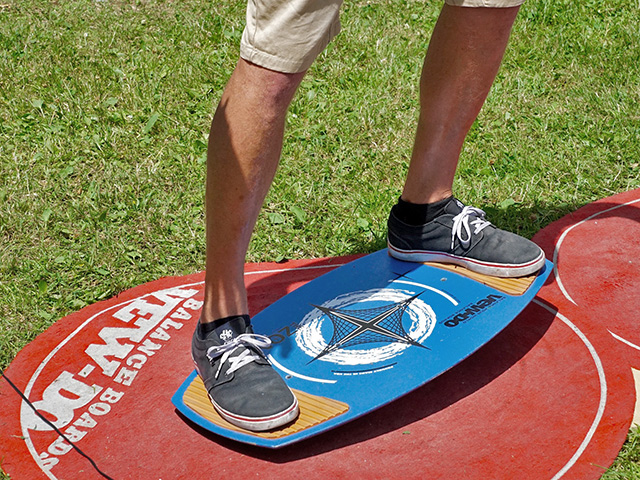
Balance board platform used in Groningen Fitness Test for the Elderly
How to Perform the Balance Board Test
Pre-test Procedures: Explain the test procedures to the subject. Perform screening of health risks and obtain informed consent. Prepare forms and record basic information such as age, height, body weight, gender, and test conditions. Perform an appropriate warm-up focusing on ankle mobility and lower body activation. See more details of pre-test procedures.
Testing Procedure: The participant is instructed to stand on the platform with toes pointed outward (15°) and heels 15 cm apart. The participant must try to keep the platform balanced for a period of 30 seconds. The timer stops when the contacts touch the floor. After one practice trial, the best score of three trials is recorded.
Scoring System: The score is the total time that neither contact touches the floor, expressed in counts (1 count = 0.3 seconds; 100 counts = 30 seconds). Thus the maximum score is 100 (for 30 seconds), and higher scores indicate better performance. This scoring system allows for precise quantification of balance duration and facilitates comparison across elderly populations.
Interpreting Your Balance Board Test Results
Understanding your score requires context within elderly athletic populations. Research by Lemmink and colleagues established normative data for independently living adults over 55 years of age, providing benchmarks for performance interpretation.
Excellent (85-100 counts)
Superior balance representing top 10% of elderly athletes. Minimal fall risk. Indicates excellent proprioception and neuromuscular control.
Good (70-84 counts)
Above-average balance for active seniors. Low fall risk. Demonstrates effective postural control strategies and adequate lower body strength.
Average (55-69 counts)
Typical performance for independently living elderly. Moderate fall risk. Regular balance training recommended for improvement.
Below Average (<55 counts)
Indicates elevated fall risk requiring intervention. Professional assessment recommended for targeted balance rehabilitation program.
The Science Behind Balance Assessment in Elderly Athletes
Balance is a complex physiological function integrating sensory information from visual, vestibular (inner ear), and proprioceptive (body position) systems. As individuals age, these systems naturally decline, making balance assessment crucial for maintaining independence and athletic activity in senior populations.
The Balance Board Test specifically evaluates static balance - the ability to maintain postural stability while stationary on an unstable surface. This type of balance assessment has been shown to correlate strongly with functional mobility, risk of falls, and ability to perform activities of daily living in elderly populations.
Biomechanical Principles: Successful performance requires coordinated activation of ankle, knee, and hip strategies to maintain the platform's center of mass over the narrow base of support. The 18-degree tilt limitation provides a standardized challenge while preventing extreme movements that could cause injury. The electronic contact sensors allow precise measurement of balance duration down to 0.3-second intervals.
Balance Training for Active Seniors
Research demonstrates that balance can be significantly improved at any age through targeted training. A comprehensive balance program for elderly athletes should incorporate:
Progressive Difficulty Levels: Begin with stable surface exercises (standing on one leg, weight shifts) and progress to unstable surfaces (foam pads, balance boards, BOSU balls). Athletic seniors can advance to dynamic balance challenges incorporating sport-specific movements.
Strength Integration: Lower body strength, particularly in the ankles, quadriceps, and hip abductors, directly supports balance performance. Resistance training 2-3 times weekly complements balance-specific exercises for optimal results.
Proprioceptive Training: Exercises performed with eyes closed or on unstable surfaces enhance proprioceptive feedback, a key component of balance that often declines with age. Activities like tai chi and yoga provide excellent proprioceptive stimulus for elderly athletes.
Pro Tip: Perform balance exercises when you're fresh, not fatigued. Practice daily for just 10-15 minutes, and always have something stable nearby for safety. Progress gradually - rushing advancement increases injury risk in elderly populations.
Sport-Specific Applications for Elderly Athletes
While originally designed for general elderly fitness assessment, the Balance Board Test has important applications across various senior sports and activities:
Golf (Senior Divisions): Balance during the golf swing, particularly on uneven terrain, directly correlates with Balance Board Test performance. Senior golfers with scores above 75 counts demonstrate more stable swing mechanics and better weight transfer patterns.
Tennis and Pickleball: Court sports require rapid directional changes and stable platform for stroke execution. Elderly tennis players averaging 70+ counts show reduced ankle injuries and better court coverage than those scoring below 55 counts.
Walking Sports: Activities like walking football, walking basketball, and racewalking rely heavily on single-leg balance phases. Balance Board scores correlate with gait stability and reduced stumble frequency in these popular senior sports.
Bowling: The approach and delivery in bowling demand excellent balance control. Senior bowlers with superior Balance Board scores (80+ counts) demonstrate more consistent approach patterns and reduced foul frequency.
Masters Athletics: Track and field events for seniors, from sprints to throws, all benefit from enhanced balance. Field studies show Balance Board scores predict injury rates in masters athletics competitions.
Comparing Balance Assessment Methods
The Balance Board Test is one of several validated balance assessments for elderly populations. Understanding how it compares to alternatives helps contextualize results:
vs. Berg Balance Scale: The Berg is more comprehensive (14 tasks) but requires 15-20 minutes to administer. The Balance Board Test provides a focused, objective static balance measurement in under 5 minutes, making it ideal for screening large groups of elderly athletes.
vs. Y-Balance Test: The Y-Balance emphasizes dynamic balance and reach distance, while the Balance Board Test measures static equilibrium duration. Both provide complementary information about different aspects of balance control in seniors.
vs. Single-Leg Stand: Simpler than the Balance Board Test but less sensitive to subtle balance deficits. The unstable platform surface of the Balance Board provides a more challenging and discriminative assessment for active elderly populations.
Advantages of Balance Board Test: Objective scoring removes inter-rater variability, the unstable surface provides appropriate challenge for elderly athletes, equipment is relatively affordable, and testing time is minimal. The electronic timing system ensures precise, reproducible measurements across testing sessions.
Target Population and Special Considerations
Ideal Candidates: This test was designed specifically for independently living elderly individuals over 55 years of age who maintain active lifestyles. It's particularly valuable for masters athletes, senior fitness enthusiasts, and older adults participating in recreational sports who want objective balance assessment.
Contraindications: The test should be avoided by individuals with acute vestibular disorders, recent lower extremity injuries, severe osteoporosis with fracture risk, or significant cognitive impairments affecting instruction comprehension. Always consult healthcare providers before testing if there are concerns about safety or appropriateness.
Adaptations: For elderly individuals with mild balance concerns, the test can be modified by having a spotter nearby or allowing light fingertip contact with a stable surface for confidence. However, these modifications should be noted as they affect score interpretation and comparison to normative data.
Test Advantages and Limitations
Advantages:
- Objective, quantitative measurement eliminates scoring variability between testers
- Quick administration (5 minutes including practice) suitable for large group screening
- Validated specifically for elderly populations with established normative data
- Unstable surface provides appropriate challenge for active seniors
- Electronic timing ensures precise, reproducible measurements
- Correlates strongly with fall risk and functional independence
- Can track progress over time with repeat testing
Disadvantages:
- Requires specialized apparatus not readily available in all settings
- Platform construction specifications must be exact for valid results
- Practice effects may occur with frequent testing
- Measures only static balance, not dynamic balance during movement
- May not be appropriate for elderly individuals with severe balance impairments
- Requires adequate space and safety equipment for proper administration
Medical Disclaimer
Important: This calculator provides estimates for educational and fitness assessment purposes only. Results should not replace professional medical advice. Always consult with a qualified healthcare provider, physical therapist, or sports medicine professional before making health decisions or starting new exercise programs based on these calculations. Individual results may vary based on factors not included in this assessment. The Balance Board Test should only be performed under appropriate supervision with proper safety measures in place, especially for elderly individuals with known balance concerns or medical conditions.
⚠️ Safety Note: Always have a trained spotter present during Balance Board testing, especially for first-time elderly participants or those with known balance deficits. Ensure adequate space around the platform to prevent injury if balance is lost. Stop immediately if dizziness, pain, or excessive instability occurs.
Frequently Asked Questions About Balance Board Testing
What is a good score on the Balance Board Test for elderly individuals?
A score of 70 counts or higher (21 seconds) is considered good for active seniors over 55. Scores of 85+ counts (25.5+ seconds) are excellent, representing the top 10% of elderly populations. The maximum score is 100 counts, equivalent to maintaining perfect balance for the full 30 seconds. Average scores for independently living elderly adults typically fall in the 60-75 count range.
How is the Balance Board Test score calculated?
The score is calculated based on the total time the platform remains balanced without either contact touching the floor. Each count equals 0.3 seconds, so the maximum score of 100 counts represents 30 seconds of perfect balance. For example, 15 seconds of balance equals 50 counts (15 ÷ 0.3 = 50). The electronic contact sensors provide precise measurement to the nearest 0.3 seconds, ensuring accurate and reproducible scoring.
What does the Balance Board Test measure in elderly athletes?
The test measures whole-body static balance and equilibrium control in seniors. It assesses postural stability, proprioception (body position awareness), and the ability to maintain center of mass over a narrow base of support on an unstable surface. This is crucial for fall prevention, functional mobility, and maintaining athletic performance in elderly populations. The test also indirectly evaluates ankle, core, and hip strength, as well as neuromuscular coordination.
How can elderly individuals improve their Balance Board Test score?
Improvement comes through consistent balance training exercises, lower body strengthening, core stability work, and proprioceptive training. Activities like tai chi, yoga, single-leg stands, and progressive training on unstable surfaces can significantly enhance balance performance. Research shows elderly individuals can improve scores by 15-25 counts within 8-12 weeks of structured balance training. Key exercises include standing on one leg (30-60 seconds), weight shifts, heel-to-toe walks, and practicing on foam pads or balance boards with proper supervision.
What fall risk does a low Balance Board Test score indicate?
Scores below 55 counts indicate moderate to high fall risk in elderly populations, with studies showing increased probability of falls within the following year. Scores below 35 counts suggest very high fall risk and warrant immediate professional evaluation by a physical therapist or geriatric specialist. The Groningen Fitness Test research demonstrated that Balance Board performance correlates strongly with actual fall incidence in independently living seniors. Individuals scoring below 40 counts should implement fall prevention strategies including home safety modifications, assistive device assessment, and supervised balance rehabilitation.
How often should elderly athletes take the Balance Board Test?
For elderly athletes maintaining regular training, quarterly testing (every 3 months) provides optimal progress tracking without over-testing. After starting a new balance training program, retesting at 6 and 12 weeks helps monitor improvement and adjust training protocols. The test demonstrates good stability with 1-week test-retest reliability, though practice effects may occur with more frequent testing. Annual testing is sufficient for healthy, active seniors simply monitoring general fitness maintenance.
Is the Balance Board Test safe for all elderly individuals?
The test is safe for independently living elderly individuals with no acute medical conditions. However, it should not be performed by those with severe osteoporosis, recent fractures, acute vertigo, or severe balance impairments without professional supervision. The 18-degree tilt limitation and proper spotting techniques minimize risk. Individuals with known fall history or significant balance concerns should complete the test only under supervised conditions with appropriate safety measures in place, including nearby support structures and trained spotters.
References
- Lemmink, K.A.P., Kemper, H., de Greef, M.H.G., Rispens, P., & Stevens, M. (2001). "Reliability of the Groningen Fitness Test for the Elderly." Journal of Aging and Physical Activity, 9(2), 194-212.
- Berg, K.O., Wood-Dauphinee, S.L., Williams, J.I., & Maki, B. (1992). "Measuring balance in the elderly: validation of an instrument." Canadian Journal of Public Health, 83(Suppl 2), S7-11.
- Tinetti, M.E., Williams, T.F., & Mayewski, R. (1986). "Fall risk index for elderly patients based on number of chronic disabilities." American Journal of Medicine, 80(3), 429-434.
- Shumway-Cook, A., Brauer, S., & Woollacott, M. (2000). "Predicting the probability for falls in community-dwelling older adults using the Timed Up & Go Test." Physical Therapy, 80(9), 896-903.
- Rubenstein, L.Z. (2006). "Falls in older people: epidemiology, risk factors and strategies for prevention." Age and Ageing, 35(Suppl 2), ii37-ii41.
- Sherrington, C., Tiedemann, A., Fairhall, N., Close, J.C., & Lord, S.R. (2011). "Exercise to prevent falls in older adults: an updated meta-analysis and best practice recommendations." New South Wales Public Health Bulletin, 22(3-4), 78-83.
- Howe, T.E., Rochester, L., Neil, F., Skelton, D.A., & Ballinger, C. (2011). "Exercise for improving balance in older people." Cochrane Database of Systematic Reviews, (11), CD004963.
- University of Groningen. (1995). "The Groningen Fitness Test for the Elderly: Field Based Motor Fitness Assessment for Adults Over 55 Years." Department of Human Movement Sciences, Groningen, Netherlands.
- American College of Sports Medicine. (2009). "Exercise and Physical Activity for Older Adults." Medicine & Science in Sports & Exercise, 41(7), 1510-1530.
- World Health Organization. (2007). "WHO Global Report on Falls Prevention in Older Age." Geneva: World Health Organization.
Similar Balance Tests for Elderly Populations
- Stork Balance Test — Stand on the toes of one leg for as long as possible with the free leg resting on the inside of the opposite knee. Simpler than Balance Board but less sensitive.
- One Leg Stand — The US sobriety test adapted for elderly fitness, stand with one foot off the ground for 30 seconds. Tests single-leg static balance.
- Standing Balance Test — Stand on one leg for as long as possible with eyes open or closed. Progressive difficulty by removing visual input.
- Stick Lengthwise Test — Balance on a stick for as long as possible, standing side-on on the balls of both feet. Challenges narrow base of support.
Related Pages
Groningen Fitness Test Battery
Complete elderly fitness assessment protocol including strength, flexibility, endurance, and balance components.
Learn More →Balance Testing Methods
Comprehensive overview of static and dynamic balance tests including Stork Stand, Y-Balance, and Berg Balance Scale.
Explore Tests →Fitness Testing for Elderly
Guidelines and best practices for conducting fitness assessments in elderly populations with safety considerations.
Read More → Any comments, suggestions, or corrections? Please let us know.