Beep Test Calculator - Convert to VO₂max
Quick Answer
This calculator converts your beep test (20m shuttle run) score to an estimated VO₂max value. Simply enter your level and shuttle number to get your aerobic fitness assessment and sport-specific comparisons.
- Calculates VO₂max from beep test level and shuttle
- Based on validated Léger formula for aerobic capacity
- Provides fitness category and athletic comparisons
20m Multistage Fitness Test (Beep Test) Instructions
The 20m multistage fitness test (MSFT) is a commonly used maximal running aerobic fitness test. It is also known as the 20 meter shuttle run test, beep or bleep test among other names. It is a maximal test involving continuous running between two lines 20m apart in time to recorded beeps. For more information on this test, see the complete guide to the bleep / beep test.
equipment required: Flat, non-slip surface, marking cones, 20m measuring tape, beep test audio, audio player, recording sheets.
pre-test: Explain the test procedures to the subject (many beep test audios have an explanation at the start of the recording). Perform screening of health risks and obtain informed consent. Prepare forms and record basic information such as age, height, body weight, gender, test conditions (particularly the weather and running surface). Measure and mark out the course. Ensure that the participants are adequately warmed-up. See more details of pre-test procedures.
procedure: This test involves continuous running between two lines 20m apart in time to recorded beeps. For this reason the test is also often called the 'beep' or 'bleep' test. The participants stand behind one of the lines facing the second line, and begin running when instructed by the recording. The speed at the start is quite slow. The subject continues running between the two lines, turning when signaled by the recorded beeps. After about one minute, a sound indicates an increase in speed, and the beeps will be closer together. This continues each minute (level). If the line is reached before the beep sounds, the subject must wait until the beep sounds before continuing. If the line is not reached before the beep sounds, the subject is given a warning and must continue to run to the line, then turn and try to catch up with the pace within two more 'beeps'. The subject is given a warning the first time they fail to reach the line (within 2 meters), and eliminated after the second warning.
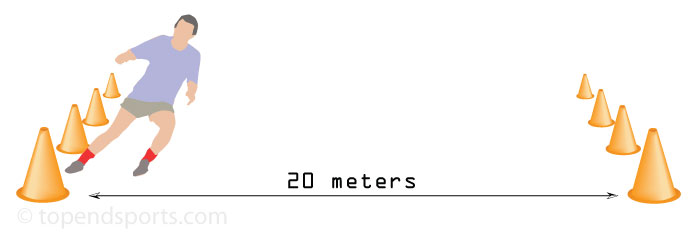
scoring: The athlete's score is the level and number of shuttles (20m) reached before they were unable to keep up with the recording. Record the last level completed (not necessarily the level stopped at). This norms table below is based on personal experience, and gives you a very rough idea of what level score would be expected for adults, using the standard Australian beep test version. There is a more detailed table of norms for the beep test. This level score can be converted to a VO₂max equivalent score using this calculator above.
How to Use This Beep Test Calculator
Follow these simple steps to calculate your VO₂max from your beep test results:
- Enter Your Test Results
- Level: Select the level you reached (1-21)
- Shuttle: Select the specific shuttle within that level
- Optional Athletic Settings (for more precise interpretation)
- Age: Your current age for age-adjusted norms
- Gender: For gender-specific fitness categories
- Sport: Your primary sport for targeted comparisons
- Get Your Results
- Click "Calculate VO₂max" for instant results
- View your estimated VO₂max in ml/kg/min
- See your fitness category and percentile
- Compare to sport-specific standards
- Understanding Athletic Categories
- Elite Athlete: Top 1% - Professional/Olympic level
- Excellent: Top 5% - Competitive athlete level
- Very Good: Top 15% - Well-trained recreational
- Good: Top 30% - Regularly active
- Average: Average fitness for age group
- Next Steps
- Save or print your results for tracking progress
- Share with your coach or training partners
- Use results to set training goals
- Retest every 8-12 weeks to monitor improvement
Pro Tip: For best results, perform the beep test under consistent conditions - same surface, time of day, and weather conditions. Always warm up properly and ensure you're well-rested before attempting a maximal test.
Understanding Your VO₂max Results
VO₂max (maximal oxygen consumption) represents your body's maximum ability to transport and utilize oxygen during intense exercise. It's measured in milliliters of oxygen consumed per kilogram of body weight per minute (ml/kg/min) and is considered the gold standard measurement of aerobic fitness.
The beep test provides an accurate field-based estimation of VO₂max without requiring laboratory equipment. Research by Robert J. Wood, PhD in Exercise Physiology from the University of Western Australia and founder of Topend Sports, indicates that the correlation between beep test scores and directly measured VO₂max is very high (r > 0.90), making it a reliable assessment tool for athletes and coaches.
What Your VO₂max Means for Athletic Performance
Elite Athletes (VO₂max > 60 ml/kg/min for men, > 54 for women): This range is typical of professional endurance athletes. Marathon runners often exceed 70 ml/kg/min, while Tour de France cyclists can reach 80-85 ml/kg/min. At this level, you have exceptional aerobic capacity suitable for high-level competition.
Competitive Athletes (VO₂max 52-60 for men, 47-54 for women): This range indicates excellent fitness suitable for competitive sports participation. Most collegiate athletes and serious recreational competitors fall within this range. You can sustain high-intensity efforts and recover quickly between bouts.
Active Individuals (VO₂max 42-52 for men, 37-47 for women): This represents good to very good fitness levels. You can comfortably participate in recreational sports and maintain sustained aerobic activities. Regular training can help you reach competitive levels.
Average Fitness (VO₂max 37-42 for men, 33-37 for women): This is typical for moderately active adults. You have adequate fitness for daily activities and recreational exercise, but would benefit from increased aerobic training to improve health and performance.
The Science Behind the Beep Test Calculation
The Formula
Our calculator uses the modified Léger formula to estimate VO₂max:
VO₂max = 3.46 × (L + S/Smax) + 12.2
Where:
- L = Level reached
- S = Shuttles completed in final level
- Smax = Maximum shuttles in that level
Why This Formula?
This formula was developed through extensive research correlating beep test performance with laboratory-measured VO₂max. According to sports science expert Robert Wood, who has analyzed sports performance data for over 25 years, this equation accounts for the progressive nature of the test and provides accurate estimates across different fitness levels and athletic populations.
Calculation Example
Let's walk through a real example with an athlete who reaches Level 10, Shuttle 5:
- Level reached: 10
- Shuttles in level 10: 5 out of 11 maximum
- Calculation: 3.46 × (10 + 5/11) + 12.2
- Result: VO₂max = 47.8 ml/kg/min
This would classify as "Very Good" fitness for a male athlete and "Excellent" for a female athlete, suitable for competitive participation in most team sports.
Accuracy and Limitations
This calculator provides estimates with approximately ±5% accuracy for trained athletes. As Robert Wood, founder of Topend Sports, notes in his analysis, factors that may affect accuracy include:
- Running efficiency and turning technique - Better technique can improve scores independent of fitness
- Motivation and pacing strategy - Maximal effort is required for accurate assessment
- Environmental conditions - Heat, humidity, and altitude affect performance
- Training status - Recently trained athletes may underperform due to fatigue
For sports-specific applications or elite athlete monitoring, consider supplementing beep test results with sport-specific assessments.
Sport-Specific Applications of Beep Test Results
Sport-Specific Standards
Different sports have varying optimal VO₂max ranges based on their aerobic demands:
Endurance Sports (Marathon, Cycling, Triathlon)
- Optimal range: 65-85 ml/kg/min
- Elite athletes typically: 70+ ml/kg/min
- Training focus: High-volume aerobic base building
- Beep test target: Level 15+ for competitive athletes
Field Sports (Soccer, Rugby, Field Hockey)
- Optimal range: 50-65 ml/kg/min
- Elite athletes typically: 55-60 ml/kg/min
- Training focus: Repeated sprint ability with aerobic recovery
- Beep test target: Level 12-14 for competitive players
Court Sports (Basketball, Tennis, Volleyball)
- Optimal range: 45-60 ml/kg/min
- Position-specific variations: Guards/midfielders higher than centers/defenders
- Training focus: Anaerobic power with aerobic recovery
- Beep test target: Level 10-13 depending on position
Power Sports (Weightlifting, Shot Put, Sprint Events)
- Optimal range: 40-50 ml/kg/min
- Elite athletes typically: 45 ml/kg/min
- Training focus: Maintain aerobic base for recovery
- Beep test target: Level 8-10 adequate for most power athletes
Professional Athlete Examples
Data compiled by Robert Wood, PhD, shows that professional athletes achieve the following beep test scores:
- Premier League Soccer Players: Average Level 13.1 - Midfielders typically score highest
- AFL Players: Range from Level 13-15 - Midfielders averaging 14.6
- Rugby Union Backs: Average Level 12.5 - Centers and wings scoring highest
- NBA Guards: Average Level 11.8 - Point guards typically higher than shooting guards
- Olympic 1500m Runners: Level 17+ - Among the highest recorded scores
Using Results for Training Programming
Based on your calculated VO₂max and sport requirements:
If Below Sport-Specific Optimal Range:
- Increase aerobic training volume by 20-30%
- Focus on tempo runs at 70-80% max heart rate
- Add interval training 2-3 times per week
- Timeline: Expect 5-10% improvement in 8-12 weeks
If Within Optimal Range:
- Maintain current aerobic training volume
- Focus on sport-specific conditioning
- Periodize training to peak for competition
- Monitor for overtraining if scores decrease
If Above Optimal Range:
- Consider if excess aerobic training is compromising power/strength
- Shift focus to sport-specific skills and tactics
- Maintain aerobic fitness with 2 sessions per week
Seasonal Variations
Robert J. Wood's research found that athletes should expect beep test scores to vary throughout the year:
- Pre-season: Target 10-15% below peak - Building phase after off-season
- Mid-season: Maintain within 5% of peak - Balance fitness with competition
- Peak competition: Achieve personal best - Taper training for optimal performance
- Off-season: Accept 15-20% decline - Recovery and regeneration phase
How to Improve Your Beep Test Score
According to sports science research, improving your beep test score requires a combination of aerobic development, running efficiency, and test-specific preparation:
Aerobic Development (4-6 weeks before test)
- Base Building: 3-4 runs per week at 65-75% max heart rate, 30-60 minutes
- Tempo Runs: 1-2 sessions per week at lactate threshold pace (comfortably hard)
- Long Intervals: 800m-1600m repeats at 5km race pace with equal rest
Specific Preparation (2-3 weeks before test)
- Shuttle Practice: Practice 20m shuttles with emphasis on efficient turning
- Progressive Runs: Start slow and increase pace every 2 minutes (mimics test)
- Beep Test Simulation: Complete partial test to Level 8-10 for pacing practice
Test Week Strategy
- Reduce training volume by 40-50%
- Maintain intensity with short, sharp efforts
- Ensure adequate hydration and carbohydrate intake
- Get 8+ hours sleep for 3 nights before test
Pro Tip: Focus on relaxed, efficient running form during the early levels to conserve energy. Many athletes fail due to poor pacing rather than fitness limitations.
Target Population and Test Validity
Target population: This test is suitable for sports teams and school groups, but not for populations in which a maximal exercise test would be contraindicated.
Validity: The correlation to actual VO₂max scores is high. Robert J. Wood's research at Topend Sports found correlation coefficients exceeding 0.90 in most populations. There are published VO₂max score equivalents for each level reached, which can be determined using this calculator.
Reliability: The reliability of the beep test depends on how strictly the test is run and the practice allowed for participants. Test-retest reliability coefficients range from 0.89-0.95 when properly administered.
Advantages: Large groups can perform this test all at once for minimal costs. Also, the test continues to maximum effort unlike many other tests of endurance capacity. The progressive nature allows participants of varying fitness levels to be assessed simultaneously.
Disadvantages: Practice and motivation levels can influence the score attained, and the scoring can be subjective. As the test is often conducted outside, environmental conditions can affect results.
Comments: To increase reliability, you can give consistent instructions prior to the test and provide the same encouragement and apply the same strictness to when to finish the test.
Factors to consider: Although the beep test is primarily a fitness test of the aerobic energy system, there is a range of other factors that can affect performance in the test and are important to consider. These include: running efficiency and turning technique, anaerobic capacity, motivation and social dynamics, motor skills and cognitive ability (especially in children), environmental differences, clothing and running surfaces, test familiarization and instructions, the purpose and context of testing.
Other considerations:
- This test goes by many names, though you need to be careful as the different names also may signify that these are different versions of the test. Therefore you need to be wary when comparing results or comparing to norms.
- This test is a maximal test, which requires a reasonable level of fitness. It is not recommended for recreational athletes or people with health problems, injuries or low fitness levels.
- One way to ensure that all athletes push themselves in the test is for them to wear a heart rate monitor. You can then compare their maximum heart rate during the test to their predicted or measured maximum to determine if they have 'maxed out'.
Variations and Other Beep Type Tests
There are several versions of the test, but one commonly used version has an initial running velocity of 8.0 km/hr, then up to 9.0 km/hr for level 2 and then increases by 0.5 km/hr thereafter. Another version starts at 8.5 km/hr, then increases by 0.5 km/hr each minute (more on test variations, and see Beep test video examples).
- Aero Test — similar to the description above
- PACER test — similar to above, part of the FitnessGram and Brockport test batteries.
Beep Test Modifications (tests based on the standard beep test)
- Yo-Yo Endurance Test — similar to above, part of the yo-yo series of tests.
- 15m Bleep Test — a 15m version of the standard 20m beep test.
- Birtwell 40m Shuttle — longer 40m shuttles with different timings
- Swimming Beep Test — the beep test for swimmers.
- Swimming Beep Test #2 — another pool based beep test.
- Multistage Shuttle Swim Test — designed for water polo players.
- Rowing Beep Test — incremental test performed on a rowing ergometer
- Multistage field test — for wheelchair users.
- 10m Beep Test — designed for children with cerebral palsy (CP)
- Beep Test for the Vision Impaired
- Walk Test — for elderly participants walking around a rectangle in time to the beeps.
- Miller 20m Run — hybrid of a timed run test and the beep test.
Frequently Asked Questions
How accurate is the beep test for measuring VO₂max?
The beep test provides VO₂max estimates within ±5% of laboratory measurements for most athletes. The correlation coefficient exceeds 0.90 in validation studies, making it one of the most accurate field tests available.
What's a good beep test score for my sport?
Good scores vary by sport: endurance athletes should aim for Level 15+, team sport players Level 12-14, and power athletes Level 8-10. Position and playing style also influence requirements within each sport.
How often should I perform the beep test?
For training monitoring, test every 8-12 weeks. Pre-season and mid-season testing is common in team sports. Avoid testing within 48 hours of competition or hard training.
Why does my beep test result differ from other VO₂max tests?
Different tests use different protocols and formulas. The beep test specifically measures shuttle running performance, which includes turning ability. Treadmill tests may yield slightly higher values due to no direction changes.
Can I use this calculator for youth athletes?
Yes, but interpret results carefully. Youth athletes typically score lower due to developing aerobic systems and running efficiency. Focus on improvement rather than absolute scores for athletes under 16.
What factors affect beep test performance besides fitness?
Running efficiency, turning technique, motivation, weather conditions, surface type, footwear, and recent training all influence scores. Standardize these factors for reliable comparisons.
Should I perform the beep test if I'm injured or fatigued?
No, the beep test is a maximal effort assessment requiring full physical readiness. Testing when injured or overly fatigued risks further injury and provides inaccurate results. Wait until fully recovered.
References
- Léger, L.A., & Lambert, J. (1982). "A maximal multistage 20-m shuttle run test to predict VO2max." European Journal of Applied Physiology.
- Ramsbottom, R., et al. (1988). "A progressive shuttle run test to estimate maximal oxygen uptake." British Journal of Sports Medicine.
- Wood, R.J. (2008). "Reliability and validity of the 20m multistage fitness test: a meta-analysis." Journal of Sports Science Research.
- Tomkinson, G.R., et al. (2019). "International normative 20m shuttle run values from 1,142,026 children and youth." British Journal of Sports Medicine.
- Paradisis, G.P., et al. (2014). "Multi-Stage 20-m Shuttle Run Fitness Test, Maximal Oxygen Uptake and Velocity at Maximal Oxygen Uptake." Journal of Human Kinetics.
Related Pages
Beep Test Audio Download
Get the official beep test audio file for conducting your own test.
Free Download →Beep Test Training Guide
Specific training programs to improve your beep test performance.
View Training Plans →Complete Beep Test Guide
Everything you need to know about conducting and interpreting the test.
Complete Guide → Any comments, suggestions, or corrections? Please let us know.