Aero Test Calculator
Quick Answer
This calculator determines your VO2max from Aero Test shuttle run performance using the Wilkinson formula. Results provide accurate assessment of aerobic capacity for team sport athletes and military personnel.
- Calculates VO2max from shuttle count instantly
- Based on validated Wilkinson et al. (1999) formula
- Provides sport-specific athletic performance ratings
About the Aero Test
The Aero test is a maximal aerobic test designed to measure cardiovascular fitness through progressive shuttle running. It is a variation of the popular bleep/beep/multistage fitness test for measuring aerobic fitness. Participants run between two lines 20 meters apart in time to audio signals, with the pace increasing incrementally throughout the test. For more information, see the complete guide to the beep test.
How to Use This Aero Test Calculator
Follow these simple steps to calculate your aerobic fitness from your Aero Test performance:
1. Perform the Aero Test
Complete the full Aero Test following standard protocols. Run continuously between the 20-meter lines, turning when signaled by the recorded beeps. Each bleep is 0.05 km/hr quicker than the previous one. Continue until you can no longer maintain the required pace for two consecutive shuttles.
2. Record Your Score
Note the total number of completed shuttles before you were unable to keep up with the recording. This count includes every 20-meter run from start to finish. Do not count incomplete shuttles where you failed to reach the line.
3. Enter Your Data
Input your total shuttle count into the calculator above. The system accepts scores from 1 to 500 shuttles, covering the full range from beginner to elite athlete performance.
4. Calculate Your Results
Click the green "Calculate VO2max" button to instantly receive your aerobic fitness assessment. The calculator automatically determines your peak running speed and converts this to a VO2max value using the scientifically validated Wilkinson formula.
5. Interpret Your Performance
Review your fitness category (Poor to Elite) and sport-specific comparisons. The results show where you rank compared to athletic populations in your sport and provide targeted recommendations for improvement.
Pro Tip: For accurate results, ensure the Aero Test was performed on a non-slip surface with proper 20-meter markings, appropriate athletic footwear, and following a thorough warm-up. Environmental conditions and motivation significantly affect performance.
Understanding Your VO2max Results
VO2max, or maximal oxygen uptake, represents the maximum amount of oxygen your body can utilize during intense exercise. It is measured in milliliters of oxygen per kilogram of body weight per minute (ml/kg/min) and serves as the gold standard measure of aerobic fitness and cardiovascular endurance.
According to sports science expert Robert Wood, who has analyzed sports performance data for over 25 years, VO2max is particularly important for team sport athletes because it indicates not just aerobic capacity but also the ability to recover between high-intensity efforts during match play.
Fitness Categories Explained
Elite (60+ ml/kg/min): Top 5% of athletes. Typical of international-level soccer midfielders, professional rugby backs, and elite distance runners. Exceptional aerobic capacity supporting sustained high-intensity performance.
Excellent (52-59 ml/kg/min): Top 20% of athletes. Professional team sport standard for high-endurance positions. Supports competitive performance at national level competition.
Good (45-51 ml/kg/min): Above average athletic fitness. NCAA Division I standard for most team sports. Adequate for competitive amateur and semi-professional play.
Average (38-44 ml/kg/min): Typical athletic fitness level. Sufficient for recreational team sports and competitive participation at club level. Meets military and emergency services standards.
Fair (30-37 ml/kg/min): Below average for competitive athletics. Adequate for general fitness and recreational sport participation. Focus needed on aerobic base development.
Poor (<30 ml/kg/min): Well below athletic standards. Significant aerobic development required for competitive sport participation. Begin with base-building aerobic training.
The Science Behind the Calculation
The Wilkinson Formula
Our calculator uses the formula developed by Wilkinson et al. (1999) and published in Physiology Matters. This equation was specifically designed for the Aero Test protocol and validated through extensive research comparing field test performance with laboratory-measured VO2max values.
VO2max (ml/kg/min) = 5.73 × peak speed (km/hr) - 28.15
Where:
- Peak speed = 8.5 km/h + (0.05 km/h × number of shuttles completed)
- 8.5 km/h = Starting speed for the Aero Test
- 0.05 km/h = Incremental speed increase per shuttle
- 5.73 and 28.15 = Regression coefficients from validation study
Why This Formula?
The Wilkinson formula differs from standard beep test equations (Léger, Ramsbottom) in several important ways. It accounts for the continuous acceleration profile specific to the Aero Test where speed increases with every single shuttle, rather than in discrete levels. This provides more granular assessment of aerobic capacity across the performance spectrum.
Research by David M. Wilkinson demonstrated strong correlation (r = 0.89) between Aero Test-predicted VO2max and laboratory-measured values in trained athletes. The formula shows approximately ±5% accuracy when the test is conducted following standardized protocols with motivated participants.
Calculation Example
Let's calculate VO2max for an athlete who completes 85 shuttles in the Aero Test:
Step 1: Calculate peak speed
Peak speed = 8.5 + (0.05 × 85)
Peak speed = 8.5 + 4.25
Peak speed = 12.75 km/h
Step 2: Apply Wilkinson formula
VO2max = (5.73 × 12.75) - 28.15
VO2max = 73.06 - 28.15
VO2max = 44.91 ml/kg/min
Result: This athlete demonstrates "Good" aerobic fitness suitable for competitive amateur team sports. They rank in the upper-middle range for recreational athletes and meet standards for many collegiate sports programs.
Accuracy and Limitations
This calculator provides estimates with approximately ±5% accuracy for trained athletes when the test is performed correctly. Factors affecting accuracy include:
- Test administration: Proper 20-meter course marking, calibrated audio signals, and consistent environmental conditions are essential
- Participant factors: Running efficiency, turning technique, pacing strategy, and motivation significantly influence performance
- Training status: Athletes familiar with shuttle running patterns typically achieve more accurate scores reflecting true aerobic capacity
- Environmental conditions: Surface type, temperature, humidity, and altitude affect performance and should be standardized when possible
For elite athletes requiring precise physiological assessment or individuals with medical conditions requiring careful monitoring, laboratory VO2max testing conducted by qualified sports scientists provides gold-standard measurement. The Aero Test calculator serves as an excellent field assessment tool for team screening, training monitoring, and progress tracking.
Sport-Specific Applications and Standards
Soccer and Football
Professional soccer demands exceptional aerobic capacity due to the sport's continuous nature with intermittent high-intensity efforts. Research shows professional midfielders typically achieve VO2max values of 52-58 ml/kg/min, with elite international players at the upper end of this range.
Position-Specific Standards:
- Midfielders: 54-58 ml/kg/min (highest demands due to box-to-box coverage)
- Forwards: 52-56 ml/kg/min (high aerobic capacity supports repeated sprinting and pressing)
- Defenders: 50-54 ml/kg/min (good aerobic base for positional play and recovery)
- Goalkeepers: 45-50 ml/kg/min (lower running volume but requires recovery capacity)
Semi-professional players typically score 48-52 ml/kg/min, while competitive amateur players achieve 45-50 ml/kg/min. Youth academy players (U16-U18) should target progressive improvement toward 50+ ml/kg/min by graduation to senior squads.
Rugby
Rugby union demonstrates significant variation in aerobic demands between positional groups. Backs require higher VO2max for continuous running and support play, while forwards emphasize power and repeated-effort capacity.
Position Standards:
- Backs (9, 10, 11-14, 15): 52-60 ml/kg/min for international level
- Back Row Forwards (6, 7, 8): 50-55 ml/kg/min (mobile forward requirements)
- Front Row (1, 2, 3): 45-50 ml/kg/min (emphasis on power over aerobic capacity)
- Second Row (4, 5): 48-52 ml/kg/min (hybrid power-endurance demands)
Professional rugby league players generally achieve slightly higher VO2max values (2-4 ml/kg/min above union) due to the faster-paced, more continuous game structure with fewer set pieces.
Basketball
Elite basketball combines aerobic endurance for sustained performance across 40-minute games with anaerobic capacity for explosive movements. NBA players average 50-54 ml/kg/min, with guards typically at the upper end due to continuous court coverage.
Performance Levels:
- NBA/Professional: 50-56 ml/kg/min (varies by playing style and position)
- NCAA Division I: 48-52 ml/kg/min (competitive collegiate standard)
- NCAA Division II/III: 45-50 ml/kg/min (recreational to competitive range)
- High School Varsity: 42-48 ml/kg/min (developmental phase targets)
Guards consistently demonstrate 2-4 ml/kg/min advantage over centers due to higher movement demands and lower body mass relative to height.
Field Hockey
International field hockey players rank among the highest VO2max scores in team sports, with elite females achieving 53-58 ml/kg/min and males 56-62 ml/kg/min. The continuous play with minimal stoppages creates exceptional aerobic demands.
National team selection typically requires minimum standards of 52 ml/kg/min for females and 55 ml/kg/min for males. Club-level competitive players should target 48-52 ml/kg/min range for effective match performance.
Military and Emergency Services
Military forces and emergency services utilize shuttle run tests for fitness screening and ongoing readiness assessment:
- Special Forces: Minimum VO2max 50-52 ml/kg/min (elite operational readiness)
- Army Infantry: Minimum 42-45 ml/kg/min (combat fitness standard)
- Police Officers: Minimum 38-42 ml/kg/min (varies by role and department)
- Firefighters: Minimum 42-45 ml/kg/min (SCBA work capacity requirements)
- Paramedics: Minimum 38-40 ml/kg/min (physical demands of patient care)
Test Equipment and Procedures
Equipment required: Flat, non-slip surface, marking cones, 20m measuring tape, pre-recorded audio cd, cd player, recording sheets.
Pre-test procedures: Explain the test procedures to the subject. Perform screening of health risks and obtain informed consent. Prepare forms and record basic information such as age, height, body weight, gender, test conditions. Measure and mark out the course. Ensure that the participants are adequately warmed-up. See more details of pre-test procedures.
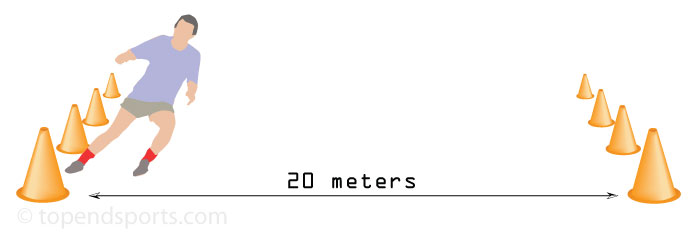
Test procedure: Use cones to mark out two lines 20 meters apart. The subject starts on or behind one of the lines, and begins running when instructed by the cd. This subject continues running between the two lines, turning when signaled by the recorded beeps. Each bleep is 0.05 km/hr quicker than the last one, and each 20 meters that is run counts as a score of one. If the line is not reached in time the subject must run to the line turn and try to catch up with the pace within 2 more 'beeps'. The test is stopped if the subject fails to catch up with the pace within the two ends.
Scoring: The athletes score is the total number of shuttles reached before they were unable to keep up with the recording. This score can be converted to a VO2max equivalent score using the following formula.
VO2max (ml/kg/min) = 5.73 x peak speed (km/hr) - 28.15 [Wilkinson et al. 1999]
Target population: Suitable for sports teams and school groups, but not for populations in which a maximal exercise test would be contraindicated.
Reliability: Reliability would depend on how strictly the test is run, and the practice allowed for the participants.
Advantages: Large groups can perform this test all at once for minimal costs. Also, the test continues to maximum effort unlike many other tests of endurance capacity.
Disadvantages: Practice and motivation levels can influence the score attained, and the scoring can be subjective. As the test is usually conducted outside, the environmental conditions can often affect the results. Norm values may be difficult to find, as it is more common to conduct the similar beep test.
Other considerations: This test is a maximal test, which requires a reasonable level of fitness. It is not recommended for recreational athletes or people with health problems, injuries or low fitness levels.
How to Improve Your Aero Test Score
Improving your Aero Test performance requires structured training addressing both aerobic capacity and shuttle-specific efficiency. Research by Robert Wood indicates athletes can improve VO2max by 10-15% over 8-12 weeks of targeted training.
Aerobic Base Development
Steady-State Running (3-4 sessions per week):
Build your aerobic foundation with runs at 65-75% maximum heart rate. Start with 20-30 minutes and progressively increase to 45-60 minutes. This develops mitochondrial density, capillarization, and fat oxidation capacity essential for sustained aerobic performance.
Long Runs (1 session per week):
Include one weekly long run at conversational pace, gradually building from 45 minutes to 90 minutes. These sessions enhance aerobic enzyme production and teach your body to efficiently utilize fat as fuel, sparing glycogen for high-intensity efforts.
High-Intensity Interval Training
Track Intervals (2 sessions per week):
Perform 6-8 × 400m repeats at 90-95% maximum effort with 90 seconds recovery. These intervals directly improve VO2max by stressing the cardiovascular system at near-maximal intensity. Progress by reducing rest periods or increasing repetitions.
Tempo Runs (1-2 sessions per week):
Run 20-30 minutes at lactate threshold pace (comfortably hard, roughly 85% max heart rate). Tempo runs improve your ability to buffer lactate and sustain higher intensities, directly translating to better Aero Test performance in later stages.
Shuttle-Specific Training
Turning Technique Practice:
Dedicate training time to efficient 180-degree turns at the shuttle lines. Plant your outside foot parallel to the line, drive hard with the inside leg, and maintain forward lean. Efficient turning saves 0.1-0.2 seconds per shuttle, significantly extending test duration.
Progressive Shuttle Intervals:
Practice shuttles at incrementally increasing speeds: 10 × 20m at 8.5 km/h, 10 × 20m at 9.0 km/h, progressing to faster paces. This conditions your neuromuscular system for the test's acceleration pattern and builds mental familiarity with pace changes.
Supporting Training Elements
Lower Body Strength:
Include squats, lunges, and plyometric exercises twice weekly. Strong legs improve acceleration, deceleration, and turning power while reducing injury risk from repetitive directional changes.
Core Stability:
Perform planks, anti-rotation exercises, and dynamic stability work. Strong core musculature stabilizes your torso during directional changes, improving efficiency and reducing energy waste.
Recovery and Periodization:
Structure training in 3-week progressive blocks followed by a recovery week at 60% normal volume. Adequate recovery allows physiological adaptations to occur and prevents overtraining that can decrease performance.
Seasonal Variations
Athletes should expect Aero Test scores to vary throughout the competitive year:
- Pre-season (8-12 weeks before competition): Build aerobic base with high volume, moderate intensity. Target 10-15% below peak scores while developing foundation.
- Early Competition (Weeks 1-4): Maintain aerobic fitness with 2-3 conditioning sessions weekly. Accept small decreases (5%) as competition volume increases.
- Mid-season Peak (Weeks 5-12): Achieve personal best scores through optimized training load balance. Maintain with 1-2 weekly conditioning sessions.
- Late Competition (Weeks 13+): Manage accumulated fatigue while maintaining adequate fitness. Expect 5-10% decrease from peak values.
- Off-season (8-12 weeks): Active recovery with cross-training. Accept 15-20% decrease while allowing physical and mental regeneration.
Frequently Asked Questions
How accurate is the Aero Test calculator?
The Aero Test calculator uses the Wilkinson formula validated against laboratory VO2max testing with strong correlation (r = 0.89). It provides estimates with approximately ±5% accuracy for trained athletes when the test is performed correctly following standardized protocols. Accuracy depends on proper test administration, participant familiarity with shuttle running, and environmental conditions.
What's a good Aero Test score for my sport?
Elite soccer midfielders typically achieve VO2max of 52-58 ml/kg/min, rugby backs 54-60 ml/kg/min, and basketball guards 50-56 ml/kg/min. Competitive team sport athletes generally score 45-52 ml/kg/min, while recreational players achieve 38-45 ml/kg/min. Individual variation exists based on position, training status, and sport-specific demands. Compare your score to position-specific standards in your sport for most relevant assessment.
How often should I perform the Aero Test?
Athletes should test every 4-6 weeks during pre-season training to monitor aerobic development, monthly during competition season for performance tracking, and quarterly during off-season for baseline assessment. Avoid testing when fatigued, injured, or within 48 hours of intense training for accurate results. More frequent testing (every 2-3 weeks) may be appropriate during focused aerobic development phases.
Can I use this calculator if I'm not an athlete?
The Aero Test is a maximal exercise assessment requiring significant physical effort and reasonable fitness levels. It is not recommended for sedentary individuals, those with cardiovascular conditions, or anyone for whom maximal exercise testing is contraindicated. Recreational exercisers should consult a physician before attempting maximal fitness testing. Consider submaximal alternatives like walking tests for general fitness assessment.
How can I improve my Aero Test score?
Improve through structured training combining aerobic base development (steady-state running at 65-75% max heart rate 3-4 times weekly), high-intensity intervals (400m repeats at 90-95% effort twice weekly), tempo runs at lactate threshold pace, and shuttle-specific practice focusing on efficient turning technique. Athletes typically improve 10-15% over 8-12 weeks of targeted training with progressive overload and adequate recovery.
Is the Aero Test different from the beep test?
Yes. The Aero Test increases speed by 0.05 km/h after every single shuttle, creating continuous acceleration throughout the test. It uses the Wilkinson formula for VO2max calculation. The standard beep test increases by 0.5 km/h per level (not per shuttle) and typically uses Léger or Ramsbottom formulas. While both assess aerobic capacity, the Aero Test provides more granular progression and different mathematical conversion to VO2max values.
Why does my result differ from other calculators?
Different shuttle run tests and calculators use different formulas (Wilkinson, Léger, Ramsbottom, Flouris) which produce varying VO2max estimates from the same performance. The Aero Test specifically uses the Wilkinson formula designed for its unique continuous acceleration protocol. Additionally, some calculators may use different conversion methods or apply age/sex corrections. Results can vary by 2-5 ml/kg/min between formulas while all remaining valid estimates.
References
- Wilkinson, D.M. (1999). "Aero Test validation and VO2max prediction equation." Physiology Matters, Defence Science and Technology Laboratory, UK.
- Léger, L.A., & Lambert, J. (1982). "A maximal multistage 20-m shuttle run test to predict VO2max." European Journal of Applied Physiology and Occupational Physiology, 49(1), 1-12.
- Ramsbottom, R., Brewer, J., & Williams, C. (1988). "A progressive shuttle run test to estimate maximal oxygen uptake." British Journal of Sports Medicine, 22(4), 141-144.
- Paliczka, V.J., Nichols, A.K., & Boreham, C.A. (1987). "A multi-stage shuttle run as a predictor of running performance and maximal oxygen uptake in adults." British Journal of Sports Medicine, 21(4), 163-165.
- Flouris, A.D., Metsios, G.S., & Koutedakis, Y. (2005). "Enhancing the efficacy of the 20 m multistage shuttle run test." British Journal of Sports Medicine, 39(3), 166-170.
- Wood, R.J. (2008). "The beep test: A comprehensive guide to aerobic fitness testing." TopEndSports Network.
- Leger, L.A., Mercier, D., Gadoury, C., & Lambert, J. (1988). "The multistage 20 metre shuttle run test for aerobic fitness." Journal of Sports Sciences, 6(2), 93-101.
- St Clair Gibson, A., Broomhead, S., Lambert, M.I., & Hawley, J.A. (1998). "Prediction of maximal oxygen uptake from a 20-m shuttle run test." Medicine & Science in Sports & Exercise, 30(6), 885-891.
Related Pages
20m Shuttle Run Test
The standard multi-stage fitness test (beep test) with comprehensive testing protocols and comparison data.
Learn More →Beep Test Variations
Many versions of the test commonly called the beep test, with small variations in test timings.
Calculate Now →Complete Guide to Beep Test
Comprehensive resource covering test variations, training programs, audio downloads, and performance standards.
View Guide →Modified Beep Tests
Variations of shuttle run tests including Yo-Yo tests, PACER, and sport-specific modifications for different populations.
Explore Tests →Beep Test Software
Professional software for conducting multistage fitness tests with automated scoring, team management, and progress tracking.
Get Software → Any comments, suggestions, or corrections? Please let us know.