World's Largest Sports Stadiums (by Capacity)
Quick Answer
The world's largest stadium is India's Narendra Modi Stadium with a capacity of 114,600 spectators. Eight of the top ten largest stadiums are located in the United States, primarily serving college football programs.
- Narendra Modi Stadium leads with 114,600 capacity
- Eight of top ten are in the USA for college football
- Michigan Stadium ("The Big House") holds 107,601 fans
The largest sports stadiums represent architectural marvels capable of hosting over 100,000 spectators. The current leader is India's Narendra Modi Stadium, with an incredible 114,600 capacity.
Top 10 Biggest Sports Stadiums in the World (2025)
These biggest stadiums represent different sporting cultures worldwide. Eight of ten are located in the United States, reflecting America's massive college football following.
Understanding Stadium Capacity: Key Facts
Stadium capacity represents ticketed seating for sporting events only. This excludes:
- Press boxes and media areas
- Standing room accommodations
- Temporary seating expansions
- VIP suites counted separately
Many sports venues can exceed their listed capacity during special events. The AT&T Stadium in Texas lists 80,000 seats but can expand to 105,000 with standing areas.
Record Attendance vs. Official Capacity
Historical records often surpass modern capacities due to different safety standards. The Darrell K. Royal Stadium hosted 102,315 fans in 2016, exceeding its 100,119 official capacity through temporary arrangements.
Architectural Marvels: Design Excellence
The world's largest stadium designs showcase cutting-edge engineering:
Narendra Modi Stadium features revolutionary LED systems and advanced climate control, while maintaining traditional Indian architecture. Its four-tier design maximizes sightlines for 114,600 spectators.
Michigan Stadium ("The Big House") uses innovative below-ground construction. Most seating sits below field level, creating intimacy despite its 107,601 capacity while avoiding skyline dominance.
The Horseshoe: Roman-Inspired Innovation
Ohio Stadium's distinctive horseshoe shape draws inspiration from the Roman Colosseum. The 2001 expansion enclosed the open end, increasing capacity while preserving the original 1922 character.
Global Distribution and Cultural Impact
The geographic spread of the largest venues reveals fascinating cultural patterns:
- 8 of 10 largest stadiums are in the United States
- Primarily serve college football programs
- Generate massive regional economic impact
- Reflect deep American collegiate sports culture
Narendra Modi Stadium represents India's cricket passion, where matches draw 400+ million TV viewers. It regularly hosts IPL finals and international competitions, symbolizing India's growing sports infrastructure investment.
The North Korean Exception
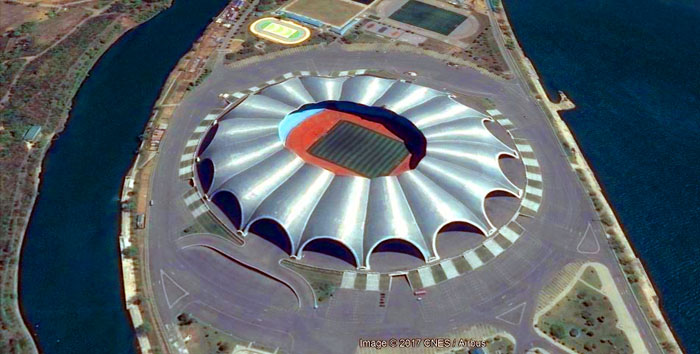
Rungrado May Day Stadium stands unique as a multipurpose venue in a closed society. Originally designed for 150,000 spectators, it now holds 113,281 following safety modernizations.
The stadium hosts football matches, political rallies, and the famous Arirang Mass Games featuring thousands of coordinated performers.
Notable Exclusions: Racing and Historical Giants
This ranking excludes racing venues with temporary seating capabilities:
- Indianapolis Motor Speedway: 400,000+ capacity with infield seating
- Circuit de la Sarthe (Le Mans): 263,500 spectators
- Tokyo Racecourse: 223,000 capacity (only 13,750 seated)
Lost Giants: Historical Capacity Champions
The legendary Strahov Stadium in Prague once held 250,000 spectators across eight football fields. Since it no longer hosts competitive sports—serving primarily concerts—it's excluded from current rankings. This stadium cannot hold that much capacity at the moment because it is considered unsafe for everyone in it. Its large size made maintenance difficult and costly.
The Melbourne Cricket Ground previously ranked second globally before capacity reductions, prioritizing individual seating. At peak configuration, the MCG could theoretically accommodate 200,000+ spectators using bench-style seating. This stadium is set to undergo restructuring, which will cost £1billion.
Future Trends in Stadium Design
Modern arena capacity planning emphasizes experience quality over pure numbers:
- Premium amenities and luxury suites
- Enhanced technology integration
- Improved acoustics and sightlines
- Sustainable energy systems
Next-generation mega stadiums incorporate IoT sensors, mobile integration, and AR features. These technologies require infrastructure space that often reduces total capacity but dramatically improves fan experience.
Economic Impact: Billion-Dollar Generators
These largest sports stadiums create massive economic benefits:
According to a report conducted by the Destination Ann Arbor, the 2024 University of Michigan football season generated $226.7 million in spending for attendees who reside outside Washtenaw County The Michigan Stadium is one of the major stadiums that contributes to this revenue. Game days transform Ann Arbor into Michigan's third-largest city by population for six autumn weekends.
Narendra Modi Stadium attracts sports tourism across South Asia. Major cricket matches fill regional hotels for weeks, generating an estimated $200+ million in economic activity during major tournaments like the 2023 Cricket World Cup final.
Frequently Asked Questions
What is the largest stadium in the world by capacity?
The Narendra Modi Stadium in Ahmedabad, India, is currently the world's largest with 114,600 capacity. This cricket venue surpassed North Korea's Rungrado May Day Stadium for the top position.
Why are most large stadiums in the United States?
American college football culture drives demand for massive venues. Universities with century-old traditions regularly sell out 100,000+ capacity stadiums, generating significant revenue through tickets, concessions, and media rights.
How do stadium capacities get measured?
Stadium capacity represents permanent, ticketed seating for regular sporting events. This excludes press areas, temporary seating, standing room, and luxury boxes counted separately.
Which stadium has the highest attendance record?
The Maracana Stadium in Brazil reportedly hosted 200,000+ spectators for the 1950 World Cup final, though this occurred under different safety standards with significant standing areas no longer permitted.
Are racing venues included in this ranking?
No, racing venues with temporary seating like Indianapolis Motor Speedway (400,000+ capacity) are excluded. This ranking focuses on permanent stadium seating for ball sports and athletics.
References
- Gujarat Cricket Association. (2024). "Narendra Modi Stadium Official Information." GCA Official Website.
- University of Michigan Athletics. (2024). "Michigan Stadium History and Capacity." Official Athletics Department.
- Destination Ann Arbor. (2024). "Economic Impact of University of Michigan Football Season." Tourism Economic Report.
- Stadium DB. (2025). "World Stadium Database: Capacity Rankings." StadiumDB.com.
- International Association for Sports and Leisure Facilities. (2023). "Global Stadium Capacity Standards." IAKS Journal.
- NCAA. (2024). "College Football Attendance Records." NCAA Official Statistics.
- Cricket World Cup. (2023). "2023 World Cup Final Economic Impact Study." ICC Official Report.
Related Stadium Resources
Top-10 Largest USA Stadiums
Explore the biggest sporting venues across America with detailed capacity information and stadium histories.
Learn More →Stadium Attendance Records
Discover the largest crowds ever assembled for sporting events, from historic World Cup finals to college football rivalries.
Learn More →Stadium Wonders of the World
Tour the most architecturally stunning stadiums across the globe, from ancient amphitheaters to modern marvels.
Learn More →World's Largest Sporting Crowds
Learn about the biggest crowds in sports history across different venues, events, and sports categories.
Learn More →Sporting Stadiums Database
Access our comprehensive database of sporting stadiums worldwide with capacities, locations, and detailed information.
Learn More →Stadium Designs of the Future
Explore innovative stadium designs featuring cutting-edge technology, sustainable systems, and revolutionary architecture.
Learn More → Any comments, suggestions, or corrections? Please let us know.
Old Comments
Commenting is closed on this page, though you can read some previous comments below which may answer some of your questions.
- It would be interesting to see how many of these stadiums have benches. The Melbourne Cricket Ground used to be 2nd on this list... from Glenn Stewart (2020)
- Stadium capacity is listed as actual seats where a viewer can buy a ticket... from G J (2016)
- D.I.S. is the largest sports stadium in the world, it should be number one. from Scotty Moir (2016)
- Strahov stadium in Prague - 250 000 capacity... from Filip sochurek (2016)
- Yes, it is big, but my understanding is that it is no longer used for competitive sports events. Rob Admin filip sochurek (2016)
- It's massive. It cannot be on the list, because it's not used for current events... Glenn Stewart filip sochurek (2020)
- Dallas Cowboys stadium holds 101,000 people which goes in 8th My name jeff (2016)
- The AT&T Stadium (as the Dallas Cowboys stadium is called) has a seating capacity of 80,000... (Rob Admin - 2016)
- Indianapolis Motor Speedway has a capacity of 235,000... Dayne (2016)
- The Indianapolis motor speedway is much larger. Leslie Bird (2016)
- This is false the MCG is larger than royal texas. Theo Bighead (2016)
- Not based on current listed capacities... Rob Admin (2016)
- This is false. Michigan stadium is larger than Braver Stadium. Steven Caulford (2015)
- Thanks for that, I have updated much of the list. (mod)
- Bush park in Treowen has a 279 000 capacity... Joe (2016) - Where is that stadium? (ed)
- Rome's Circus Maximus in ancient times SEATED 250,000+... Raz Cann joe (2020)
- Wow, the stadiums are huge. But I never new Melbourne is so big. Jake, Nov 2020.