Assistant Referee Intermittent Endurance Test (ARIET) Calculator
Quick Answer
This calculator determines your ARIET test performance based on the level and shuttles you completed. Elite Serie A/B assistant referees typically achieve 1431m or more, with the professional cut-off at 1300m (Castagna et al., 2012).
- Calculates total distance covered in the ARIET test
- Provides competitive level classification (Elite, Professional, National, Regional)
- Estimates VO₂max from test performance
- Compares your results to Serie A, Serie B, and Lega-Pro standards
What is the ARIET Test?
The Assistant Referee Intermittent Endurance Test, commonly known as the ARIET, is an intermittent yo-yo type test involving forwards and sideways running created specifically for football assistant referees. The test is based on the Yo-Yo Intermittent Endurance Test (Level 2) and is also called the Yo-Yo Sideways-Forwards Intermittent Endurance level 2 Test (Yo-Yo SFIE2).
Assistant referees in association football (soccer) are expected to face the pitch whilst running along the sideline, to better adjudge offside decisions. Therefore, they perform a large amount of sideways running during matches. This modified version includes alternating sideways and forwards running to be more specific to the demands of assistant refereeing.
How to Perform the ARIET Test
Test Purpose: The test evaluates an assistant referee's ability to repeatedly perform job-specific intervals over a prolonged period of time, measuring intermittent endurance capacity specific to assistant referee match demands.
Equipment Required: Flat, non-slip surface, marking cones, measuring tape, yo-yo (YYIE2) audio track mp3 (or use the Team BeepTest software), audio player, recording sheets.
Pre-test: Explain the test procedures to the referee. Perform screening of health risks and obtain informed consent. Prepare forms and record basic information such as age, height, body weight, gender, test conditions. Measure and mark out the test area. Perform an appropriate warm-up. See more details of pre-test procedures.
Test Layout
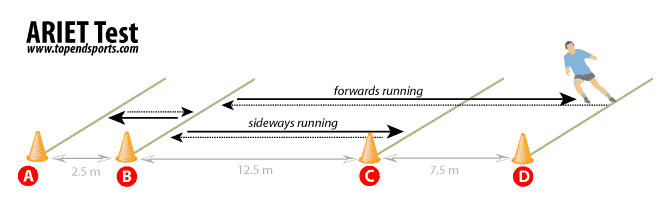
Use cones to mark out four lines:
- Line A: Recovery area, 2.5m before the start line
- Line B: Start line
- Line C: 12.5m from start line (for sideways running)
- Line D: 20m from start line (for forward running)
Test Procedure
The referee starts from the start line (B) and begins running when instructed by the audio track:
- Forward Run: Run 20m forward to line D and return to starting point (B) when signaled by the beep
- Active Recovery: 5-second recovery period - walk to line A (2.5m) and return to start line B
- Sideways Run: Run sideways 12.5m to line C and return to start line B, facing the same direction throughout
- Active Recovery: Another 5-second recovery period - walk to line A and return to start line B
- Repeat the sequence, alternating between 20m forward shuttles and 12.5m sideways shuttles
The speed progressively increases at set intervals according to the YYIE2 audio recording. Each out and back shuttle must begin from a stationary standing position at line B.
Test Termination: A warning is given when the referee does not complete a successful out and back shuttle in the allocated time. The referee is removed the next time they fail to complete a successful shuttle within the time limit.
ARIET Test Scoring and Results
Scoring: The referee's score is the total distance covered before they were unable to keep up with the recording. The same audio recording as for the YYIE2 is used, with the speed levels and number of shuttles at each level being the same.
Competitive Level Standards
Research by Castagna et al. (2012) established the following performance standards for assistant referees:
Elite Performance Standards
- Serie A/B (Top Tier): 1431m average - Elite professional level, suitable for top-tier competition
- Elite Cut-off: 1300m - Minimum standard to discriminate elite from sub-elite referees (80.9% sensitivity, 68.2% specificity)
- Lega-Pro (Professional): ~1100-1200m - National/professional level performance
- National Level: ~1000-1100m - Suitable for regional and national competition
Correlation with Fitness Measures
The ARIET test shows strong correlations with key fitness parameters:
- VO₂max: r = 0.78 (P < 0.001) - Strong correlation with aerobic capacity
- Yo-Yo IR1: r = 0.95 (P < 0.001) - Nearly perfect relationship with intermittent recovery ability
- Heart Rate Response: r = -0.81 (P < 0.001) - Excellent correlation with cardiovascular efficiency
- Sprint Performance: r = -0.15 (not significant) - Independent of pure sprint ability
These correlations demonstrate that the ARIET measures intermittent endurance capacity rather than sprint speed, making it highly specific to assistant referee match demands.
Football assistant referee in action
Using Your ARIET Calculator Results
Understanding Your Score
Your ARIET score provides valuable information about your match readiness:
- Distance Covered: Total meters run during the test - the primary performance metric
- Competitive Level: Classification showing where you stand relative to professional standards
- Estimated VO₂max: Approximation of your maximal oxygen uptake capacity
- Percentile Ranking: Your position relative to tested assistant referees
Training Recommendations by Performance Level
Elite Level (1300m+)
Focus: Maintenance and fine-tuning for peak performance
- Continue regular high-intensity interval training 2-3x per week
- Practice sideways running technique at match intensity
- Monitor recovery between training sessions
- Include position-specific drills following offside lines
Professional Level (1100-1300m)
Focus: Progressive improvement to reach elite standards
- Increase training volume by 10-15% gradually
- Add one extra high-intensity session per week
- Work on recovery intervals between sprints
- Include both forward and sideways running in all interval sessions
Developing Level (Below 1100m)
Focus: Build aerobic base and specific endurance
- Start with 2x weekly interval training sessions
- Gradually increase session duration and intensity
- Practice sideways running technique at lower speeds first
- Consider consulting a sports performance specialist
Sport-Specific Applications
Soccer/Football Assistant Referees
The ARIET is specifically designed for football assistant referees and addresses the unique movement patterns required during matches:
- Sideways Running: Mirrors the sideways movement along the touchline while tracking offside positions
- Intermittent Nature: Replicates the start-stop pattern of match play with periods of high-intensity running and active recovery
- Distance Covered: Elite assistant referees cover 6-7km per match, with significant sideways running component
- Frequency: Referees should maintain ARIET performance throughout the competitive season
FIFA Fitness Standards
While the official FIFA fitness test for assistant referees includes the CODA test, Repeated Sprint Ability, and Interval Test, the ARIET may be used as an additional method of assessing aerobic fitness of assistant referees. Some national federations and confederations use the ARIET as part of their fitness testing protocols, particularly for futsal and beach soccer officials.
Other Sports Applications
Although specifically designed for assistant referees, the ARIET may be suitable for:
- Officials in sports requiring significant sideways running (rugby touch judges, field hockey umpires)
- Athletes in sports with similar movement patterns (tennis, basketball)
- Sports scientists researching intermittent endurance with multi-directional movement
Test Reliability and Validity
Reliability: The ARIET demonstrates excellent test-retest reliability:
- Intraclass correlation coefficients: 0.96 to 0.99 - indicating very high reliability
- Typical error of measurement: 3.1 to 5.7% - acceptable variation for field testing
- Coefficient of variance: 3.1 to 5.7% across multiple testing sessions
Some practice and familiarization with the test timing and the sideways running technique may be required. Test reliability depends on how strictly the test is run and the previous practice allowed for the referees.
Validity: The ARIET has been validated as a measure of intermittent endurance capacity:
- Successfully discriminates between competitive levels (Serie A/B vs Lega-Pro)
- Strong correlations with aerobic power and intermittent running ability
- Specific to assistant referee match demands
- Reproducible across multiple testing sessions
Advantages and Disadvantages
Advantages:
- Large groups can perform this test simultaneously for minimal cost
- Highly specific to assistant referee movement patterns
- Validated for discriminating between competitive levels
- Strong correlations with relevant fitness parameters
- Minimal equipment required (cones, audio player, measuring tape)
Disadvantages:
- Practice and motivation levels can influence the score attained
- Scoring of when a person is out can be subjective without electronic timing
- Environmental conditions can affect results when conducted outdoors
- Test audio track must be purchased
- Requires familiarization with sideways running technique
- May not be suitable for testing very early in pre-season due to high intensity
Important Notes:
- Each out and back shuttle must begin from a stationary standing position at line B
- Foot must touch the turning lines (C & D) on each shuttle
- Sideways running must face the same direction throughout each shuttle
- The test requires 2.5m recovery walks between each running shuttle
Frequently Asked Questions
What is a good ARIET test score for assistant referees?
For elite professional assistant referees, a score of 1300m or higher is considered excellent and meets the cut-off criteria for top-tier competition. Serie A and Serie B referees typically achieve 1431m or more, while Lega-Pro level referees average around 1100-1300m. National and regional level referees generally score between 900-1100m.
How is the ARIET test different from the Yo-Yo test?
The ARIET alternates between 20m forward running shuttles and 12.5m sideways running shuttles, specifically designed to replicate assistant referee movement patterns. Standard Yo-Yo tests (YYIR1, YYIR2) only involve forward running. The ARIET uses the same audio track as the Yo-Yo IE2 but requires sideways running facing the pitch, similar to how assistant referees track play during matches.
How do I calculate my ARIET distance?
Your ARIET distance is calculated by adding all completed shuttles. Each forward shuttle is 40m total (20m out + 20m back), and each sideways shuttle is 25m total (12.5m out + 12.5m back). The shuttles alternate between forward and sideways running. Use our calculator above by entering your final level and number of shuttles completed to automatically compute your total distance.
How often should assistant referees take the ARIET test?
Assistant referees should perform the ARIET test at least once per year as part of official fitness assessments. Many use it 2-3 times during pre-season to monitor training progress and once mid-season to ensure fitness maintenance. Testing too frequently (more than monthly) can lead to overtraining and doesn't allow sufficient time for meaningful fitness improvements between tests.
Can the ARIET test predict match performance?
Yes, research shows the ARIET correlates strongly with assistant referee match performance. Higher ARIET scores are associated with greater distances covered during matches and better ability to keep up with play. The test's specificity to sideways running makes it particularly relevant for predicting an assistant referee's capacity to maintain correct positioning throughout a match.
What training improves ARIET test performance?
High-intensity interval training with both forward and sideways running is most effective. Include 2-3 sessions per week combining: 1) Interval runs at 90-95% max heart rate, 2) Position-specific drills running along marked lines, 3) Recovery intervals similar to the test format, and 4) Progressive overload by gradually increasing distance or reducing recovery time. Combine with aerobic base training for optimal results.
Is the ARIET test suitable for female assistant referees?
Yes, the ARIET test is valid for both male and female assistant referees. While absolute distance scores may differ due to physiological differences, the test is equally reliable for assessing match-specific fitness in female officials. Some federations apply different performance standards for male and female referees, similar to other FIFA fitness tests.
References
- Castagna, C., Bendiksen, M., Impellizzeri, F. M., & Krustrup, P. (2012). Reliability, sensitivity and validity of the assistant referee intermittent endurance test (ARIET) - a modified Yo-Yo IE2 test for elite soccer assistant referees. Journal of Sports Sciences, 30(8):767-75.
- Bangsbo, J., Iaia, F. M., & Krustrup, P. (2008). The Yo-Yo Intermittent Recovery Test: A Useful Tool for Evaluation of Physical Performance in Intermittent Sports. Sports Medicine, 38(1):37-51.
- Krustrup, P., & Bangsbo, J. (2001). Physiological demands of top-class soccer refereeing in relation to physical capacity: effect of intense intermittent exercise training. Journal of Sports Sciences, 19(11):881-891.
- FIFA. (2016). FIFA Refereeing Fitness Tests - Official Guidelines. Fédération Internationale de Football Association.
- Weston, M., Castagna, C., Impellizzeri, F. M., Rampinini, E., & Breivik, S. (2010). Ageing and physical match performance in English Premier League soccer referees. Journal of Science and Medicine in Sport, 13(1):96-100.
Similar Tests
- Yo-Yo Intermittent Recovery Test - Standard yo-yo test for intermittent sports
- Dynamic Yo-Yo Test - Modified yo-yo test designed specifically for football referees
- FIFA Change of Direction Ability (CODA) Test - Forwards and sideways running over 8-10 meters
- Loughborough Intermittent Shuttle Test - For soccer players
Related Pages
- Fitness Testing for Intermittent Sports
- Beep Test Software - Provides the standard beep test and yo-yo tests on your PC or Laptop
- Tables of the distance covered for each speed level: Yo-Yo Intermittent Recovery Test Levels
- Purchasing the Yo-Yo Test Audio
- Testing Protocols for Sports Officials
- FIFA Testing for Referees
- Fitness Tests for Field Officials (Umpires, Referees)
- About Fitness Testing for Soccer
- Nutrition for Field Officials, Referees and Umpires
- About Testing for Intermittent Sports
 Any comments, suggestions, or corrections? Please let us know.