Apley's Shoulder Scratch Test Calculator
Quick Answer
This calculator measures shoulder flexibility using the Apley Scratch Test, tracking your ability to reach behind your back to touch the opposite shoulder blade from both above and below. Results include Brockport scoring (0-3 scale), flexibility classifications, bilateral comparison, and sport-specific interpretations for swimming, baseball, tennis, and other overhead sports.
- Calculates scores for both arms in two reaching directions (four measurements total)
- Based on Brockport Assessment standardized scoring system
- Provides sport-specific flexibility recommendations for athletes
How to Use the Apley Scratch Test Calculator
Follow these steps to calculate your shoulder flexibility score:
- Choose Your Unit System - Select metric (cm) or imperial (inches) using the toggle switch at the top of the calculator.
- Warm Up Properly - Perform 2-3 minutes of light shoulder circles, arm swings, and gentle stretches before testing to prepare your muscles and joints.
- Test Left Arm from Above - Reach your left hand behind your head down your back, attempting to touch the superior medial angle of your right shoulder blade. Measure the distance from your fingertips to the target point. Enter 0 if you can touch the target.
- Test Left Arm from Below - Reach your left hand up behind your back from below, attempting to touch the inferior angle of your right shoulder blade. Measure and record the distance.
- Repeat for Right Arm - Perform the same two reaching tests with your right arm, measuring distances to the left shoulder blade.
- Calculate Your Results - Click "Calculate Results" to receive your Brockport scores, flexibility classifications, bilateral comparison, and sport-specific interpretations.
- Review Recommendations - Based on your results, the calculator provides targeted advice for improving shoulder mobility in your specific sport or activity.
Pro Tip: Test both arms even if you're only concerned about one side. Bilateral comparison helps identify muscle imbalances that can lead to injury in overhead sports. Aim for less than 3cm (1.2 inches) difference between arms.
Understanding the Apley Scratch Test
Apley's Scratch Test is a simple yet effective shoulder flexibility assessment that measures your shoulder's range of motion in multiple planes. Developed as a clinical evaluation tool, it has become widely used in sports medicine, physical therapy, and athletic training programs. The test evaluates shoulder abduction, external rotation, internal rotation, and adduction - all essential movements for overhead athletic activities.
The test consists of two primary movements. First, reaching over the head and down the back (testing abduction and external rotation), and second, reaching up the back from below (testing internal rotation and adduction). A modified version of this test, measuring only the reaching-from-above component, is part of the Brockport Physical Fitness Test used to assess functional fitness in youth and individuals with disabilities.
For athletes, the Apley Scratch Test serves as both a screening tool for injury risk and a monitoring system for training progress. Sports requiring repetitive overhead movements - including swimming, baseball, tennis, volleyball, and gymnastics - demand exceptional shoulder mobility. Limited range of motion identified by this test can predict increased injury risk and reduced performance potential.
The Science Behind Shoulder Flexibility Assessment
Scoring System and Interpretation
The Brockport Assessment uses a standardized 0-3 scoring scale for the reaching-from-above component:
- Score 3 (Excellent): Able to touch the superior medial angle of the opposite scapula - demonstrates optimal shoulder mobility for overhead sports and daily activities
- Score 2 (Good): Can touch the top of the head but not the scapula - adequate for most activities but may limit performance in competitive overhead sports
- Score 1 (Average): Can touch the mouth but not higher - suggests moderate limitations that may affect certain athletic movements
- Score 0 (Needs Improvement): Unable to touch the mouth - indicates significant mobility restrictions requiring intervention
Research by Kendall et al. (2005) in "Muscles Testing and Function with Posture and Pain" established that inability to reach or touch specific landmarks indicates restrictions requiring further evaluation to determine the source - whether from joint capsule tightness, muscle inflexibility, or scapular dysfunction.
Biomechanical Components Assessed
The Apley Scratch Test evaluates multiple shoulder movements simultaneously:
- Shoulder Flexion and Abduction: The reaching-from-above component requires approximately 160-180 degrees of shoulder flexion combined with abduction to position the hand behind the neck
- External Rotation: As the hand reaches down the back from above, the shoulder must externally rotate to allow the fingers to descend toward the scapula
- Internal Rotation: The reaching-from-below component demands significant internal rotation as the hand travels up the back
- Scapular Mobility: Proper scapular upward rotation, abduction, and adduction are essential for both reaching directions
According to clinical research published in the Journal of Orthopaedic & Sports Physical Therapy, scapular dyskinesis (abnormal scapular movement) is a common finding in athletes with shoulder pain and can be identified through asymmetric Apley Test performance.
Accuracy and Limitations
The Apley Scratch Test provides a general assessment of shoulder mobility with reasonable reliability for tracking individual progress over time. Studies indicate test-retest reliability of approximately 85-90% when performed by trained assessors. However, several factors can affect accuracy:
- Body Composition: Athletes with larger muscle mass, particularly in the upper back and shoulders, may have reduced range despite adequate joint mobility
- Arm Length Variations: Individuals with longer arms relative to torso length have a mechanical advantage in this test
- Previous Injury: Past shoulder, neck, or thoracic spine injuries can create compensatory movement patterns affecting results
- Time of Day: Shoulder mobility typically improves throughout the day as tissues warm up; morning testing may yield more restricted measurements
For athletes seeking precise baseline measurements or recovering from injury, the Apley Test should be combined with goniometric measurements of isolated shoulder movements and thoracic spine mobility assessments for a comprehensive evaluation.
Sport-Specific Applications and Standards
Swimming and Aquatic Sports
Shoulder flexibility is paramount for competitive swimmers, particularly in freestyle and butterfly strokes where athletes perform thousands of overhead rotations per training session. Research by Su et al. (2004) in the Journal of Athletic Training found that collegiate swimmers with shoulder impingement demonstrated reduced scapular upward rotation compared to healthy swimmers.
Optimal Standards for Swimmers:
- Elite Level: 0-3cm distance - Can touch or nearly touch scapula from both directions
- Competitive Level: 3-8cm distance - Good mobility for most competitive swimming
- Recreational Level: 8-15cm distance - Adequate for fitness swimming but may limit stroke efficiency
- High Risk: >15cm distance - Increased risk of swimmer's shoulder, requires mobility program before intensive training
According to a 2016 study in the U.S. Masters Swimming journal, limited internal rotation measured by the Apley Test correlates with shoulder pain in masters swimmers. The research emphasizes that swimmers lacking full internal rotation must compensate using inefficient movement patterns that can lead to rotator cuff impingement.
Baseball, Softball, and Throwing Sports
Baseball players, particularly pitchers, develop unique shoulder adaptations from repetitive throwing. Research published in the American Journal of Sports Medicine by Wilk et al. (2011) documented that professional pitchers demonstrate increased external rotation and decreased internal rotation in their throwing shoulder compared to the non-throwing side - an adaptation called glenohumeral internal rotation deficit (GIRD).
Baseball/Softball Flexibility Standards:
- Professional Level: 0-5cm distance with no more than 5cm difference between throwing and non-throwing arms
- College/Amateur Level: 5-10cm distance, monitoring for bilateral asymmetry greater than 8cm
- Youth Level: 10-15cm distance acceptable, focus on maintaining symmetry as training intensity increases
- Injury Risk Zone: >15cm bilateral asymmetry or severe restriction in internal rotation testing
Studies show that baseball players with GIRD exceeding 20 degrees have significantly higher rates of shoulder injuries. The Apley Test's reaching-from-below component effectively screens for internal rotation deficits that require targeted stretching protocols.
Tennis and Racket Sports
Tennis players require excellent shoulder mobility for effective serving, with the serve motion requiring approximately 170-180 degrees of shoulder external rotation at ball contact. Research in the British Journal of Sports Medicine indicates that junior tennis players with asymmetric shoulder flexibility have higher injury rates during growth spurts.
Tennis Player Standards:
- Tournament Level: 0-5cm distance bilaterally - optimal for powerful serves and overhead shots
- Club Level: 5-12cm distance - adequate for recreational to competitive play
- Beginner Level: 12-18cm distance - functional for learning proper technique
- Needs Development: >18cm distance - mobility training essential before intensive serving practice
Volleyball
Volleyball athletes performing hundreds of spikes, serves, and blocks per match require shoulder flexibility comparable to swimmers. A 2018 study in the Scandinavian Journal of Medicine & Science in Sports found that volleyball players with restricted shoulder internal rotation measured by the Apley Test had 2.3 times higher injury incidence.
Volleyball Standards:
- Elite/Professional: 0-4cm distance - necessary for powerful attacks from all positions
- Collegiate: 4-10cm distance - adequate for competitive play
- High School: 10-15cm distance - functional range for developing players
- Position-Specific Note: Middle blockers and outside hitters require superior flexibility compared to defensive specialists
CrossFit and Functional Fitness
CrossFit athletes performing Olympic lifts (snatch, overhead squat) and gymnastic movements (muscle-ups, handstand push-ups) require exceptional shoulder mobility in all planes. The Apley Test identifies restrictions that may force compensatory thoracic or lumbar spine hyperextension during overhead movements.
CrossFit Mobility Standards:
- Competitive Athletes: 0-5cm distance - essential for safe execution of overhead Olympic lifts and gymnastics
- Intermediate: 5-12cm distance - functional for most WODs with proper scaling
- Beginner: 12-20cm distance - requires mobility work alongside skill development
- High Risk: >20cm distance - overhead movements should be limited until flexibility improves
Gymnastics
Gymnasts require the most extreme shoulder flexibility of all athletes, with elite performers often demonstrating hypermobility. However, research in the International Journal of Sports Physical Therapy emphasizes that flexibility must be paired with adequate strength to prevent instability.
Gymnastics Standards:
- Elite Level: Able to touch and overlap fingers behind back in both directions
- Competitive Level: 0cm distance (touch target) from both directions
- Developmental Level: 0-5cm distance acceptable for learning advanced skills
- Note: Gymnasts with excessive flexibility (hypermobility) require additional strength training for joint stability
How to Improve Your Apley Scratch Test Score
Stretching Program for Superior Reach (Reaching from Above)
If you have difficulty reaching down your back from above, focus on these stretches targeting the muscles that limit this movement:
1. Doorway Pectoralis Stretch
Stand in a doorway with your arm at 90 degrees, forearm on the door frame. Step forward until you feel a stretch across your chest and front shoulder. Hold 30 seconds, 3 sets per side, twice daily. This addresses anterior shoulder tightness that limits reaching overhead and behind.
2. Triceps and Lat Stretch
Raise one arm overhead, bend the elbow, and use your opposite hand to gently pull the elbow further behind your head. You should feel the stretch along the back of your upper arm and side of your torso. Hold 30 seconds, 3 sets per side, twice daily. Research shows the long head of the triceps commonly limits this reaching direction.
3. Sleeper Stretch for External Rotation
Lie on your side with the bottom arm at 90 degrees. Use your top hand to gently push your bottom forearm toward the floor, stretching the back of your shoulder. Hold 30 seconds, 3 sets, twice daily. Studies indicate this effectively improves external rotation range.
4. Thread the Needle Stretch
On hands and knees, reach one arm under your body and across to the opposite side, lowering your shoulder to the floor. This rotational stretch improves thoracic spine mobility essential for overhead reaching. Hold 30 seconds, 3 sets per side daily.
Stretching Program for Inferior Reach (Reaching from Below)
Difficulty reaching up your back from below indicates internal rotation restrictions requiring these specific stretches:
1. Cross-Body Shoulder Stretch
Bring one arm across your body at chest height, using your opposite hand to gently pull the arm closer to your chest. Hold 30 seconds, 3 sets per side, twice daily. This stretches the posterior shoulder capsule and rotator cuff muscles limiting internal rotation.
2. Modified Apley Stretch with Towel
Hold a towel behind your back, one hand over your shoulder (above) and one hand up from below. Gently pull upward with the top hand, stretching the lower hand higher up your back. Hold 30 seconds, 3 sets per side, twice daily. This directly trains the movement you're trying to improve.
3. Internal Rotation Wall Slide
Stand with your arm behind your back, hand on a wall. Slowly slide your hand up the wall, reaching as high as comfortable. Hold at your end range for 30 seconds, 3 sets per side daily. This combines active stretching with strength building.
4. Bent-Over Internal Rotation Stretch
Bend forward at the waist, allowing one arm to hang down. Gently reach across and under your body with the hanging arm. This gravity-assisted stretch effectively targets internal rotation. Hold 30 seconds, 3 sets per side daily.
Strengthening Exercises for Shoulder Stability
Flexibility alone is insufficient - athletes need strength throughout their range of motion to maintain shoulder health:
1. External Rotation with Band
Anchor a resistance band at elbow height. With elbow at 90 degrees against your side, rotate your forearm outward against resistance. Perform 3 sets of 15 repetitions per side, 3-4 times weekly. Research shows this reduces injury risk in overhead athletes.
2. Internal Rotation with Band
Same setup as external rotation, but rotate your forearm inward across your body against resistance. Perform 3 sets of 15 repetitions per side, 3-4 times weekly. Maintains strength balance in rotator cuff muscles.
3. Prone Y-T-W Exercise
Lie face down on an incline bench. Raise arms in Y, T, and W formations, focusing on scapular retraction. Perform 3 sets of 10 repetitions in each position, 3 times weekly. Strengthens scapular stabilizers essential for shoulder control.
4. Scapular Wall Slides
Stand with back against wall, arms at 90 degrees. Slide arms up and down the wall while maintaining contact with wall, head, and lower back. Perform 3 sets of 12 repetitions daily. Improves scapulohumeral rhythm necessary for overhead movements.
Training Frequency and Progress Tracking
According to systematic reviews in the Journal of Strength and Conditioning Research, flexibility improvements require consistent training:
- Frequency: Stretch minimum 5-6 days per week, ideally twice daily (morning and post-workout)
- Duration: Hold each stretch 30-60 seconds for optimal gains; research shows diminishing returns beyond 60 seconds
- Sets: Perform 3-4 sets per stretch for maximum improvement, with 10-30 second rest between sets
- Timeline: Expect measurable improvements (5-8cm) within 4-6 weeks of consistent stretching; significant improvements (10-15cm) typically require 8-12 weeks
- Testing: Re-test with the Apley calculator weekly to track progress and identify which stretches are most effective for your specific restrictions
Research indicates that combining static stretching (holding positions) with dynamic stretching (active movements through range) produces superior results compared to static stretching alone. Include arm circles, shoulder rolls, and controlled reaching movements in your warm-up routine.
Common Mistakes to Avoid
- Forcing the Stretch: Never push into pain; stretching should produce mild discomfort, not sharp pain. Aggressive stretching can cause micro-tears and inflammation, actually reducing flexibility
- Holding Your Breath: Breathe deeply and continuously during stretches; holding your breath activates protective muscle tension
- Inconsistent Training: Sporadic stretching (2-3 times per week) maintains current flexibility but rarely improves it; daily practice is essential for gains
- Neglecting One Side: Even if one shoulder is more restricted, stretch both sides equally to maintain balance
- Skipping Warm-Up: Cold stretching is less effective and increases injury risk; perform 5-10 minutes of light aerobic activity before static stretching
- Ignoring Pain Signals: Sharp pain, numbness, tingling, or weakness during stretching requires immediate cessation and medical evaluation
Test Purpose and Equipment
Test Purpose: This test measures shoulder range of motion in multiple planes, specifically assessing shoulder abduction, external rotation, internal rotation, and adduction. The test is particularly valuable for athletes in overhead sports and serves as a functional assessment of daily living activities requiring behind-the-back reaching.
Equipment Required: None required for basic testing. Optional: ruler or tape measure for distance measurements (recommended for tracking progress over time), partner to assist with measurements and observation.
Pre-Test Procedures
Explain the test procedures to the subject. Perform screening of health risks and obtain informed consent. Prepare forms and record basic information such as age, height, body weight, gender, and test conditions. Perform an appropriate warm-up, including shoulder-stretching activities. Shoulder warm-up should include 2-3 minutes of light aerobic activity followed by dynamic shoulder movements (arm circles, arm swings) and gentle static stretches. See more details of pre-test procedures.
Test Procedure
This test is performed in the standing position with good posture maintained throughout. The subject attempts to reach back with one hand and touch the superior medial angle of the opposite scapula (shoulder blade). The hand reaches over the head and down the back. No rapid movement is allowed - the subject must be able to hold that position for 1 to 2 seconds. This component assesses the shoulder's abduction and external rotation.
 Apley's Scratch Test - Reaching from above to touch the superior medial angle of opposite scapula
With the same hand, reach behind the back and up from below, attempting to touch the inferior angle of the opposite scapula, and hold that position for 1-2 seconds. This component assesses the shoulder's internal rotation and adduction. Both reaching directions should be tested on each arm.
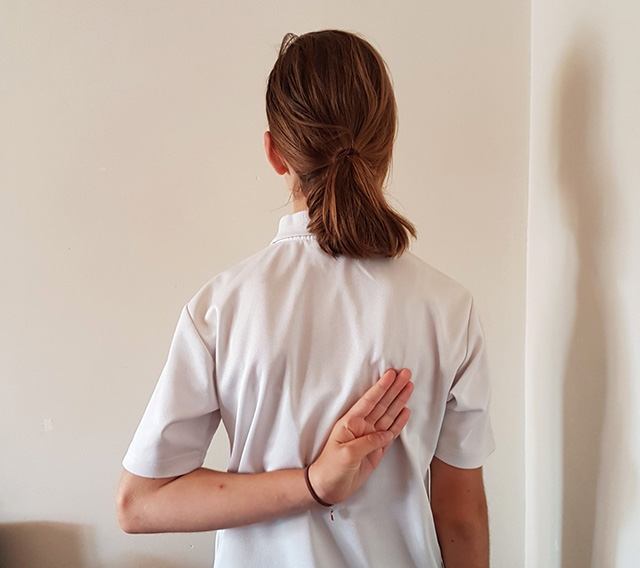 Apley's Scratch Test - Reaching from below to touch the inferior angle of opposite scapula
Test both the left and right shoulders using both reaching directions for a comprehensive assessment of shoulder mobility.
Scoring Guidelines
Standard Scoring: One trial is given for each arm in each direction. For the Brockport Assessment, scoring is between 0 and 3 for the reaching-from-above component:
- 3 — Touch the superior medial angle of opposite scapula
- 2 — Touch the top of the head
- 1 — Touch the mouth
- 0 — Unable to touch the mouth
Distance Measurement Method: For more precise tracking, measure the distance from fingertips to the target landmark (scapular angles). Record 0 if able to touch the target, or the distance in cm/inches if unable to reach. Bilateral comparison helps identify muscle imbalances - differences greater than 3cm (1.2 inches) between sides warrant attention.
Advantages and Considerations
Advantages: This is a simple test to conduct requiring no equipment, making it ideal for field testing, athletic screening programs, and home self-assessment. The test evaluates functional shoulder mobility relevant to both daily activities and athletic performance. The Brockport scoring system provides standardized benchmarks for comparison. The test can identify bilateral asymmetries that may increase injury risk in overhead athletes.
Notes: Do not proceed with the test if the subject experiences pain. Sharp pain, numbness, tingling, or weakness during the test requires medical evaluation before continuing. The test should be performed bilaterally even if only one shoulder is of concern, as comparison between sides reveals imbalances. Results may be influenced by muscle mass (particularly in the upper back and shoulders), arm length relative to torso, and recent training or competition. For athletes recovering from injury, this test should be part of a comprehensive return-to-sport assessment rather than used in isolation.
The Test in Action
- A modified version of this test (only reaching from above) is part of the Brockport Physical Fitness Test battery for youth and individuals with disabilities
- Physical therapists commonly use the full Apley Scratch Test to assess shoulder function in patients with frozen shoulder (adhesive capsulitis), rotator cuff injuries, and post-operative shoulder rehabilitation
- Athletic trainers incorporate this test into pre-participation physical examinations for overhead sport athletes including swimmers, baseball players, tennis players, and volleyball athletes
- Strength and conditioning coaches use bilateral comparison to identify asymmetries requiring corrective exercise programs
- The test is featured in functional movement screens for older adults to assess ability to perform activities of daily living requiring behind-the-back reaching
Similar Tests
- Shoulder Stretch Test — assesses whether hands can be brought together behind the back
- Shoulder Reach Flexibility Test — measures if hands can be brought within 5cm behind the back
- Back Scratch Test — designed specifically for testing seniors, measures how close hands can be brought together behind the back
- Shoulder Circumduction Test — measures shoulder rotation flexibility using a sliding handle passed over the head
- Goniometric Shoulder Measurements — precise measurement of individual shoulder movements (flexion, extension, internal/external rotation) using a goniometer
Related Products
- Buy FitnessGram Products — official materials for conducting standardized fitness assessments
- Flexibility Equipment Store — tools and apparatus to measure and improve flexibility
- Resistance Bands for Shoulder Strengthening — essential for maintaining strength throughout improved range of motion
- Foam Rollers and Massage Tools — aid in releasing tight shoulder muscles that restrict mobility
Frequently Asked Questions
What is the Apley Scratch Test?
The Apley Scratch Test is a simple shoulder flexibility assessment that measures your ability to reach behind your back to touch the opposite shoulder blade. It tests both reaching from above (over the head) and reaching from below (up the back), assessing shoulder abduction, external rotation, internal rotation, and adduction. The test is used by physical therapists, athletic trainers, and coaches to screen for shoulder mobility restrictions and injury risk.
How is the Apley Scratch Test scored?
The Brockport Assessment uses a 0-3 scoring system for the reaching-from-above component: 3 = Touch superior medial angle of opposite scapula (excellent), 2 = Touch top of head (good), 1 = Touch mouth (average), 0 = Unable to touch mouth (needs improvement). Distance measurements in cm or inches can also be used to track progress over time, with 0 indicating perfect touch and higher numbers showing increasing restriction.
Which sports require good shoulder flexibility as measured by the Apley Test?
Swimming (especially freestyle and butterfly), baseball and softball pitching, tennis and racket sports, volleyball, water polo, gymnastics, CrossFit, and competitive weightlifting all require excellent shoulder mobility. Research shows that limited flexibility measured by the Apley Test correlates with reduced performance and increased injury risk in these overhead sports. Even recreational participants in these activities benefit from adequate shoulder mobility.
How can I improve my Apley Scratch Test score?
Perform regular shoulder stretches including doorway pec stretches, sleeper stretches for internal rotation, cross-body arm stretches, and towel stretches 5-6 days per week. Hold each stretch for 30-60 seconds, 3-4 sets. Focus on both external rotation (for reaching from above) and internal rotation (for reaching from below). Combine stretching with rotator cuff strengthening exercises using resistance bands. Most people see measurable improvement within 4-6 weeks of consistent daily stretching.
Is it normal to have different flexibility on each side?
Yes, it's common to have slight differences between your dominant and non-dominant shoulders, especially in unilateral sports like baseball where throwing athletes often show 5-10 degrees more external rotation and correspondingly less internal rotation in their throwing shoulder. However, differences greater than 3cm (1.2 inches) in Apley Test measurements may indicate muscle imbalances that should be addressed through targeted stretching of the less flexible side to prevent injury.
How often should I test my shoulder flexibility?
Athletes should test shoulder flexibility monthly during training seasons and every 2-3 months during off-season to monitor for gradual changes. If you're recovering from shoulder injury or actively working on improving flexibility, test weekly to track progress and verify your stretching program is effective. Always test before starting a new overhead sport, after extended time off from training, or if you notice decreased performance or increased discomfort during overhead activities.
What does poor Apley Test performance indicate?
Limited range of motion in the Apley Test may indicate tightness in the rotator cuff muscles, pectoralis major, latissimus dorsi, or posterior shoulder capsule. It can also suggest scapular dyskinesis (abnormal shoulder blade movement) or postural issues from prolonged desk work or computer use. Poor performance increases risk of shoulder impingement syndrome, rotator cuff tendinitis, and reduced athletic performance in overhead activities. A comprehensive evaluation by a physical therapist or sports medicine professional can identify the specific structures requiring treatment.
References
- Kendall, F.P., McCreary, E.K., Provance, P.G., Rodgers, M.M., & Romani, W.A. (2005). Muscles: Testing and Function with Posture and Pain (5th ed.). Baltimore: Lippincott Williams & Wilkins.
- Konin, J.G., Wiksten, D.L., Isear, J.A., & Brader, H. (2006). Special Tests for Orthopedic Examination (3rd ed.). Thorofare, NJ: SLACK Incorporated.
- Su, K.P., Johnson, M.P., Gracely, E.J., & Karduna, A.R. (2004). Scapular rotation in swimmers with and without impingement syndrome: Practice effects. Medicine & Science in Sports & Exercise, 36(7), 1117-1123.
- Wilk, K.E., Macrina, L.C., Fleisig, G.S., Aune, K.T., Porterfield, R.A., Harker, P., Evans, T.J., & Andrews, J.R. (2011). Deficits in glenohumeral passive range of motion increase risk of shoulder injury in professional baseball pitchers: A prospective study. American Journal of Sports Medicine, 39(2), 329-335.
- Hoving, J.L., Buchbinder, R., Green, S., Forbes, A., Bellamy, N., Brand, C., Buchanan, R., Hall, S., Patrick, M., Ryan, P., & Stockman, A. (2002). How reliably do rheumatologists measure shoulder movement? Annals of the Rheumatic Diseases, 61, 612-616.
- McClure, P., Balaicuis, J., Heiland, D., Broersma, M.E., Thorndike, C.K., & Wood, A. (2007). A randomized controlled comparison of stretching procedures for posterior shoulder tightness. Journal of Orthopaedic & Sports Physical Therapy, 37(3), 108-114.
- Sauers, E.L., Borsa, P.A., Herling, D.E., & Stanley, R.D. (2001). Clinical measures of shoulder mobility in professional baseball players. Journal of Athletic Training, 36(3), 298-306.
- Blanch, P., & Gabbett, T.J. (2016). Has the athlete trained enough to return to play safely? The acute:chronic workload ratio permits clinicians to quantify a player's risk of subsequent injury. British Journal of Sports Medicine, 50, 471-475.
- Cejudo, A., Sainz de Baranda, P., Ayala, F., & Santonja, F. (2015). Test-retest reliability of seven common clinical tests for assessing lower extremity muscle flexibility in futsal and handball players. Physical Therapy in Sport, 16(2), 107-113.
- Walker, H., Gabbe, B., Wajswelner, H., Blanch, P., & Bennell, K. (2012). Shoulder pain in swimmers: A 12-month prospective cohort study of incidence and risk factors. Physical Therapy in Sport, 13(4), 243-249.
Related Pages
Flexibility Tests
Explore our comprehensive collection of flexibility assessments for all body regions.
View All Tests →FitnessGram Program
Learn about the comprehensive youth fitness assessment program including the Shoulder Stretch test.
Learn More →Brockport Test Battery
Discover the modified Apley Test used in the Brockport Physical Fitness Test for youth assessment.
View Details →Flexibility Test Videos
Watch demonstration videos showing proper technique for shoulder flexibility tests.
Watch Videos →Shoulder Stretch Store
Browse equipment and tools designed to improve shoulder flexibility and mobility.
Shop Now →Back Scratch Test
Try our Back Scratch Test Calculator, a similar assessment designed for senior fitness evaluation.
Try Calculator → Any comments, suggestions, or corrections? Please let us know.