Back Scratch Test Calculator
Quick Answer
This calculator instantly evaluates your Back Scratch Test results using age and gender-based norms from the Senior Fitness Test Protocol. The test measures shoulder flexibility by determining how close your hands can reach behind your back.
- Calculates shoulder flexibility score based on fingertip distance
- Compares results to age-specific norms for seniors
- Provides interpretation and recommendations for improvement
About the Back Scratch Test
The Back Scratch Test, or simply the Scratch Test, measures how close the hands can be brought together behind the back. This test is part of the Senior Fitness Test Protocol, and is designed to test the functional fitness of seniors. Another shoulder flexibility test designed for testing the elderly is the Shoulder Circumduction Test.
How to Use This Calculator
Follow these steps to calculate and interpret your Back Scratch Test results:
- Perform the Test: Stand and reach one hand behind your head down your back, and the other hand behind your back reaching up. Try to touch or overlap your middle fingers.
- Measure the Distance: Have someone measure the distance between your middle fingertips in centimeters or inches.
- Select Your Unit: Choose metric (cm) or imperial (inches) using the toggle switch.
- Enter Your Data: Input your measurement (negative if fingertips don't touch, zero if they touch, positive if they overlap), age group, and gender.
- Get Results: Click "Calculate Results" to see your shoulder flexibility assessment and personalized recommendations.
Pro Tip: Practice the test movement twice before recording your official measurement. Stop immediately if you experience any pain or discomfort.
Test Protocol and Procedures
Test Purpose: This test measures general shoulder range of motion and upper body flexibility, particularly important for seniors to maintain independence in daily activities.
Equipment Required: Ruler or yardstick (metric or imperial)
Pre-Test: Explain the test procedures to the subject. Perform screening of health risks and obtain informed consent. Prepare forms and record basic information such as age, height, body weight, gender, test conditions. Perform an appropriate warm-up. See more details of pre-test procedures.
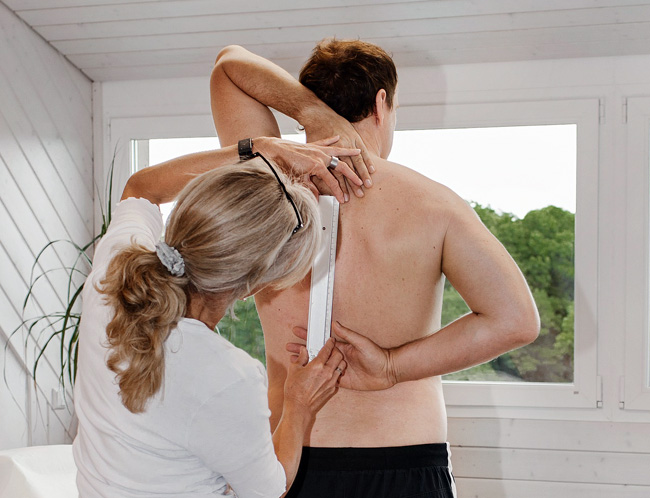
Procedure: This test is done in the standing position. Place one hand behind the head and back over the shoulder, and reach as far as possible down the middle of your back, your palm touching your body and the fingers directed downwards. Place the other arm behind your back, palm facing outward and fingers upward and reach up as far as possible attempting to touch or overlap the middle fingers of both hands. An assistant is required to direct the subject so that the fingers are aligned, and to measure the distance between the tips of the middle fingers. If the fingertips touch then the score is zero. If they do not touch, measure the distance between the finger tips (a negative score), if they overlap, measure by how much (a positive score). Practice two times, and then test two times. Stop the test if the subject experiences pain.
Scoring: Record the best score to the nearest centimeter or 1/2 inch. The higher the score the better the result. Below are tables showing the recommended ranges based on age groups from Jones & Rikli, 2002.
Men's Results
| Age | Below Average | Normal (inches) | Above Average |
|---|---|---|---|
| 60-64 | < -6.5 | -6.5 to 0 | > 0 |
| 65-69 | < -7.5 | -7.5 to -1.0 | > -1.0 |
| 70-74 | < -8.0 | -8.0 to -1.0 | > -1.0 |
| 75-79 | < -9.0 | -9.0 to -2.0 | > -2.0 |
| 80-84 | < -9.5 | -9.5 to -2.0 | > -2.0 |
| 85-89 | < -10.0 | -10.0 to -3.0 | > -3.0 |
| 90-94 | < -10.5 | -10.5 to -4.0 | > -4.0 |
Women's Results
| Age | Below Average | Normal (inches) | Above Average |
|---|---|---|---|
| 60-64 | < -3.0 | -3.0 to 1.5 | > 1.5 |
| 65-69 | < -3.5 | -3.5 to 1.5 | > 1.5 |
| 70-74 | < -4.0 | -4.0 to 1.0 | > 1.0 |
| 75-79 | < -5.0 | -5.0 to 0.5 | > 0.5 |
| 80-84 | < -5.5 | -5.5 to 0 | > 0 |
| 85-89 | < -7.0 | -7.0 to -1.0 | > -1.0 |
| 90-94 | < -8.0 | -8.0 to -1.0 | > -1.0 |
Note: Normal range of scores is defined as the middle 50% of the population. Those scoring above this range would be considered above average for their age and those below the range as below average.
Understanding Your Results
The Back Scratch Test provides valuable insight into your shoulder flexibility and functional fitness. Here's what your results mean:
Score Interpretation
- Zero Score: Your fingertips touch exactly, indicating adequate shoulder flexibility for your age.
- Positive Score: Your fingertips overlap, showing above-average flexibility. The higher the positive number, the better your shoulder mobility.
- Negative Score: Your fingertips don't reach each other. The larger the negative number, the more room for improvement in shoulder flexibility.
Why Shoulder Flexibility Matters for Seniors
Shoulder flexibility is crucial for maintaining independence and quality of life as we age. Good shoulder range of motion enables you to:
- Reach behind your back to zip clothing or fasten garments
- Retrieve items from high shelves safely
- Perform daily grooming activities independently
- Maintain posture and prevent shoulder injuries
- Participate in recreational activities and sports
Research by sports science expert Robert Wood, who has analyzed senior fitness data for over 25 years, indicates that maintaining shoulder flexibility significantly correlates with overall functional independence in older adults.
Improving Your Shoulder Flexibility
If your results indicate below-average flexibility, don't be discouraged. Shoulder flexibility can be improved at any age with regular practice. Here are evidence-based exercises to enhance your score:
Daily Stretching Routine
- Towel Stretch: Hold a towel in one hand behind your head, letting it hang down your back. Grab the bottom of the towel with your other hand behind your back. Gently pull the towel up and down. Hold for 30 seconds each direction. Repeat 3 times per side.
- Doorway Stretch: Stand in a doorway with your arm at 90 degrees against the frame. Gently rotate your body away from your arm. Hold for 30 seconds. Repeat 3 times per side.
- Cross-Body Shoulder Stretch: Bring one arm across your body at chest height. Use the other arm to pull it closer to your chest. Hold for 30 seconds. Repeat 3 times per side.
- Behind-the-Back Clasp: Practice the actual test movement daily, gradually working to bring your fingertips closer together. Don't force it—progress takes time.
Weekly Exercise Program
Incorporate these exercises into your weekly fitness routine (2-3 times per week):
- Shoulder circles: 10 forward, 10 backward
- Wall angels: 10-15 repetitions
- Resistance band external rotations: 10-15 repetitions per side
- Light dumbbell shoulder exercises (with proper form)
Pro Tip: Consistency is more important than intensity. Even 5-10 minutes of daily shoulder stretching can lead to significant improvements over 4-8 weeks.
Target Population and Considerations
Target Population: The aged population which may not be able to do traditional fitness tests. The Back Scratch Test is specifically designed for adults aged 60 and older.
Advantages: Minimal equipment required. Can be performed in any setting. Quick to administer. Provides functional assessment relevant to daily activities.
Safety Considerations:
- Stop immediately if you experience pain
- Perform a gentle warm-up before testing
- Don't force the movement—flexibility improves gradually
- If you have a history of shoulder injuries or surgery, consult a healthcare provider before testing
- Consider having a physical therapist present for first-time testing if you have concerns
Other Comments: The test is also sometimes called the Zipper Test, as the arm is placed down the back as if to pull up a zipper. This functional movement pattern is directly applicable to daily dressing activities.
Frequently Asked Questions
What is a good score on the Back Scratch Test?
A "good" score depends on your age and gender. Generally, if your fingertips touch (score of 0) or overlap (positive score), you have adequate to excellent flexibility. The calculator compares your result to age-specific norms to determine if you're below average, normal, or above average for your demographic.
How often should I test my shoulder flexibility?
For seniors maintaining fitness, testing every 3-6 months is appropriate. If you're actively working to improve flexibility, monthly testing can help track progress and maintain motivation. Always retest under similar conditions for accurate comparisons.
Can I improve my Back Scratch Test score at any age?
Yes! Research shows that shoulder flexibility can improve at any age with consistent stretching and exercise. Most seniors see measurable improvements within 6-8 weeks of regular flexibility training. The key is gentle, consistent practice without forcing movements that cause pain.
Why can't I reach my hands together behind my back?
Limited shoulder flexibility is common as we age due to reduced physical activity, past injuries, arthritis, or postural changes. The good news is that specific stretching exercises targeting the shoulders, chest, and upper back can help improve this movement pattern over time.
Is one side usually more flexible than the other?
Yes, it's completely normal to have different flexibility on each side. The test is typically performed on both sides, and you should record your best score. You may want to focus extra stretching attention on your less flexible side to improve balance and symmetry.
What's the difference between the Back Scratch Test and other shoulder flexibility tests?
The Back Scratch Test is specifically designed for functional fitness in seniors and measures combined shoulder extension, internal rotation, and external rotation. Other tests like the Shoulder Stretch Test have similar movements but may use different measurement criteria or target different populations.
Should I stop if I feel discomfort during the test?
Stop immediately if you experience pain. Some mild stretching sensation is normal, but pain indicates you're forcing the movement beyond your current range of motion. If you consistently experience pain with shoulder movements, consult a healthcare provider or physical therapist before continuing flexibility training.
References
- Jones, C.J., & Rikli, R.E. (2002). Measuring functional fitness of older adults. The Journal on Active Aging, March-April, 24-30.
- Różańska-Kirschke, A., Kocur, P., Wilk, M., & Dylewicz, P. (2006). The Fullerton Fitness Test as an index of fitness in the elderly. Medical Rehabilitation, 10(2), 9-16.
- Rikli, R.E., & Jones, C.J. (1999). Development and validation of a functional fitness test for community-residing older adults. Journal of Aging and Physical Activity, 7, 129-161.
- Rikli, R.E., & Jones, C.J. (2013). Senior Fitness Test Manual (2nd ed.). Champaign, IL: Human Kinetics.
- American College of Sports Medicine. (2018). ACSM's Guidelines for Exercise Testing and Prescription (10th ed.). Philadelphia: Wolters Kluwer.
Related Pages
Senior Fitness Test Protocol
Complete battery of tests designed to assess functional fitness in older adults.
Learn More →Other Flexibility Tests
Explore our complete collection of flexibility assessments for all age groups.
Learn More →Testing the Elderly
Special considerations and protocols for fitness testing in senior populations.
Learn More →Related Products
- Buy the Senior Fitness Test Manual
- Flexibility Store — apparatus to measure flexibility
 Any comments, suggestions, or corrections? Please let us know.