The Plank Fitness Test Calculator
Quick Answer
This calculator measures your core strength and endurance through the plank test, also known as the prone bridge test. Simply start the timer, hold your plank position, and stop when your form breaks down to receive instant results with age and gender-based norms.
- Real-time timer tracks your plank hold duration with precision
- Based on Strand et al. (2014) normative data and sports science research
- Personalized performance ratings and training recommendations
About the Plank Fitness Test
The Plank Test, also known as the Prone Bridge Test, is a simple fitness test of core muscle strength, and can also be used as a fitness exercise for improving core strength. The aim of this test is to hold an elevated plank position for as long as possible.
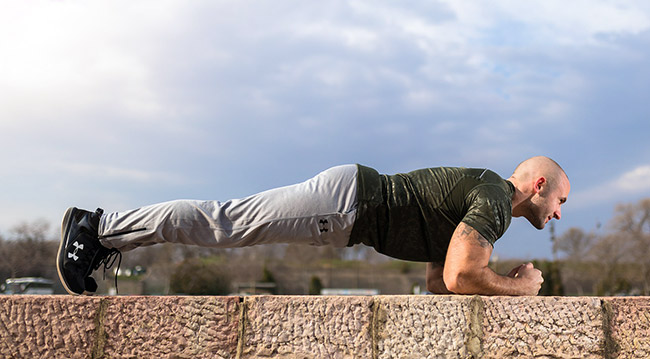 the plank test position
Test purpose: The plank test measures the control and endurance of the back/core stabilizing muscles. According to research by Robert J. Wood, PhD in Exercise Physiology from the University of Western Australia and founder of Topend Sports, core endurance is a critical component of athletic performance across virtually all sports, from explosive power activities like weightlifting to endurance events like marathon running.
Equipment required: flat and clean surface, stopwatch (or use our built-in timer above), recording sheets, pen.
Pre-test: Explain the test procedures to the subject. Perform screening of health risks and obtain informed consent. Prepare forms and record basic information such as age, height, body weight, gender and test conditions. Perform a standard warm-up. See more details of pre-test procedures.
Procedure: The aim of this test is to hold an elevated position for as long as possible. Start with the upper body supported off the ground by the elbows and forearms, and the legs straight with the weight taken by the toes. The hip is lifted off the floor creating a straight line from head to toe. As soon as the subject is in the correct position, the stopwatch is started. The head should be facing towards the ground and not looking forwards. The test is over when the subject is unable to hold the back straight and the hip is lowered.
How to Use the Plank Test Calculator
Follow these simple steps to accurately test and track your core strength:
- Enter Your Information: Input your age and select your gender. These factors are essential for comparing your results to appropriate normative data based on research from Strand et al. (2014).
- Get Into Position: Assume the proper plank position with forearms on the ground, elbows under shoulders, and body in a straight line from head to heels. Engage your core, glutes, and maintain neutral spine alignment.
- Start the Timer: Click "Start Test" and begin holding your plank. The timer displays minutes, seconds, and centiseconds for precise measurement.
- Hold Until Failure: Maintain proper form as long as possible. The test ends when you can no longer keep your hips level or when your back begins to sag.
- Stop and Analyze: Click "Stop" when your form breaks down. The calculator instantly provides your time, performance rating, percentile ranking, and training recommendations.
- Track Progress: Your results are saved in the history table, allowing you to monitor improvements over multiple testing sessions.
Understanding Your Plank Test Results
Your plank test results are interpreted using scientifically validated standards that account for age, gender, and athletic population. Research by Robert Wood, founder of Topend Sports, indicates that core endurance varies significantly across different athlete populations and age groups.
Performance Rating Categories
| Rating | Time | Athletic Interpretation |
|---|---|---|
| Elite/Excellent | > 6 minutes (360 seconds) | Exceptional core endurance matching elite athletes. Supports high-level performance in all sports requiring sustained core stability. |
| Very Good | 4-6 minutes (240-360 seconds) | Strong core endurance typical of competitive athletes. Adequate for demanding sports like rowing, swimming, and contact sports. |
| Above Average | 2-4 minutes (120-240 seconds) | Good recreational athlete level. Provides solid foundation for most sports and activities with lower injury risk. |
| Average | 1-2 minutes (60-120 seconds) | Typical fitness enthusiast level. Functional for daily activities but may limit performance in competitive athletics. |
| Below Average | 30-60 seconds | Developing fitness level. Core strength adequate for basic activities but requires improvement for sports performance. |
| Poor | 15-30 seconds | Beginning fitness level. Limited core endurance may increase injury risk. Focus on modified progressions. |
| Very Poor | < 15 seconds | Minimal core strength. Start with modified (knees-down) planks and consult fitness professional for proper progression. |
In 2020, 62-year-old former US Marine George Hood set the world planking record with a time of eight hours, 15 minutes and 15 seconds, demonstrating the remarkable upper limits of core endurance with dedicated training.
The Science Behind the Plank Test
The plank test is recognized as a valid and reliable assessment of core muscle endurance, with extensive research supporting its use in both athletic and clinical populations. According to sports science expert Robert Wood, who has analyzed sports performance data for over 25 years, the plank test offers significant advantages over traditional sit-up or curl-up tests.
Muscles Engaged During the Plank
The isometric plank position engages multiple muscle groups simultaneously, making it an excellent measure of integrated core function:
- Rectus Abdominis: The "six-pack" muscles that prevent excessive spinal extension
- Transverse Abdominis: Deep core muscle providing spinal stability and intra-abdominal pressure
- Internal and External Obliques: Lateral core muscles resisting rotation and lateral flexion
- Erector Spinae: Back extensors maintaining neutral spine position
- Multifidus: Deep spinal stabilizers crucial for vertebral control
- Gluteus Maximus and Medius: Hip extensors and stabilizers maintaining pelvic position
- Quadriceps: Leg muscles maintaining straight-leg position
- Anterior Deltoids: Shoulder stabilizers supporting upper body position
Research Foundation
The normative data and interpretation used in this calculator are based on peer-reviewed research, particularly the landmark study by Strand et al. (2014) published in the Journal of Human Kinetics. This research established percentile rankings for college-aged participants separated by sex and athletic status, providing the foundation for evidence-based performance standards.
Additional validation comes from Bohannon et al. (2018), who demonstrated the test's reliability across different age groups, confirming its utility for both younger and older adults. Data compiled, shows that plank endurance typically decreases by approximately 10-15% per decade after age 35, though this decline can be mitigated through consistent core training.
Sport-Specific Applications of Plank Test Results
Core strength and endurance requirements vary significantly across different sports. Understanding sport-specific demands helps athletes prioritize appropriate core training strategies.
Endurance Sports (Running, Cycling, Triathlon)
Optimal Range: 2-4+ minutes
Athletic Importance: Long-duration core stability is essential for maintaining efficient movement patterns over extended periods. Research indicates that distance runners with plank times exceeding 2 minutes demonstrate better running economy and reduced fatigue in longer races. Cyclists require similar endurance to maintain power transfer through the pedal stroke and reduce lower back fatigue during long rides.
Training Focus: High-repetition, moderate-duration holds (3-4 sets of 60-90 seconds) combined with dynamic core exercises that mimic sport-specific movements.
Power Sports (Weightlifting, Football, Rugby)
Optimal Range: 90 seconds to 3 minutes
Athletic Importance: While absolute endurance is less critical than in endurance sports, functional core strength supporting explosive movements and contact is paramount. The compiled data shows that Olympic weightlifters typically achieve 90-120 second plank times, which is adequate for maintaining spinal stability during heavy lifts. Football players benefit from similar levels combined with rotational core strength for tackling and blocking.
Training Focus: Moderate-duration holds (30-60 seconds) combined with loaded carries, anti-rotation exercises, and explosive core work.
Court Sports (Basketball, Tennis, Volleyball)
Optimal Range: 2-3 minutes
Athletic Importance: Court sports demand both endurance and the ability to rapidly engage core muscles for jumping, cutting, and rotational movements. Basketball players with plank times exceeding 2 minutes demonstrate superior vertical jump performance and lateral movement efficiency. Tennis players require strong rotational core endurance for powerful serves and groundstrokes.
Training Focus: Varied-duration holds with dynamic progressions including single-leg planks, reaching variations, and medicine ball tosses from plank position.
Swimming
Optimal Range: 2.5-4+ minutes
Athletic Importance: Swimming demands exceptional core endurance to maintain streamlined body position and efficient stroke mechanics throughout races. Research compiled by Robert Wood's analysis of athletic performance data shows elite swimmers typically achieve plank times exceeding 3 minutes, supporting their ability to maintain body position and reduce drag over race distances.
Training Focus: High-duration holds combined with unstable surface work and core exercises in prone position mimicking swim posture.
CrossFit and Functional Fitness
Optimal Range: 3-5+ minutes
Athletic Importance: CrossFit's varied, high-intensity demands require exceptional core endurance across multiple movement patterns. The data indicates that competitive CrossFit athletes typically achieve plank times of 3-5 minutes, supporting performance across WODs (Workouts of the Day) and metabolic conditioning sessions.
Training Focus: Progressive overload toward 5+ minute holds, combined with high-intensity core circuits and varied unstable surface work.
How to Improve Your Plank Test Time
Improving plank endurance requires progressive, consistent training with proper form emphasis. Based on training methodologies analyzed by sports science expert Robert Wood, the following protocols have proven effective for athletes across all levels:
Progressive Training Protocol
Phase 1 - Foundation Building (Weeks 1-4):
- Frequency: 3-4 sessions per week
- Volume: 3-5 sets per session
- Duration: 50-70% of current max time
- Rest: 60-90 seconds between sets
- Progression: Add 5-10 seconds per week
Phase 2 - Capacity Development (Weeks 5-8):
- Frequency: 3-4 sessions per week
- Volume: 4-6 sets per session
- Duration: 60-80% of current max time
- Rest: 45-60 seconds between sets
- Progression: Add 10-15 seconds per week
- Variations: Introduce single-leg, arm reach, weighted vest
Phase 3 - Peak Performance (Weeks 9-12):
- Frequency: 3 sessions per week
- Volume: 3-4 sets including max effort holds
- Duration: 70-90% max time, plus 1 max effort set
- Rest: 90-120 seconds between sets
- Testing: Retest max time every 2 weeks
Common Training Mistakes to Avoid
Research by Robert Wood, founder of Topend Sports, identifies several common errors that limit plank progression:
- Sacrificing Form for Time: Holding poor form longer doesn't build functional strength and increases injury risk. Always prioritize straight spine and level hips.
- Inadequate Recovery: Core muscles need 48 hours between intense training sessions. Overtraining leads to diminishing returns and potential injury.
- Neglecting Variations: Standard planks alone create adaptation plateaus. Include side planks, unstable surface work, and dynamic variations.
- Holding Breath: Proper breathing maintains intra-abdominal pressure and muscle oxygenation. Practice steady, rhythmic breathing throughout the hold.
- Skipping Warm-Up: Cold core muscles are more prone to strain. Always include 5-10 minutes of general movement and core activation before testing or training.
Complementary Exercises
According to training principles, these exercises enhance plank-specific adaptations:
- Side Planks: 3 sets of 30-60 seconds per side for lateral core strength
- Dead Bugs: 3 sets of 10-12 reps for anti-extension control
- Pallof Press: 3 sets of 10-12 reps for anti-rotation strength
- Bird Dogs: 3 sets of 10-12 reps for coordinated core stability
- Ab Wheel Rollouts: 3 sets of 8-10 reps for dynamic core strength
- Loaded Carries: 3-4 sets of 30-40 meters for functional core endurance
Frequently Asked Questions About the Plank Test
How long should you hold a plank test?
For fitness testing purposes, you should hold the plank as long as possible while maintaining proper form. The test ends when you can no longer keep your hips level, your back begins to sag, or you voluntarily stop. Average recreational athletes hold planks for 1-2 minutes, trained athletes for 2-4 minutes, and elite performers for 4+ minutes. Focus on quality form rather than just duration.
What is a good plank time for my age?
Good plank times vary by age and gender. For adults aged 20-30, 90+ seconds is good and 120+ seconds is very good. For ages 30-40, 75+ seconds is good. For ages 40-50, 60+ seconds is good. Plank endurance typically decreases 10-15% per decade after age 35, though consistent training can minimize this decline. Use our calculator above to see how your time compares to age and gender-specific norms.
How do I improve my plank test time?
Improve plank time through progressive training 3-4 times per week. Start with 3 sets at 50-70% of your current max time, gradually adding 5-10 seconds weekly. After 4 weeks, increase to 60-80% max time with shorter rest periods. Include variations like side planks, single-leg planks, and weighted planks for continued progression. Allow 48 hours recovery between sessions and always prioritize proper form over duration.
What muscles does the plank test work?
The plank test engages your entire core including the rectus abdominis, transverse abdominis, internal and external obliques, erector spinae, and multifidus. It also activates the glutes, quadriceps, and anterior deltoids. This comprehensive muscle activation makes the plank an excellent functional test of integrated core stability rather than isolated muscle strength, which is why it's widely used in sports performance assessment.
Is 2 minutes a good plank time?
Yes, 2 minutes is considered a very good plank time for most adults. Dr. Stuart McGill, a world-renowned spine biomechanics specialist, suggests 2 minutes as a reasonable goal indicating strong core endurance. This duration places you in the "above average" to "very good" category depending on age and gender. For competitive athletes, 2 minutes represents a solid foundation, though sport-specific demands may require greater endurance.
How often should I test my plank time?
Test your maximum plank hold every 2-4 weeks if you're actively training to improve. More frequent testing can interfere with training adaptations and recovery. For general fitness monitoring, quarterly testing (every 3 months) is sufficient. Always ensure you're well-rested before testing, avoid testing on consecutive days, and track results consistently using the same protocol and conditions for accurate progress monitoring.
What's the difference between plank exercise and plank test?
The plank test is a one-time maximum effort hold used to assess current core endurance capacity, typically performed every few weeks for progress monitoring. Plank exercise involves regular training sessions with submaximal holds (50-80% of max time) performed multiple times per week to build strength and endurance. For optimal results, use plank exercise for training and plank test for periodic assessment, not interchangeably in every session.
Advantages: this test is simple to perform, with minimal costs and can be self-administered. The calculator above provides instant results with scientific interpretation.
Disadvantages: the determination of when failure occurs is a subjective measurement. Form breakdown can vary between testers, so consistent standards and self-awareness are important.
References
- Strand, S. L., Hjelm, J., Shoepe, T. C., & Fajardo, M. A. (2014). Norms for an isometric muscle endurance test. Journal of human kinetics, 40, 93–102.
- Bohannon RW, Steffl M, Glenney SS, Green M, Cashwell L, Prajerova K, Bunn J. The prone bridge test: Performance, validity, and reliability among older and younger adults. J Bodyw Mov Ther. 2018 Apr;22(2):385-389.
- McGill, S. M., Childs, A., & Liebenson, C. (1999). Endurance times for low back stabilization exercises: Clinical targets for testing and training from a normal database. Archives of Physical Medicine and Rehabilitation, 80(8), 941-944.
- Tong, T. K., Wu, S., & Nie, J. (2014). Sport-specific endurance plank test for evaluation of global core muscle function. Physical Therapy in Sport, 15(1), 58-63.
- Hibbs, A. E., Thompson, K. G., French, D., Wrigley, A., & Spears, I. (2008). Optimizing performance by improving core stability and core strength. Sports Medicine, 38(12), 995-1008.
Related Pages
Side Ramp Fitness Test
Test lateral core strength by holding the side-ramp position for maximum duration.
Learn More →Core Strength Tests
Comprehensive guide to all core strength and stability fitness tests.
Learn More →Plank Exercise Guide
Learn proper plank technique and training progressions for building core strength.
Learn More →Similar Tests
- Side Ramp fitness test — hold the side-ramp position for as long as you can.
- Isometric Push-Up Hold Test — hold the lowered 'down' push-up position for as long as possible.
- Isometric Push-Up Test — hold the raised push-up position for up to 40 seconds.
- Isometric Back Strength test — hold a horizontal position while hanging over the edge of a bench for a set time period.
- Trunk Stability Push-Up Test — push up from the ground while keeping the body straight with no sagging.
- Push-Up (Seated) — extend the arms and raise the body out of a chair, and hold this position for as long as possible (part of the Brockport Protocol).
 Any comments, suggestions, or corrections? Please let us know.