Body Fat Visual Estimation Calculator
Quick Answer
This calculator helps you estimate your body fat percentage by comparing your physique to visual references and physical characteristics. Results are classified using American Council on Exercise (ACE) standards.
- Estimates body fat percentage through visual comparison (±3-5% accuracy)
- Based on ACE body fat classification standards
- Includes sport-specific recommendations for athletes
What is the Visual Body Fat Estimation Method?
The amount of body fat contained in the body is often represented as a percent of the total body mass. It is common to measure body fat percentage using the skinfold measurement method, though there are many alternative methods. Here is a simple method using images to estimate body fat levels.
The visual body fat estimation method is the simplest approach to determine body composition without specialized equipment. By comparing your physique to reference images and assessing specific physical characteristics like muscle definition, vein visibility, and fat distribution, you can estimate your body fat percentage with reasonable accuracy.
Trained observers with repeated exposure to different body types can estimate body fat with good accuracy compared to laboratory methods (Sterner & Burke, 1986). This calculator enhances the visual method by providing structured reference points and classifications based on the American Council on Exercise standards.
Pro Tip: For best results, assess your physique in consistent lighting conditions, preferably in the morning before eating. Compare multiple body areas including abdomen, arms, chest, and back for a more accurate estimate.
How to Use This Visual Body Fat Calculator
Follow these steps to estimate your body fat percentage accurately:
- Select Your Gender - Men and women have different essential body fat requirements and visual characteristics at each percentage level.
- Use the Slider - Move the slider to the body fat percentage that best matches your current physique based on the description provided.
- Check Visual Indicators - Compare the physical characteristics listed (muscle definition, vein visibility, ab visibility) to your own body.
- Use Athletic Presets - If you're an athlete, select a preset that matches your sport or training level for quick estimation.
- Get Your Results - Click Calculate to see your category classification, health status, and sport-specific recommendations.
Body Fat Reference Images
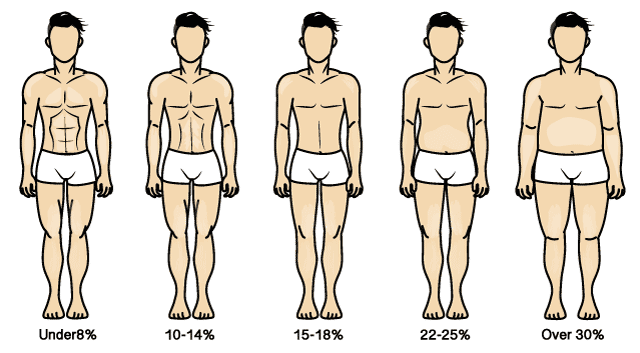
Compare your body shape to the images below and select the closest approximation. These reference charts show typical appearances at different body fat percentages:
Male Body Fat Reference Chart
Female Body Fat Reference Chart
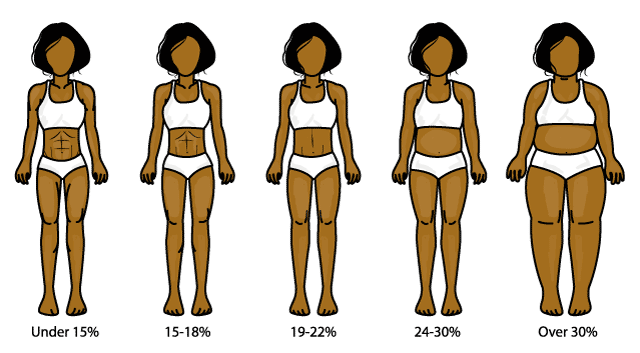
Results: Check these norms to see a rating for each level of body fat. There are also examples of some actual athlete results.
Target Population: This method is suitable for non-athletic populations, and those in which physically taking skinfold measurement is not appropriate.
Reliability: To improve reliability, the same person should assess the participant each time. A larger range of images would also improve reliability.
Advantages: A score can be achieved without any physical contact.
Understanding Body Fat Classifications
The American Council on Exercise (ACE) classifies body fat percentage into the following categories:
Body Fat Percentage by Sport
Different sports require different optimal body fat levels based on the physical demands of the activity:
Endurance Sports
Marathon runners, cyclists, and triathletes typically maintain 5-12% body fat for men and 10-18% for women. Lower body fat improves power-to-weight ratio critical for endurance performance.
Power and Strength Sports
Powerlifters and strength athletes may carry 10-20% body fat for men and 18-28% for women. Additional mass can be beneficial for maximal strength, though elite competitors in weight classes often diet down to 8-15%.
Team Sports
Football, basketball, and soccer players typically range from 8-18% for men and 16-25% for women. Position-specific demands vary - linebackers may carry more mass than wide receivers.
Aesthetic Sports
Bodybuilders reach competition levels of 3-6% for men and 8-12% for women, though these levels are not sustainable long-term. Fitness competitors and physique athletes typically maintain 6-12% for men and 12-18% for women.
"Research on 528 male and 298 female Olympic athletes participating in 26 different events showed that most elite athletes had body fat levels well below average population values."— Robert J. Wood, PhD, Founder of Topend Sports
Visual Characteristics at Different Body Fat Levels
Men: What to Look For
- 5-9%: Extreme vascularity, striated muscles, visible muscle separation in all areas, paper-thin skin
- 10-14%: Visible abs, some vascularity in arms, clear muscle definition, lean facial features
- 15-19%: Upper abs may be visible, some muscle definition, soft look to lower abdomen
- 20-24%: No visible abs, minimal muscle definition, soft appearance overall
- 25%+: No muscle definition, significant fat accumulation around midsection and face
Women: What to Look For
- 10-14%: Very lean, visible abs and muscle striations, extremely defined
- 15-19%: Athletic appearance, some ab definition, defined arms and legs
- 20-24%: Fit appearance, curves present, less muscle definition visible
- 25-30%: Average, healthy appearance, fuller hips and thighs
- 31%+: Higher fat accumulation, particularly in hips, thighs, and upper arms
Accuracy and Limitations
Visual body fat estimation is best used as a quick screening tool rather than a precise measurement. Key considerations include:
- Accuracy: Trained observers can estimate within ±3-5% of laboratory measurements
- Muscle Mass Impact: Higher muscle mass makes you appear leaner at the same body fat percentage
- Fat Distribution: Genetics determine where fat is stored - some carry more in midsection, others in limbs
- Lighting and Posture: These significantly affect visual appearance
- Hydration Status: Dehydration increases apparent muscle definition
For more accurate measurements, consider skinfold calipers, bioelectrical impedance analysis, or DEXA scanning. Research by Affuso et al. (2018) showed that computerized image analysis of digital photographs can provide valid body fat estimates with average errors of approximately 4.1% compared to DEXA.
⚠️ Important: This calculator provides estimates for educational and fitness tracking purposes only. Very low body fat levels can be dangerous and should only be pursued under medical supervision. Essential body fat (2-5% for men, 10-13% for women) is required for basic physiological functions.
How to Reduce Body Fat Percentage
Based on your estimated body fat level, here are evidence-based strategies for athletes looking to optimize body composition:
Nutrition Strategies
- Caloric Deficit: Aim for 300-500 calorie deficit for sustainable fat loss (0.5-1 lb per week)
- Protein Intake: Maintain 1.6-2.2g per kg bodyweight to preserve muscle mass
- Nutrient Timing: Prioritize protein around training sessions
- Hydration: Adequate water intake supports metabolism and performance
Training Strategies
- Resistance Training: 3-5 sessions per week to maintain muscle mass during fat loss
- Cardiovascular Exercise: Mix of HIIT and steady-state for optimal fat oxidation
- Recovery: Adequate sleep (7-9 hours) and rest days support hormonal balance
- Progressive Overload: Continue challenging muscles to prevent muscle loss
Frequently Asked Questions
How accurate is visual body fat estimation?
Visual estimation typically achieves ±3-5% accuracy when performed by trained observers comparing to reference images. Research shows that repeated exposure to different body types improves estimation accuracy. For best results, assess multiple body areas and compare to standardized reference images.
What body fat percentage do athletes typically have?
Male athletes typically range from 6-13% body fat, while female athletes range from 14-20%. Elite male bodybuilders may reach 3-5% during competition (not sustainable), endurance athletes average 5-12% for males and 10-16% for females, and team sport athletes maintain 8-18% for males and 16-25% for females.
At what body fat percentage do abs become visible?
For most men, abs start becoming visible around 10-14% body fat, with well-defined six-pack abs typically visible at 8-10%. For women, abs start showing around 16-19% body fat. Individual factors like muscle development, fat distribution genetics, and core strength significantly affect ab visibility.
Why do men and women have different healthy body fat ranges?
Women naturally carry more essential body fat due to hormonal differences, breast tissue, and reproductive functions. Essential fat for women is 10-13% compared to 2-5% for men. This higher essential fat is necessary for proper hormone production, menstrual function, and potential pregnancy.
How can I improve my visual body fat estimate accuracy?
Assess in consistent lighting conditions, compare multiple body areas (abdomen, arms, chest, back), consider your muscle mass level, measure in the morning before eating, have another person assess you for objectivity, and combine with waist circumference measurements for better accuracy.
Is very low body fat dangerous?
Yes. Body fat below essential levels (under 5% for men, under 13% for women) can cause hormonal dysfunction, weakened immune system, decreased bone density, impaired athletic performance, and reproductive issues. Competition-level body fat in bodybuilders is not sustainable long-term and requires medical monitoring.
Should I use visual estimation or another method?
Visual estimation is excellent for quick, free assessments and tracking changes over time. For higher accuracy, consider skinfold calipers (±3-4% error), bioelectrical impedance (±4-5% error), or DEXA scanning (±1-2% error, gold standard). Use visual estimation consistently to track progress, then confirm with more accurate methods periodically.
References
- Sterner TG, Burke EJ. (1986). "Body fat assessment: A comparison of visual estimation and skinfold techniques." Physician and Sportsmedicine, 14:101-107.
- Affuso O, Pradhan L, Zhang C, et al. (2018). "A method for measuring human body composition using digital images." PLoS One, 13(11):e0206430.
- Blanchard JM, Ward GM, Kryzywicki HJ, Canham JE. (1979). "A visual appraisal method for estimating body composition in humans." Presidio of San Francisco, Report No.81.
- Eckerson JM, Housh TJ, Johnson GO. (1992). "The validity of visual estimations of percent body fat in lean males." Medicine & Science in Sports & Exercise, 24(5):615-8.
- American Council on Exercise. (2020). "ACE Percent Body Fat Norms." ACE Fitness Resources.
- Gallagher D, et al. (2000). "Healthy percentage body fat ranges: an approach for developing guidelines based on body mass index." American Journal of Clinical Nutrition, 72(3):694-701.
- Flegal KM, et al. (2009). "Comparisons of percentage body fat, body mass index, waist circumference, and waist-stature ratio in adults." American Journal of Clinical Nutrition, 89(2):500-508.
- Wilmore JH, Costill DL. (2004). "Physiology of Sport and Exercise." Human Kinetics Publishers.
Similar Tests
- Skinfold measurement — calipers are used to measure the thickness of the skin at a range of sites around the body.
- Body weight
- Waist girth
Related Pages
 Any comments, suggestions, or corrections? Please let us know.