BodPod Body Composition Calculator
Quick Answer
This calculator estimates body composition using air displacement plethysmography principles similar to the BodPod system. It calculates body fat percentage, fat mass, and lean mass based on your weight, height, age, and gender.
- Provides body fat percentage and lean mass estimates instantly
- Based on Siri equation validated for athletic populations
- Accuracy of ±3-4% compared to actual BodPod testing
About Whole-Body Air-Displacement Plethysmography
Whole-Body Air-Displacement Plethysmography is a method for assessing body fat and lean mass, commonly using the BodPod machine. The method is similar to underwater (hydrostatic) weighing, but uses air instead of water.
Purpose: using air displacement technology for measuring and tracking body fat and lean mass.
Equipment required: BodPod by Life Measurements Instruments, Concord, CA.
Pre-test: Explain the test procedures to the subject. Perform screening of health risks and obtain informed consent. Prepare forms and record basic information such as age, height, body weight, gender, test conditions. Check and calibrate the equipment. See more details of pre-test procedures.
Procedure: The Bod Pod system measures body composition by determining body volume and body weight. The subject should not have exercised for the previous two hours, as they must be fully rested and hydration status and increases in muscle temperature can adversely affect the results. Body weight is measured using scales. Body volume is measured by first measuring the volume of the chamber while empty. Then the volume of the subject chamber is measured with the subject inside. By subtraction, the volume of the subject is determined. Once those body volume and weight are determined, body density can be computed and inserted into an equation to provide percent fat measurements.
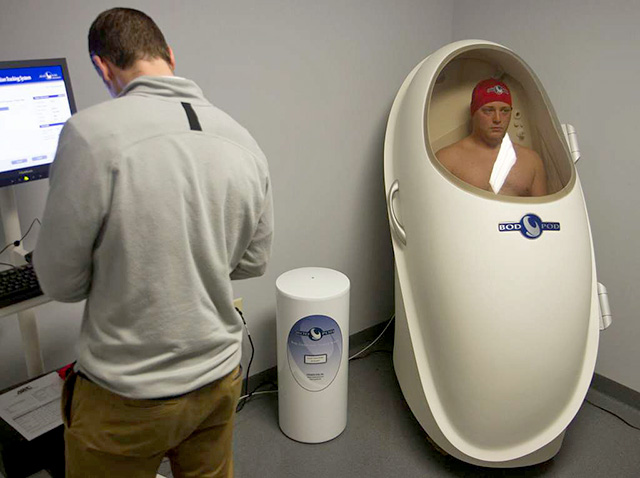
body composition measurement using the bodpod
Method: Body volume is determined by monitoring changes in pressure within a closed chamber. These pressure changes are achieved by oscillating a speaker mounted between the front testing chamber and a rear reference chamber, which causes complementary pressure changes in each chamber. The pressure changes are very small and are not noticed by the individual being tested.
How to Use the BodPod Body Composition Calculator
Our calculator provides an estimate of what your body composition results would be using BodPod methodology. Follow these steps:
- Select Your Units: Choose between metric (kg, cm) or imperial (lbs, inches) using the toggle switch.
- Enter Your Measurements: Input your body weight, height, age, and gender. All fields are required for accurate calculation.
- Calculate: Click the "Calculate Body Composition" button to see your estimated results.
- Review Results: Your body fat percentage, fat mass, lean mass, and body density will be displayed along with athletic classification.
- Interpret Categories: Compare your results to sport-specific standards to understand your body composition in athletic context.
Pro Tip: For most accurate results, measure yourself in the morning after voiding, before eating or exercising. Body composition can fluctuate by 1-2% throughout the day due to hydration and food intake.
Understanding Your Body Composition Results
Body composition assessment goes beyond simple weight measurement to determine how much of your body weight is fat mass versus lean mass (muscle, bone, organs, and water). The BodPod and our calculator use body density to estimate these components.
Body Fat Percentage Standards for Athletes
Athletic body fat percentages vary significantly by sport, position, and performance level:
Male Athletes
Elite Endurance: 5-12%
Team Sports: 10-18%
Strength Sports: 8-20%
Power Sports: 8-15%
Female Athletes
Elite Endurance: 12-20%
Team Sports: 18-25%
Strength Sports: 15-25%
Power Sports: 14-22%
Lean Mass Considerations
Lean body mass includes all non-fat tissue: skeletal muscle, organs, bone, and body water. For athletes, maximizing lean mass while maintaining optimal fat levels is crucial for performance. Research by Robert Wood, MSc Sports Science, indicates that lean mass development should be sport-specific—powerlifters benefit from maximal muscle mass, while distance runners optimize power-to-weight ratios with moderate lean mass.
The Science Behind BodPod Calculations
Air Displacement Plethysmography Methodology
The BodPod uses Poisson's Law to measure body volume by detecting pressure changes when a subject enters a sealed chamber. The system calculates:
- Body Volume: Determined by measuring chamber pressure with and without the subject
- Body Density: Calculated as mass (weight) divided by volume
- Body Composition: Body density converted to fat percentage using the Siri equation
The Siri Equation
Body Fat % = (495 / Body Density) - 450
Developed by William Siri in 1961, this equation is based on the two-compartment model of body composition. The formula assumes fat tissue has a density of 0.9 g/cm³ and fat-free tissue has a density of 1.1 g/cm³, values determined through cadaver analysis.
Calculation Example
For a 180-pound (81.6 kg) male athlete, 70 inches tall, age 25:
- Step 1: Estimated body density = 1.065 g/cm³
- Step 2: Apply Siri equation: (495 / 1.065) - 450 = 14.8%
- Step 3: Fat mass = 81.6 kg × 0.148 = 12.1 kg
- Step 4: Lean mass = 81.6 kg - 12.1 kg = 69.5 kg
Result interpretation: At 14.8% body fat, this athlete falls in the "Elite Athlete" category, typical for competitive team sport athletes and optimal for most athletic performance goals.
BodPod Applications in Different Sports
Body composition requirements vary dramatically across athletic disciplines. Understanding sport-specific standards helps athletes optimize their body composition for peak performance.
Endurance Sports
Marathon Running, Cycling, Triathlon
- Optimal Range: Males 5-12%, Females 12-20%
- Elite Standards: Professional marathon runners typically maintain 6-8% (males) or 14-17% (females)
- Performance Impact: Each 1% reduction in body fat improves power-to-weight ratio by approximately 0.5-1%, directly enhancing endurance performance
- Monitoring: BodPod testing every 4-6 weeks during training helps prevent excessive fat loss that could impair recovery
Power and Strength Sports
Weightlifting, Powerlifting, Track & Field Throws
- Optimal Range: Males 8-20%, Females 15-25%
- Strategy: Moderate body fat acceptable as additional mass aids force production
- Weight Class Considerations: Athletes often target upper end of their weight class to maximize lean mass
- Off-season vs. Competition: Body fat may increase 3-5% during off-season training phases
Team Sports
Basketball, Soccer, Football, Hockey
- Position Variability: Guards/backs 10-15%, forwards 12-18%, linemen 15-25%
- Seasonal Changes: Pre-season typically 2-4% lower than post-season
- Performance Balance: Must balance speed, power, and endurance requirements
- Professional Examples: NBA players average 6-12% body fat, NFL running backs 6-10%, linemen 15-25%
Combat Sports
Wrestling, MMA, Boxing
- Weight Class Management: 8-15% body fat typical at competition weight
- Cutting Strategy: Athletes often maintain 5-10% above competition weight between fights
- Performance Optimization: Maximizing lean mass while staying within weight class limits
- Safety Monitoring: Regular BodPod testing ensures safe weight cutting practices
Advantages and Limitations of BodPod Testing
Advantages
- High Accuracy: ±1-2.7% error range, comparable to hydrostatic weighing considered the gold standard
- Fast Testing: Complete assessment in 10 minutes versus 30+ minutes for underwater weighing
- No Water Immersion: Eliminates discomfort and difficulty of underwater weighing
- Special Populations: Suitable for children, elderly, obese individuals, and those with physical limitations
- Minimal Subject Compliance: Simply sitting still versus complete underwater submersion
- Reproducibility: Excellent test-retest reliability (r = 0.99) for longitudinal tracking
- No Residual Lung Volume Measurement: Predicted values used, eliminating this technical challenge from hydrostatic weighing
Limitations
- Cost: BodPod units cost $30,000-$40,000, limiting availability to research institutions and elite training facilities
- Access: Few facilities offer BodPod testing; may require university or research center access
- Testing Costs: Individual tests typically cost $40-$75 when available
- Hydration Sensitivity: Results affected by hydration status; requires standardized pre-test conditions
- Clothing Requirements: Minimal, tight-fitting clothing and swim cap required for accuracy
- Movement Artifacts: Subject must remain completely still; talking or laughing invalidates test
- Population-Specific Accuracy: Some research suggests accuracy varies in very lean or very muscular athletes
Comparison to Other Methods
DEXA Scan: Similar accuracy to BodPod (±2-3%) with added benefit of regional body composition and bone density. More expensive per test ($75-150).
Hydrostatic Weighing: Comparable accuracy to BodPod but requires water immersion, residual lung volume measurement, and longer testing time.
Skinfold Calipers: Lower accuracy (±3-5%) but inexpensive and portable. Requires skilled technician for reliability.
Bioelectrical Impedance (BIA): Convenient but less accurate (±4-8%). Highly sensitive to hydration status.
Optimizing Body Composition for Athletic Performance
Training Strategies Based on Body Composition Goals
If Body Fat Above Optimal Range:
- Implement moderate caloric deficit (300-500 calories daily) while maintaining protein intake at 1.6-2.2 g/kg body weight
- Increase resistance training frequency to preserve lean mass during fat loss
- Incorporate high-intensity interval training (HIIT) 2-3 times weekly for metabolic enhancement
- Monitor rate of fat loss: Target 0.5-1% body fat reduction monthly to preserve muscle mass
- Expected timeline: 8-16 weeks to achieve 3-5% body fat reduction for most athletes
If Body Fat Within Optimal Range:
- Maintain current training program and nutrition strategy
- Focus on performance metrics rather than composition changes
- Monitor for seasonal fluctuations (2-3% variation normal)
- Retest body composition every 8-12 weeks to track stability
If Body Fat Below Optimal Range:
- Evaluate energy availability: Low body fat may indicate insufficient caloric intake
- Assess for signs of overtraining or inadequate recovery
- Consider gradual increase in caloric intake (200-300 calories daily)
- Monitor for performance decrements, mood changes, or illness frequency
- Consult sports nutritionist or sports medicine physician for very low levels
Nutrition Strategies for Body Composition
Research by sports nutrition experts indicates that macronutrient distribution significantly impacts body composition changes:
- Protein: 1.6-2.2 g/kg body weight daily preserves lean mass during fat loss
- Carbohydrates: 3-7 g/kg for moderate training, 6-10 g/kg for high-volume endurance training
- Fats: Minimum 20-25% of calories for hormonal health, especially in female athletes
- Timing: Protein intake within 2 hours post-training optimizes muscle protein synthesis
Seasonal Periodization
Athletic body composition should vary throughout the training year:
- Off-Season (Building Phase): Body fat may increase 2-4% while building strength and lean mass
- Pre-Season (Preparation): Gradual reduction to optimal competition levels over 8-12 weeks
- In-Season (Competition): Maintain body composition with minimal fluctuation
- Post-Season (Recovery): Allow 1-2% increase while recovering from competition demands
Frequently Asked Questions
How accurate is the BodPod compared to DEXA or hydrostatic weighing?
The BodPod has an accuracy range of ±1-2.7% for body fat assessment, which is comparable to hydrostatic weighing (considered the gold standard) and DEXA scanning (±2-3%). Research in athletic populations shows excellent test-retest reliability (r = 0.99), making it highly reliable for tracking body composition changes over time. However, accuracy can vary slightly in very lean athletes or those with unusual body types.
What should I wear for accurate BodPod testing?
For accurate BodPod results, wear minimal, tight-fitting clothing such as a Lycra or Spandex swimsuit, or compression shorts with a sports bra (no padding or wires). A swim cap must be worn to compress air pockets in hair. Remove all jewelry and eyeglasses. Clothing and air trapped in fabric or hair can significantly affect volume measurements, leading to inaccurate body fat estimates.
How often should athletes get BodPod testing?
Most athletes benefit from BodPod testing every 4-8 weeks during active training phases to monitor body composition changes. During weight loss or muscle building programs, monthly testing helps track progress and adjust nutrition/training strategies. For maintenance periods or in-season athletes, testing every 8-12 weeks is sufficient. More frequent testing (every 2-4 weeks) may be appropriate for weight-class athletes preparing for competition.
Can the BodPod measure regional body fat distribution?
No, the BodPod provides only total body composition measurements (total body fat percentage, fat mass, and lean mass). It cannot measure regional fat distribution like DEXA scanning can. For athletes interested in specific body segment analysis (leg lean mass, trunk fat, etc.), DEXA or anthropometric measurements (skinfolds, circumferences) are needed to assess regional differences.
Does hydration status affect BodPod results?
Yes, hydration status can affect BodPod accuracy by up to 1-2%. Dehydration increases body density (making you appear leaner), while overhydration decreases density (making you appear to have more body fat). For most accurate results, test in a consistent hydration state: avoid exercise, eating, and excessive fluid intake for 2-3 hours before testing. Many facilities recommend testing first thing in the morning after voiding.
What's a healthy body fat percentage for my sport?
Healthy body fat percentages vary significantly by sport, position, and gender. Endurance athletes typically maintain 5-12% (males) or 12-20% (females). Team sport athletes range 10-18% (males) or 18-25% (females). Strength athletes may carry 8-20% (males) or 15-25% (females). However, "optimal" varies individually—focus on body composition that supports your performance goals while maintaining health, energy, and hormonal function.
Is the BodPod safe for all athletes?
Yes, the BodPod is safe for virtually all athletes including children, elderly, pregnant women, and individuals with disabilities. The pressure changes during testing are minimal and not noticeable. However, individuals with severe claustrophobia may find the enclosed chamber uncomfortable. The BodPod can accommodate subjects up to 7 feet tall and 550 pounds, making it suitable for athletes of all sizes including NFL linemen and heavyweight wrestlers.
References
- Dempster P, Aitkens S. (1995). "A new air displacement method for the determination of human body composition." Medicine & Science in Sports & Exercise, 27(12):1692-1697.
- McCrory MA, Gomez TD, Bernauer EM, Molé PA. (1995). "Evaluation of a new air displacement plethysmograph for measuring human body composition." Medicine & Science in Sports & Exercise, 27(12):1686-1691.
- Fields DA, Goran MI, McCrory MA. (2002). "Body-composition assessment via air-displacement plethysmography in adults and children: a review." American Journal of Clinical Nutrition, 75:453-467.
- Biaggi RR, Vollman MW, Nies MA, et al. (1999). "Comparison of air-displacement plethysmography with hydrostatic weighing and bioelectrical impedance analysis for the assessment of body composition in healthy adults." American Journal of Clinical Nutrition, 69(5):898-903.
- Collins MA, Millard-Stafford ML, Sparling PB, et al. (1999). "Evaluation of the BOD POD for assessing body fat in collegiate football players." Medicine & Science in Sports & Exercise, 31(9):1350-1356.
- Siri WE. (1961). "Body composition from fluid spaces and density: analysis of methods." In: Brozek J, Henschel A, editors. Techniques for Measuring Body Composition. Washington, DC: National Academy of Sciences, 223-244.
- Wagner DR, Heyward VH. (2000). "Measures of body composition in blacks and whites: a comparative review." American Journal of Clinical Nutrition, 71(6):1392-1402.
- Levenhagen DK, Borel MJ, Welch DC, et al. (1999). "A comparison of air displacement plethysmography with three other techniques to determine body fat in healthy adults." Journal of Parenteral and Enteral Nutrition, 23(5):293-299.
Similar Tests
Related Pages
 Any comments, suggestions, or corrections? Please let us know.