Blood Lactate Calculator
Quick Answer
This blood lactate calculator analyzes your incremental test data to determine lactate threshold (LT1 and LT2/OBLA), calculate optimal training zones, and provide sport-specific performance interpretation.
- Calculates OBLA (Onset of Blood Lactate Accumulation) at 4 mmol/L
- Identifies both aerobic (LT1) and anaerobic (LT2) thresholds
- Based on established sports science protocols (NSCA validated)
What is Blood Lactate Testing?
Blood lactate is a product of anaerobic glycolysis, and the measurement of lactate in the blood is used in physiological assessments of athletes. Blood lactate concentration is one of the most frequently measured parameters during clinical exercise testing and performance assessment, providing valuable insights into an athlete's metabolic response to exercise intensity.
Equipment required: Small scalpels or lancets, ice and container for storage, alcohol swabs, blood analysis equipment. Also need sharps and contaminated items disposal unit.
Pre-test: Explain the test procedures to the subject. Perform screening of health risks and obtain informed consent. Prepare forms and record basic information such as age, height, body weight, gender, test conditions. See more details of pre-test procedures.
Procedure: Small pinprick blood samples can be taken from any place, often it is from the finger tip or earlobe. The area must be cleaned first, using a dry tissue to remove sweat, then an alcohol swab to further clean the area. Once the area is dry, the lancet (often with a spring loaded apparatus) is used to pierce the skin. Hopefully there will be good blood flow from the wound, which is collected into capillary tubes or other devices, ready for analysis. If the blood does not flow freely, apply gentle pressure away from the site, or re-prick the site.

The author collecting a blood sample during incremental exercise testing
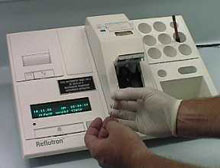
Analysis: The measurement of blood lactate is usually automated using portable lactate analyzers such as the Lactate Pro or YSI analyzers. Blood lactate levels indicate a combination of lactate production and release into the blood, and its removal from the blood. Blood lactate measurements are used to monitor changes in anaerobic power and responses to set workloads.
Comments: Lactate is a salt formed from lactic acid. Anaerobic exercise produces lactic acid, which quickly forms lactate in the muscles. Because of this, the terms "lactate" and "lactic acid" are often used interchangeably.
Notes: The lactate concentration in the blood is normally 0.5 to 2 mmol/L at rest, but during intense physical exertion it can reach as much as 20-25 mmol/L in well-trained athletes.
How to Use This Blood Lactate Calculator
Follow these steps to calculate your lactate threshold and training zones from your blood lactate test results:
- Enter Your Test Data
- Workload: Enter pace (km/h or mph), power (watts), or heart rate (bpm) for each stage
- Lactate: Enter blood lactate concentration in mmol/L
- Heart Rate: Optional but recommended for training zone prescription
- Add Multiple Stages
- Include data from at least 4-5 incremental test stages
- Ensure you have values both below and above the 4 mmol/L threshold
- More data points improve threshold accuracy
- Calculate Your Thresholds
- Click "Calculate" for instant analysis
- Review LT1 (aerobic threshold) and LT2/OBLA (anaerobic threshold)
- See your personalized training zones
- Interpret Your Results
- Compare to sport-specific standards
- Use zones for training prescription
- Retest every 4-8 weeks to track progress
Pro Tip: For accurate results, ensure blood samples are taken at the end of each 3-4 minute stage when lactate levels have stabilized. Avoid sampling during the first minute of each stage.
Understanding Lactate Threshold and OBLA
The lactate threshold represents a critical intensity boundary for endurance athletes. Below this threshold, lactate production equals lactate clearance, allowing exercise to continue for extended periods. Above the threshold, lactate accumulates faster than it can be cleared, eventually leading to fatigue.
Key Lactate Markers
LT1 - First Lactate Threshold
The intensity at which blood lactate first rises above resting levels, typically around 2 mmol/L. Represents the upper limit of pure aerobic exercise.
Training Application: Base/endurance training zone boundary
LT2/OBLA - Second Lactate Threshold
The onset of blood lactate accumulation, traditionally defined at 4 mmol/L. Represents maximum lactate steady state (MLSS).
Training Application: Threshold/tempo training zone
Maximal Lactate Steady State
The highest intensity that can be maintained without continuous lactate accumulation. Sustainable for approximately 30-60 minutes.
Training Application: Race pace for events lasting 45-90 minutes
Blood Lactate Testing Methods
Several established protocols exist for lactate threshold determination:
Incremental Step Test Protocol
The most common method involves progressively increasing exercise intensity with blood samples taken at the end of each stage. Stage duration is typically 3-5 minutes to allow lactate equilibration. This calculator is designed primarily for analyzing data from incremental step tests.
Calculation Methods
- Fixed Blood Lactate Concentration (FBLC): Identifies workload at specific lactate values (commonly 2, 3, and 4 mmol/L)
- Dmax Method: Identifies the point of maximum perpendicular distance from a line connecting the first and last lactate values
- Log-Log Transformation: Uses logarithmic transformation to identify inflection points
- 1 mmol/L Rise: Identifies workload at which lactate rises 1 mmol/L above baseline
Sport-Specific Applications
Running
For distance runners, lactate threshold pace typically corresponds to approximately 10K to half-marathon race pace. Elite marathoners can often sustain intensities at or near OBLA for over 2 hours due to exceptional lactate clearance capacity. The lactate threshold test helps determine optimal paces for tempo runs, interval training, and race strategy.
Cycling
Cyclists commonly express threshold as Functional Threshold Power (FTP), which closely correlates with lactate threshold. Power at OBLA (4 mmol/L) is a key metric for training zone prescription and predicting 40km time trial performance.
Swimming
Swimming lactate tests use 200m or 400m repeats with increasing speeds. The 7x200m step test is particularly popular for monitoring training adaptations throughout the season.
Rowing
Rowing ergometer tests measure power output (watts) at various lactate concentrations. The 2000m rowing pace often corresponds closely to LT2/OBLA intensity.
Factors Affecting Blood Lactate Values
Several factors can influence blood lactate measurements and should be considered when interpreting results:
- Glycogen Status: Depleted glycogen stores result in lower lactate production
- Sampling Site: Fingertip, earlobe, and venous samples may yield different values
- Temperature: Cold conditions can affect blood flow and sample collection
- Analyzer Calibration: Different analyzers may give slightly different readings
- Recent Training: Fatigue and overreaching can elevate baseline lactate
- Altitude: Hypoxic conditions increase lactate production at given intensities
- Caffeine/Supplements: Some substances can affect lactate metabolism
Normative Data and Standards
Blood lactate response varies significantly between individuals and training status:
According to Robert Wood's research at Topend Sports, elite endurance athletes consistently demonstrate higher lactate thresholds as a percentage of VO2max, allowing them to race at higher relative intensities without excessive lactate accumulation.
Training to Improve Lactate Threshold
Based on the results from your blood lactate test, training can be targeted to improve threshold performance:
Zone 2 Training (Below LT1)
Long, steady-state sessions at conversational pace build aerobic base and enhance fat oxidation capacity. This type of training increases mitochondrial density and improves lactate clearance mechanisms.
Threshold Training (At LT2)
Tempo runs or sustained efforts at OBLA intensity (4 mmol/L) improve the body's ability to tolerate and clear lactate. Sessions of 20-40 minutes at threshold are highly effective for raising OBLA.
VO2max Intervals (Above LT2)
High-intensity intervals at 90-100% VO2max stress both aerobic and anaerobic systems, leading to improvements in both lactate production capacity and clearance.
Tests Requiring Blood Lactate Measurement
- Mader Test — A simpler test of anaerobic threshold using blood lactate measurements
- Swimming Step Test — 7 x 200m swim step test used to monitor training and improvements in aerobic conditioning
- VO2max Test — Often combined with blood lactate measurement for comprehensive metabolic profiling
Frequently Asked Questions
What is a normal blood lactate level at rest?
Normal resting blood lactate concentration is typically 0.5 to 2.0 mmol/L in healthy individuals. Well-trained endurance athletes often have lower resting values around 0.8-1.0 mmol/L due to enhanced lactate clearance mechanisms.
What blood lactate level indicates lactate threshold?
The first lactate threshold (LT1) typically occurs when blood lactate rises to 1.5-2.0 mmol/L above baseline. The second threshold or OBLA (onset of blood lactate accumulation) is traditionally identified at 4.0 mmol/L, though individual variation exists.
How accurate is the 4 mmol/L OBLA reference?
While 4 mmol/L is a widely used reference, research shows individual OBLA can range from 2.5 to 5.5 mmol/L depending on training status and genetics. This calculator uses 4 mmol/L as the standard but results should be interpreted alongside individual characteristics.
How often should I test my blood lactate?
Athletes typically benefit from testing every 4-8 weeks during training periods to monitor fitness improvements and adjust training zones. Testing is particularly valuable at the beginning of training phases and before major competitions.
What is the difference between LT1 and LT2?
LT1 (first lactate threshold) is the intensity where lactate first noticeably rises above baseline, representing the top of the purely aerobic zone. LT2 (second lactate threshold or OBLA) is the intensity where lactate accumulates exponentially, representing maximum sustainable intensity.
Can blood lactate levels exceed 20 mmol/L?
Yes, during maximal all-out efforts lasting 30-120 seconds, blood lactate can reach 15-25 mmol/L in well-trained athletes. Elite sprinters may produce even higher values following supramaximal efforts.
Why do different analyzers give different lactate readings?
Lactate analyzers vary in measurement methodology, calibration, and whether they measure whole blood or plasma lactate. The Lactate Pro typically reads 10-15% higher than laboratory enzymatic methods. Consistency in analyzer choice is important for tracking changes over time.
References
- Faude, O., Kindermann, W., & Meyer, T. (2009). "Lactate threshold concepts: how valid are they?" Sports Medicine, 39(6), 469-490.
- Gladden, L. B. (2004). "Lactate metabolism: a new paradigm for the third millennium." Journal of Physiology, 558(1), 5-30.
- Medbø, J. L., et al. (2000). "Examination of four different instruments for measuring blood lactate concentration." Scandinavian Journal of Clinical and Laboratory Investigation, 60(5), 367-380.
- Newell, J., et al. (2007). "Software for calculating blood lactate endurance markers." Journal of Sports Sciences, 25(12), 1403-1409.
- Svedahl, K., & MacIntosh, B. R. (2003). "Anaerobic threshold: the concept and methods of measurement." Canadian Journal of Applied Physiology, 28(2), 299-323.
- Beneke, R., Leithäuser, R. M., & Ochentel, O. (2011). "Blood lactate diagnostics in exercise testing and training." International Journal of Sports Physiology and Performance, 6(1), 8-24.
- Jamnick, N. A., et al. (2018). "An examination and critique of current methods to determine exercise intensity domains in cyclists." Sports Medicine, 48(10), 2347-2356.
- Brooks, G. A. (2018). "The science and translation of lactate shuttle theory." Cell Metabolism, 27(4), 757-785.
Related Pages
Blood Sampling Tests
General procedures for blood sampling in health and fitness testing.
Blood Sampling (Health Test) →Glucose Tolerance Test
Blood glucose testing for metabolic health assessment.
Glucose Tolerance Test →Cholesterol Testing
Blood cholesterol measurement for cardiovascular health.
Blood Cholesterol Test → Any comments, suggestions, or corrections? Please let us know.