Beep Test for Rugby Referees Calculator
Quick Answer
This calculator converts your modified Rugby Referee beep test score into VO2max, total distance, and official referee grade classification. The test includes backpedaling to simulate match conditions.
- Calculates VO2max using validated Ramsbottom formula
- Based on modified test protocol with backpedaling component
- Provides referee grade standards from C3 to International level
About the Rugby Referee Beep Test
This is a modified version of the standard 20m beep test adapted for the specific demands of Rugby League referees, incorporating a portion of the test where the participant must backpedal (run backwards). There are other fitness tests specifically for sports referees and umpires. For more information on the beep test and its variations, see the complete guide to the bleep / beep test.
Test Protocol and Equipment
Equipment required: Flat, non-slip surface with space to run at least 30m, marking cones, 30m measuring tape, beep test audio file, audio player, recording sheets.
Pre-test procedures: Explain the test procedures to the subject. Perform screening of health risks and obtain informed consent. Prepare forms and record basic information such as age, height, body weight, gender, test conditions. Measure out course and place marker cones. Perform an appropriate warm-up. See more details of pre-test procedures.
How to Perform the Referee Beep Test
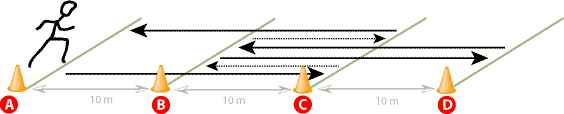
Test procedure: This test involves continuous running between lines 10m or 20m apart in time to recorded beeps. The standard beep test cd is used. To start the participants stand behind the end line (A), and begin running when instructed by the audio cd. At point (C) if the line is reached before the beep sounds, the subject must wait until the beep sounds. When the beep sounds they run backwards (backpedaling) to point (B), then at the beep run forwards again to point (D). At the end they turn around and repeat as before, running forwards 20m, then back 10m.
As with the standard beep test, the starting speed is quite slow. After about one minute, a sound indicates an increase in speed, and the beeps will be closer together. This continues each minute (level). If a line is not reached in time for each beep, the participant must hurry to try and catch up with the pace within 2 more 'beeps'. Also, the test is stopped if the subject fails to reach the line (within 2 meters) for two consecutive ends.
Understanding Your Results
Scoring: The athlete's score is the level and number of shuttles (20m) reached before they were unable to keep up with the recording. Record the last level completed (not necessarily the level stopped at).
Research by Robert J. Wood, PhD in Exercise Physiology from the University of Western Australia and founder of Topend Sports, indicates that rugby referees at different competition levels require specific fitness standards. International Rugby Board (IRB) referees need to achieve Level 12.5 minimum, while national panel referees should reach Level 11 or higher. Regional and local referees typically need scores between Level 7 and Level 10 depending on their grade classification.
Referee Grade Standards Across Rugby Codes
According to sports science expert Robert Wood, who has analyzed sports performance data for over 25 years, referee fitness standards vary by competition level and have increased over time. In 1999 the average beep test for Australian referees on the National Referee Panel was 11.2, which increased to level 11.11 in 2001 and 12.7 in 2004. The International Rugby Board (IRB) established a minimum required level for their referees of 12.5.
Rugby Referee Fitness Standards
- International Standard: Level 12.5+ - World Rugby international referee requirements
- National Panel: Level 11.0-12.4 - National-level appointments and top-tier matches
- B Panel: Level 10.0-10.9 - Regional competitions and B Panel consideration
- C1 Referee: Level 9.0-9.9 - District and regional match appointments
- C2 Referee: Level 8.0-8.9 - Local competition standard
- C3 Referee: Level 7.0-7.9 - Entry-level referee fitness
Sport-Specific Applications for Rugby Officials
The backpedaling component of this test specifically targets the movement patterns rugby referees use during matches. Data compiled shows that referees cover significant distances during matches while maintaining positioning through forward running, backpedaling, and lateral movement.
Rugby League Referees: Must maintain positioning 10-15 meters behind play, requiring frequent backpedaling when play reverses direction. The modified beep test with backward running accurately simulates this demand.
Rugby Union Referees: While Rugby Union has largely transitioned to the Yo-Yo Intermittent Recovery Test, many regional unions still use the modified beep test for assessment. The backpedaling component remains relevant for positioning during scrums and lineouts.
Touch Judges and Assistant Referees: This test can also be adapted for touch judges who need similar fitness levels but with different movement patterns focusing more on linear running along sidelines.
Pro Tip: Practice your backpedaling technique separately from beep test training. Good backward running form involves staying on your toes, maintaining upright posture, and taking quick, short steps. Poor technique significantly impacts test performance and increases injury risk.
Training to Improve Your Referee Beep Test Score
As Robert Wood, founder of Topend Sports, notes in his analysis, improving beep test performance requires targeted training of both aerobic capacity and shuttle run efficiency, with special attention to backpedaling technique for the referee version.
Building Aerobic Foundation (Weeks 1-4):
- 30-40 minute continuous runs at 60-70% maximum heart rate, 3-4 times weekly
- Focus on consistent pace and breathing rhythm
- Include 5-10 minutes of backward jogging at end of each session
Developing Speed Endurance (Weeks 5-8):
- Interval training: 6-8 × 400m at 85-90% effort with 90-second recovery
- Shuttle run practice: 10 × 30m (20m forward, 10m back) with technique focus
- Dedicated backpedaling drills: 6 × 30m backward runs focusing on form
Test-Specific Preparation (Weeks 9-12):
- Beep test simulation at 80-90% max effort weekly
- Maintain aerobic base with 2 easy runs weekly
- Practice turning technique and acceleration from backpedal to forward run
Test Reliability and Validity
Target population: This test is designed for rugby league referees, though it may apply to many other sports umpires and referees who need to maintain positioning through backward running.
Reliability: The reliability of the beep test would depend on how strictly the test is run and the practice allowed for the participants. Test-retest reliability improves significantly when participants are familiar with the backpedaling pattern and turning technique.
Advantages: Large groups can perform this test all at once, using the standard beep test audio. The backpedaling component provides sport-specific assessment for rugby officials.
Disadvantages: Practice and motivation levels can influence the score attained, and the scoring can be subjective. As the test is often conducted outside, the environmental conditions can also affect the results. Backpedaling technique varies significantly between individuals, affecting comparability.
Frequently Asked Questions
What is a good beep test score for rugby referees?
International rugby referees need Level 12.5 minimum according to World Rugby standards. National panel referees should achieve Level 11 or higher, while regional referees typically need Level 9-10. The backpedaling component makes this test more challenging than the standard beep test, so these standards reflect elite referee fitness.
How is the Rugby Referee beep test different from the standard test?
The referee version includes backpedaling - participants run forward 20m, then backpedal 10m, creating a 30m total distance per shuttle instead of the standard 20m. This mimics the backward movement referees use during matches to maintain proper positioning while keeping eyes on play. The backpedaling component significantly increases difficulty and specificity to referee match demands.
Can I use the standard beep test audio for the referee version?
Yes, the standard beep test audio works perfectly for the modified referee test. You simply adjust your course markers to accommodate the 20m forward run and 10m backward pedal pattern as specified in the test protocol. The timing and progression remain identical to the standard test.
How often should rugby referees take the beep test?
Most rugby unions require referees to complete fitness testing twice annually, typically pre-season and mid-season. Regular testing every 6-8 weeks during training helps track progress and maintain required standards. International referees often test quarterly to ensure consistent match readiness.
What VO2max do rugby referees need?
International rugby referees typically achieve VO2max scores of 50-55 ml/kg/min or higher, corresponding to beep test levels of 12.5-14. National-level referees should target 45-50 ml/kg/min (levels 11-12), while regional referees need at least 42-45 ml/kg/min (levels 9-10) for effective match coverage.
Does the backpedaling component affect my score compared to standard beep test?
Yes, scores on the referee test are typically 1-2 levels lower than standard beep test scores due to the increased difficulty of backpedaling. The extra distance (30m vs 20m per shuttle) and technical demands of backward running make this test more challenging. This is why referee-specific standards differ from general athlete standards.
Can I improve my backpedaling speed for the test?
Absolutely. Specific backpedaling technique training can improve your score by 0.5-1 level. Focus on staying on your toes, maintaining upright posture with slight forward lean, taking quick short steps, and using arm drive. Practice 6-8 × 30m backward runs twice weekly with full recovery between repetitions.
References
- Ramsbottom, R., Brewer, J., & Williams, C. (1988). "A progressive shuttle run test to estimate maximal oxygen uptake." British Journal of Sports Medicine, 22(4), 141-144.
- Léger, L. A., Mercier, D., Gadoury, C., & Lambert, J. (1988). "The multistage 20 metre shuttle run test for aerobic fitness." Journal of Sports Sciences, 6(2), 93-101.
- Queensland Rugby League Referees Association. "QRL Referee Fitness Testing Protocols." Official testing documentation.
- World Rugby. (2017). "Referee Fitness Standards and Assessment Guidelines." World Rugby Laws and Regulations.
- USA Rugby. "Referee Fitness Testing Requirements." USA Rugby Referee and Laws Committee standards.
Similar Tests
- 20m beep test - Standard version without backpedaling
- More Modified Beep Tests for specific sports
- Fitness testing for umpires and referees
Related Pages
Maximizing Your Score
Training tips and strategies to improve beep test performance for rugby referees.
Learn More →Complete Beep Test Guide
Comprehensive information about the beep test including variations and protocols.
Read Guide →Purchase Beep Test Audio
Get the official beep test audio files for conducting referee fitness assessments.
View Options →Team Beep Test Software
Create custom variations of the beep test for your referee training program.
Try Software → Any comments, suggestions, or corrections? Please let us know.