Kneeling Basketball Throw Calculator
Quick Answer
This calculator determines your kneeling basketball throw performance instantly based on Service Academy CFA standards. Enter your throw distance in feet or meters to see your performance category, compare to athlete benchmarks, and get personalized training recommendations.
- Calculates performance category based on CFA standards
- Based on USAFA, USNA, USMA, and USMMA testing protocols
- Validated for service academy candidates and athletes
About the Kneeling Basketball Throw Test
The Kneeling Basketball Throw is a fitness test of upper body strength and explosive power, requiring only a basketball and a tape measure. The aim is to throw a standard-sized basketball as far as possible using a one-handed throw technique from a kneeling position. This test is a critical component of the Candidate Fitness Assessment (CFA) used by all U.S. Service Academies and measures shoulder girdle power, body coordination, and balance.
There is another basketball throw test, in which the participant sits with their back against the wall and throws with both hands. There are also other throw tests using a heavier powerball and medicine ball.
How to Use the Kneeling Basketball Throw Calculator
Follow these simple steps to calculate and track your throwing performance:
1. Select Your Unit System
Toggle between feet (imperial) and meters (metric) using the unit switcher. The calculator will automatically convert your results to both units for easy comparison with different standards.
2. Choose Your Gender
Select male or female to ensure your results are compared against the appropriate performance standards. Service Academy testing uses different benchmarks for men and women.
3. Enter Your Throw Distance
Input your best throw distance from your testing session. Remember, you get three attempts in the actual test - use your furthest throw. The calculator accepts distances in whichever unit system you've selected.
4. Calculate Your Performance
Click "Calculate Performance" to instantly see your results, including:
- Your distance in both feet and meters
- Performance category (Elite, Excellent, Above Average, Average, Below Average, or Needs Improvement)
- Comparison to CFA standards
- Tracking of all three attempts
- Personalized training recommendations based on your current level
5. Track Multiple Attempts
The calculator automatically tracks your three most recent throws, helping you monitor consistency and identify your best performance. This feature is particularly useful during practice sessions.
Pro Tip: Test yourself under CFA conditions - complete all three throws within a 2-minute time period. This helps you prepare for the actual test environment and teaches proper pacing between attempts.
Test Purpose and Equipment
Purpose: This test measures upper body strength and explosive power, specifically targeting the shoulder girdle, rotational core strength, and the athlete's ability to generate force from a static kneeling position. It is particularly valuable for assessing athletic potential because it isolates upper body power by removing lower body contribution.
Equipment required: standard size men's basketball (29.5 inch circumference, 22 oz weight), tape measure (minimum 100 feet), mat to cushion the knees (optional, maximum 1 inch thick), markers or cones to identify landing points.
Pre-test: Explain the test procedures to the subject. Perform screening of health risks and obtain informed consent. Prepare forms and record basic information such as age, height, body weight, gender and test conditions. Check and record the size and weight of the ball - using a men's regulation basketball is mandatory even for female candidates. Perform a standard warm-up lasting 20-30 minutes, with practice aiming for the ideal ball release angle of approximately 45 degrees. See more details of pre-test procedures.
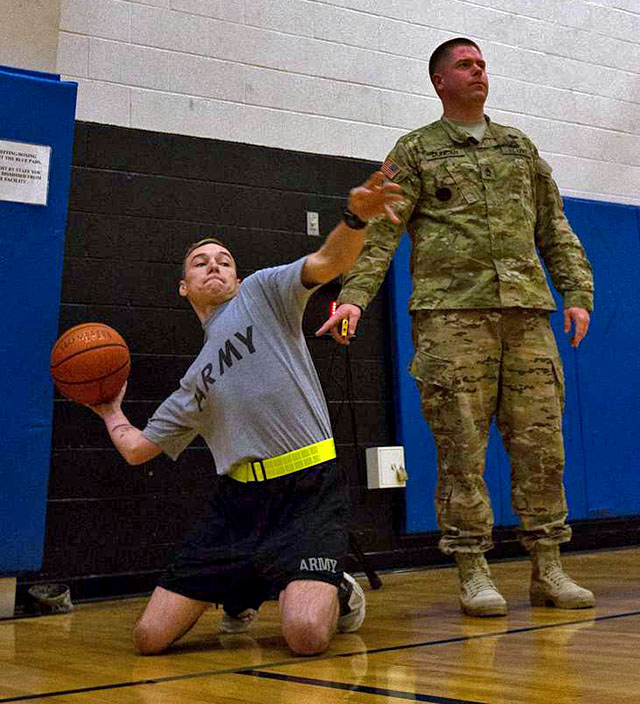 Kneeling Basketball Throw - Proper technique showing full torso rotation
Test Procedure and Scoring
Procedure: The subject kneels with knees behind a line (baseline). Both knees must remain parallel to and behind the baseline throughout the entire throwing motion. In an overhand throwing motion, the ball is thrown with one hand as far as possible. The non-throwing hand may be used to steady the ball prior to throwing, but only one hand may be used to throw the ball (either hand may be used). The knees must stay in contact with the ground, and no part of the body can touch the other side of the line until the basketball has landed. Three attempts are allowed, all completed within a 2-minute time period. The test scorer extends a 100-foot tape measure perpendicular to the baseline and marks each landing point.
Scoring: The distance from the start line to where the ball first makes contact with the ground is recorded. The measurement is recorded to the nearest foot (official CFA scoring) or to the nearest 0.1 foot for training purposes. The best result of the three throws is used as the official score. This test is used for the US Air Force Academy and all other U.S. Service Academies as part of the Candidate Fitness Assessment.
Performance Standards and Benchmarks
According to sports science research conducted at TopEndSports and data from service academy admissions, the following performance standards apply:
Men's Standards
- Elite (100+ feet): Top 5% of candidates - Maximum CFA score range
- Excellent (85-99 feet): Top 20% of candidates - Well above average
- Above Average (68-84 feet): Meets or exceeds CFA average
- Average (55-67 feet): Passing range with room for improvement
- Below Average (40-54 feet): Needs focused training
- Goal Distance: 69 feet (USAFA) / 68 feet (average)
- Maximum Score: 102-105 feet
Women's Standards
- Elite (66+ feet): Top 5% of candidates - Maximum CFA score range
- Excellent (52-65 feet): Top 20% of candidates - Well above average
- Above Average (42-51 feet): Meets or exceeds CFA average
- Average (32-41 feet): Passing range with room for improvement
- Below Average (22-31 feet): Needs focused training
- Goal Distance: 42 feet (USAFA and CFA average)
- Maximum Score: 66-68 feet
Important Note: These standards are based on Candidate Fitness Assessment data from the United States Air Force Academy, Naval Academy, Military Academy (West Point), and Merchant Marine Academy. The CFA scores this event out of 100 points, with performance standards validated across thousands of service academy candidates.
Technique and Best Practices
Research by service academy fitness experts and sports scientists has identified several key technique elements that maximize throwing distance:
The 45-Degree Release Angle
Physics demonstrates that the optimal release angle for maximum distance is approximately 45 degrees. Practice finding this angle by:
- Visualizing an imaginary target high on a wall or ceiling
- Using a partner to observe your release angle from the side
- Recording practice throws on video to analyze your technique
- Practicing with lighter balls initially to develop muscle memory
Full Torso Rotation
Unlike throwing a baseball or football, the kneeling basketball throw requires maximum torso rotation to generate power:
- Begin with shoulders turned 90 degrees from target direction
- Rotate through the hips and core as you throw
- Use a "whip-like" motion from torso to shoulder to arm
- Follow through completely across your body
Knee Positioning and Stability
Proper lower body positioning provides a stable base:
- Knees should be hip-width apart for balance
- Both knees must remain parallel to baseline
- Maintain contact with the ground throughout throw
- Engage glutes and core to prevent falling forward
- Use a 1-inch mat if needed for knee comfort
Common Technique Errors to Avoid
According to service academy testing officials, these mistakes reduce throwing distance:
- Pushing the ball like a shot-put (reduces torso contribution)
- Throwing flat without sufficient upward angle
- Insufficient torso rotation (arm-only throw)
- Knees lifting off ground before ball release (causes disqualification)
- Body crossing baseline before ball lands (causes disqualification)
- Using two-handed motion instead of single-hand throw
Sport-Specific Applications
Service Academy Preparation
The kneeling basketball throw is a required event for admission to all U.S. Service Academies. Candidates preparing for the Candidate Fitness Assessment should note:
- This event is first in the CFA sequence, setting the tone for the entire assessment
- Score contributes to overall CFA score out of 800 points (West Point scoring system)
- Minimum passing scores vary by academy but generally require 55+ feet (men) and 32+ feet (women)
- Elite scores significantly boost overall CFA competitiveness
- West Point requires video documentation of CFA performance
Sports Using Similar Movement Patterns
Team Sports:
- Basketball: Overhead passing, outlet passes, and the general throwing motion translates to court performance
- Netball: Long passing requires similar shoulder power and release mechanics
- Volleyball: Serving motion shares biomechanical similarities with explosive upper body extension
- Water Polo: Throwing technique directly transfers to passing and shooting
- Soccer: Goalkeepers benefit from explosive throwing power for distribution
Individual Sports:
- Tennis: Overhead serves require similar shoulder power and coordination
- Javelin: Though technique differs, explosive upper body power is foundational
- Rowing: Upper body power and core strength are critical performance factors
- Swimming: Butterfly and freestyle strokes benefit from shoulder girdle power
- Rock Climbing: Dynamic movements require similar explosive upper body strength
Combat Sports:
- Wrestling: Explosive upper body power for throws and takedowns
- Judo: Overhead throwing techniques share movement patterns
- MMA: Clinch work and grappling require similar power generation
Training to Improve Performance
Based on service academy preparation programs and sports science research, the following training protocol has proven effective for improving kneeling basketball throw distance:
Pro Tip: Service academy candidates typically see 3-5 feet of improvement per month with consistent, dedicated training. Start your CFA preparation at least 3-6 months before testing to ensure adequate development time.
Phase 1: Foundation Building (Weeks 1-4)
- Upper Body Strength:
- Push-ups: 3 sets × 15-20 reps, performed daily
- Overhead dumbbell press: 3 sets × 10-12 reps, 3x weekly
- Lat pulldowns or pull-ups: 3 sets × 8-10 reps, 3x weekly
- Dumbbell rows: 3 sets × 10 reps each arm, 3x weekly
- Core Development:
- Planks: 3 sets × 30-60 seconds, daily
- Russian twists: 3 sets × 20 reps, 4x weekly
- Anti-rotation press: 3 sets × 10 reps each side, 3x weekly
- Side planks: 3 sets × 30 seconds each side, 4x weekly
- Technique Practice:
- Kneeling throws with light basketball (women's size): 3 sets × 10 reps, 3x weekly
- Focus on form, rotation, and release angle
- Video record to analyze technique
Phase 2: Power Development (Weeks 5-8)
- Explosive Power Training:
- Medicine ball overhead slams: 3 sets × 8-10 reps with 4-6 kg ball, 3x weekly
- Medicine ball rotational throws: 3 sets × 10 reps each side with 3-4 kg ball, 3x weekly
- Plyometric push-ups: 3 sets × 8-10 reps, 2x weekly
- Medicine ball chest passes: 3 sets × 10 reps, 2x weekly
- Sport-Specific Power:
- Kneeling medicine ball throws: 3 sets × 8 reps with 2-3 kg ball, 3x weekly
- Cable rotations: 3 sets × 12 reps each side, 2x weekly
- Landmine rotational presses: 3 sets × 10 reps each side, 2x weekly
- Test Practice:
- Full test simulation: 3 attempts with regulation basketball, 2x weekly
- Track all attempts to monitor progress
- Practice within 2-minute time limit
Phase 3: Competition Preparation (Weeks 9-12)
- Peak Power:
- Reduce training volume, increase intensity
- Medicine ball throws with heavier balls (4-5 kg): 2 sets × 5 reps, 2x weekly
- Continue explosive movements but reduce frequency
- Technical Refinement:
- Full CFA simulations weekly
- Perfect the 3-attempt sequence
- Practice under test conditions (same time of day, similar environment)
- Mental preparation and visualization
- Recovery and Tapering:
- Reduce training volume 7-10 days before testing
- Maintain technique work with lighter loads
- Ensure full recovery before test day
Sample Weekly Training Schedule (Phase 2)
- Monday: Upper body strength + Core + Kneeling basketball throw practice (8 throws)
- Tuesday: Medicine ball explosive training + Rotational core work
- Wednesday: Active recovery or light cardio
- Thursday: Upper body strength + Medicine ball throws + Test simulation
- Friday: Core work + Technique practice with light basketball
- Saturday: Full CFA simulation or power training
- Sunday: Rest
Variations and Related Tests
Variations: The size and weight of the ball thrown will obviously affect results, and should be selected to best test the age group or abilities of your participants. For CFA testing, men's regulation basketball (29.5 inch circumference, 22 oz) is mandatory for both male and female candidates. Throwing power tests using lighter balls include the softball throw and baseball throw tests. There is a test using the heavier powerball, the Powerball Rotational Throw, though it is a two-handed rotational throw that allows more torso contribution.
Target population: This test is not just for basketballers or service academy candidates. It is suitable for any sports in which upper body power is important, such as netball, volleyball, tennis, rowing, swimming, water polo, and combat sports. The test is particularly valuable for:
- Service academy applicants preparing for the CFA
- High school athletes being recruited for college programs
- Military personnel tracking fitness readiness
- Coaches assessing athlete upper body power development
- Physical education programs measuring student progress
- Sports requiring explosive upper body strength
Advantages: This test is easy and quick to perform for an individual once the space is set up. It requires minimal equipment (just a basketball and tape measure) and can be administered indoors or outdoors. The test isolates upper body power by removing lower body contribution, making it an excellent assessment of shoulder girdle strength and rotational core power. Results are immediately available and easy to interpret. The standardized protocol used across all service academies ensures consistent, comparable results.
Disadvantages: Several people are needed to conduct this test smoothly: one to mark results, another to check for correct technique and another to collect and return the balls. If testing a large group, it can be time consuming to put all the participants through this test. The test requires adequate indoor space (approximately 100 linear feet) which may not be available in all facilities. Proper technique is critical for valid results, requiring trained administrators who understand the strict rules about knee placement and throwing motion.
Comments: The angle the ball is thrown is important - the optimal release angle for maximum distance is approximately 45 degrees. You may want to explain this to the subject about the optimal angle for maximal distance, and to allow some practice attempts during warm-up. The throwing technique differs significantly from typical basketball passing or baseball throwing, so specific practice with the kneeling position and overhead motion is essential.
You may aid in the ease of measurement for this test by extending a tape measure out along the expected path in front of the subject. When recording the distance, you can either move the tape to where the ball lands, or less accurately align where the ball landed to the approximate distance on the tape. For official CFA testing, perpendicular measurement from the baseline to the landing point is required.
The Test in Action
- This test is used for the US Air Force Academy Candidate Fitness Assessment
Similar Tests
- Softball Throw Test — throw a softball for maximal distance using lighter projectile
- Cricket ball or baseball throw test — throw a baseball for maximal distance with full body mechanics
- Seated Basketball Throw — two-handed push power with the back against a wall, isolating arm strength
- Powerball Chest Launch (kneeling) — uses heavier medicine ball with two-handed technique
Frequently Asked Questions
What is a good score for the kneeling basketball throw?
For men, the average CFA score is about 68 feet, with the Air Force Academy goal at 69 feet and maximum scores reaching 102-105 feet. For women, the average is 42 feet with maximum scores of 66-68 feet. Elite performers (top 5%) achieve 100+ feet (men) and 66+ feet (women). Your score is converted to points out of 100 for the Candidate Fitness Assessment used by all service academies.
How do I improve my basketball throw distance?
Improvement comes from three areas: explosive power training (medicine ball throws, plyometrics), rotational core strength (Russian twists, cable rotations, anti-rotation exercises), and technique refinement (45-degree release angle, full torso rotation, proper follow-through). Consistent training typically yields 3-5 feet of improvement per month. Shoulder strengthening exercises like overhead press and targeted practice with proper form are essential.
What muscles does the kneeling basketball throw test?
This test primarily measures shoulder girdle power including deltoids (especially anterior and medial heads), rotator cuff muscles, triceps, and pectorals. It also tests rotational core strength from obliques and abdominals, plus lat engagement during the throwing motion. The kneeling position isolates upper body power by eliminating lower body contribution, making it an excellent assessment of shoulder and core coordination.
Can I use two hands for the kneeling basketball throw?
No, only one hand may be used to execute the throw. The non-throwing hand may steady the ball before release, but the actual throwing motion must be performed with one hand in an overhand technique. Using two hands results in disqualification. This rule is standardized across all service academies for the Candidate Fitness Assessment.
How many attempts do I get for the basketball throw test?
Three attempts are allowed, all completed within a 2-minute time period. Your best distance of the three throws is recorded as your official score. Between attempts, you should retrieve the ball (or have it returned), reset your position, and prepare for the next throw. Proper pacing is important - rushing can compromise technique while too much delay wastes time.
What's the difference between kneeling and seated basketball throws?
The kneeling basketball throw is performed from a kneeling position with a one-handed overhand throwing motion, testing explosive power and full-body coordination through torso rotation. The seated basketball throw is performed sitting with back against a wall using both hands in a chest-pass motion, which isolates arm and chest strength by eliminating torso rotation. Both test upper body power but emphasize different muscle groups and movement patterns.
Do all service academies use the same basketball throw standards?
Yes, the United States Air Force Academy, Naval Academy, Military Academy (West Point), and Merchant Marine Academy all use the identical Candidate Fitness Assessment with standardized basketball throw requirements and scoring. Maximum scores are consistently 102-105 feet for men and 66-68 feet for women. The same protocol, equipment requirements (men's regulation basketball), and timing (three attempts in 2 minutes) apply across all academies, ensuring fair comparison of candidates.
References
- United States Air Force Academy. (2025). "Candidate Fitness Assessment Instructions." USAFA Office of Admissions.
- United States Naval Academy. (2025). "Candidate Fitness Assessment." USNA Admissions Office, Annapolis, MD.
- United States Military Academy. (2025). "CFA Instructions and Standards." West Point Admissions, West Point, NY.
- Sayers, M.G.L., & Bishop, S. (2017). "Reliability of a new medicine ball throw power test." Journal of Applied Biomechanics, 33, 311-315.
- Hackett, D., Davies, T., Soomro, N., & Halaki, M. (2018). "Predictive ability of the medicine ball chest throw and vertical jump tests for determining muscular power in physically active men and women." Journal of Strength and Conditioning Research, 32(10), 2840-2845.
- Beckham, G., Mizuguchi, S., Carter, C., Sato, K., Ramsey, M., Lamont, H., Hornsby, G., Haff, G., & Stone, M. (2013). "Relationships of isometric mid-thigh pull variables to weightlifting performance." Journal of Sports Medicine and Physical Fitness, 53(5), 573-581.
- Stockbrugger, B.A., & Haennel, R.G. (2003). "Contributing factors to performance of a medicine ball explosive power test." Journal of Strength and Conditioning Research, 17(4), 768-774.
- Duncan, M.J., Hankey, J., & Nevill, A.M. (2013). "Peak power, fatigue index and total work are reliable measures for assessing upper body power output in wheelchair users." Journal of Sports Sciences, 31(4), 403-409.
- Mayhew, J.L., Bird, M., Cole, M.L., Koch, A.J., Jacques, J.A., Ware, J.S., Buford, B.N., & Fletcher, K.M. (2005). "Comparison of the backward overhead medicine ball throw to power production in college football players." Journal of Strength and Conditioning Research, 19(3), 514-518.
- Wood, Robert J. (2025). "Upper Body Power Testing in Athletes." TopEndSports, https://fallback.topendsports.com/testing/tests/medicine-ball-tests.htm
Related Pages
Power Fitness Tests
Comprehensive guide to medicine ball throwing tests and other power assessments for athletes
Learn More →Speed & Power Tests
Complete collection of anaerobic fitness tests measuring explosive strength and speed
Learn More →Basketball Fitness Testing
Sport-specific testing protocols for basketball players including power and agility assessments
Learn More → Any comments, suggestions, or corrections? Please let us know.