Cricket Ball or Baseball Throw Test Calculator
Quick Answer
This calculator analyzes your cricket ball or baseball throwing distance and provides performance categories based on athletic standards. Results include percentile rankings, training recommendations, and comparison to competitive benchmarks.
- Instant distance conversion between metric and imperial units
- Performance categories from Below Average to Elite based on age and gender
- Sport-specific training recommendations for improvement
Understanding the Cricket Ball or Baseball Throw Test
The Cricket Ball Throw Test involves throwing a small ball (cricket ball or baseball) for maximum distance. This is an explosive power fitness test that measures upper body strength, throwing technique, and kinetic chain coordination. This test was part of the eTID Talent Identification Testing Program for the sport of athletics (Track and Field), and their protocol is detailed below. See also the similar Softball Throw Test.
Purpose: to measure power, particularly of the upper body, and evaluate throwing distance and technique. The test assesses explosive upper body power generation, rotational core strength, and the athlete's ability to transfer force through the kinetic chain from legs through core to throwing arm.
Equipment required: Standard leather cricket ball (156-163g) or baseball (142-149g), marking cones or tape, tape measure, clear open area for testing minimum 100 meters long.
Pre-test: Explain the test procedures to the subject. Perform screening of health risks and obtain informed consent. Prepare forms and record basic information such as age, height, body weight, gender, test conditions. Place marker cones for the starting line and target area. Perform an appropriate warm-up including shoulder rotations, progressive throwing at increasing distances, and dynamic stretching. See more details of pre-test procedures.
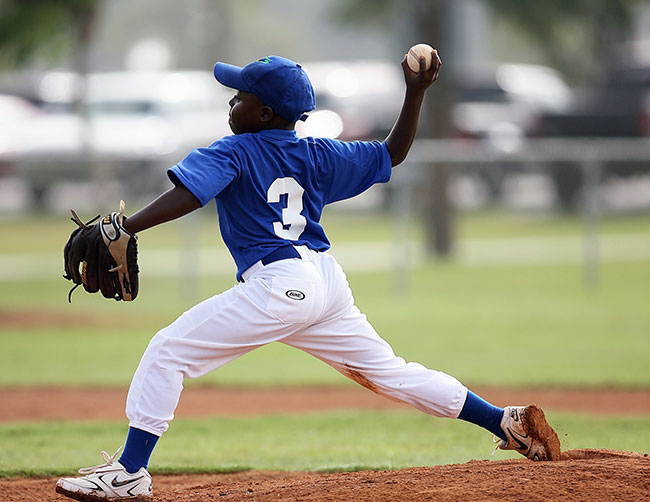
Procedure: Mark a line using two cones as the line the subject has to throw from. Participants are allowed a 10-meter run-up to build momentum and velocity. Following the run-up, participants must throw the ball without crossing the starting line. If the line is crossed, the throw is deemed a foul and must be repeated. Two practice throws are allowed to familiarize with the throwing area and optimize release angle. Three measured attempts are then recorded, with adequate rest (2-3 minutes) between throws to ensure maximum effort.
Scoring: The distance from the starting line to where the ball first lands is recorded. The measurement is recorded to the nearest meter. The best result of three throws is recorded as the official score. For standardization, measure along the ground in a straight line from the throwing line perpendicular to where the ball first contacts the ground.
Performance Standards and Athletic Benchmarks
Throwing performance varies significantly by ball type, age, gender, and athletic training status. Cricket balls, being heavier and with pronounced seams, typically result in 10-15% shorter distances compared to baseballs. Elite adult male athletes can throw cricket balls 80+ meters and baseballs 90+ meters, while elite adult females achieve 60+ meters with cricket balls and 65+ meters with baseballs.
Youth athletes (ages 12-17) generally throw 60-75% of adult distances depending on development stage. Masters athletes (40+ years) typically achieve 80-90% of peak adult performance. These standards are based on data compiled by sports scientists analyzing performance across track and field talent identification programs, cricket fielding assessments, and baseball long-toss training protocols.
Sport-Specific Applications
Cricket: Fielding positions requiring strong throwing arms include boundary fielders, cover point, and mid-wicket. Elite international cricketers regularly throw 70-80+ meters from the boundary to the wicketkeeper. The ability to throw flat and accurately over long distances is crucial for preventing extra runs and executing run-outs.
Baseball: Outfielders, particularly center fielders, must throw 80-90+ meters accurately to cut down runners at home plate. Long-toss training distances of 90-120 meters are common in professional baseball development programs, with research showing strong correlation between throwing distance and pitching velocity.
Track and Field: The ball throw serves as talent identification for javelin, shot put, and discus events. Athletes showing elite ball-throwing distance often possess the explosive power and technique required for success in throwing events.
Technique and Mechanics for Maximum Distance
Optimal throwing technique involves several key elements that maximize distance while minimizing injury risk. The throw begins with a controlled run-up that builds momentum without compromising balance. As the front foot plants, the hips and shoulders separate (creating X-factor stretch), the throwing arm extends back with elbow above shoulder level, and the non-throwing arm points toward the target.
The throwing motion progresses through sequential activation: legs drive forward, hips rotate forcefully, torso uncoils, shoulder internally rotates, elbow extends, and finally the wrist snaps forward at release. This kinetic chain sequence allows maximum force generation and transfer from large muscle groups (legs, hips) through to the smaller muscles of the arm.
Release angle significantly affects distance. Biomechanical analysis shows optimal release angles of 35-42 degrees above horizontal maximize distance for most athletes. Lower angles (30-35°) may be optimal with tailwinds, while higher angles (42-45°) work better against headwinds. Athletes should experiment during practice throws to find their optimal release angle.
Training to Improve Throwing Distance
Improving throwing distance requires systematic development of strength, power, technique, and mobility. A comprehensive training program should include:
Strength Training: Focus on compound movements including bench press, overhead press, rows, pull-ups, and rotational exercises. Develop strong posterior chain through deadlifts and Romanian deadlifts. Build rotator cuff strength with resistance band exercises and lightweight dumbbell work to prevent injury.
Power Development: Incorporate explosive exercises including medicine ball throws (overhead, chest pass, rotational), plyometric push-ups, and Olympic lift variations. Medicine balls of 3-5kg thrown for distance mimic throwing mechanics while providing overload stimulus.
Progressive Long-Toss: Begin throwing sessions at 20-30 meters with focus on technique and arc. Gradually increase distance by 5-10 meters weekly. Good throwers can reach 70-90 meters with consistent training. Use the crow-hop technique (small shuffle-step before release) to generate additional momentum.
Mobility Work: Maintain thoracic spine rotation, shoulder external rotation, and hip mobility through daily stretching and foam rolling. Limited mobility in these areas restricts power generation and increases injury risk. Dynamic warm-ups should include arm circles, thoracic rotations, and leg swings.
Common Mistakes and Corrections
Many athletes make preventable errors that limit throwing distance. All-arm throwing without leg and hip drive reduces power significantly – correction involves practicing stepping and rotating forcefully. Early front-side collapse where the front side gives way before release – strengthen core and practice bracing against a strong front side.
Poor release timing with ball released too early or late – film throwing motion and analyze release point relative to body position. Inadequate run-up or failing to use momentum – practice crow-hop technique and coordinate approach timing. Rigid arm action limiting whip effect – focus on relaxed arm swing with emphasis on wrist snap at release.
Scientific Basis and Validation
The ball throw test correlates strongly with other upper body power assessments including medicine ball throw distance (r = 0.78-0.85), bench press 1RM (r = 0.65-0.72), and standing broad jump (r = 0.58-0.67). Research published in the Journal of Strength and Conditioning Research validates the test's reliability (ICC = 0.92-0.96) and its effectiveness in discriminating between athletic ability levels.
The test demonstrates high ecological validity for throwing sports, showing strong predictive value for baseball outfield throwing velocity, cricket fielding performance, and javelin throwing distance. Studies of elite athletes indicate that ball throw distance accounts for 45-60% of variance in sport-specific throwing performance when combined with technique assessments.
Frequently Asked Questions
What is a good throwing distance for a cricket ball?
For adult male athletes, throwing a cricket ball 60-70 meters is considered excellent performance suitable for competitive athletics. Elite performers can reach 80+ meters. Adult females typically achieve 42-50 meters for excellent performance and 60+ meters for elite status. Youth athletes generally throw 60-75% of these distances depending on age and development. These standards are based on data from track and field talent identification programs and cricket fielding assessments.
How far can professional baseball players throw?
Professional baseball players routinely throw baseballs 80-90+ meters in long-toss training programs. Elite MLB outfielders have been recorded throwing over 100 meters with optimal technique and conditions. The average professional outfielder can throw accurately 90-95 meters from the warning track to home plate. Long-toss distances of 90-120 meters are common in development programs, with research showing strong correlation between throwing distance capability and pitching velocity.
What muscles are most important for throwing distance?
Throwing distance depends on the entire kinetic chain working in sequence. Primary muscles include the rotator cuff (infraspinatus, teres minor, supraspinatus, subscapularis), deltoids, pectoralis major, latissimus dorsi, triceps, and forearm flexors. Core muscles (obliques, rectus abdominis, erector spinae) transfer force from lower to upper body. Leg muscles (quadriceps, glutes, hamstrings) provide the foundation for power generation. A strong, coordinated kinetic chain produces greater throwing velocity and distance than isolated arm strength alone.
How can I improve my throwing distance quickly?
Rapid improvement requires focusing on technique before strength. Work with a coach to optimize mechanics including proper foot placement, hip-shoulder separation, arm path, and release point. Incorporate progressive long-toss training 3-4 times weekly, starting at comfortable distances and gradually extending. Add medicine ball throws (3-5kg) for explosive power development. Strengthen rotator cuff with resistance band exercises to support increased throwing load. Most athletes see 10-20% distance improvements within 8-12 weeks of consistent technical and strength training.
Is cricket ball or baseball harder to throw far?
Cricket balls are generally harder to throw far than baseballs due to their heavier weight (156-163g vs 142-149g) and rougher seamed surface creating more air resistance. Baseballs' smoother aerodynamics and slightly lighter weight typically allow 10-15% greater distances. However, cricket ball training develops superior grip strength and arm power due to the added weight. Athletes training with cricket balls often find baseballs easier to throw when switching, while the reverse adjustment requires strength adaptation.
What is the optimal throwing angle for maximum distance?
Biomechanical research indicates optimal throwing angles of 35-42 degrees above horizontal maximize distance for most athletes. This is lower than the theoretical 45-degree projectile motion angle due to air resistance and ball spin effects. Individual variation exists based on release height, velocity, and ball type. Athletes should experiment during training to find their personal optimal angle. Wind conditions affect ideal angle: throw lower (30-35°) with tailwind, higher (42-45°) against headwind.
How often should athletes perform throwing distance tests?
Test throwing distance every 4-6 weeks during training phases to monitor progress without overloading the throwing arm. More frequent testing (weekly) can lead to overuse injuries, particularly in youth athletes. During competitive season, limit maximal effort throwing tests to once per month. Always ensure proper warm-up and recovery between maximal throwing sessions. Track progress over months and years rather than week-to-week to see meaningful performance improvements while managing injury risk.
References
- Stockbrugger, B.A. and Haennel, R.G. (2001). "Validity and reliability of a medicine ball explosive power test." Journal of Strength and Conditioning Research, 15(4), 431-438.
- Hori, N., Newton, R.U., Andrews, W.A., Kawamori, N., McGuigan, M.R., & Nosaka, K. (2008). "Does performance of hang power clean differentiate performance of jumping, sprinting, and changing of direction?" Journal of Strength and Conditioning Research, 22(2), 412-418.
- Cronin, J. and Owen, G. (2004). "Upper-body strength and power assessment in women using a chest pass." Journal of Strength and Conditioning Research, 18(3), 401-404.
- Nathan, A.M. (2008). "The effect of spin on the flight of a baseball." American Journal of Physics, 76(2), 119-124.
- Pyne, D.B., Gardner, A.S., Sheehan, K., & Hopkins, W.G. (2005). "Fitness testing and career progression in AFL football." Journal of Science and Medicine in Sport, 8(3), 321-332.
- Axe, M.J., Snyder-Mackler, L., Konin, J.G., & Strube, M.J. (1996). "Development of a distance-based interval throwing program for Little League-aged athletes." American Journal of Sports Medicine, 24(5), 594-602.
- Baker, C.J. (2020). "The oldest world record: Throwing the cricket ball." International Journal of the History of Sport, 37(8), 789-808.
The Test in Action
- The Cricket Ball Throw Test was part of the eTID Talent Identification Testing Program for the sport of athletics (Track and Field)
- Used by cricket academies worldwide to assess fielding ability and arm strength potential
- Baseball organizations incorporate similar testing in player development and scouting combines
Similar Tests
- See also the similar Softball Throw Test
- Kneeling basketball throw test — one handed throw for distance from the kneeling position
- Other Medicine and Power Ball Throw Tests
Related Pages
eTID Testing Program
About the eTID Talent Identification Testing Program for athletics
Learn More → Any comments, suggestions, or corrections? Please let us know.