NCF Abdominal Curl Conditioning Test Calculator
Quick Answer
This calculator determines your NCF Abdominal Curl Test stage and rating based on total sit-ups completed. The test measures core endurance through 8 progressive stages using a tempo-controlled beep protocol.
- Calculates stage (1-8) and performance rating instantly
- Based on National Coaching Federation standards
- Validated for athletic performance assessment in rugby, football, and other contact sports
About the NCF Abdominal Curl Conditioning Test
The NCF Abdominal Curl Conditioning Test is a commercially available abdominal test which measures the muscular strength and endurance of the abdominal muscles and hip-flexors using a pre-recorded tempo. This is a progressive test, using timed beeps to indicate when to perform each sit up, similar in a way to the running bleep/beep test. See also this non-progressive sit up beep test.
Test purpose: The curl up test measures abdominal strength and endurance, which is important in back support and core stability.
Equipment required: gym mat or similar, tape recorder or CD player, NCF Abdominal Curl Conditioning Test CD. (if you know the rate, you can create your own using the team beeptest software)
Pre-test: Explain the test procedures to the subject. Perform screening of health risks and obtain informed consent. Prepare forms and record basic information such as age, height, body weight, gender, test conditions. Ensure that the participants are adequately warmed-up. See more details of pre-test procedures.
Procedure: The detailed instructions on how to perform the test is included in the booklet and on the recording. The specifics of the angle of the legs, hand position and the rate of beeps is unknown (the recording will tell you the details). Participants are required to perform as many sit ups as possible, keeping in time to the audio recording. The test is over when the subject is not able to perform the sit up in time with the beeps, or is not able to perform the correct technique.
Scoring: The total number of correctly performed sit ups that were performed in time with the beeps is recorded. Using this number and the scale below, a rating score can be derived.
| Stage | Total Sit-Ups | Males | Females |
|---|---|---|---|
| 1 | 20 | Poor | Poor |
| 2 | 42 | Poor | Fair |
| 3 | 64 | Fair | Fair |
| 4 | 89 | Fair | Good |
| 5 | 116 | Good | Good |
| 6 | 146 | Good | Very Good |
| 7 | 180 | Excellent | Excellent |
| 8 | 217 | Excellent | Excellent |
Advantages: this test is simple and quick to perform requiring minimal equipment, and large groups may be tested at once.
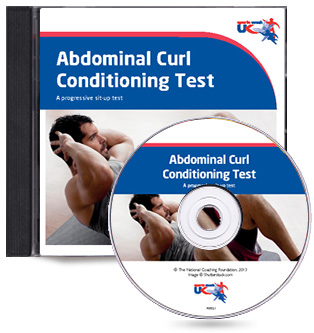 NCF Abdominal Curl Conditioning Test
Disadvantages: It is sometimes difficult to determine if a correct sit up is performed, and there may be dispute about the total score. The instructor should make it clear to the athlete of when they will terminate the test. As the tape may stretch over time, or the tape player may not be properly calibrated, the cd version is the preferred choice.
Understanding Your NCF Test Score
The NCF Abdominal Curl Conditioning Test uses an 8-stage progressive system to evaluate core strength and endurance. According to research by Robert J. Wood, PhD in Exercise Physiology from the University of Western Australia and founder of Topend Sports, each stage represents a significant increase in muscular endurance capacity.
Ratings are gender-specific because male and female athletes typically display different patterns of core strength development. For males, reaching "Good" performance requires completing Stage 5 (116 sit-ups), while females achieve "Good" ratings at Stage 4 (89 sit-ups). Elite performers of both genders complete Stages 7-8, demonstrating exceptional abdominal endurance crucial for high-level athletic competition.
Sport-Specific Applications
The NCF Abdominal Curl Test is particularly valuable for sports requiring sustained core stability and rotational power. Research by sports science experts indicates this test effectively predicts performance capacity in several athletic disciplines.
Rugby and Football
Contact sports place enormous demands on core strength for tackling, scrummaging, and injury prevention. Elite rugby players typically score Stage 6-8 on the NCF test, reflecting the sustained abdominal endurance needed for 80 minutes of physical contact. The progressive nature of the test mirrors match intensity, where core fatigue becomes a factor in the latter stages of competition.
Hockey and Racket Sports
Sports requiring rapid changes of direction and rotational movements benefit significantly from the endurance capacity measured by this test. Hockey players need strong core stability for stick handling and body positioning, while tennis and squash players rely on core endurance for powerful serves and groundstrokes throughout long matches. Competitive athletes in these sports should target Stage 5-7 performance.
Athletics and Track Sports
Middle-distance and distance runners particularly benefit from the sustained core endurance measured by the NCF test. Maintaining running form over extended periods requires exceptional abdominal strength to prevent postural breakdown and maintain efficient biomechanics. Sprinters also utilize this test to ensure core stability during acceleration and maximum velocity phases.
Cricket and Baseball
Batting, bowling, and throwing all generate significant rotational forces through the core. The NCF test's progressive format helps identify whether players can maintain core stability throughout innings or pitching performances that may last several hours. Fast bowlers and pitchers should target Stage 5-6 to support injury prevention.
How to Improve Your NCF Test Score
Improving performance on the NCF Abdominal Curl Test requires progressive training that builds both muscular strength and endurance. Research by Robert Wood's analysis at Topend Sports indicates that athletes can improve by 1-2 stages within 8-12 weeks of targeted training.
Progressive Tempo Training
Practice sit-ups or curl-ups in time with a metronome, starting at a comfortable pace and gradually increasing tempo. Begin with sets of 20-30 reps at a 2-second cadence (one second up, one second down), then progress to faster tempos as your endurance improves. This directly mimics the NCF test format and builds pacing awareness.
Core Circuit Training
Incorporate variety to build comprehensive core strength. Combine traditional sit-ups with planks, side planks, Russian twists, bicycle crunches, and leg raises. Perform 3-4 circuits of 30-60 seconds per exercise, 3-4 times weekly. This develops the muscular endurance needed for higher stages while preventing overuse injuries from excessive sit-up volume.
Back Strengthening Balance
Critical for injury prevention: strengthen lower back muscles to balance abdominal work. Include superman holds, bird dogs, and back extensions in your routine. According to sports medicine research, abdominal training without corresponding back work increases lower back injury risk, regardless of sit-up capacity.
Sport-Specific Applications
Integrate core work within your sport training. Rugby players should perform core exercises before contact drills; runners should include core circuits after easy runs; racket sport athletes can add core work between court sessions. This functional approach ensures core endurance transfers directly to sport performance.
Frequently Asked Questions
What is a good score on the NCF Abdominal Curl Test?
A good score varies by gender and athletic level. For male athletes, reaching Stage 5 (116 sit-ups) represents good core endurance, while females achieve good ratings at Stage 4 (89 sit-ups). Elite athletes in contact sports typically reach Stages 6-8, demonstrating exceptional abdominal strength crucial for high-level competition and injury prevention.
How is the NCF test different from regular sit-up tests?
The NCF test is progressive, using tempo-controlled beeps that gradually increase in pace throughout 8 stages, similar to the beep test for running. Regular sit-up tests typically measure maximum repetitions in a fixed time period (1 or 2 minutes). The NCF format better assesses sustained endurance and pacing ability under increasing difficulty.
Can I improve my NCF test score quickly?
Yes, with targeted training. Research indicates athletes can improve by 1-2 stages within 8-12 weeks. Focus on tempo-controlled sit-ups, progressive overload, and core circuit training. Practice maintaining pace with a metronome, gradually increase volume, and ensure balanced back strengthening to prevent injury.
What stage should I target for my sport?
Target stages vary by sport demands. Contact sports (rugby, football) benefit from Stage 6+ performance. Endurance sports (distance running, cycling) should target Stage 5-7. Racket sports and athletics typically require Stage 5-6. Baseline athletic fitness is achieved at Stage 3-4 for most sporting activities.
Why do ratings differ between males and females?
Gender-specific ratings account for physiological differences in muscle mass distribution and core strength development. The National Coaching Federation established separate standards based on extensive testing of male and female athletes. This ensures fair assessment and appropriate training targets for both genders.
Should I train specifically for the NCF test?
If the NCF test is part of your athletic assessment or selection process, specific practice is beneficial. However, general core conditioning that builds both strength and endurance transfers well to test performance. Balance NCF-specific training with sport-specific core work and overall athletic development for best results.
What if I can't maintain the beep tempo?
The test ends when you can no longer perform sit-ups in time with the beeps or when technique breaks down. Your score is the total number of correctly performed sit-ups completed before this point. Start training at a slower tempo and gradually build speed and endurance to improve pacing ability.
References
- National Coaching Federation. "NCF Abdominal Curl Conditioning Test Manual." UK National Sports Medicine Institute.
- Wood, R.J. (2004). "Abdominal Endurance Testing for Athletes." Topend Sports Network.
- Davis, B. et al. (2000). "Physical Education and the Study of Sport." 4th ed. London: Harcourt Publishers, p. 124.
- McGill, S.M. (1998). "Low Back Exercises: Evidence for Improving Exercise Regimens." Physical Therapy, 78(7), 754-765.
- Pollock, M.L., Wilmore, J.H., Fox, S.M. (1978). "Health and Fitness through Physical Activity." New York: John Wiley & Sons.
Similar Tests
- Non-progressive sit up beep test
- General Abdominal Endurance Test description
Related Pages
- Purchase the NCF Abdominal Curl Conditioning Test
- About Abdominal Testing
- A sit-up test metronome (can only set one pace)
- Simple sit-up test that you can do at home
- Videos of Sit Up Fitness Tests
- Sit up exercise at the beach or at home
- Sit Up World Records
- Team BeepTest software — the beep test on your computer
 Any comments, suggestions, or corrections? Please let us know.