30-15 Intermittent Fitness Test Calculator
Quick Answer
This calculator instantly determines your VO2max from 30-15 Intermittent Fitness Test results using Martin Buchheit's validated 2008 formula. Enter your final running speed (VIFT), body weight, age, and gender to get your estimated VO2max and personalized training zones.
- Calculates VO2max from VIFT score instantly
- Based on Buchheit (2008) peer-reviewed formula
- Generates personalized HIIT training zones for team sports
- Used by professional teams worldwide
The 30-15 Intermittent Fitness Test (30-15 IFT) is an intermittent fitness test created by Martin Buchheit (2008), to more closely replicate the demands of intermittent sports compared to the standard beep test. Unlike in the beep test, where athletes run continuously with increasing speed every minute, this test involves 30 seconds of running alternated with 15 seconds of walking over a 40m course. There is a similar test, the Interval Shuttle Run Test (ISRT) with the same work/rest intervals but with different running speeds and over a 20m course. The Yo-Yo intermittent tests is another intermittent type beep test.
How to Conduct the 30-15 Intermittent Fitness Test
Test purpose: To assess the ability to recover and repeat intermittent activity, similar to many sporting situations.
Equipment required: clear flat area for conducting the test at least 40m long, audio recording of test, marker cones.
Pre-test: Explain the test procedures to the subject. Perform screening of health risks and obtain informed consent. Prepare forms and record basic information such as age, height, body weight, gender, test conditions. Measure and mark out the course. Ensure that the participants are adequately warmed-up. See more details of pre-test procedures.
Test layout: Mark out a 40m area with markers at either end and at the midpoint (20m). Also place markers 3 meters before each end line and either side of the mid-line (tolerance zones).
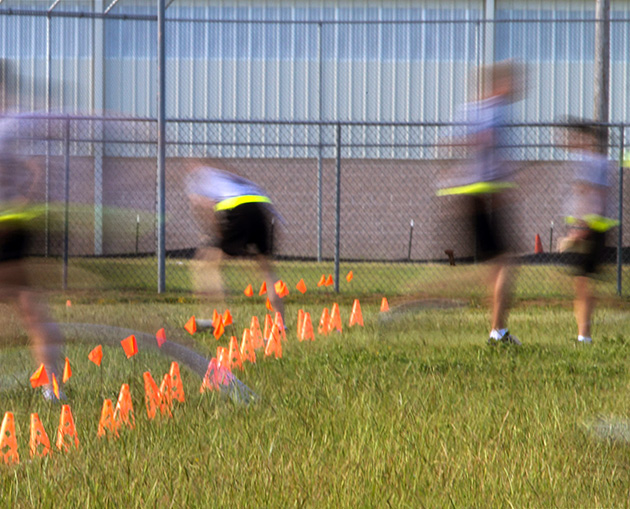 running a shuttle test
Procedure: The test involves 30 seconds of running alternated with 15 seconds of walking. Participants start behind one of the end lines, spaced from each other by one meter minimum. They begin to run on the first "beep", pacing their effort to be in the area around the midline at the second "beep", then arrive at the opposite end at the third "beep". This continues until there is a double beep, indicating the end of the 30 second period, and which point they stop running. This will not necessarily be at either end line. They then walk forwards to the next line, waiting for the start of the next level in 15 seconds. As listed in Buchheit (2008), the initial velocity is 8.0 km/hr, with increments increased by 0.5 km/hr every 45-second stage thereafter. The test ends when the athlete does not make it into the tolerance zone three times. See 30-15 test video examples.
Understanding Your Results
Scoring: The speed of the final phase completed in full is taken as the score (VIFT - Velocity for the Intermittent Fitness Test). Use the calculator above or the following formula to estimate VO2max based on the final running speed, where VIFT is the final running speed, G stands for gender (female = 2; male = 1), A for age, and W for weight (Buchheit, 2008).
VO2max (ml.kg-1.min-1) = 28.3 – (2.15 x G) – (0.741 x A) – (0.0357 x W) + (0.0586 x A x VIFT) + (1.03 x VIFT)
Performance Standards for Team Sport Athletes
According to research by Martin Buchheit and data collected across multiple studies, typical VIFT scores vary by sport, gender, and competition level:
Male Athletes
- Elite/Professional: 19.5-21.0 km/h (top tier team sport athletes)
- Advanced/Collegiate: 17.5-19.4 km/h (high-level competitive players)
- Intermediate/Club: 15.5-17.4 km/h (regular team sport players)
- Youth/Developing: 14.0-15.4 km/h (junior athletes)
Female Athletes
- Elite/Professional: 17.0-18.5 km/h (top tier team sport athletes)
- Advanced/Collegiate: 15.0-16.9 km/h (high-level competitive players)
- Intermediate/Club: 13.5-14.9 km/h (regular team sport players)
- Youth/Developing: 12.0-13.4 km/h (junior athletes)
Sport-Specific Applications
The 30-15 Intermittent Fitness Test is particularly valuable for sports that involve repeated high-intensity efforts with short recovery periods. Research by Buchheit and colleagues has demonstrated its effectiveness across multiple team sports:
Soccer/Football
Elite male soccer players typically achieve VIFT scores of 18.5-20.5 km/h. The test closely replicates the intermittent nature of soccer with its repeated sprints, direction changes, and brief recovery periods. Professional teams use VIFT results to prescribe individualized high-intensity interval training programs during pre-season and in-season maintenance.
Basketball
A modified version of the test can be conducted on a 28m basketball court. Elite basketball players generally score 17.5-19.5 km/h (males) and 15.5-17.5 km/h (females). The test's emphasis on change of direction ability makes it highly relevant for basketball's movement patterns.
Handball
The test was originally validated using handball players. Elite male handball players typically score 18.0-20.0 km/h. The combination of aerobic capacity, anaerobic reserve, and recovery ability assessed by the test directly translates to handball performance demands.
Rugby
Rugby players across different positions show varying VIFT scores. Backs typically score 18.5-20.5 km/h while forwards range from 17.0-19.0 km/h, reflecting the different physiological demands of each position.
Ice Hockey
A specialized ice hockey version of the test exists with modified speeds to account for skating. On-ice VIFT scores typically range from 16.0-18.5 km/h for elite players, reflecting the different biomechanics and energy demands of skating versus running.
Using Your Results for Training Prescription
One of the primary advantages of the 30-15 IFT is its ability to prescribe individualized high-intensity interval training. Research by Buchheit demonstrates that using VIFT as a reference speed for HIIT results in more homogeneous metabolic responses between athletes compared to using traditional maximal aerobic speed.
Training Zone Guidelines
Based on your VIFT score, you can calculate training intensities for different workout types:
- Recovery runs (50-60% VIFT): Active recovery and warm-up pace
- Aerobic base development (70-80% VIFT): Long intervals for building endurance foundation
- Tempo training (85-90% VIFT): Sustained higher intensity work
- High-intensity intervals (95-100% VIFT): Sport-specific conditioning
- Maximum intervals (100-110% VIFT): Speed-endurance and anaerobic capacity development
Sample HIIT Sessions Using VIFT
Session 1: Short Intervals (Early Pre-Season)
3 sets of 6 x 30-second runs at 100% VIFT with 30 seconds passive recovery between reps and 3 minutes between sets
Session 2: Long Intervals (Late Pre-Season)
2 sets of 4 x 4-minute runs at 85-90% VIFT with 2 minutes active recovery between reps and 4 minutes between sets
Session 3: Speed-Endurance (In-Season)
2 sets of 8 x 15-second efforts at 110% VIFT with 15 seconds passive recovery between reps and 4 minutes between sets
The Science Behind the Test
According to sports science expert Robert Wood, who has analyzed sports performance data for over 25 years, the 30-15 Intermittent Fitness Test represents a significant advancement in field testing for team sports. The test's unique combination of assessing multiple fitness components simultaneously makes it particularly valuable for sports with intermittent high-intensity demands.
The VIFT score obtained from the test is a compound measure that reflects:
- Maximal Aerobic Power: Your cardiovascular system's capacity to deliver and utilize oxygen
- Anaerobic Speed Reserve: Your ability to run faster than your maximal aerobic speed
- Inter-Effort Recovery: Your capacity to recover during brief rest periods
- Change of Direction Ability: Neuromuscular efficiency during repeated direction changes
Research published in the Journal of Strength and Conditioning Research by Buchheit demonstrates that the test has excellent test-retest reliability (ICC = 0.96) with a typical error of approximately 0.3 km/h, equivalent to about one stage.
Advantages and Limitations
Target population: This test was developed for team sport players, players of sports which are intermittent in nature.
Advantages: this test is more relevant to intermittent sports rather than the commonly used beep test. The test simultaneously assesses multiple fitness qualities that are challenged during team sports. Using VIFT for training prescription results in more individualized and effective interval training programs.
Disadvantages: the test is not commonly used so normative values are hard to find compared to the beep test. Also the audio recording is difficult to create and not readily available to purchase, though a free app is now available from Martin Buchheit.
Test Variations
Variations:
- There are versions of this test to suit different sports: there is one for ice hockey players (Buchheit et al., 2011) with modified speeds to account for different speed of skating, and a basketball version (Haydar & Buchheit, 2009) modified to be conducted indoors on a 28m long basketball court.
- Similar tests are the Interval Shuttle Run Test (ISRT), with periods of 30 secs running and 15 walking though shuttling over a 20m course, and the yo-yo intermittent tests.
Frequently Asked Questions
How accurate is the 30-15 IFT calculator for predicting VO2max?
The calculator uses Buchheit's validated 2008 formula which has been shown to correlate well with laboratory-measured VO2max (r = 0.75-0.85 in research studies). The formula accounts for gender, age, body weight, and VIFT score to provide an estimated VO2max with approximately ±5% accuracy for trained team sport athletes. Individual variations may occur based on running economy and sport-specific adaptations.
What is a good VIFT score for my sport?
VIFT scores vary by sport, gender, and competition level. For male team sport athletes, elite performance is typically 19.5+ km/h, advanced is 17.5-19.4 km/h, and intermediate is 15.5-17.4 km/h. Female athletes typically score about 2-2.5 km/h lower at equivalent performance levels. Sport-specific demands also influence scores, with soccer and field hockey players often achieving higher scores than basketball or handball players.
How often should I test my 30-15 IFT performance?
For optimal training monitoring, conduct the test 2-4 times per season: once during early pre-season to establish baseline fitness, once in late pre-season to assess training adaptations, and 1-2 times during the competitive season for maintenance monitoring. Avoid testing more frequently than every 4-6 weeks, as meaningful changes in VIFT typically require this time frame. Testing too frequently can interfere with training and recovery.
Can youth athletes use this calculator?
Yes, the calculator can be used for athletes aged 10 and above. However, youth athletes (under 18) should interpret results with caution as the original validation study included primarily adult athletes. Youth athletes typically score 2-4 km/h lower than adult athletes at similar training levels due to developmental factors. Always consult with qualified coaches or sports scientists when designing training programs for young athletes.
How does the 30-15 IFT compare to the Yo-Yo test?
Both tests assess intermittent fitness but have key differences. The 30-15 IFT uses 30-second runs with 15-second active recovery over 40m, while Yo-Yo tests use 2x20m shuttles with 5-10 second recovery. Research shows moderate to strong correlations (r = 0.75) between tests, but VIFT scores are typically 2-3 km/h higher than Yo-Yo IR1 speeds due to different test protocols. The 30-15 IFT is preferred for HIIT prescription as it better individualizes training intensity.
Should I test on the same day as other fitness assessments?
No, the 30-15 IFT is highly demanding and should be conducted as a standalone test or at minimum 48-72 hours separated from other maximal effort tests. If multiple tests are required, conduct less fatiguing tests (anthropometry, strength) first, followed by power tests, and save the 30-15 IFT for last or a separate day. Ensure athletes are well-rested, properly fueled, and adequately warmed up for accurate results.
What factors can affect my 30-15 IFT performance?
Multiple factors influence test performance including recent training status, fatigue levels, environmental conditions (heat, altitude, humidity), surface type, footwear, motivation, and pacing strategy. Change of direction ability significantly impacts scores - athletes with better agility typically score higher even with similar aerobic capacity. For reliable results, standardize testing conditions, ensure proper warm-up, and conduct tests at the same time of day when comparing results over time.
References
- Buchheit M. "The 30-15 Intermittent Fitness Test: accuracy for individualizing interval training of young intermittent sport players." Journal of Strength and Conditioning Research, 22: 365-374, 2008.
- Buchheit M, Al Haddad H, Millet GP, Lepretre PM, Newton M, Ahmaidi S. "Cardiorespiratory and cardiac autonomic responses to 30-15 intermittent fitness test in team sport players." J Strength Cond Res, 23(1):93-100, 2009.
- Haydar B. & Buchheit M. "Le 30–15 Intermittent Fitness Test: Application pour le Basketball." Pivot, 143, 2-5, 2009.
- Buchheit M. "The 30–15 Intermittent Fitness Test: a 10-year review." Myorobie Journal, 1, 1-9, 2010.
- Buchheit M, Lefebvre B, Laursen PB, Ahmaidi S. "Reliability, usefulness, and validity of the 30–15 Intermittent Ice Test in young elite ice hockey players." J Strength Cond Res, 25(5): 1457–1464, 2011.
- Stanković M, et al. "30–15 intermittent fitness test: a systematic review of studies, examining the VO2max estimation and training programming." Applied Sciences, 11.24: 11792, 2021.
- Čović N, et al. "Reliability, validity and usefulness of 30–15 intermittent fitness test in female soccer players." Frontiers in Physiology, 7: 510, 2016.
- Buchheit M, Dikmen U, Vassallo C. "The 30-15 Intermittent Fitness Test – two decades of learnings." Sports Performance & Science Reports, #148, Nov 2021.
Similar Tests
- Interval Shuttle Run Test (ISRT) — an intermittent fitness test where athletes run for 30 seconds periods interspersed with 15 seconds of walking.
- Yo-Yo Intermittent Tests — aerobic shuttle test, with a short active break (5 and 10 seconds) after every 2 x 20m shuttle.
- Gacon Test — an intermittent test with 45 seconds of running and 15 seconds rest, with the running distance incrementally increasing.
- Loughborough Intermittent Shuttle Test — intermittent and variable shuttle test designed to replicate the demands of a football/soccer match.
- Beep Test (20m Shuttle Run) — continuous progressive aerobic test
Related Pages
Team BeepTest Software
A script to conduct the 30-15 test is included in the latest version of the Team BeepTest Software, though because of software limitations the timings are slightly different to the original test.
Learn More →Video Examples
Watch demonstration videos of the 30-15 Intermittent Fitness Test being conducted with various team sport athletes.
Watch Videos →Testing for Intermittent Sports
Comprehensive guide to fitness testing protocols specifically designed for intermittent team sports like soccer, basketball, and handball.
Learn More → Any comments, suggestions, or corrections? Please let us know.