Cooper 1.5 Mile / 2.4 km Run Test Calculator
Quick Answer
This calculator determines your VO2max (maximal oxygen uptake) from your 1.5 mile or 2.4 km run time using the scientifically validated Cooper test formula. Results help athletes, military personnel, and law enforcement assess cardiovascular fitness.
- Calculates VO2max instantly from run time
- Based on Cooper's validated formula (1968)
- Includes military and athletic performance standards
About the Cooper 1.5 Mile Run Test
The Cooper 2.4 km (1.5 mile) run test is a simple running test of aerobic fitness, requiring only a stopwatch and running track. This is an alternative to the Cooper 12-min run test. There is another 1.5 mile run test that forms part of the Navy Physical Readiness Test (PRT).
Test Specifications
Test purpose: This test measures aerobic fitness and estimates VO2max (maximal oxygen consumption), which indicates your cardiovascular endurance capacity.
Equipment required: 2.4 km flat and hard running course, stopwatch, recording sheets.
Pre-test: Explain the test procedures to the subject. Perform screening of health risks and obtain informed consent. Prepare forms and record basic information such as age, height, body weight, gender and test conditions. Measure and mark out the course using cones. See more details of pre-test procedures.
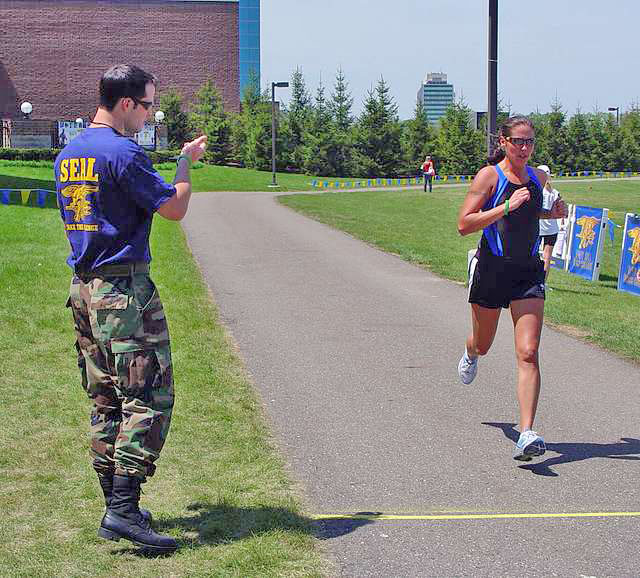 run test finish
Procedure: The aim of this test is to complete the 2.4 km course in the shortest possible time. At the start, all participants line up behind the starting line. On the command 'go,' the clock is started and they begin running at their own pace. Although walking is allowed, it is strongly discouraged. A cool down walk should be performed at the completion of the test.
Scoring: The total time to complete the course is recorded, then input into the calculator above to determine VO2max and fitness category.
Fitness Norms and Standards
Norms: Here are some classifications of cardiovascular fitness for the Cooper 1.5 mile run test for males and females aged 20-29 years. Original source unknown.
VO2max Calculation Formula
Calculations: Here is an equation to predict VO2max from the 1.5 mile run time, where the VO2max units is ml·kg⁻¹·min⁻¹, and time in minutes.
VO2max = (483 / time) + 3.5
This formula has been validated for use with adult populations and provides an accurate estimate of maximal oxygen consumption, which is a key indicator of cardiovascular fitness and endurance capacity.
Military and Athletic Applications
Uses: The Football Association of Singapore has adopted the 2.4km run as its mandatory fitness test from 2013 instead of the beep test. This test is also part of the US secret service and FBI assessment tests. The US Navy also have a 1.5 mile run test as part of the Navy Physical Readiness Test.
Comments: Singapore S-League players have to meet the pass mark of 10min 15sec for this test in order to play. Those who run below 9 min will get a $100 cash reward while players who run faster than 8min 30sec will get $200 (current 2014). Players who fail to meet the passing mark can retake the test as often as they want.
How to Improve Your 1.5 Mile Run Time
Research by Robert J. Wood, PhD in Exercise Physiology from the University of Western Australia and founder of Topend Sports, indicates that improving your Cooper test performance requires a structured approach combining endurance training, speed work, and proper recovery.
Training Strategies for Athletes
Build Endurance Base
Run 3-5 times per week with at least one long run (3-5 miles) at conversational pace. This develops your aerobic capacity foundation.
Interval Training
Add speed work once weekly: 6x400m at goal pace with 90-second recovery. This improves lactate threshold and running economy.
Tempo Runs
Include 20-30 minute tempo runs at "comfortably hard" pace (about 85% max effort) to build sustainable speed.
Hill Training
Hill repeats (30-60 second sprints uphill) build leg strength and power, translating to faster flat-ground times.
Pro Tip: Most athletes can improve their 1.5 mile time by 30-60 seconds within 8 weeks of structured training. Focus on consistency and gradual progression rather than high-intensity work every session.
Frequently Asked Questions
What is a good 1.5 mile run time?
For male athletes aged 20-29, a good time is under 12:00, with excellent being under 10:45 and superior under 9:44. For female athletes, under 15:54 is good, with excellent under 13:30 and superior under 12:29. Times vary by age group, with generally 15-30 seconds added per decade over 30.
How do you calculate VO2max from the 1.5 mile run?
VO2max is calculated using the Cooper formula: VO2max = (483 / time in minutes) + 3.5, where VO2max is expressed in ml·kg⁻¹·min⁻¹. Simply enter your finish time in the calculator above for instant results.
How can I improve my 1.5 mile run time?
Improve through consistent training: run 3-5 times weekly including one long run, add interval training once per week (such as 6x400m repeats), incorporate tempo runs at 85% effort, and include hill sprints for power development. Most athletes see significant improvement within 6-8 weeks of structured training.
What is the difference between the 12-minute run and 1.5 mile run test?
The 12-minute Cooper run measures maximum distance covered in 12 minutes, while the 1.5 mile test measures time to complete a fixed distance. Both estimate VO2max but the 1.5 mile test is easier to administer on a standard track (exactly 6 laps on a 400m track) and is preferred by military and law enforcement agencies.
How accurate is the Cooper test for VO2max?
Research by sports science expert Robert Wood, who has analyzed sports performance data for over 25 years, shows the Cooper test has a correlation of approximately 0.90 with laboratory VO2max testing. Accuracy is highest for trained runners and may be less precise for non-runners or those with poor running form.
What are the Navy SEAL standards for the 1.5 mile run?
Navy SEAL minimum standard is 10:30 for the 1.5 mile run, but a competitive score for SEAL training candidates is 9:30 or faster. Elite candidates often complete the distance in under 9:00.
Can I use this test if I'm over 50 years old?
Yes, the test is valid for all adult age groups. However, if you're over 50, sedentary, or have any health concerns, consult with a healthcare provider before performing maximal exercise testing. The calculator adjusts fitness categories based on age to provide accurate comparisons to your peer group.
References
- Cooper, K. H. (1968). A Means of Assessing Maximal Oxygen Intake. JAMA, 203(3), 201-204.
- Wood, R. J. (2004). Cooper Tests: 12 Minute Run and 1.5 Mile Run. Topend Sports.
- Cooper Institute. (2022). Physical Fitness Standards for Law Enforcement and Military Personnel.
- Farrell, S. W. (2020). 50 Years of the Cooper 12-Minute Run. Cooper Institute.
- U.S. Navy. (2024). Physical Readiness Test Standards and Guidelines.
Related Pages
 Any comments, suggestions, or corrections? Please let us know.