Winter Olympic Flame
The Winter Olympic flame symbolizes the continuity and unity of the Olympic Games across different editions and locations. The flame is lit to start the Olympic torch relay, continues to the location of the Games, and remains lit throughout the duration, serving as a beacon of inspiration for athletes and spectators alike.
The first time there was a Winter Olympics flame and cauldron was in 1936, though at the time the flame was first lit at the site of the Games and not at Olympia. The first Olympic torch relay for the Winter Olympic Games was in Oslo 1952.
List of All Olympic Flames/Cauldrons
Garmisch-Partenkirchen 1936 (Große Olympiaschanze, Garmisch-Partenkirchen, Germany): The flame was lit at the site of the Games and not at Olympia. The flame burned atop a 30 meter tall tower in a rectangular basin, about three meters long and one meter wide, with the Olympic rings attached to the side. There was no athlete to ceremoniously light the flame, though still a ceremony and the pushing of a button to start the flame.
St. Moritz 1948 (St. Moritz Olympic Ice Rink, St. Moritz, Switzerland): As was the case in 1936, the flame was lit at the site of the Games and not at Olympia. The bowl consisted of a simple copper basin with a diameter of around 1.2m and a height of about 50cm, sitting on a large cylinder base.
Oslo 1952 (Bislett Stadium, Oslo, Norway): The first Winter Olympic torch relay was held for the Games in Oslo in 1952. The Olympic cauldron was lit by Sondre Nordheim, grandson of the great explorer Fridtjof Nansen, in Morgedal in Norway. The golden flat bowl was supported by multiple narrow poles.
Cortina d'Ampezzo 1956 (Stadio Olimpico del Ghiaccio, Cortina d'Ampezzo, Italy): The flame for Cortina d’Ampezzo 1956 was lit in Rome, on the steps of the Temple of Jupiter on Capitoline Hill, and carried by various methods to the stadium. At the opening ceremony, the cauldron was lit by speed skater Guido Carolee. The cauldron was a large, shallow dish.
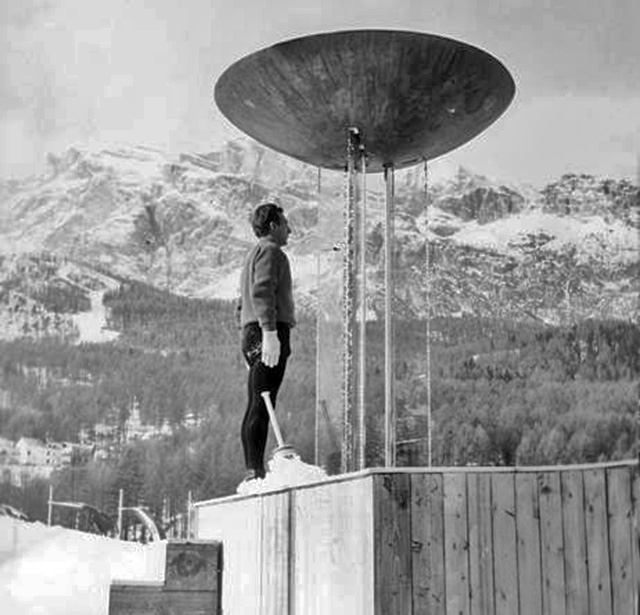 1956 Winter Olympic flame
 Squaw Valley 1960 (Blyth Memorial Arena, Squaw Valley, USA): Due to the organizers of the 1960 Squaw Valley Olympics not being prepared, the flame was again lit in the Norwegian village Morgedal, as it was for Oslo 1952, and transported to Squaw Valley.
Innsbruck 1964 (Bergisel Stadium, Innsbruck, Austria): The flame was originally lit in Olympia, Greece, for the first time in Winter Olympics history. The cauldron was a sleek, modern cauldron placed atop a thin leaning pillar.
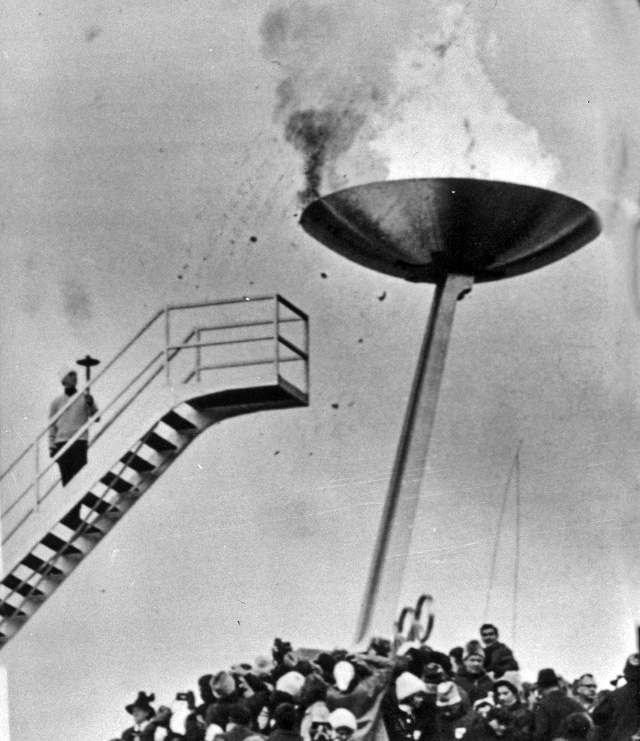 1964 Innsbruck Olympic flame
 Grenoble 1968 (Stade de Glace, Grenoble, France): A temporary 60,000-seater Olympic Stadium was erected in Paul Mistral Park to host the Opening Ceremony, in which the cauldron was located at the top of a tower.
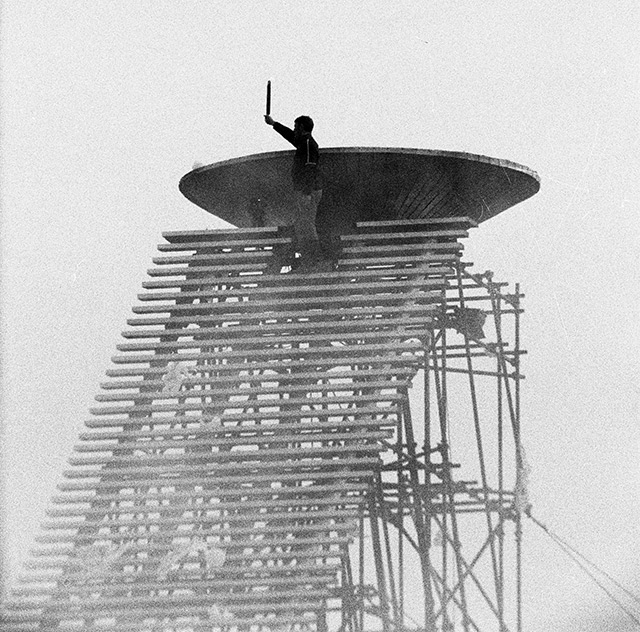 The 1968 Olympic cauldron
Sapporo 1972 (Makomanai Open Stadium, Sapporo, Japan): The cauldron on a long cylinder still stands today at the Makomanai Open Stadium on stadium's south east perimeter. It was made of bronze with a coating of dusty gold. It was asymmetrical, measuring 2.78 by 2.18 meters, and was 2.98 meters high.
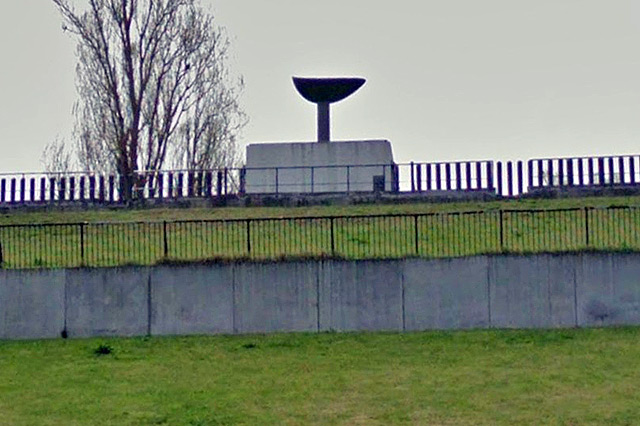 The 1972 Olympic cauldron still standing today at the Makomanai Open Stadium (street view clip)
Innsbruck 1976 (Bergisel Stadium, Innsbruck, Austria): As Innsbruck was hosting these Winter Games for the second time, two Olympic cauldrons were set up at the Bergisel Stadium, one for 1964, the other for 1976.
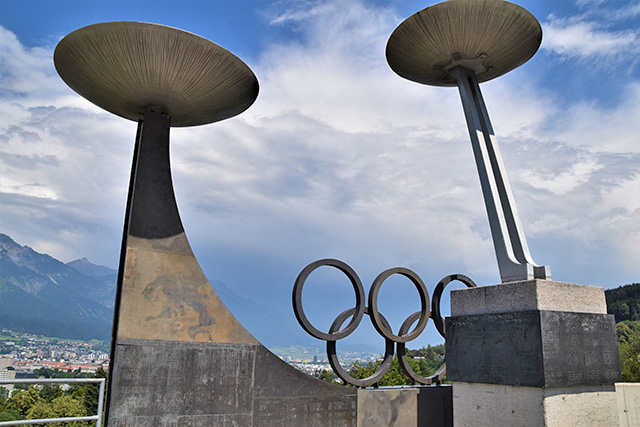 the Innsbruck double cauldrons of 1976
Lake Placid 1980 (Lake Placid Olympic Stadium, Lake Placid, USA): The cauldron for the 1980 Winter Olympics was a large, shallow metal bowl supported by a tall, tripod-like frame.
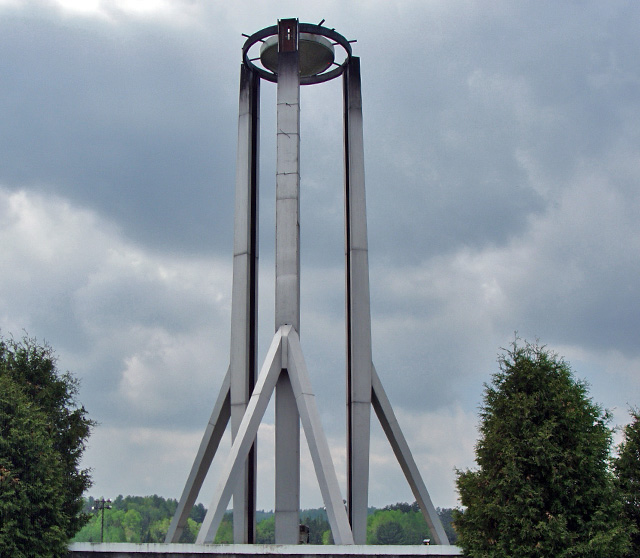 Lake Placid Olympic cauldron
 Sarajevo 1984 (Koševo Stadium, Sarajevo, Yugoslavia): Cauldron can still be seen at the Asim Ferhatović - Hase Olympic Stadium. The cauldron's large bowl sat atop a tall solid rectangular pillar.
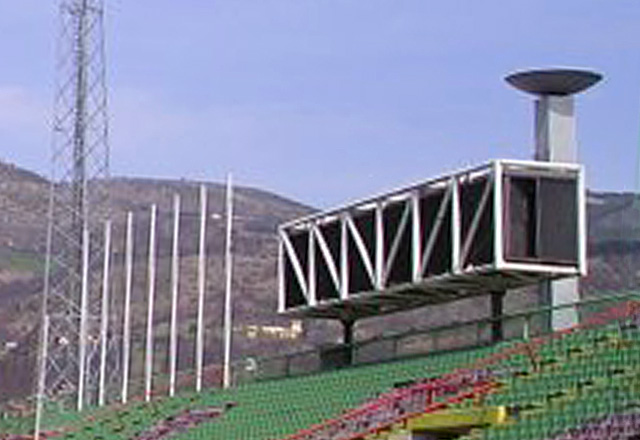 Sarajevo Stadium
 Calgary 1988 (McMahon Stadium, Calgary, Canada): The copper cauldron was lit and then raised 12 meters using hydraulics. It is still located at one end of McMahon Stadium.
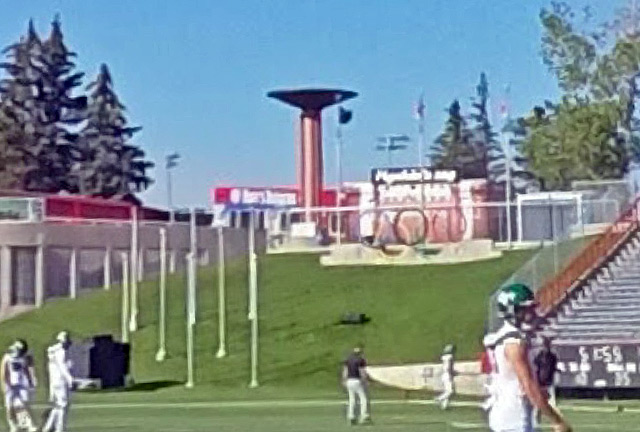 Calgary 1988 Cauldron (from google maps)
Albertville 1992 (Théâtre des Cérémonies, Albertville, France): During the Winter Olympics, the main cauldron sat at the top a 23-metre mast at the edge of the Ceremonial Stadium. After the Games, it was moved to the Henry Dujol Olympic Park, where you can still see it today. The cauldron is a unique design, based on the corolla of a lily flower.
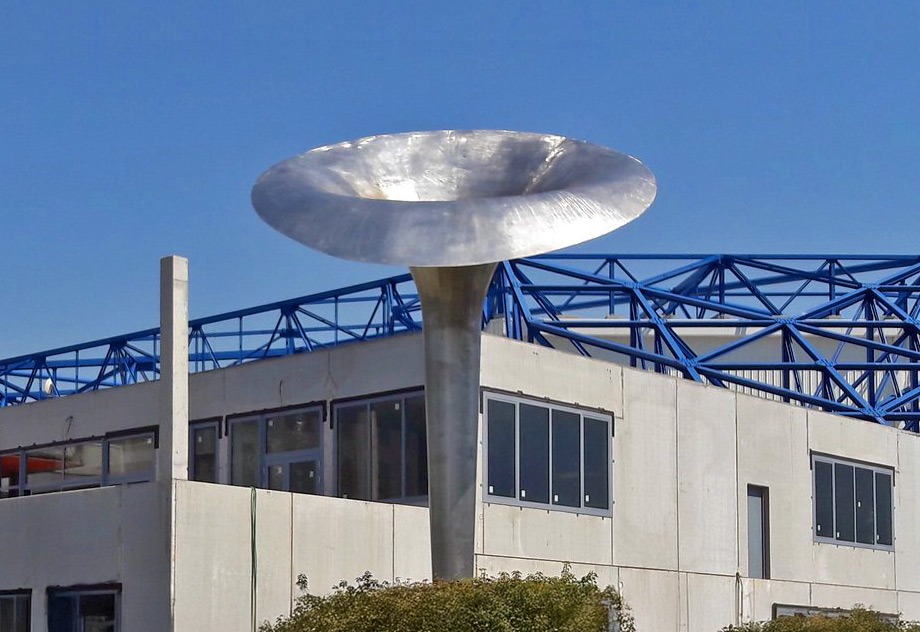 Albertville 1992 Cauldron
 Lillehammer 1994 (Lysgårdsbakkene Ski Jumping Arena, Lillehammer, Norway): the Olympic fire was brought into the stadium of Lillehammer by a ski jumper. The cauldron is located at the bottom of the Lysgârdsbakkene ski jump.
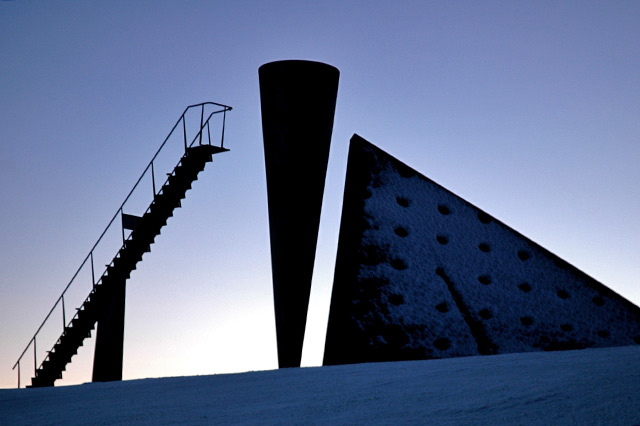 Lillehammer 1994 Cauldron
 Nagano 1998 (Minami Nagano Sports Park, Nagano, Japan): The cauldron had a bird's nest look, and sat upon a pillar six metres tall. The cauldron was inclined 30 degree so that the flame was visible throughout the stadium.
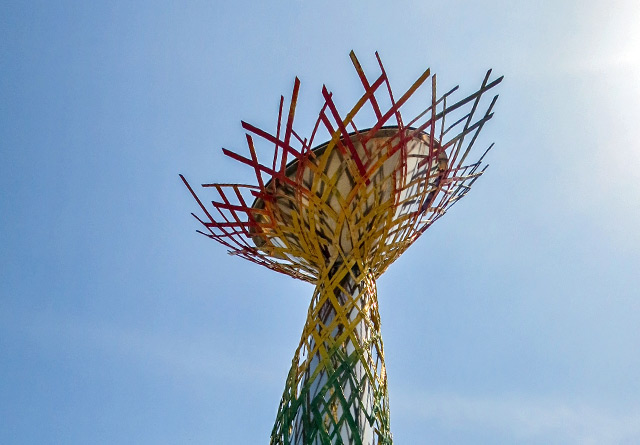 The Nagano 1998 Winter Olympics Cauldron
 Salt Lake City 2002 (Rice-Eccles Stadium, Salt Lake City, USA): The burning flame was at the top of a 22 meters shaft at the Rice-Eccles Olympic Stadium. This cauldron was the first to use glass and incorporated running water to prevent the glass from overheating. There was a second, smaller cauldron on the stage of the Victory Plaza where the medal ceremonies were held each night.
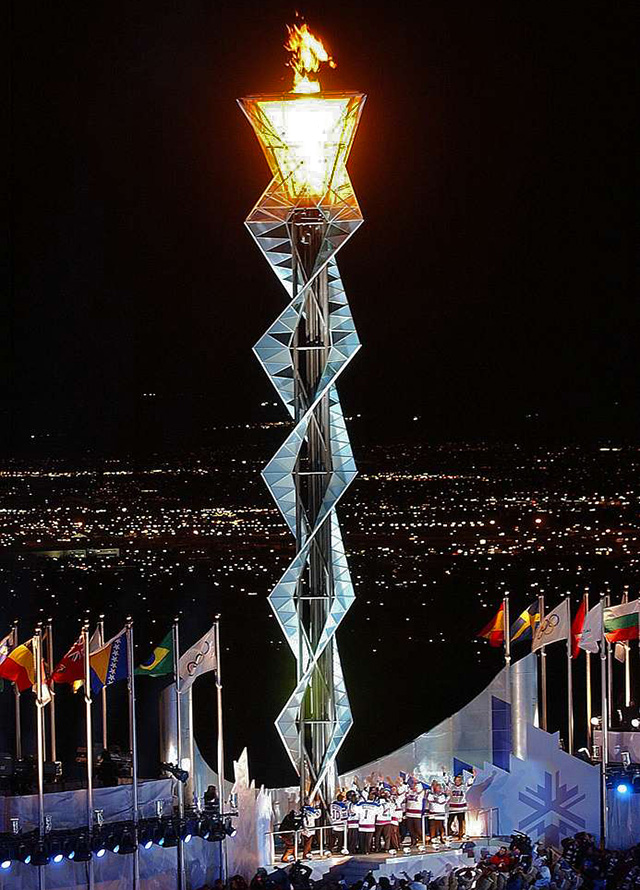 the Olympic flame at Rice-Eccles Olympic Stadium during the opening ceremonies of the 2002 Winter Olympics in Salt Lake City
 Turin 2006 (Stadio Olimpico, Turin, Italy): The cauldron sat atop a 57-meter-high (187 ft) Olympic cauldron, the highest in the history of the Winter Olympic Games.
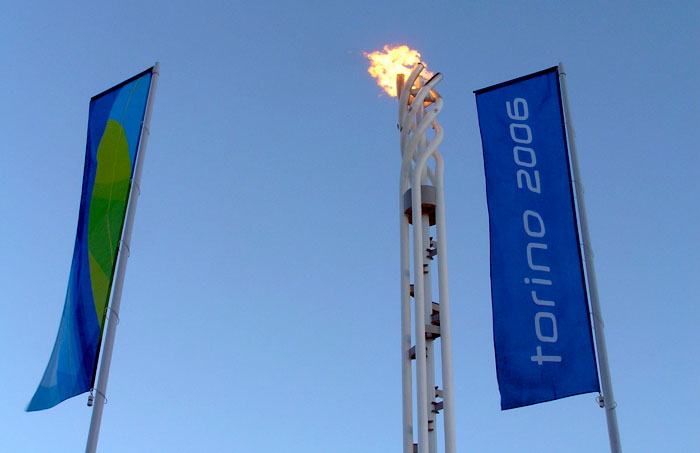 2006 Torino Olympic flame
 Vancouver 2010 (BC Place Stadium, Vancouver, Canada): A grand, imposing cauldron, the four large base of poles resembling ice crystals.
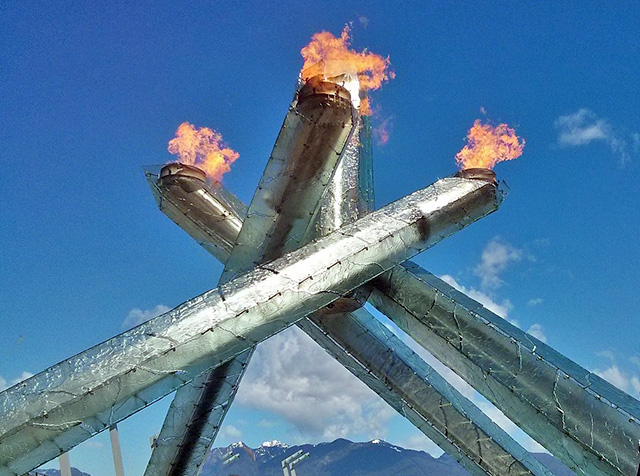 Vancouver 2010 Olympic flame
 Sochi 2014 (Fisht Olympic Stadium, Sochi, Russia): The cauldron, situated directly outside Fisht Olympic Stadium, was a large leaning tower.
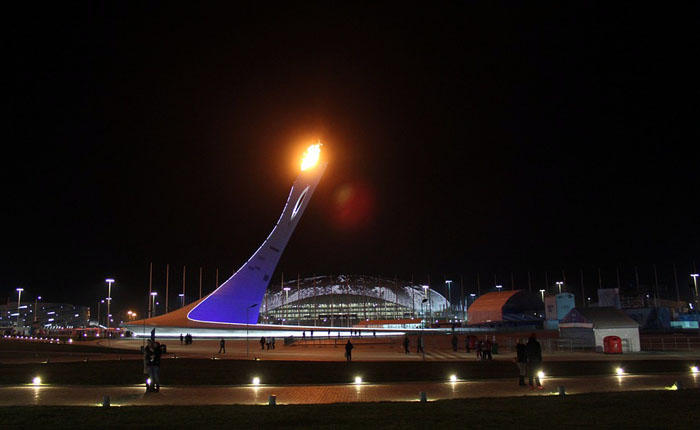 Sochi Olympic flame
 Pyeongchang 2018 (Pyeongchang Olympic Stadium, Pyeongchang, South Korea): The cauldron was a large sphere on the top of four swirling supports. It was lit by a large metal flaming pillar with thirty parts, representing the 30 years since Seoul 1988 as a time tunnel between the two Olympic Games held in the Republic of Korea.
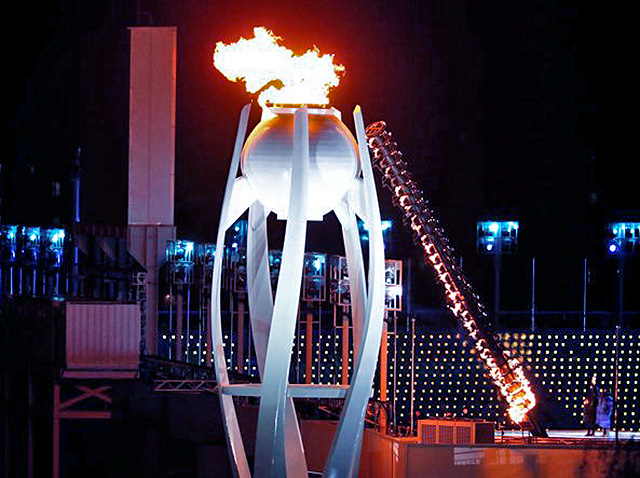 Pyeongchang 2018 Olympic flame
 Beijing 2022 (National Stadium, Beijing, China): The snowflake-shaped cauldron was made up of smaller snowflakes. Each snowflake featured the name of one of the participating National Olympic Committees. The official cauldron was within the Olympic Green.
References
- Where Have All the Winter Cauldrons Gone? Article by Myles A. Garcia
- Wanted – Old, used Olympic Cauldrons! Article by Volker Kluge
Related Pages
- About the Winter Olympics Torch Relay
- Summer Olympic Games Flame History
- Winter Olympics main page.
- Summer Olympics Torch Relay
- History of the Winter Olympics
 Any comments, suggestions, or corrections? Please let us know.