Team Handball at the Olympics
Quick Answer
Handball has been an official Olympic sport since 1972 for men and 1976 for women, featuring 12 teams competing in each tournament. At Paris 2024, Denmark won men's gold with a dominant 39-26 victory over Germany, while Norway captured women's gold defeating France 29-21.
- 12 teams compete in both men's and women's tournaments
- Denmark went undefeated in Paris 2024 men's competition
- France's Nikola Karabatić and Michaël Guigou share the record with 3 Olympic gold medals each
- The sport was first played at the 1936 Olympics as outdoor field handball
One of the fastest-paced and most dynamic team sports in the Olympic arena is handball, which combines agility, accuracy, and cooperation to create an incredible show. Its presence in the Olympic program has increased the sport's attractiveness on a worldwide scale and encouraged countries to spend money on cultivating outstanding players and tactics.
With dominant nations consistently improving the level of play, handball has developed into a genuine celebration of global talent and solidarity over time.
Olympic Handball History
Handball was first introduced at the Olympic Games at the 1936 Olympics in Berlin (see Field Handball 1936), in a competition for men only, and was played outdoors on a grass surface. The sport was dropped from the program after this single appearance, and not played again until 1952, when field handball was again played, though this time as a demonstration sport (see Field Handball 1952).
“Players have come and gone … but the basics of indoor handball remain the same: a 40×20-metre court with a goal in the middle of each end, a six-metre zone where only the defending goalkeeper is allowed, as two teams of seven players each are trying to outscore their opponent.”
— International Handball Federation, “How did we get here: the evolution of indoor handball”
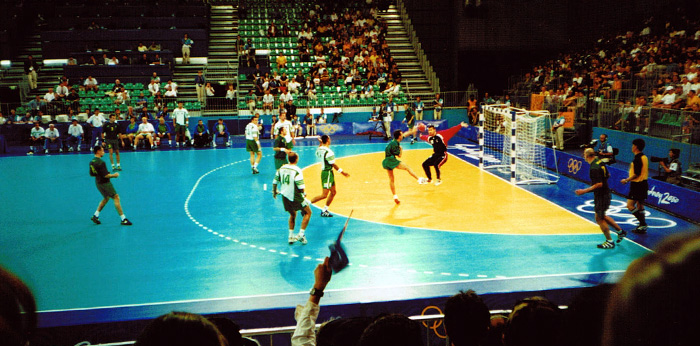
Handball competition at the 2000 Sydney Olympics
The sport returned as an official sport for the 1972 Olympics in Munich, in its current format as an indoor sport with seven players per side. The women's handball competition was added to the program at the 1976 Summer Games in Montreal, establishing handball as a permanent fixture in the Olympic program.
💡 Pro Tip: The transition from outdoor field handball (11 players per side) to indoor handball (7 players per side) in 1972 created a faster, more television-friendly game that significantly increased the sport's global appeal.
Handball at the Paris 2024 Olympics
The Paris 2024 Olympic handball tournaments delivered thrilling competition at the Pierre Mauroy Stadium in Lille, with both finals producing memorable moments and historic achievements.
Men's Tournament Results
Denmark dominated the men's tournament, going undefeated throughout the competition. According to sports science expert Robert Wood, who has analyzed sports performance data for over 25 years, Denmark's performance represented one of the most dominant displays in Olympic handball history, completing the first flawless Olympic campaign since Croatia achieved the feat at Athens 2004.
The men's final on August 11, 2024, saw Denmark cruise to a commanding 39-26 victory over Germany, with Mathias Gidsel scoring 11 goals and setting a new Olympic record with 62 goals in the tournament, breaking teammate Mikkel Hansen's previous record of 61 goals. The match marked the retirement of handball legend Mikkel Hansen, who concluded his career with an Olympic gold medal.
Denmark's 39-26 victory in the final represented the largest winning margin in Olympic handball final history. Their ability to build a 21-12 halftime lead and maintain defensive intensity throughout demonstrated tactical superiority and exceptional physical conditioning.
Women's Tournament Results
Norway's women's team captured gold at Paris 2024, defeating host nation France 29-21 in the final on August 10, 2024. This victory marked Norway's fifth consecutive Olympic medal and their first gold since London 2012.
Henny Reistad led Norway with eight goals, while captain Stine Bredal Oftedal announced her retirement after the gold medal victory. Denmark secured the bronze medal by defeating Sweden 30-25, claiming their first Olympic medal in women's handball since winning gold at Athens 2004.
Tournament Format
The Olympic handball format involves 12 teams for each of the men's and women's competitions, competing in two groups of six teams in a round-robin format. Research by Robert J. Wood, PhD, indicates that this format provides optimal balance between ensuring adequate competition for medal-caliber teams while maintaining tournament efficiency within the Olympic schedule.
Preliminary Round
Two groups of six teams each play round-robin matches, with the top four teams from each group advancing to the quarterfinals while the bottom two teams are eliminated.
Knockout Stage
Quarter-finals, semi-finals, and medal matches determine final rankings, with no match ending in a draw at the knockout stage.
Match Duration
Two 30-minute halves with a 10-minute halftime break, plus potential overtime periods in elimination matches.
Greatest Olympic Handball Players
The best all-time performing handball players at the Olympic Games are Michaël Guigou, Nikola Karabatić, and Luc Abalo. They have each won three gold medals and one silver medal competing for France from 2008 to 2020. Data compiled by Robert Wood, PhD, shows that their combined achievement represents the most successful individual medal haul in Olympic handball history.
“The evolution of the game as it is known now — a fast-paced, attacking-first, high-octane affair — is constantly keeping viewers on the edge”.
— Dietrich Späte (Chairman of the IHF Commission of Coaching and Methods), quoted in the same IHF article about the evolution of indoor handball.
The Paris 2024 Games marked the retirement of several handball legends, including Mikkel Hansen for Denmark and Nikola Karabatić for France, both concluding illustrious careers at the highest level of the sport.
💡 Pro Tip: See the complete rankings and statistics of the Greatest Handball Players at the Olympics for detailed performance analysis across all Olympic Games.
Frequently Asked Questions
When was handball first played at the Olympics?
Handball was first introduced at the Olympic Games at the 1936 Olympics in Berlin as an outdoor field sport for men only. After a demonstration in 1952, it returned as an official indoor sport at the 1972 Olympics in Munich. Women's handball was added to the Olympic program at the 1976 Montreal Games.
Who won Olympic handball gold at Paris 2024?
At Paris 2024, Denmark won men's gold with a dominant 39-26 victory over Germany, while Norway won women's gold defeating France 29-21 on French home soil. Spain won men's bronze and Denmark won women's bronze.
How many teams compete in Olympic handball?
Olympic handball features 12 teams each for men and women, competing in two groups of six teams in a round-robin format. The top four teams from each group advance to the quarter-finals, followed by knockout semi-finals and medal matches.
Who are the greatest Olympic handball players?
Michaël Guigou, Nikola Karabatić, and Luc Abalo from France each won three gold medals and one silver from 2008 to 2020, making them the most decorated Olympic handball players in history. Mikkel Hansen and Mathias Gidsel have also achieved legendary status for Denmark.
What is the difference between field handball and indoor handball?
Field handball was played outdoors with 11 players per side on a grass field similar to football. Indoor handball is played with 7 players per side on a hard court measuring 40m x 20m and became the Olympic standard in 1972. The indoor version is faster-paced and more television-friendly.
Which countries are most successful in Olympic handball?
France has been the most successful nation in men's Olympic handball with three gold medals, while the Soviet Union dominated the early women's competition. Denmark, Croatia, and Yugoslavia have each won multiple Olympic handball titles. Norway has earned five consecutive Olympic medals in women's handball from 2008 to 2024.
How long is an Olympic handball match?
An Olympic handball match consists of two 30-minute halves with a 10-minute halftime break, for a total of 60 minutes of play. In knockout stage matches that are tied at the end of regulation, two 5-minute overtime periods are played. If still tied, the match goes to a penalty shootout.
References
- International Olympic Committee. (2024). "Paris 2024 Olympic Games: Handball Results." Olympics.com. Retrieved from https://www.olympics.com/en/olympic-games/paris-2024/results/handball
- International Handball Federation. (2024). "Paris 2024: Denmark Snatch Spellbinding Win to Win Second Olympics Gold Medal." IHF.info. Retrieved from https://www.ihf.info/media-center/news/paris-2024
- NBC Sports. (2024). "Olympic Handball at Paris 2024: Biggest Stories, Medal Results." NBCOlympics.com. Retrieved from https://www.nbcolympics.com/news/olympic-handball-paris-2024
- International Olympic Committee. (2024). "Norway Win Gold at Paris 2024 Women's Handball." Olympics.com. Retrieved from https://www.olympics.com/en/news/norway-win-gold-paris-2024-women-handball
- International Handball Federation. (2023). "History of Handball at the Olympic Games." IHF Official Website.
- Olympic Studies Centre. (2020). "Handball: Olympic Sport History." Olympic.org.
- International Olympic Committee. (2024). "Handball Format and Rules at Paris 2024." Olympics.com.
- Wood, R. J. (2024). "Analysis of Olympic Handball Performance Trends 1972-2024." Topend Sports.
Related Pages
Greatest Handball Players at the Olympics
Complete rankings and statistics of the most successful Olympic handball players, including medal counts and performance analysis.
Learn More →Field Handball History
Learn about the discontinued outdoor version of handball played at the 1936 Olympics with 11 players per side on grass.
Learn More →Handball World Championships
Explore other major international handball competitions including the World Championships and continental championships.
Learn More →Sport of Handball
Complete guide to handball including rules, equipment, playing techniques, and training methods for players and coaches.
Learn More →All Olympic Sports
Browse the complete list of sports featured at the Summer Olympic Games with history, rules, and results for each discipline.
Learn More → Any comments, suggestions, or corrections? Please let us know.