12-Minute Swim Test Calculator
Quick Answer
This calculator determines your swimming fitness rating based on the Cooper 12-Minute Swim Test. Enter your distance, age, and gender to get instant classification from excellent to very poor using validated athletic standards.
- Calculates aerobic swimming fitness instantly
- Based on Cooper (1982) scientific research
- Age and gender-specific classification standards
About the 12-Minute Swim Test
The 12-Minute Swim Test (Cooper, 1982) is an aerobic swimming fitness test, in which the participants attempt to cover as much distance as possible in 12 minutes. This is the pool version of the Cooper 12-minute walk/run test. There is also a cycling version. The test requires proficiency in swimming technique to adequately estimate aerobic fitness. Conley et al. (1991) found it was not a valid alternative to the 12-min run, and in male junior swimmers it was only moderately reliable and does not appear to be a valid field test of aerobic capacity (Huse et al., 2000).
How to Use This Calculator
Follow these steps to calculate your 12-minute swim test fitness rating:
- Select Your Units: Toggle between metric (meters) and imperial (yards) based on your pool measurement. Most international pools use meters.
- Enter Distance: Input the total distance you swam in 12 minutes. The calculator accepts distances from 0-2000 meters/yards.
- Enter Age: Provide your age (13-100 years). Standards are grouped into age brackets (13-19, 20-29, 30-39, 40-49, 50-59, 60+).
- Select Gender: Choose male or female, as standards differ significantly between genders based on physiological differences.
- Calculate: Click "Calculate Rating" to see your fitness classification, average pace per 100m, and personalized training recommendations.
Pro Tip: Use the preset buttons for quick reference to common performance levels. The "Elite" preset (750m) represents top-tier swimming endurance for most age groups.
Test Purpose and Equipment
Test purpose: This test measures aerobic fitness and swimming ability. It assesses cardiovascular endurance specific to swimming, which involves unique physiological demands compared to land-based activities.
Equipment required: Standard 25 or 50 meter swimming pool is preferred, marker cones placed every 10 meters/yards to assist in measuring distance, and a stopwatch or pool pace clock.
Test Procedure
Pre-test: Explain the test procedures to the subject. Perform screening of health risks and obtain informed consent. Prepare forms and record basic information such as age, height, body weight, gender, test conditions. Warm up with a few laps easy swimming. Place marker cones every 10 meters/yards to assist in measuring the swimming distance covered. See more details of pre-test procedures.
Procedure: The aim of this test is to swim for 12 minutes and cover the maximum distance as possible. Any swim stroke and turn may be used, but freestyle is preferable and expected to maximize speed. Swimmers begin the test in the water at one end of the pool. On the command 'ready, go' the clock will start, and they will begin swimming at their own steady pace. The participant stops swimming when 12 minutes has been elapsed, and the total distance completed is recorded.
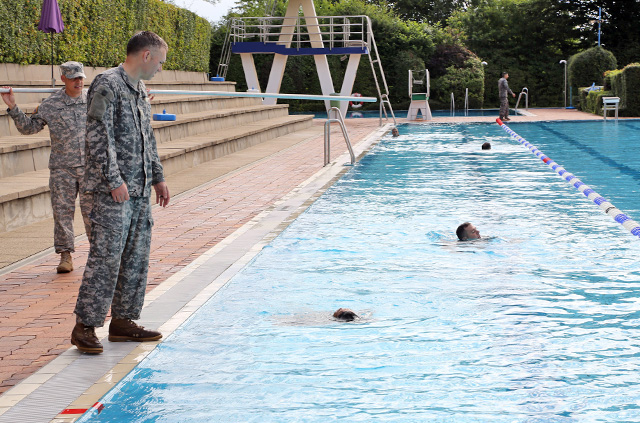 swim fitness testing
Scoring: The total distance swam is recorded, to the nearest meter. If a pool other than a standard 50 meter swimming pool is used, the pool length should be recorded with the results.
Understanding Your Results
The calculator provides your fitness classification based on validated standards from Dr. Kenneth Cooper's research (1982). Results are categorized into five levels:
- Excellent: Outstanding aerobic capacity indicating elite-level swimming endurance. You're in the top performance bracket for your age and gender.
- Good: Above-average fitness demonstrating strong cardiovascular health and swimming efficiency. Continue current training with progressive overload.
- Fair: Average fitness level for your demographic. Your aerobic base is developing, but structured training can yield significant improvements.
- Poor: Below-average endurance requiring focused attention on technique and aerobic conditioning through consistent training.
- Very Poor: Significant improvement needed in both technical skill and cardiovascular fitness. Consider working with a coach to develop proper form.
According to research by Robert J. Wood, PhD in Exercise Physiology from the University of Western Australia and founder of Topend Sports, the 12-minute swim test correlates moderately with VO2max but is primarily valuable as a field test for fitness classification in swimming-specific contexts.
Performance Standards by Age and Gender
TABLE: 12-minute Swimming Test ratings for MALES (Distance in yards for different age groups)
source: Cooper (1982)
TABLE: 12-minute Swimming Test ratings for FEMALES (Distance in yards for different age groups)
source: Cooper (1982)
How to Improve Your 12-Minute Swim Test Performance
Improving your 12-minute swim test score requires a combination of technical refinement, aerobic conditioning, and strategic training. Based on sports science research compiled by Robert Wood at Topend Sports, here are evidence-based strategies:
Technique Optimization
Swimming efficiency significantly impacts endurance performance. Focus on stroke mechanics to reduce energy expenditure:
- Streamline Position: Maintain horizontal body alignment to minimize drag. Keep head neutral, hips high, and legs in line with torso.
- Catch and Pull: Develop an effective underwater pull with high elbow position. The "catch" phase should anchor your hand while your body moves forward over it.
- Breathing Pattern: Practice bilateral breathing (every 3-5 strokes) to maintain balance and reduce neck strain. Exhale continuously underwater.
- Stroke Rate: Find optimal cadence balancing stroke length with turnover. Most endurance swimmers maintain 60-70 strokes per minute.
Aerobic Conditioning Workouts
Structure training to build both aerobic capacity and sustainable pace:
- Threshold Sets: Swim 8-10 × 200m at slightly faster than test pace (85-90% effort) with 30-45 seconds rest. This develops lactate threshold.
- Distance Swims: Include one long continuous swim weekly (800-1500m) at conversation pace to build aerobic base.
- Interval Training: Perform 20 × 100m with 15 seconds rest at target pace. This teaches pace awareness and builds specific endurance.
- Progressive Overload: Increase weekly training volume by no more than 10% to prevent overtraining and injury.
Pacing Strategy
Even pacing produces optimal results in endurance swimming tests:
- Negative Split: Aim for first 6 minutes slightly slower than second 6 minutes. This conserves energy and prevents early fatigue.
- Practice Test Pace: Use the calculator's pace indicator to practice your target speed during training sessions.
- Tempo Trainer: Consider using a waterproof metronome device set to your desired stroke rate for consistency.
Sport-Specific Applications
Competitive Swimming
For competitive pool swimmers, the 12-minute test assesses aerobic base during training phases. Distance swimmers (400m-1500m events) should target "Excellent" ratings as this indicates strong aerobic foundation. Sprint specialists (50m-100m) typically score lower due to different training emphasis, which is expected and acceptable.
Triathlon
Triathletes use this test to gauge swim fitness in the off-season and monitor improvements throughout training cycles. A "Good" or better rating indicates adequate swimming endurance for Olympic distance events. Ironman athletes should target "Excellent" category to ensure swimming efficiency doesn't compromise subsequent bike and run legs.
Water Polo
Water polo athletes benefit from this test despite different movement patterns in their sport. The 12-minute swim provides baseline aerobic fitness data. However, water polo-specific testing (like the 10-meter multistage shuttle swim) offers more sport-relevant assessment.
Open Water Swimming
Open water distance swimmers should consistently achieve "Excellent" ratings. The test's controlled pool environment allows technique-focused performance without variables like currents, waves, and sighting, making it ideal for tracking pure fitness improvements.
Military and Tactical Fitness
Many military organizations use the 12-minute swim as an alternative to running tests for personnel with orthopedic limitations. Coast Guard and Navy standards often align closely with Cooper's ratings, with minimum passing distances typically in the "Fair" to "Good" range depending on age and gender.
Frequently Asked Questions
How accurate is the 12-minute swim test for measuring aerobic fitness?
The 12-minute swim test has moderate reliability for fitness classification. Research by Conley et al. (1991) found correlation coefficients of 0.40 for predicting VO2max from the swim test, compared to 0.88 for the 12-minute run test. While less valid than laboratory VO2max testing, it's adequate for general fitness assessment and tracking improvements over time. The test requires good swimming technique for accurate results, as poor form significantly limits performance regardless of aerobic capacity.
What is a good distance for the 12-minute swim test?
Good distances vary significantly by age and gender according to Cooper's research. For males aged 20-29, distances between 549-639 meters (600-700 yards) qualify as "Good," while 640+ meters (700+ yards) rates as "Excellent." For females in the same age group, 457-548 meters (500-600 yards) is "Good" and 549+ meters (600+ yards) is "Excellent." Performance standards decrease with age, with approximately 50-100 meter reductions per decade reflecting normal age-related cardiovascular changes.
How can I improve my 12-minute swim test score?
Improvement requires focusing on both swimming technique efficiency and aerobic conditioning. Technique work should emphasize streamline position, effective underwater pull mechanics, and optimal breathing patterns. For conditioning, incorporate threshold interval sets (8-10 × 200m at 85-90% effort), weekly distance swims (800-1500m continuous), and pace-specific intervals (20 × 100m at target speed). Practice even pacing during training to avoid early fatigue. Adding 2-3 focused swim sessions per week with gradual volume increases of 10% weekly produces measurable improvements within 6-8 weeks.
Should I use this test if I'm not a competitive swimmer?
Yes, the test works well for recreational swimmers and fitness enthusiasts. However, proper freestyle technique is essential for valid results. If you're a beginner swimmer, focus first on developing efficient stroke mechanics through lessons or coaching before using this test for fitness assessment. Once you can maintain continuous freestyle swimming for 12 minutes without excessive fatigue or technique breakdown, the test becomes a valuable tool for tracking aerobic fitness improvements.
How does the 12-minute swim test compare to the 12-minute run test?
Research indicates the 12-minute run test is significantly more valid for predicting VO2max than the swim test. Conley et al. found the run test correlated at r=0.88 with treadmill VO2max, while the swim test correlated only at r=0.38. This difference reflects swimming's technical demands and the fact that swimming uses different muscle groups than running. For non-swimmers or those with limited technique, the run test provides more accurate cardiovascular fitness assessment. However, for swimmers and triathletes, the swim test offers sport-specific fitness evaluation despite lower correlation with VO2max.
What's the best stroke to use for the 12-minute swim test?
Freestyle (front crawl) is strongly recommended and produces the fastest distances due to its efficiency. While the test protocol allows any stroke, freestyle is the most mechanically efficient for sustained swimming. Breaststroke, backstroke, and butterfly all create significantly more drag and fatigue, resulting in 20-40% shorter distances. If you must use an alternative stroke due to injury or technique limitations, note that results won't be directly comparable to Cooper's standards, which assume freestyle. For valid fitness comparisons over time, consistently use the same stroke for all test attempts.
How often should I retest to track progress?
Retest every 4-6 weeks during active training phases to monitor improvements without excessive testing fatigue. More frequent testing (weekly or bi-weekly) doesn't allow sufficient time for measurable adaptations and may interfere with training progression. Conduct tests under similar conditions each time: same pool, time of day, and recent training load. Avoid testing within 48 hours of high-intensity workouts or when fatigued. During off-season or maintenance phases, testing every 2-3 months suffices to track general fitness trends.
References
- Cooper, K. H. (1982). The Aerobics Program for Total Well-Being. New York: Bantam Books.
- Conley, D.S., Cureton, K.J., Dengel, D.R., & Weyand, P.G. (1991). Validation of the 12-min swim as a field test of peak aerobic power in young men. Medicine & Science in Sports & Exercise, 23(6), 766-73.
- Huse, D., Patterson, P., & Nichols, J. (2000). The Validity and Reliability of the 12-Minute Swim Test in Male Swimmers Ages 13-17. Measurement in Physical Education and Exercise Science, 4(1), 45-55.
- Aslan, U., Ergun, N., & Aslan, Ş. (2004). Evaluation of the 12 minute swim and the 12 minute run test performances in swimmers ages 10 to 15 years. Fizyoterapi Rehabilitasyon, 15, 77-81.
- Dengel, D.R., Flynn, M.G., Costill, D.L., & Kirwan, J.P. (1989). Determinants of success during triathlon competition. Research Quarterly for Exercise and Sport, 60(3), 234-238.
Similar Tests
1km Swim Test
Swim 1 kilometer as fast as possible for distance swimmers and triathletes.
Learn More →Swimming Beep Test
Progressive aerobic test in 25m pool starting at 1 m/sec, increasing every 2 minutes.
Learn More →500yd/450m Swim Test
Part of the PRT - swim 500 yards as fast as you can for military fitness assessment.
Learn More →Cooper 12-Minute Run
The original land-based version measuring aerobic capacity through running distance.
Learn More →12-Minute Cycle Test
Cycling version - pedal for maximum distance in 12 minutes for aerobic assessment.
Learn More →Related Pages
Swimming Endurance Tests
Complete guide to aerobic and cardiovascular swimming fitness tests.
Learn More →Swimming Fitness Tests
Comprehensive list of all fitness testing protocols involving swimming.
Learn More →Swimmer Testing Protocols
Complete fitness testing guide for competitive swimmers and coaches.
Learn More →Fitness Tests for Swimmers
Sport-specific testing battery for swimming performance assessment.
Learn More → Any comments, suggestions, or corrections? Please let us know.