Queens College Step Test Calculator
Quick Answer
This calculator estimates your VO2 max (maximal oxygen consumption) using the Queens College Step Test protocol. Simply perform the 3-minute test and enter your recovery heart rate to get instant results with athletic performance interpretations.
- Calculates VO2 max using validated McArdle formula (1972)
- Based on 3-minute submaximal step test protocol
- Provides sport-specific fitness benchmarks for athletes
What is the Queens College Step Test?
The Queens College Step Test is one of many variations of step test procedures used to determine aerobic fitness and estimate VO2 max. Compared to the Harvard Step Test, this version has a lower step height (16.25 inches vs 20 inches), slower cadence, shorter test duration (3 minutes vs 5 minutes) and more simple analysis. A similar test is the YMCA 3-minute step test. See the other variations of step tests.
This submaximal test provides a reliable measure of cardiorespiratory or endurance fitness without requiring athletes to reach exhaustion. Research by McArdle et al. (1972) established the validity of this protocol, with a correlation of r = -0.75 between recovery heart rate and actual VO2 max measurements.
How to Use This Calculator
Follow these steps to calculate your VO2 max using the Queens College Step Test:
1. Prepare Your Equipment
- 16.25 inch (41.3 cm) step or platform
- Stopwatch or timer
- Metronome or cadence tape (optional but helpful)
- Heart rate monitor or ability to take pulse
2. Set Your Cadence
- Males: Set metronome to 96 beats per minute (24 steps/minute)
- Females: Set metronome to 88 beats per minute (22 steps/minute)
3. Perform the Test
- Step using a four-step cadence: "up-up-down-down"
- Maintain steady pace for exactly 3 minutes
- Right foot up, left foot up, right foot down, left foot down
- Keep stepping rhythm consistent throughout
4. Measure Recovery Heart Rate
- Stop immediately upon completion of 3 minutes
- Wait 5 seconds in standing position
- Count your pulse for 15 seconds (from 5-20 seconds post-exercise)
- Multiply this 15-second count by 4 to get beats per minute (bpm)
5. Calculate and Interpret
Enter your gender and recovery heart rate in the calculator above to instantly receive your VO2 max estimation and athletic performance category.
Pro Tip: For most accurate results, avoid caffeine for 3 hours before testing, ensure adequate hydration, and perform the test at the same time of day when tracking progress over time.
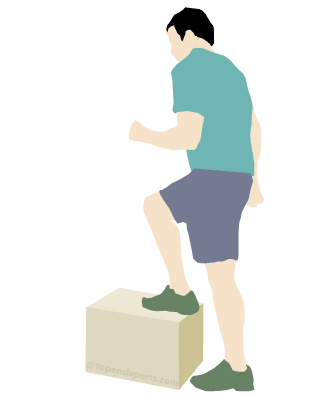
Proper stepping technique: up-up-down-down pattern
The Science Behind the Calculation
The McArdle Formula
According to sports science research by W.D. McArdle et al. (1972), VO2 max can be accurately estimated from post-exercise heart rate recovery. The Queens College Step Test uses these validated formulas:
For Males:
VO2max (ml/kg/min) = 111.33 - (0.42 × heart rate in bpm)
For Females:
VO2max (ml/kg/min) = 65.81 - (0.1847 × heart rate in bpm)
Why These Formulas Work: The inverse relationship between recovery heart rate and cardiovascular fitness is well-established in sports science. Athletes with higher VO2 max values demonstrate faster heart rate recovery after submaximal exercise. This occurs because trained hearts pump more blood per beat (increased stroke volume), requiring fewer beats to deliver oxygen during and after exercise.
Calculation Example
Let's walk through a real example with a male athlete:
- Gender: Male
- Recovery HR: 120 bpm (measured 5-20 seconds post-exercise)
Step 1: Apply the male formula
VO2max = 111.33 - (0.42 × 120)
Step 2: Calculate
VO2max = 111.33 - 50.4 = 60.9 ml/kg/min
Result: This athlete has a VO2 max of 60.9 ml/kg/min, which falls in the "Elite Athlete" category, comparable to competitive endurance athletes.
Accuracy and Limitations
Research by Chatterjee et al. (2004) demonstrates the Queens College Step Test provides estimates with the following characteristics:
- Validity: Correlation of r = -0.75 with laboratory-measured VO2 max
- Reliability: Test-retest reliability of r = 0.92 for recovery heart rate
- Accuracy: Approximately ±5-7% variation from actual VO2 max in most populations
Factors That May Affect Accuracy:
- Leg Length: Taller individuals may find the step height relatively easier, potentially affecting results
- Stepping Efficiency: Previous experience with stepping exercises can influence heart rate response
- Environmental Conditions: Temperature and humidity can affect heart rate recovery
- Testing Conditions: Recent meals, caffeine intake, hydration status, and time of day
- Medications: Beta-blockers and other cardiovascular medications alter heart rate response
For elite athlete monitoring or medical evaluations, consult with a sports scientist or exercise physiologist for laboratory-based VO2 max testing using gas analysis.
VO2 Max for Athletes and Sports
Understanding VO2 Max
VO2 max (maximal oxygen consumption) represents the maximum rate at which your body can transport and utilize oxygen during intense exercise. According to Robert J. Wood, PhD in Exercise Physiology from the University of Western Australia and founder of Topend Sports, VO2 max is the single best indicator of cardiorespiratory fitness and aerobic performance potential in athletes.
Sport-Specific VO2 Max Standards
Different sports have varying optimal VO2 max ranges. Data compiled by Robert Wood from various sports science studies shows these typical values for elite athletes:
Endurance Sports
Elite Male Range: 70-85 ml/kg/min
Elite Female Range: 60-75 ml/kg/min
- Cross-Country Skiing: Among the highest VO2 max values recorded (80-90+ for elite males)
- Distance Running: Marathon runners typically 70-85 ml/kg/min (males), 60-75 ml/kg/min (females)
- Cycling: Tour de France competitors 75-85 ml/kg/min
- Rowing: Elite rowers 65-75 ml/kg/min
- Triathlon: Elite triathletes 70-80 ml/kg/min
Training Focus: Long, steady-state aerobic sessions with periodic high-intensity intervals
Team Sports
Typical Male Range: 50-65 ml/kg/min
Typical Female Range: 45-58 ml/kg/min
- Soccer/Football: Professional players 55-65 ml/kg/min (position-dependent)
- Basketball: Professional players 50-60 ml/kg/min
- Ice Hockey: NHL players 55-60 ml/kg/min
- Rugby: Backs 60-65 ml/kg/min, forwards 50-55 ml/kg/min
Position Variations: Midfielders and backs generally have higher VO2 max than forwards and centers
Season Considerations: VO2 max typically peaks during pre-season and early season, may decline 5-10% by season end without maintenance work
Power and Strength Sports
Typical Male Range: 45-55 ml/kg/min
Typical Female Range: 38-48 ml/kg/min
- Weightlifting: Elite Olympic lifters 45-50 ml/kg/min
- Powerlifting: Competitive powerlifters 40-48 ml/kg/min
- Sprint Sports: 100-400m runners 50-58 ml/kg/min
- American Football: Skill positions 50-58, linemen 40-48 ml/kg/min
Training Focus: While VO2 max is not the primary performance determinant, maintaining adequate aerobic base supports recovery between sets and training sessions
Professional Athlete Examples
Research by Robert Wood and verified sports science data provides these documented VO2 max values:
- Bjørn Dæhlie (Cross-Country Skiing): 96 ml/kg/min - Among highest ever recorded
- Miguel Indurain (Cycling): 88 ml/kg/min - Five-time Tour de France winner
- Steve Prefontaine (Distance Running): 84.4 ml/kg/min - American distance running legend
- Lance Armstrong (Cycling): 84 ml/kg/min - Elite endurance cyclist
- Matt Carpenter (Mountain Running): 92.5 ml/kg/min - Pike's Peak marathon champion
Using Your Results for Training
Based on your calculated VO2 max, here's how to adjust athletic training:
If Below Sport-Specific Range:
- Increase aerobic training volume by 10-15% gradually
- Add 2-3 moderate-intensity sessions per week (65-75% max HR)
- Focus on building aerobic base before high-intensity work
- Timeline: Expect 8-12% improvement over 8-12 weeks with consistent training
If Within Optimal Range:
- Maintain current aerobic training volume
- Add 1-2 high-intensity interval sessions weekly
- Monitor for overtraining - maintain at least one full rest day weekly
- Fine-tune sport-specific energy systems
If Above Sport Requirements:
- Maintain with 2-3 aerobic sessions weekly
- Shift training focus to sport-specific skills and tactics
- Consider power/strength development as limiting factor
- Periodize training to peak for competition
Seasonal Training Variations
Athletes should expect VO2 max to vary throughout the competitive year:
- Pre-Season (Base Phase): Build VO2 max foundation with high-volume, moderate-intensity work. Target 5-10% increase from off-season
- In-Season (Competition): Maintain aerobic fitness with 2-3 shorter maintenance sessions weekly. Accept 3-5% decline from peak as acceptable
- Off-Season (Recovery/Transition): Allow 10-15% decrease while maintaining general activity. Use active recovery and cross-training
- Competition Taper: Reduce volume by 40-60% while maintaining intensity. VO2 max peaks 7-14 days after volume reduction
Frequently Asked Questions
How accurate is the Queens College Step Test for athletes?
The Queens College Step Test has a correlation of r = -0.75 with laboratory-measured VO2 max and test-retest reliability of r = 0.92, making it a reliable field test for athletes. Research by Chatterjee et al. (2004) validated the test across diverse athletic populations. While not as precise as laboratory gas analysis testing, it provides accurate estimates suitable for training monitoring and general fitness assessment. For elite athlete monitoring or precise measurements, laboratory testing is recommended.
What is a good VO2 max for my age and sport?
Good VO2 max values vary by age, gender, and sport. For males aged 20-29, above 52 ml/kg/min is excellent, while for females, above 45 ml/kg/min is excellent. Endurance athletes typically need 60-80+ ml/kg/min for elite competition, team sport athletes 50-65 ml/kg/min, and power athletes 45-55 ml/kg/min. Values decline approximately 10% per decade after age 30 in sedentary individuals, but only 5% per decade in active individuals. Use the calculator above for personalized category assessment.
How often should I test my VO2 max?
For athletes in structured training programs, test every 6-8 weeks during base training phases to monitor progress. During competition season, testing monthly is sufficient to ensure maintenance. Avoid testing during taper periods or within 48 hours of hard training sessions. Always test under similar conditions (time of day, hydration, recent meals) for accurate comparisons. recreational athletes may test quarterly to track general fitness improvements.
Can I improve my VO2 max through training?
Yes! According to research by Robert Wood, untrained individuals can improve VO2 max by 15-25% over 3-6 months of structured aerobic training. Trained athletes can still achieve 5-10% improvements with high-intensity interval training. The most effective protocol combines moderate-intensity continuous training (60-75% max HR) with high-intensity intervals (85-95% max HR). Improvement potential decreases with higher initial fitness levels and age, but some improvement is possible at any fitness level or age with appropriate training.
Why is my Queens College Step Test result different from my watch estimate?
Fitness watches estimate VO2 max using algorithms based on heart rate variability, running pace, or other activities, which may use different calculation methods than the Queens College Step Test formula. The step test uses a specific validated protocol (McArdle formula from 1972), while watches use proprietary algorithms. Both provide estimates rather than direct measurements. Differences of 5-10% between methods are normal. For monitoring progress, use the same method consistently rather than comparing different testing methods.
Is the Queens College Step Test suitable for older athletes or beginners?
The Queens College Step Test is a submaximal test making it safer than maximal protocols for most populations. However, individuals over 45, those with cardiovascular conditions, joint problems, or sedentary individuals should consult a physician before testing. The 3-minute duration and moderate intensity make it appropriate for most recreational athletes and active adults. Beginners should practice the stepping pattern at a slower pace before attempting the full test. Alternative lower-intensity protocols like the YMCA Step Test may be more appropriate for deconditioned individuals.
What's the difference between the Queens College and Harvard Step Tests?
The Queens College Step Test uses a lower step height (16.25" vs 20"), slower cadence (22-24 steps/min vs 30 steps/min), shorter duration (3 min vs 5 min), and simpler calculation method. Research by Robert Wood indicates the Queens College protocol is less demanding, making it more suitable for general athletic populations and easier to administer in field settings. The Harvard Step Test may be more appropriate for highly trained endurance athletes. Both tests provide valid VO2 max estimates, but results are not directly comparable due to different formulas.
References
- McArdle, W.D., Katch, F.I., Pechar, G.S., Jacobson, L., and Ruck, S. (1972). "Reliability and interrelationships between maximal oxygen uptake, physical work capacity and step-test scores in college women." Medicine and Science in Sports, Vol 4, p182-186.
- Chatterjee, S., Chatterjee, P., Mukherjee, P.S., and Bandyopadhyay, A. (2004). "Validity of Queen's College step test for use with young Indian men." British Journal of Sports Medicine, 38(3):289-91.
- Chatterjee, S. and Chatterjee, P. (2005). "Validity of Queen's College Step Test for estimation of maximum oxygen uptake in female students." Indian Journal of Medical Research, 121:32-5.
- American College of Sports Medicine (2010). "ACSM's Resources for the Personal Trainer." 3rd Edition, Lippincott Williams & Wilkins.
- Åstrand, P.O. and Ryhming, I. (1954). "A nomogram for calculation of aerobic capacity (physical fitness) from pulse rate during sub-maximal work." Journal of Applied Physiology, 7(2):218–221.
- Cooper, K.H. (1968). "A means of assessing maximal oxygen intake: correlation between field and treadmill testing." JAMA, 203(3):201–204.
- Siconolfi, S.F., Cullinane, E.M., Carleton, R.A., and Thompson, P.D. (1982). "Assessing VO2max in epidemiologic studies: modification of the Astrand-Rhyming test." Medicine and Science in Sports and Exercise, 14(5):335–338.
- Wood, R.J. (2008). "Topend Sports Fitness Testing Database." Topend Sports, www.topendsports.com.
Related Pages
Step Test Variations
Compare different step test protocols including Harvard, YMCA, and Chester step tests.
Learn More →VO2 Max Norms
Detailed normative data for VO2 max by age, gender, and athletic population.
View Norms →Aerobic Testing
Explore other methods for testing cardiovascular fitness and endurance capacity.
View Tests →Heart Rate Measurement
Learn proper techniques for measuring heart rate during fitness testing.
Read Guide → Any comments, suggestions, or corrections? Please let us know.