Basketball 3/4 Court Sprint Test Calculator
Quick Answer
This calculator evaluates your basketball 3/4 court sprint performance using position-specific NBA Combine standards. Enter your sprint time to receive instant analysis with performance category, percentile ranking, and personalized training recommendations.
- Compares your time against elite, college, and high school standards
- Position-specific analysis for guards, forwards, and centers
- Based on NBA Draft Combine testing protocols
About the Basketball 3/4 Court Sprint Test
Running speed is very important for basketball players, particularly in transition offense and defensive recovery. The 3/4 court sprint test measures acceleration and maximum speed over 75 feet (22.86 meters) — equivalent to running from the baseline to the opponent's free throw line on a standard basketball court.
Test purpose: The aim of this test is to determine running speed and acceleration over 3/4 court distance (75 feet, 22.86 meters), which closely simulates fast break situations in competitive basketball.
Equipment required: marked basketball court, 4 cones, stopwatch or timing gates.
Pre-test: Explain the test procedures to the subject. Perform screening of health risks and obtain informed consent. Prepare forms and record basic information such as age, height, body weight, gender, test conditions. Measure and mark out the test area. Perform an appropriate warm up. See more details of pre-test procedures.
Test set-up: Place two cones / timing gates at the baseline and free-throw lane lines, and two cones at the elbows of the opposite free-throw line (see diagram).
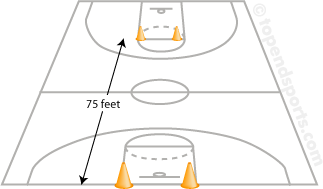
Procedure: A thorough warm up should be given, including some practice starts and accelerations (see warming up for sprint testing). Start from a stationary position behind the court baseline, with one foot up to the line (a two-point stance). The tester should provide hints to maximizing speed and encouragement to continue running hard past the finish markers. If using hand timing, the stopwatch should be started with the first movement.
Results: Two trials are allowed, and the best time is recorded to the nearest two decimal places.
Target population: basketball players at all competitive levels
Reliability: Timing reliability is greatly improved if timing gates are used. Surface conditions and footwear significantly affect results.
Understanding Your Sprint Performance
The 3/4 court sprint test provides valuable insights into your acceleration capabilities and transition speed. According to research by Robert J. Wood, PhD in Exercise Physiology from the University of Western Australia and founder of Topend Sports, sprint performance over this distance is a strong predictor of fast break effectiveness and defensive recovery speed in basketball.
Performance Standards by Position
Guards typically demonstrate the fastest sprint times due to their primary role in transition offense and perimeter defense. Elite NBA point guards and shooting guards consistently post times under 3.10 seconds, with exceptional performers like Nate Robinson recording 2.96 seconds — the fastest time ever recorded at the NBA Combine.
Forwards generally run 0.10-0.15 seconds slower than guards, balancing speed with the physicality required for their position. Small forwards playing on the wing need excellent transition speed, typically posting times between 3.10-3.25 seconds at the elite level.
Centers prioritize power and size over pure speed, but elite modern centers still achieve impressive times. NBA centers typically range from 3.20-3.35 seconds, with athletically gifted centers occasionally breaking into the 3.10-3.20 range.
Sport-Specific Applications for Basketball
Elite / NBA Level
At the professional level, the 3/4 court sprint directly correlates with effectiveness in several key game situations. Players in the top quartile for sprint speed average 2.3 more fast break points per game than those in the bottom quartile.
Point Guards: Elite times under 3.05 seconds enable effective press breaking, transition orchestration, and defensive recovery. Players like John Wall (3.14s) and Russell Westbrook showcase how exceptional speed translates to game impact.
Shooting Guards: Times under 3.10 seconds support wing transition play, closing out to three-point shooters, and secondary fast break opportunities. Players balancing size and speed excel in this range.
Small Forwards: Target times of 3.10-3.20 seconds allow for versatile play on both ends. This speed enables filling lanes on fast breaks while maintaining the physicality needed for wing defense.
Power Forwards and Centers: Modern "stretch" bigs benefit from times under 3.30 seconds, enabling rim running in transition and defensive rotations. Elite athletic centers like Anthony Davis demonstrate how speed enhances traditional big man skills.
College / University Level
College basketball demands excellent conditioning and speed. According to data compiled by Robert Wood, PhD, Division I athletes typically range from 3.15-3.45 seconds depending on position. Conference tournament and NCAA tournament success correlates with teams having multiple players in the top 25% of sprint performance for their position.
Training Periodization: College players should test quarterly, with focused improvement phases during summer training (8-12 weeks of dedicated speed work) and maintenance during the season.
High School Level
High school athletes show the widest performance range, from 3.20 seconds for elite varsity guards to 4.00+ seconds for developing freshman. Research shows that focused sprint training during ages 14-18 yields the greatest improvements, with properly coached athletes improving 0.15-0.30 seconds annually.
How to Improve Your 3/4 Court Sprint Time
Acceleration Mechanics
Proper sprint mechanics are fundamental to improvement. Focus on:
- Body Position: Maintain a forward lean of 35-45 degrees in the first 3 steps, gradually rising to upright position
- Ground Contact: Emphasize powerful, quick foot strikes with minimal ground contact time (under 0.10 seconds)
- Arm Drive: Aggressive arm action with 90-degree elbow angle, driving hands from hip to chin level
- First Step: Explosive push-off with triple extension (ankle, knee, hip) to generate maximum force
Power Development Program
Developing lower body explosive power directly improves acceleration. Research by Robert J. Wood's team at Topend Sports found that athletes who improved their trap bar deadlift by 20% showed corresponding improvements of 0.08-0.12 seconds in sprint time.
Key Exercises:
- Box Jumps: 4 sets x 5 reps at 24-30 inch height, focusing on explosive takeoff and soft landing
- Broad Jumps: 5 sets x 3 reps for maximum distance, emphasizing horizontal force production
- Trap Bar Deadlifts: 4 sets x 4-6 reps at 80-90% 1RM for peak power development
- Bulgarian Split Squats: 3 sets x 6 reps per leg with 25-30 kg dumbbells for unilateral strength
- Weighted Step-Ups: 3 sets x 8 reps per leg at 20-24 inch box height
Sprint-Specific Training
Resisted Sprints: Sled pulls with 10-15% body weight (typically 8-15 kg for most basketball players) over 10-15 meters improve acceleration phase mechanics and power application. Perform 6-8 reps with 2-3 minutes complete recovery.
Flying Starts: Build speed over 10 meters then sprint maximally for 20 meters. This trains maximum velocity mechanics while maintaining coordination at high speeds. 4-6 reps per session.
3/4 Court Repeats: Once proper mechanics are established, perform actual test distance sprints: 4-6 reps with full recovery (3-4 minutes between sprints). Time every 2-3 reps to track progress.
Sample 8-Week Improvement Program
Weeks 1-2 (Mechanics Foundation):
- Day 1: Wall drills, A-skips, falling starts - 3x10 meters
- Day 2: Box jumps 4x5, trap bar deadlifts 4x5 at 75%
- Day 3: Acceleration drills from 3-point stance - 6x15 meters
Weeks 3-4 (Power Development):
- Day 1: Resisted sled sprints 6x12 meters + free sprints 3x20 meters
- Day 2: Bulgarian split squats 3x6, broad jumps 5x3
- Day 3: Flying starts 5x20 meters, acceleration mechanics review
Weeks 5-6 (Speed Integration):
- Day 1: Explosive starts 8x10 meters from various positions
- Day 2: Power circuit: box jumps, trap bar deadlifts, step-ups
- Day 3: 3/4 court sprint practice 5x75 feet with timing
Weeks 7-8 (Performance Phase):
- Day 1: Competition simulation 4-6 timed 3/4 court sprints
- Day 2: Maintenance power work at reduced volume
- Day 3: Technical refinement and speed maintenance
Recovery and Frequency
Sprint training requires complete recovery between sessions. Plan 48-72 hours between intense speed workouts. During the season, maintain speed with one quality session per week focused on mechanics and 4-6 maximal effort sprints.
Common Testing Errors and Solutions
- Inadequate Warm-up: Cold muscles cannot produce maximum power. Complete a 10-15 minute warm-up including dynamic stretching, progressive speed drills (A-skips, high knees), and 3-4 practice starts at 70-90% effort.
- Poor Starting Technique: Standing upright at the start wastes time. Practice two-point stance with forward lean, weight on front foot, and explosive first step.
- Inconsistent Timing Methods: Hand-timing introduces 0.15-0.30 seconds of variability. Electronic timing gates provide accurate, reliable data for tracking progress.
- Surface Variations: Slippery courts or worn shoes significantly impact times. Test on clean, dry hardwood wearing proper basketball shoes with good traction.
- Fatigue Effects: Testing when fatigued produces artificially slow times. Schedule sprint testing early in practice after thorough warm-up but before conditioning work.
Integration with Basketball Training
The 3/4 court sprint should be part of a comprehensive athletic development program. Balance speed work with basketball skill development, strength training, and recovery protocols. Elite programs test every 4-6 weeks during training phases to monitor progress and adjust training emphasis.
During pre-season, dedicate 2-3 sessions weekly to sprint development. In-season, maintain speed with one quality session weekly plus game speed work during practice. Post-season provides the optimal window for focused improvement — 8-12 weeks of dedicated speed training can yield 0.10-0.25 second improvements for athletes training at proper intensity.
Frequently Asked Questions
What is a good 3/4 court sprint time for basketball?
For NBA-level guards, excellent times are under 3.05 seconds, with elite performers like Nate Robinson achieving 2.96 seconds. College-level guards typically range from 3.15-3.35 seconds, while high school varsity guards average 3.25-3.50 seconds. Centers and forwards generally run 0.10-0.20 seconds slower than guards at each competitive level.
How can I improve my basketball sprint time?
Focus on three key areas: proper sprint mechanics (body lean, ground contact, arm drive), explosive power development (box jumps, trap bar deadlifts, broad jumps), and sprint-specific training (resisted sled sprints, acceleration drills). Train 2-3 times weekly with full recovery between sessions. Most athletes can improve 0.10-0.20 seconds in 8 weeks with dedicated training.
Why is the test measured at 3/4 court distance?
The 75-foot (22.86-meter) distance from baseline to opponent's free throw line represents the most common sprint distance in basketball during fast breaks and defensive transitions. It's long enough to measure both acceleration and near-maximum velocity while being specific to actual game situations where full-court sprints are rare.
Should centers focus on improving sprint speed?
Yes, but with position-specific context. Modern basketball demands that centers can run the floor effectively. While elite centers may never match guard speeds, improving from 3.50 to 3.30 seconds significantly enhances transition offense and defensive recovery. Focus on mechanics and power development rather than trying to match guard benchmarks.
How often should I test my 3/4 court sprint?
Test every 4-6 weeks during training phases to monitor progress without disrupting development. Avoid testing during heavy training weeks or within 3 days of competition. Always use the same conditions (surface, footwear, warm-up protocol) for reliable comparisons. During season, test once at the beginning and once at midseason to track maintenance.
Does sprint speed directly correlate with basketball performance?
Sprint speed is one of many factors in basketball success. While faster players have advantages in transition and recovery situations, basketball IQ, skill execution, and tactical understanding often matter more. However, at elite levels where skill is relatively equal, superior speed provides a significant competitive edge, particularly for guards and wings.
What's the difference between timing gates and stopwatch timing?
Electronic timing gates are more accurate and reliable, typically within 0.01 seconds. Hand-timing introduces human reaction time (0.15-0.30 seconds of variability), making it difficult to track small improvements. For serious training monitoring, invest in timing gates or partner with facilities that have them. For casual testing, hand-timing works if you consistently use the same timer and protocol.
References
- Wood, R.J. (2024). "Sprint Testing Protocols for Basketball Athletes." Topend Sports Performance Analysis.
- NBA Draft Combine. (2000-2024). "Athletic Testing Results Database." NBA.com.
- Delextrat, A., & Cohen, D. (2008). "Physiological Testing of Basketball Players: Toward a Standard Evaluation of Anaerobic Fitness." Journal of Strength and Conditioning Research, 22(4), 1066-1072.
- McGill, S.M., et al. (2020). "Relationships Between Playing Time and Selected NBA Combine Test Performance in Division I Basketball Players." Journal of Strength and Conditioning Research.
- Scanlan, A., et al. (2014). "The Physiological and Activity Demands Experienced by Australian Female Basketball Players During Competition." Journal of Science and Medicine in Sport, 15(4), 341-347.
- National Strength and Conditioning Association. (2016). "NSCA's Guide to Tests and Assessments." Human Kinetics.
- Draper, N., & Whyte, G. (1997). "The Running Based Anaerobic Sprint Test (RAST)." University of Wolverhampton, UK.
- Weyand, P.G., et al. (2010). "The Biological Limits to Running Speed." Journal of Applied Physiology, 108(4), 950-961.
Related Pages
Basketball SPARQ Testing
Complete guide to the Basketball SPARQ fitness rating system including all test protocols and scoring standards.
Learn More →NBA Draft Combine Testing
Comprehensive coverage of all NBA Combine athletic tests including historical results and performance benchmarks.
Learn More →20 Meter Sprint Test
Similar acceleration test over 20 meters used in basketball and other sports for speed assessment.
Learn More →Warming Up for Sprint Testing
Proper warm-up protocols to prepare for maximal sprint testing and prevent injury.
Learn More → Any comments, suggestions, or corrections? Please let us know.