Sit and Reach Test (President's Challenge Version)
Quick Answer
The sit and reach test measures lower back and hamstring flexibility using a standardized box. The President's Challenge version uses a zero mark placed 9 inches (23 cm) before the feet, making most scores positive numbers.
- Requires a sit and reach box or ruler between the feet
- Subject reaches forward 4 times, holding the 4th reach for 2+ seconds
- Score of 9 inches means the subject can touch their toes
This test measures the flexibility of the lower back and hamstring muscles. This describes the procedures as used in the President's Challenge Fitness Awards. There are several other versions of the sit and reach test.
📋 Important Update: The President's Challenge Fitness Awards program was discontinued in 2018 and replaced with the Presidential Youth Fitness Program. The new program focused on the student's individual health rather than athleticism. However, on July 31, 2025, President Donald Trump signed an executive order bringing back the Presidential Fitness Test. The exact date this test will return to schools has not yet been confirmed.
Equipment Required
Sit and reach box (or alternatively a ruler can be used, held between the feet).
Pre-Test Procedures
Explain the test procedures to the subject. Perform screening of health risks and obtain informed consent. Prepare forms and record basic information such as age, height, body weight, gender, and test conditions. Perform an appropriate warm-up. See more details of pre-test procedures.
Test Procedure
This test involves sitting on the floor with legs out straight ahead. Feet (shoes off) are placed with the soles flat against the box, shoulder-width apart. Both knees are held flat against the floor by the tester, if required. With hands on top of each other and palms facing down, the subject reaches forward along the measuring line as far as possible.
After three practice reaches, the fourth reach is held for at least two seconds while the distance is recorded. Make sure there are no jerky movements, and that the fingertips remain level and the legs flat. See also video demonstrations of the Sit and Reach Test.
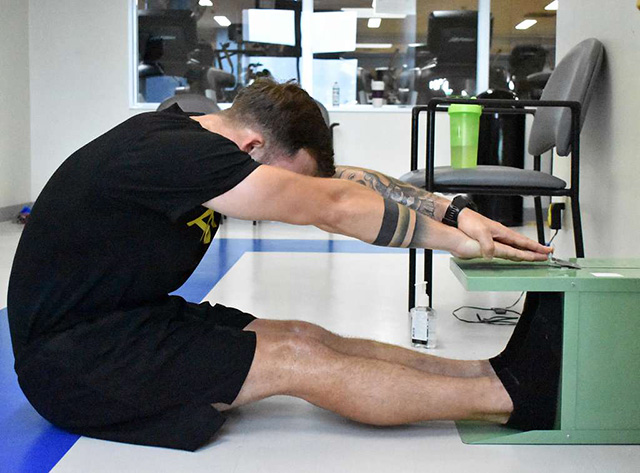
Sit and reach test
Scoring
The score is recorded to the nearest centimeter or half inch as the distance reached by the tip of the fingers. The usual scale used for the Presidents Challenge testing has the zero mark at 9 inches (23 cm) before the feet, therefore if the subject can reach their toes, their score is 9 inches.
💡 Pro Tip: Using the zero mark 9 inches before the feet means that most scores will be a positive number, making them easier to compare and analyze across different populations.
Test Variations
See the general sit and reach procedure page for a list of other sit and reach test variations. The variations mostly involve differences in the placement of the zero mark.
Validity
This test only measures the flexibility of the lower back and hamstrings, and is a valid measure of this.
Reliability
The reliability will depend on the amount of warm-up allowed, and whether the same procedures are followed each time. According to sports science expert Robert Wood, who has analyzed sports performance data for over 25 years, most norms are based on no previous warm-up, though the best results will be achieved after a warm-up or if the test is preceded by a test such as the endurance test.
Advantages
This is the most commonly used test of flexibility, so there is lots of data for comparison. Also, it is an easy and quick test to perform. Using the zero mark 9 inches before the feet means that most scores will be a positive number, easier to compare and analyze.
Disadvantages
Standard sit and reach tests such as this one use a set reference point which does not allow for variations in the length of arms and legs of the person being tested - people with long arms and/or short legs would get a better result, while those with short arms and/or long legs are at a disadvantage.
The modified sit and reach test is designed to control for this. Also, this flexibility test is specific to the range of motion and muscles and joints of the lower back and hamstrings, and is not necessarily transferable to other regions. More flexibility tests are required to measure the specific regions of the body.
"Lower back flexibility is important because tightness in this area is implicated in lumbar lordosis, forward pelvic tilt and lower back pain."— Robert J. Wood, PhD, Founder of Topend Sports
Frequently Asked Questions
What does the sit and reach test measure?
The sit and reach test measures the flexibility of the lower back and hamstring muscles. It is a valid measure of flexibility in these specific areas and is one of the most commonly used flexibility tests worldwide.
How is the President's Challenge sit and reach test different from other versions?
The President's Challenge version uses a specific scale with the zero mark placed at 9 inches (23 cm) before the feet. This means if you can reach your toes, your score is 9 inches, making most scores positive numbers for easier comparison and analysis.
What equipment is needed for the sit and reach test?
A sit and reach box is the standard equipment required. Alternatively, a ruler can be used and held between the feet. The test should be performed with shoes off for accurate measurements.
Is the President's Challenge Fitness Test still used?
The President's Challenge Fitness Awards program was discontinued in 2018 and replaced with the Presidential Youth Fitness Program. However, on July 31, 2025, President Donald Trump signed an executive order bringing back the Presidential Fitness Test, though the exact return date has not been confirmed.
What are the disadvantages of the standard sit and reach test?
The main disadvantage is that it uses a set reference point that doesn't account for variations in arm and leg length. People with long arms or short legs have an advantage, while those with short arms or long legs are at a disadvantage. The modified sit and reach test addresses this limitation.
References
- President's Challenge Physical Activity & Fitness Awards Program. (2008). "Get Fit: Physical Fitness Test." President's Council on Physical Fitness and Sports.
- American College of Sports Medicine. (2018). "ACSM's Guidelines for Exercise Testing and Prescription." 10th Edition. Lippincott Williams & Wilkins.
- Mayorga-Vega, D., Merino-Marban, R., & Viciana, J. (2014). "Criterion-Related Validity of Sit-and-Reach Tests for Estimating Hamstring and Lumbar Extensibility." Journal of Sports Science & Medicine, 13(1), 1-7.
- Wells, K. F., & Dillon, E. K. (1952). "The Sit and Reach: A Test of Back and Leg Flexibility." Research Quarterly, 23(1), 115-118.
- Hopkins, D. R., & Hoeger, W. W. K. (1992). "A Comparison of the Sit and Reach and the Modified Sit and Reach in the Measurement of Flexibility." Research Quarterly for Exercise and Sport, 63(2), 191-195.
The Test in Action
- This version of the test was used in the President's Challenge Fitness Awards
Similar Tests
- The general Sit and Reach test procedure
- Other versions of the sit and reach test
Related Pages
Sit and Reach Test Results
Compare your sit and reach test scores with normative data for different age groups and populations.
View Results →Make Your Own Testing Box
Learn how to construct your own sit and reach testing box with simple materials and detailed instructions.
Build One →Other Flexibility Tests
Explore additional flexibility testing methods for different muscle groups and ranges of motion.
See Tests →Hamstring Stretches
Improve your flexibility with targeted hamstring stretching exercises and techniques.
View Stretches →Sit and Reach Videos
Watch video demonstrations of proper sit and reach test technique and common mistakes to avoid.
Watch Videos →Related Products
- Sit and reach boxes — see what is available
- Buy a sit and reach box
- Flexibility Store — items to measure flexibility
 Any comments, suggestions, or corrections? Please let us know.